Floor plan

Time and placeThe 19th century

The 19th century

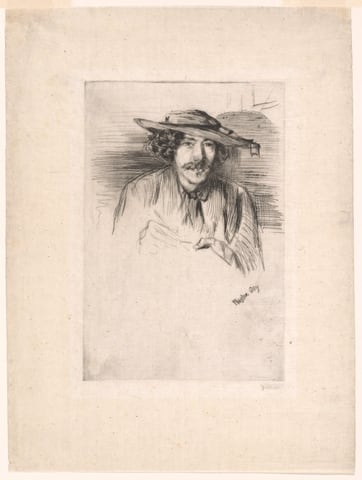
A work made of drypoint with light plate tone on thin ivory japanese paper.
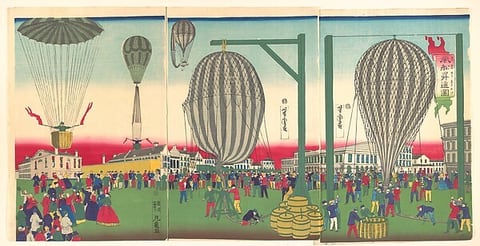
Illustration of a Balloon Ascending (Fūsen shōyō no zu), by Utagawa Yoshitora, November, 1872
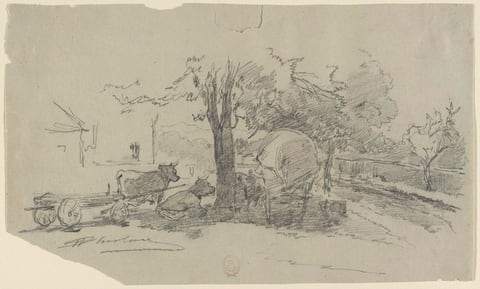
A VILLAGE SQUARE
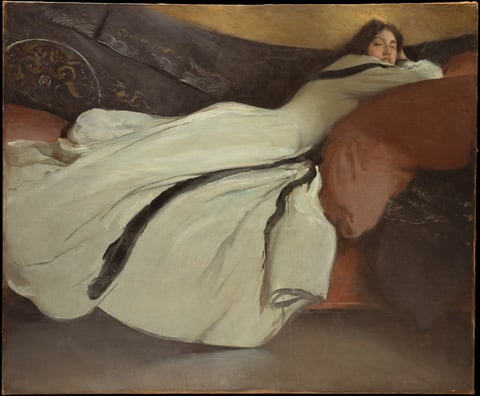
Repose, by John White Alexander, 1895
A work made of oil on canvas.
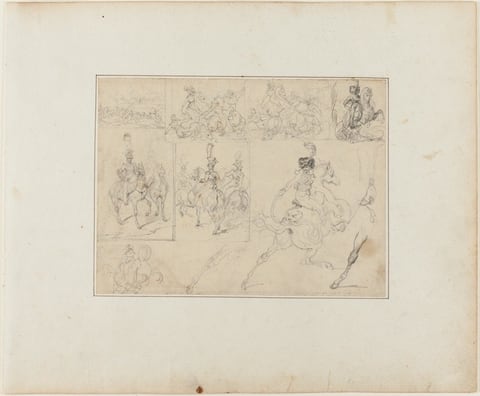
A work made of graphite, on tan wove paper, perimeter mounted on ivory laid paper.
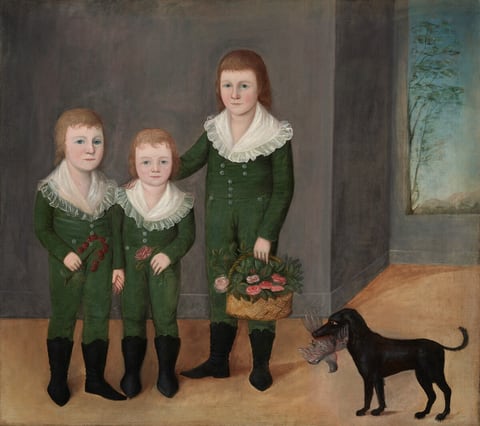
Three pale-skinned, blue-eyed children wearing green suits stand in a row facing us in this horizontal portrait painting. They all have round faces and full, pink cheeks. The tallest child is to the right, and he has shoulder-length cinnamon-brown hair. The other two come up to his shoulder and have blond hair. The tallest puts one arm on the far shoulder of the middle child, and the two smaller children hold hands. Each wears a pine-green, one-piece outfit with pewter-gray buttons, a wide, ivory-white collar lined with ruffles, and black, shin-high boots. The boy on our left holds a branch of dark red cherries. The middle child holds a pink rose, and the tallest a basket filled with pink roses. A black dog holding a gray and mauve-pink bird in its mouth stands in profile facing our left in the lower right corner of the canvas. The room around them has a tan-colored floor and gray walls. The room opens onto an alcove to our right with a rectangular window. A slender tree is along the left edge of the opening and a few pale, pink-tinged gray mountains line the bottom edge. Clear blue sky fills the rest of the window.
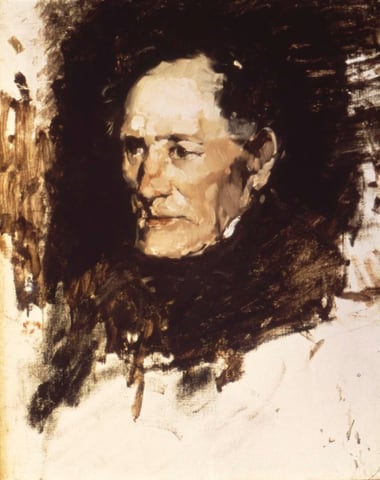
Head of an Old Man, by Frank Duveneck, ca. 1877-1879

The works in this room are listed below.

Works in this room

Works made in the 19th century, anywhere in the world.

Section 1, north wall

  1. A work made of drypoint with light plate tone on thin ivory japanese paper.
    Whistler with a HatJames McNeill Whistler, 1859Courtesy of the Art Institute of Chicago
  2. Illustration of a Balloon Ascending (Fūsen shōyō no zu), by Utagawa Yoshitora, November, 1872
    Illustration of a Balloon Ascending (Fūsen shōyō no zu)Utagawa Yoshitora, November, 1872Courtesy of The Metropolitan Museum of Art
  3. A VILLAGE SQUARE
    A Village SquareWalter Shirlaw, 1875–80Courtesy of Cooper Hewitt, Smithsonian Design Museum
  4. Repose, by John White Alexander, 1895
    ReposeJohn White Alexander, 1895Courtesy of The Metropolitan Museum of Art

Section 1, south wall

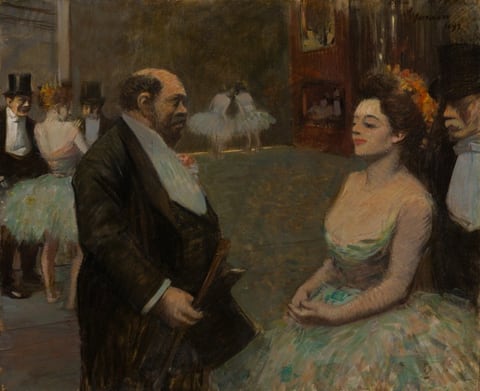
  1. A work made of oil on canvas.
    In the WingsJean Louis Forain, 1899Courtesy of the Art Institute of Chicago
  2. A work made of graphite, on tan wove paper, perimeter mounted on ivory laid paper.
    Sheet of Sketches: Cavalry Battles and Mounted SoldiersJean Louis André Théodore Géricault, 1813/14Courtesy of the Art Institute of Chicago
  3. Three pale-skinned, blue-eyed children wearing green suits stand in a row facing us in this horizontal portrait painting. They all have round faces and full, pink cheeks. The tallest child is to the right, and he has shoulder-length cinnamon-brown hair. The other two come up to his shoulder and have blond hair. The tallest puts one arm on the far shoulder of the middle child, and the two smaller children hold hands. Each wears a pine-green, one-piece outfit with pewter-gray buttons, a wide, ivory-white collar lined with ruffles, and black, shin-high boots. The boy on our left holds a branch of dark red cherries. The middle child holds a pink rose, and the tallest a basket filled with pink roses. A black dog holding a gray and mauve-pink bird in its mouth stands in profile facing our left in the lower right corner of the canvas. The room around them has a tan-colored floor and gray walls. The room opens onto an alcove to our right with a rectangular window. A slender tree is along the left edge of the opening and a few pale, pink-tinged gray mountains line the bottom edge. Clear blue sky fills the rest of the window.
    The Westwood ChildrenJoshua Johnson, c. 1807Courtesy National Gallery of Art, Washington
  4. Head of an Old Man, by Frank Duveneck, ca. 1877-1879
    Head of an Old ManFrank Duveneck, ca. 1877-1879Courtesy of the Smithsonian American Art Museum

Section 2, south wall
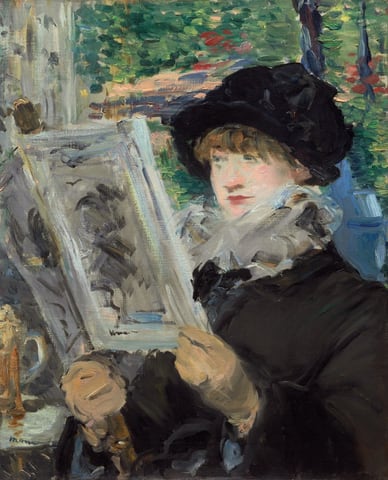
  1. A young woman in a dark hat and coat with light ruffled collar sits reading a large periodical held up in her gloved hands. Flowers and foliage are suggested behind her.
    Woman ReadingÉdouard Manet, 1880–82Courtesy of the Art Institute of Chicago
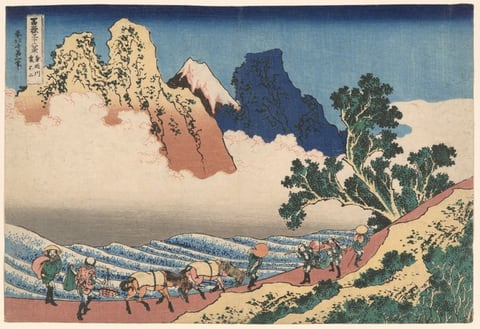
  2. Print showing a string of travelers with horses walking along a narrow hillside path beneath an enormous craggy beige mountain at left and an equally massive and craggy deep-blue mountain at right. A brown snow-covered peak appears between these mountains. A mass of cream-colored clouds and a river with rounded ripples fill the middle plane of the composition.
    The Back of Mount Fuji Seen from Minobu River (Minobugawa Urafuji), from the series Thirty-Six Views of Mount Fuji (Fugaku sanjūrokkei)Katsushika Hokusai, 1830-33Courtesy of the Art Institute of Chicago
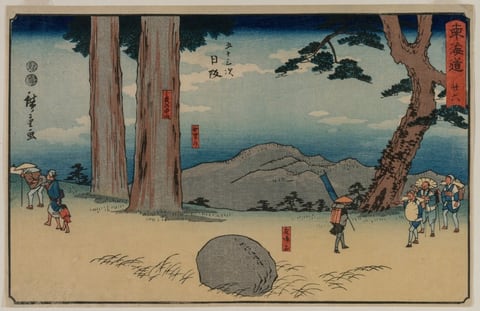
  3. Nissaka: The Night-Weeping Stone at Sayo no Nakayama, from the series The Fifty-Three Stations of the Tōkaidō, by Utagawa Hiroshige, c. 1848–50
    Nissaka: The Night-Weeping Stone at Sayo no Nakayama, from the series The Fifty-Three Stations of the TōkaidōUtagawa Hiroshige, c. 1848–50Courtesy of the Cleveland Museum of Art
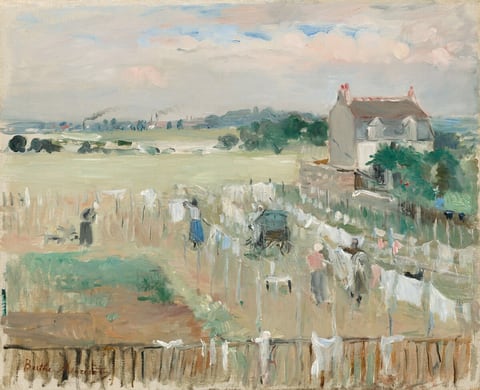
  4. We look down onto a landscape where several laundry lines have been draped mostly with white sheets or cloth to dry in a flat, grassy yard in front of a rustic house and a distant town in this horizontal painting. The scene is created entirely with thick, visible brushstrokes that creates a sense of texture on the canvas’s surface and makes many details difficult to make out. The forms of at least three women wearing skirts hang laundry out along the lines, and a person wearing trousers tends to a flat piece of green ground near the lower left corner. A few pieces of white cloth have been draped over the wooden fence that runs along the bottom edge of the canvas. A dove-gray cart with wooden carriage wheels rests, tipped forward, at the center of the laundry lines. To our right and just beyond the laundry lines, a two-story ivory and slate-blue house with a gray peaked roof sits behind a grove of emerald-green trees. The laundry field and the grassy plane beyond is painted with a pale celery green with long, horizontal strokes. Dabs of moss green and a white streak interrupt the field in the distance. Beyond that, touches of steel and silvery-gray paint suggest smokestacks and smoke in a town along the horizon, which comes about three-quarters of the way up this composition. A few patches of vivid blue sky peek through a screen of shell-pink and cream-white clouds above. The artist signed the work in brick-red paint in the lower left corner, “Berthe Morisot.”
    Hanging the Laundry out to DryBerthe Morisot, 1875Courtesy National Gallery of Art, Washington

Section 2, north wall
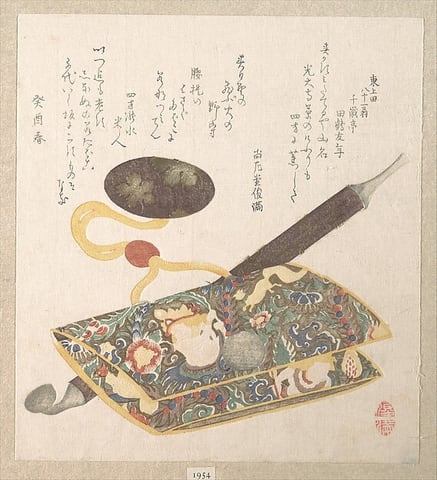
  1. Tobacco Pouch and Pipe, by Kubo Shunman, 1813
    Tobacco Pouch and PipeKubo Shunman, 1813Courtesy of The Metropolitan Museum of Art
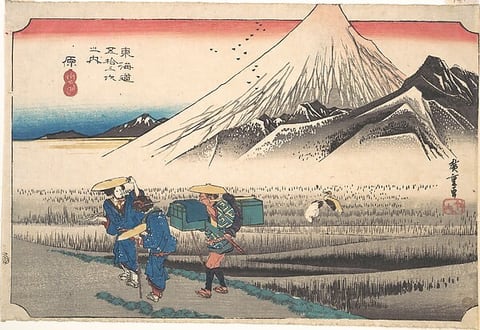
  2. Hara: Mount Fuji in the Morning (Hara, Asa no Fuji), from the series Fifty-Three Stations of the Tōkaidō Road (Tōkaidō gojūsan tsugi), also known as the First Tōkaidō or Great Tōkaidō, by Utagawa Hiroshige, ca. 1833–34
    Hara: Mount Fuji in the Morning (Hara, Asa no Fuji), from the series Fifty-Three Stations of the Tōkaidō Road (Tōkaidō gojūsan tsugi), also known as the First Tōkaidō or Great TōkaidōUtagawa Hiroshige, ca. 1833–34Courtesy of The Metropolitan Museum of Art
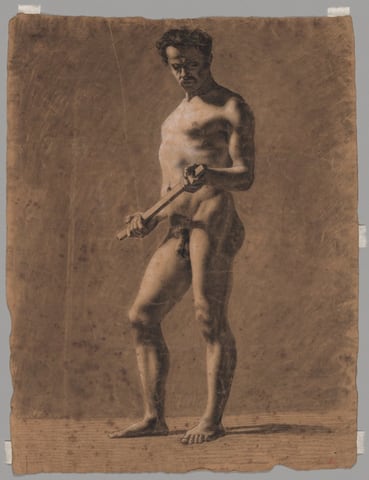
  3. A work made of black chalk and charcoal with stumping, heightened with white chalk (recto), and black chalk and charcoal with stumping (verso), on dark tan laid paper.
    Standing Academic Male Nude (recto); Sketch of Upper Arm (verso)Eugène Delacroix, 1816Courtesy of the Art Institute of Chicago
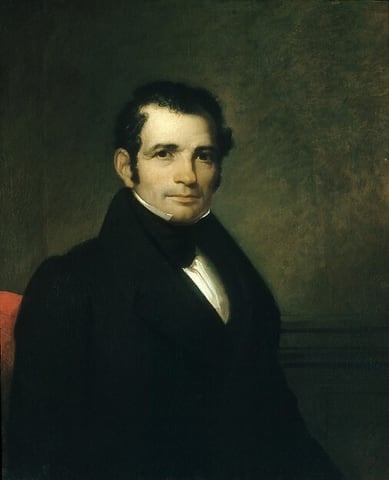
  4. Luman Reed, by Asher Brown Durand, 1835
    Luman ReedAsher Brown Durand, 1835Courtesy of The Metropolitan Museum of Art