Floor plan

Time and place19th-century United States
19th-century United States
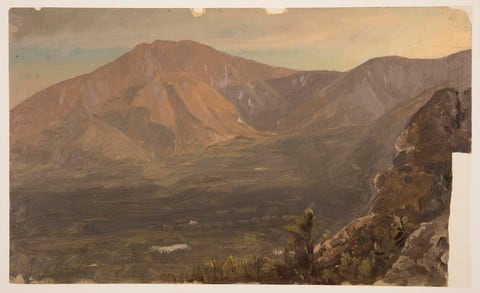
MT. KATAHDIN FROM SOUTH TURNER MOUNTAIN, MAINE
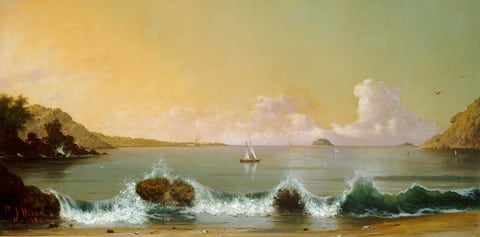
Across a short stretch of sand in front of us, waves of bottle-green water break over two boulders on the shoreline, with sailboats in the water beyond, in this wide, horizontal painting. One boulder is at the left edge of the painting; the other is a short distance away, about a quarter of the way across. The water cascades down between those large rocks. Across the rest of the beach, the waves flare up to break toward us in white, foamy surf. The land curves back into view on both sides of the canvas with muted, sage-green hills and, to our left, dark green trees on more craggy boulders. A more distant finger of land to our left stretches nearly halfway across the horizon, which comes about halfway up the composition. Minuscule in scale there, smoke pours out of a chimney, which is surrounded by pale yellow buildings. A mound emerges from the horizon to our right of center. About ten sailboats float on the water. The closest one to us is near the center of the painting, and the tiny forms of people aboard can just barely be made out. The other boats become smaller as they move back to the horizon, and some are only a touch of white or gray on the canvas. White and pale lavender-purple clouds sweep up from the horizon into the sky, which glows butter yellow along the left edge. The sky cools to mint green in the upper right corner. Several white or brown birds fly across the sky or low over the water. The artist signed and dated the lower left, “M. J. Heade 1864.”
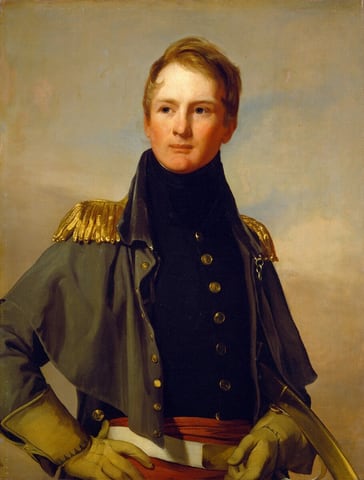
Major Thomas Biddle, by Thomas Wilcocks Sully, 1832
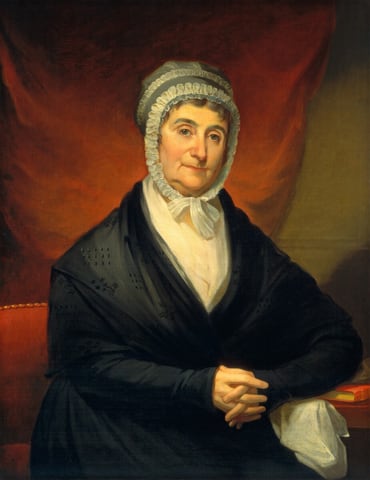
The image shows the upper half of a seated woman facing forward. She has her hands clasped together in front of her. The woman appears calm with visible signs of age, including a few wrinkles on her face. She wears a white bonnet with a frilled edge tied under her chin, a dark shawl over a white high-collared blouse, and sits on a red chair with a gold trim. A red book and a handkerchief are on the surface next to her. The background transitions from deep red to brown tones.
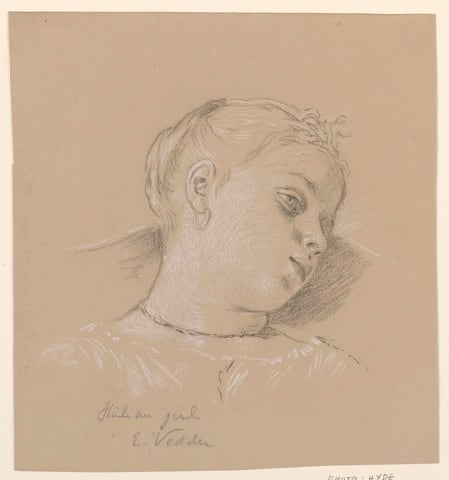
ITALIAN GIRL
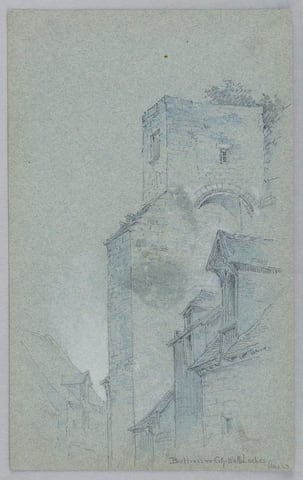
BUTTRESSES ON CITY WALLS; LOCHES
Self-Portrait, by Oliver Tarbell Eddy, ca. 1850
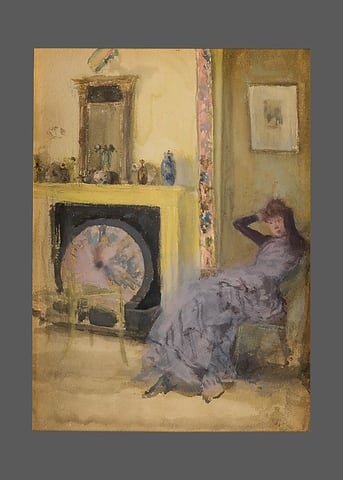
The Yellow Room, by James McNeill Whistler, ca. 1883–84

The works in this room are listed below.

Works in this room

Works made in the United States in the 19th century.

Section 1, north wall

  1. MT. KATAHDIN FROM SOUTH TURNER MOUNTAIN, MAINE
    Mt. Katahdin from South Turner Mountain, MaineFrederic Edwin Church, 1877–78Courtesy of Cooper Hewitt, Smithsonian Design Museum
  2. Across a short stretch of sand in front of us, waves of bottle-green water break over two boulders on the shoreline, with sailboats in the water beyond, in this wide, horizontal painting. One boulder is at the left edge of the painting; the other is a short distance away, about a quarter of the way across. The water cascades down between those large rocks. Across the rest of the beach, the waves flare up to break toward us in white, foamy surf. The land curves back into view on both sides of the canvas with muted, sage-green hills and, to our left, dark green trees on more craggy boulders. A more distant finger of land to our left stretches nearly halfway across the horizon, which comes about halfway up the composition. Minuscule in scale there, smoke pours out of a chimney, which is surrounded by pale yellow buildings. A mound emerges from the horizon to our right of center. About ten sailboats float on the water. The closest one to us is near the center of the painting, and the tiny forms of people aboard can just barely be made out. The other boats become smaller as they move back to the horizon, and some are only a touch of white or gray on the canvas. White and pale lavender-purple clouds sweep up from the horizon into the sky, which glows butter yellow along the left edge. The sky cools to mint green in the upper right corner. Several white or brown birds fly across the sky or low over the water. The artist signed and dated the lower left, “M. J. Heade 1864.”
    Rio de Janeiro BayMartin Johnson Heade, 1864Courtesy National Gallery of Art, Washington
  3. Major Thomas Biddle, by Thomas Wilcocks Sully, 1832
    Major Thomas BiddleThomas Wilcocks Sully, 1832Courtesy National Gallery of Art, Washington
  4. The image shows the upper half of a seated woman facing forward. She has her hands clasped together in front of her. The woman appears calm with visible signs of age, including a few wrinkles on her face. She wears a white bonnet with a frilled edge tied under her chin, a dark shawl over a white high-collared blouse, and sits on a red chair with a gold trim. A red book and a handkerchief are on the surface next to her. The background transitions from deep red to brown tones.
    Ann Old Coleman (Mrs. Robert Coleman)Jacob Eichholtz, c. 1820Courtesy National Gallery of Art, Washington

Section 1, south wall

  1. ITALIAN GIRL
    Italian girlElihu Vedder, ca. 1885Courtesy of Cooper Hewitt, Smithsonian Design Museum
  2. BUTTRESSES ON CITY WALLS; LOCHES
    Buttresses on City Walls; LochesArnold William Brunner, 1883Courtesy of Cooper Hewitt, Smithsonian Design Museum
  3. Self-Portrait, by Oliver Tarbell Eddy, ca. 1850
    Self-PortraitOliver Tarbell Eddy, ca. 1850Courtesy of the Smithsonian American Art Museum
  4. The Yellow Room, by James McNeill Whistler, ca. 1883–84
    The Yellow RoomJames McNeill Whistler, ca. 1883–84Courtesy of The Metropolitan Museum of Art

Section 2, south wall
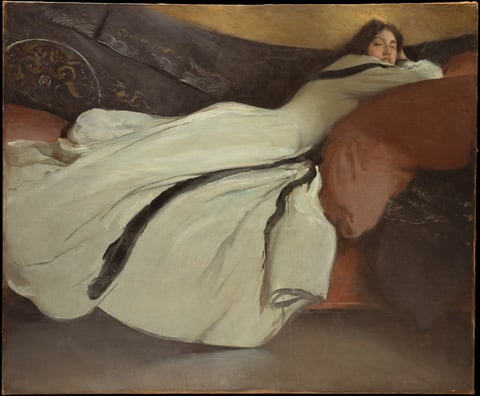
  1. Repose, by John White Alexander, 1895
    ReposeJohn White Alexander, 1895Courtesy of The Metropolitan Museum of Art
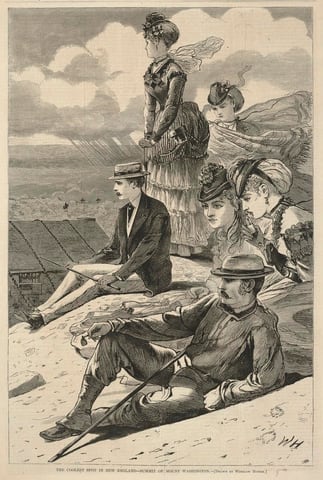
  2. The Coolest Spot in New England--Summit of Mount Washington, from Harper's Bazar, July 23, 1870, by Winslow Homer, 1870
    The Coolest Spot in New England--Summit of Mount Washington, from Harper's Bazar, July 23, 1870Winslow Homer, 1870Courtesy of the Smithsonian American Art Museum
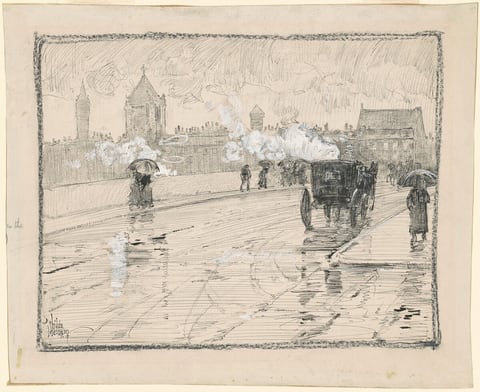
  3. The image shows a street scene from an elevated viewpoint. A horse-drawn carriage is seen moving on a wet road, reflecting light. Pedestrians with umbrellas populate the avenue. The road is visibly marked with rainwater. The skyline displays detailed architectural features like church spires and towers. The painting is done in fine, linear brushstrokes highlighting movement and atmosphere. The grayscale palette emphasizes the rainy urban setting. Wisps of steam or smoke are visible. The intricate line work and shading depict a textured, busy street under an overcast sky.
    Rainy Day, BostonChilde Hassam, 1886Courtesy National Gallery of Art, Washington
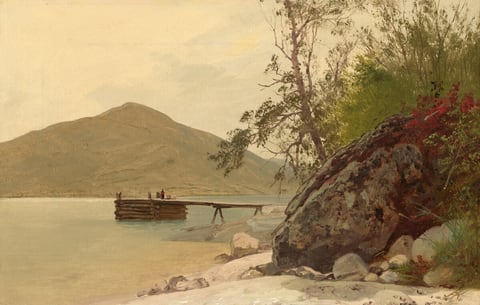
  4. The painting depicts a tranquil lake scene with a low horizon line showing a pale green hill in the background under a pale, cloudy sky. Closer to us, on the right, there is a large, textured rock surrounded by greenery and red flowers. In the distance, a wooden dock extends into the lake on the left, and a person wearing red appears to sit or stand with their back to us.
    Landing at Sabbath Day PointJohn Frederick Kensett, c. 1853Courtesy National Gallery of Art, Washington

Section 2, north wall
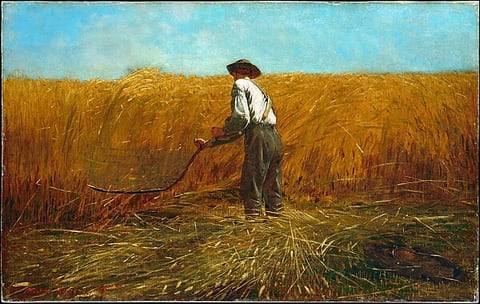
  1. The Veteran in a New Field, by Winslow Homer, 1865
    The Veteran in a New FieldWinslow Homer, 1865Courtesy of The Metropolitan Museum of Art
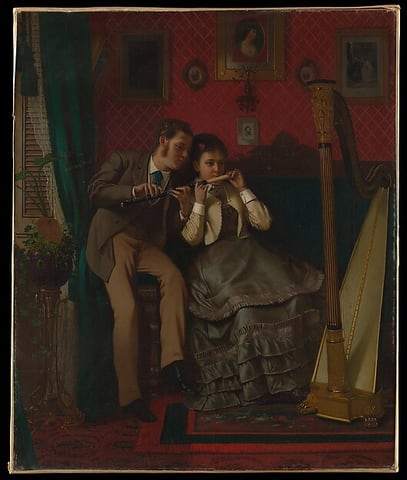
  2. The Music Lesson, by John George Brown, 1870
    The Music LessonJohn George Brown, 1870Courtesy of The Metropolitan Museum of Art
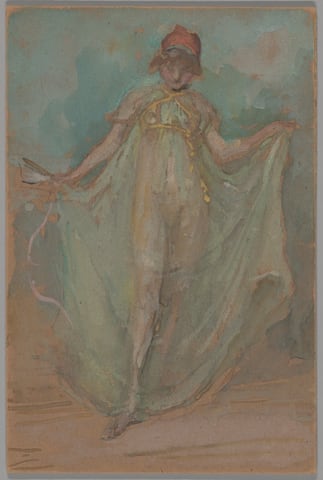
  3. Pale watercolor drawing of young dancer in long sheer dress.
    Green and Blue: The DancerJames McNeill Whistler, c. 1893Courtesy of the Art Institute of Chicago
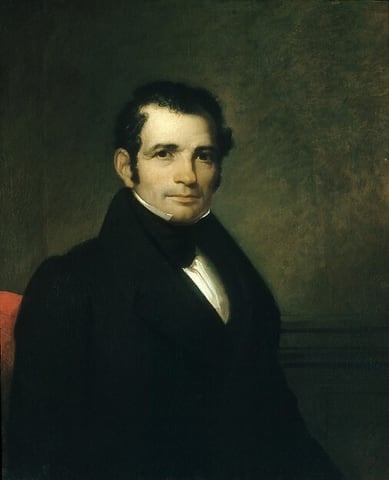
  4. Luman Reed, by Asher Brown Durand, 1835
    Luman ReedAsher Brown Durand, 1835Courtesy of The Metropolitan Museum of Art