Floor plan

Time and place19th-century United States
19th-century United States
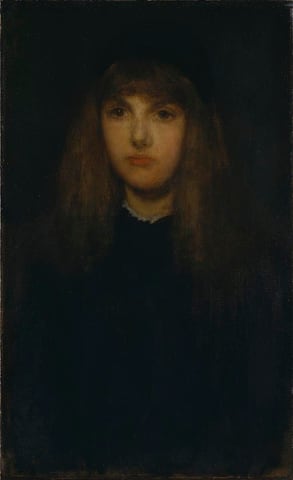
James Abbott McNeill Whistler
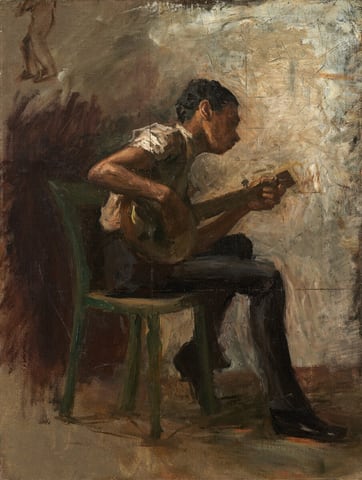
A young, gangly, brown-skinned boy sits on a green chair and leans over the banjo he plays in this loosely painted, vertical composition. His body faces our right in profile, and his head leans to his left and away from us. Light comes from our left to highlight his ear and the side of his chin, but throws his profile into shadow against the lighter background. The boy has short black hair and wears a white shirt with the sleeves rolled up, black pants, and black shoes. The floor is loosely painted with streaks of earth brown, taupe, and dark moss green. The wall behind the boy is painted with visible strokes of parchment brown, peachy tan, pearl white, and fog gray. The space to our left of the boy is dark brown, and an outline of a standing person is sketched in the top left corner. A grid is overlaid across the boy’s body and the chair.
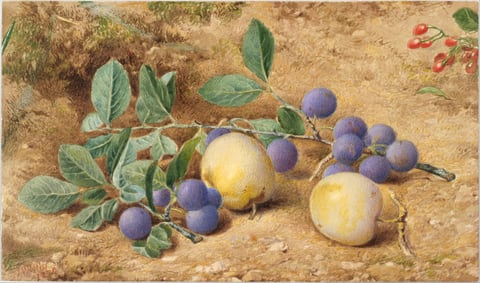
Plums, by John William Hill, 1870
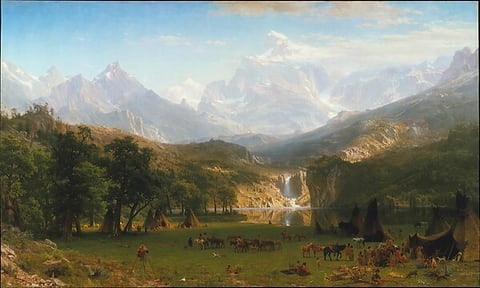
The Rocky Mountains, Lander's Peak, by Albert Bierstadt, 1863
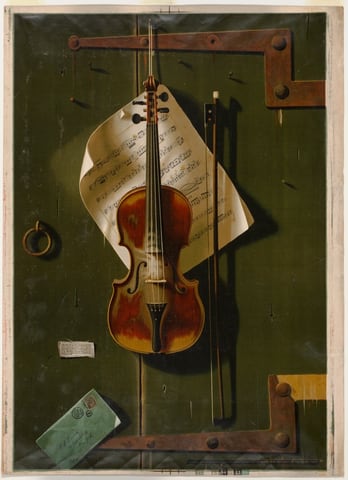
A work made of color lithograph on paper.

The works in this room are listed below.

Works in this room

Works made in the United States in the 19th century.

Section 1, north wall

  1. James Abbott McNeill Whistler
    Girl in Black (Pouting Tom)James McNeill Whistler, (1896-1901)Courtesy of the Hirshhorn Museum and Sculpture Garden, Smithsonian Institution
  2. A young, gangly, brown-skinned boy sits on a green chair and leans over the banjo he plays in this loosely painted, vertical composition. His body faces our right in profile, and his head leans to his left and away from us. Light comes from our left to highlight his ear and the side of his chin, but throws his profile into shadow against the lighter background. The boy has short black hair and wears a white shirt with the sleeves rolled up, black pants, and black shoes. The floor is loosely painted with streaks of earth brown, taupe, and dark moss green. The wall behind the boy is painted with visible strokes of parchment brown, peachy tan, pearl white, and fog gray. The space to our left of the boy is dark brown, and an outline of a standing person is sketched in the top left corner. A grid is overlaid across the boy’s body and the chair.
    Study for "The Dancing Lesson": The Banjo PlayerThomas Eakins, probably 1877Courtesy National Gallery of Art, Washington
  3. Plums, by John William Hill, 1870
    PlumsJohn William Hill, 1870Courtesy of The Metropolitan Museum of Art

Section 1, south wall

  1. The Rocky Mountains, Lander's Peak, by Albert Bierstadt, 1863
    The Rocky Mountains, Lander's PeakAlbert Bierstadt, 1863Courtesy of The Metropolitan Museum of Art
  2. A work made of color lithograph on paper.
    The Old ViolinWilliam Michael Harnett, 1887Courtesy of the Art Institute of Chicago

Section 2, south wall
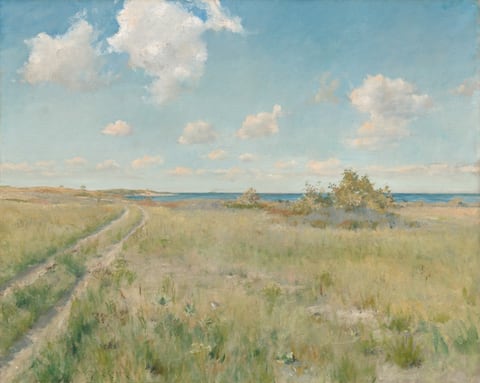
  1. The Old Road to the Sea, by William Merritt Chase, c. 1893
    The Old Road to the SeaWilliam Merritt Chase, c. 1893Courtesy of the Cleveland Museum of Art
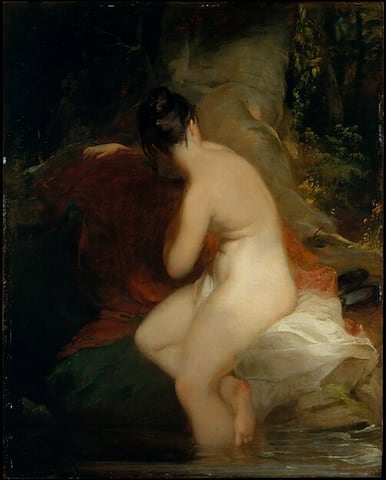
  2. Musidora, by Thomas Sully, 1813–35
    MusidoraThomas Sully, 1813–35Courtesy of The Metropolitan Museum of Art
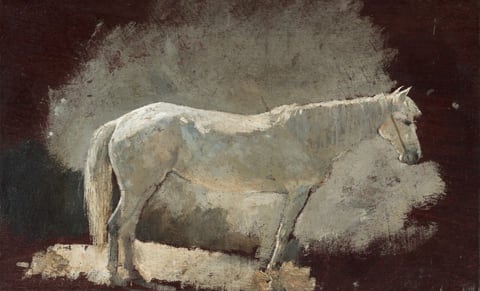
  3. White Mare, by Winslow Homer, c. 1868
    White MareWinslow Homer, c. 1868Courtesy of the Cleveland Museum of Art

Section 2, north wall
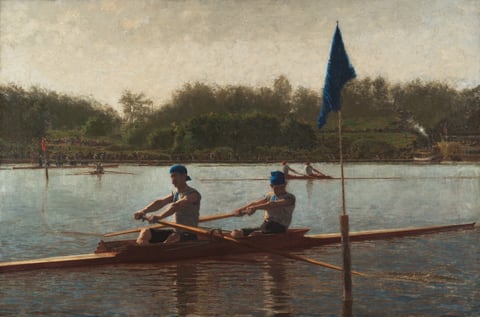
  1. The Biglin Brothers Turning the Stake, by Thomas Eakins, 1873
    The Biglin Brothers Turning the StakeThomas Eakins, 1873Courtesy of the Cleveland Museum of Art
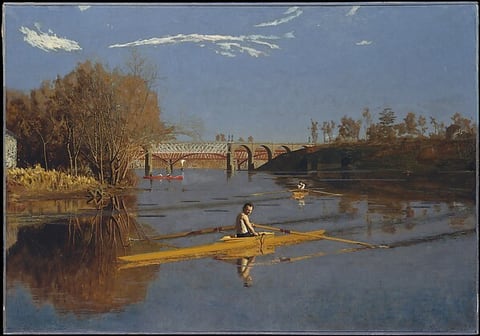
  2. The Champion Single Sculls (Max Schmitt in a Single Scull), by Thomas Eakins, 1871
    The Champion Single Sculls (Max Schmitt in a Single Scull)Thomas Eakins, 1871Courtesy of The Metropolitan Museum of Art
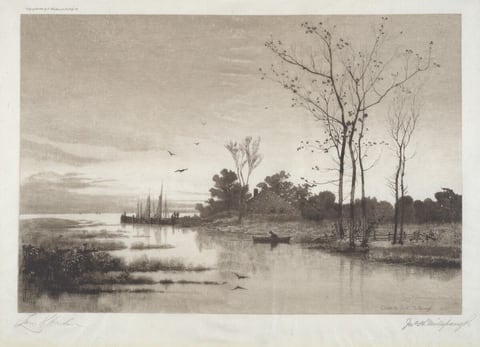
  3. The image depicts a landscape with a river flowing through it. In the foreground, there is a small boat on the water, and in the background, sailboats are docked near a strip of land. Tall trees with sparse foliage are on the right side, with a structure nestled among them near the water. The horizon is slightly above the center of the image, with a calm sky above it. The brushstrokes vary in texture, with fine strokes for the sky and water and more detailed strokes for the trees. The color palette is muted, with sepia and gray tones creating a peaceful atmosphere. Birds are scattered in the sky.
    Shrewsbury RiverJohn Hill Millspaugh, 1887Courtesy National Gallery of Art, Washington

Section 3, north wall
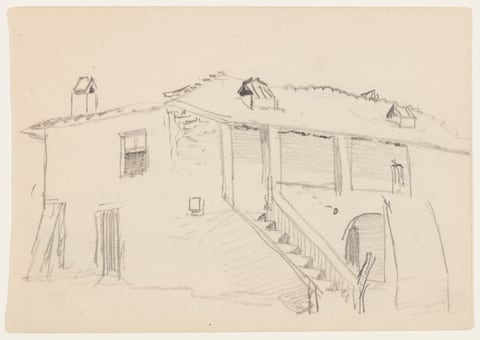
  1. ITALIAN FARMHOUSE
    Italian FarmhouseFrederic Edwin Church, September 1868 - April 1869Courtesy of Cooper Hewitt, Smithsonian Design Museum
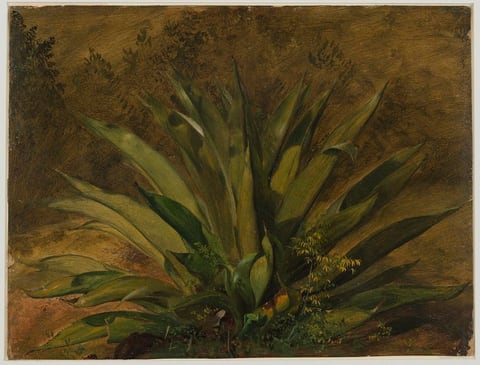
  2. CENTURY PLANT, JAMAICA
    Century Plant, JamaicaFrederic Edwin Church, May–September 1865Courtesy of Cooper Hewitt, Smithsonian Design Museum
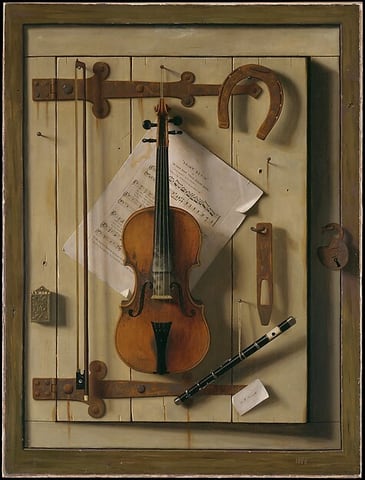
  3. Still Life—Violin and Music, by William Michael Harnett, 1888
    Still Life—Violin and MusicWilliam Michael Harnett, 1888Courtesy of The Metropolitan Museum of Art

Section 3, south wall
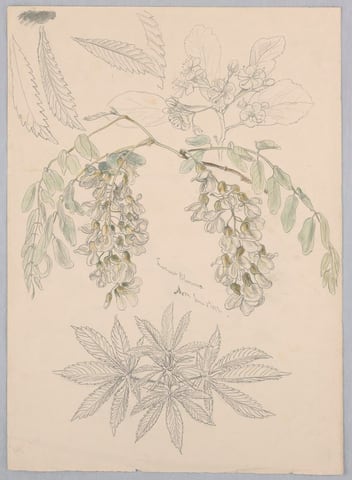
  1. LOCUST BLOSSOMS
    Locust BlossomsSamuel Colman, June 6, 1877Courtesy of Cooper Hewitt, Smithsonian Design Museum
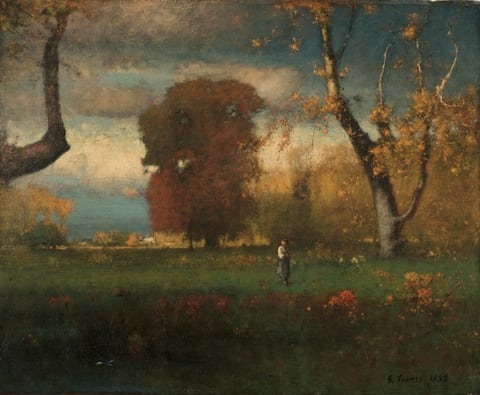
  2. Landscape, by George Inness, 1888
    LandscapeGeorge Inness, 1888Courtesy of the Cleveland Museum of Art