Floor plan

Time and place19th-century United States
19th-century United States
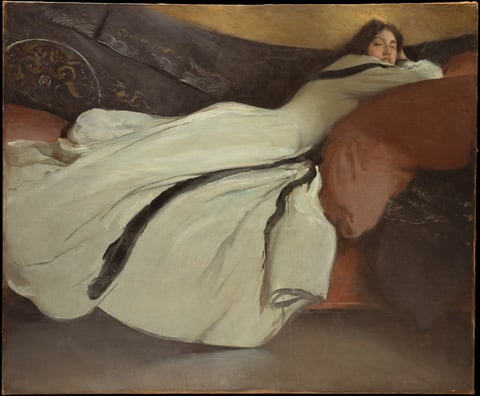
Repose, by John White Alexander, 1895
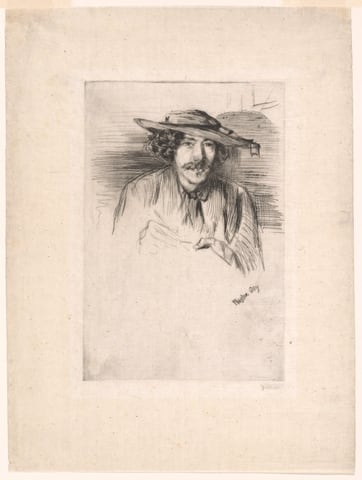
A work made of drypoint with light plate tone on thin ivory japanese paper.
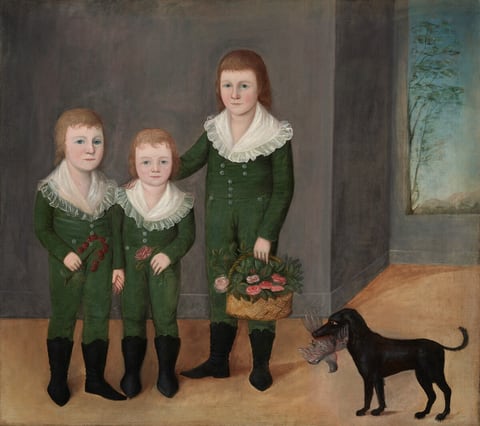
Three pale-skinned, blue-eyed children wearing green suits stand in a row facing us in this horizontal portrait painting. They all have round faces and full, pink cheeks. The tallest child is to the right, and he has shoulder-length cinnamon-brown hair. The other two come up to his shoulder and have blond hair. The tallest puts one arm on the far shoulder of the middle child, and the two smaller children hold hands. Each wears a pine-green, one-piece outfit with pewter-gray buttons, a wide, ivory-white collar lined with ruffles, and black, shin-high boots. The boy on our left holds a branch of dark red cherries. The middle child holds a pink rose, and the tallest a basket filled with pink roses. A black dog holding a gray and mauve-pink bird in its mouth stands in profile facing our left in the lower right corner of the canvas. The room around them has a tan-colored floor and gray walls. The room opens onto an alcove to our right with a rectangular window. A slender tree is along the left edge of the opening and a few pale, pink-tinged gray mountains line the bottom edge. Clear blue sky fills the rest of the window.
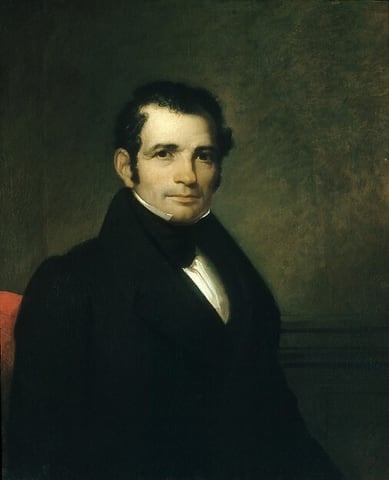
Luman Reed, by Asher Brown Durand, 1835
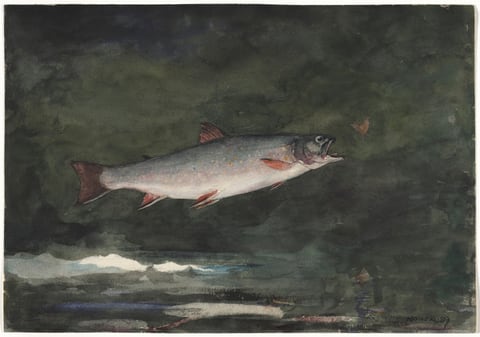
Leaping Trout, by Winslow Homer, 1889
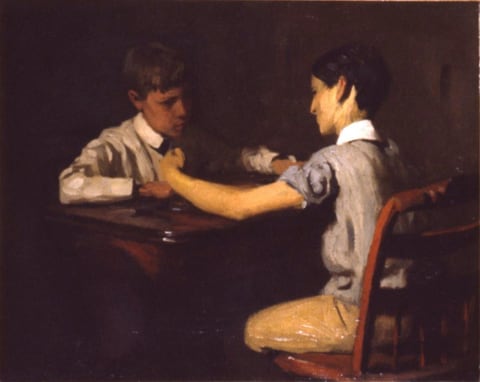
Checker Players, by Thomas Anshutz, ca. 1895
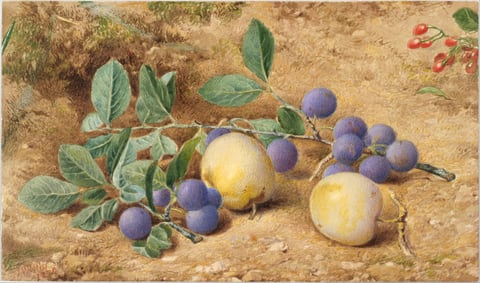
Plums, by John William Hill, 1870

The works in this room are listed below.

Works in this room

Works made in the United States in the 19th century.

Section 1, north wall

  1. Repose, by John White Alexander, 1895
    ReposeJohn White Alexander, 1895Courtesy of The Metropolitan Museum of Art
  2. A work made of drypoint with light plate tone on thin ivory japanese paper.
    Whistler with a HatJames McNeill Whistler, 1859Courtesy of the Art Institute of Chicago
  3. Three pale-skinned, blue-eyed children wearing green suits stand in a row facing us in this horizontal portrait painting. They all have round faces and full, pink cheeks. The tallest child is to the right, and he has shoulder-length cinnamon-brown hair. The other two come up to his shoulder and have blond hair. The tallest puts one arm on the far shoulder of the middle child, and the two smaller children hold hands. Each wears a pine-green, one-piece outfit with pewter-gray buttons, a wide, ivory-white collar lined with ruffles, and black, shin-high boots. The boy on our left holds a branch of dark red cherries. The middle child holds a pink rose, and the tallest a basket filled with pink roses. A black dog holding a gray and mauve-pink bird in its mouth stands in profile facing our left in the lower right corner of the canvas. The room around them has a tan-colored floor and gray walls. The room opens onto an alcove to our right with a rectangular window. A slender tree is along the left edge of the opening and a few pale, pink-tinged gray mountains line the bottom edge. Clear blue sky fills the rest of the window.
    The Westwood ChildrenJoshua Johnson, c. 1807Courtesy National Gallery of Art, Washington

Section 1, south wall

  1. Luman Reed, by Asher Brown Durand, 1835
    Luman ReedAsher Brown Durand, 1835Courtesy of The Metropolitan Museum of Art
  2. Leaping Trout, by Winslow Homer, 1889
    Leaping TroutWinslow Homer, 1889Courtesy of the Cleveland Museum of Art
  3. Checker Players, by Thomas Anshutz, ca. 1895
    Checker PlayersThomas Anshutz, ca. 1895Courtesy of the Smithsonian American Art Museum
  4. Plums, by John William Hill, 1870
    PlumsJohn William Hill, 1870Courtesy of The Metropolitan Museum of Art

Section 2, south wall
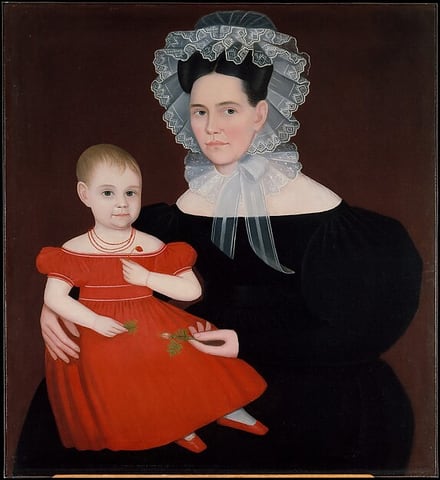
  1. Mrs. Mayer and Daughter, by Ammi Phillips, 1835–40
    Mrs. Mayer and DaughterAmmi Phillips, 1835–40Courtesy of The Metropolitan Museum of Art
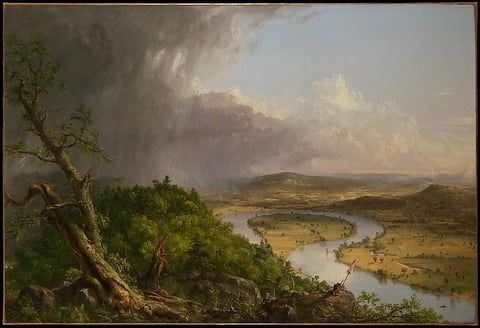
  2. View from Mount Holyoke, Northampton, Massachusetts, after a Thunderstorm—The Oxbow, by Thomas Cole, 1836
    View from Mount Holyoke, Northampton, Massachusetts, after a Thunderstorm—The OxbowThomas Cole, 1836Courtesy of The Metropolitan Museum of Art
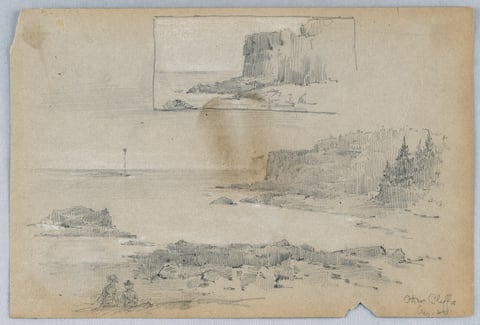
  3. OTTER CLIFFS
    Otter CliffsArnold William Brunner, 1879–80Courtesy of Cooper Hewitt, Smithsonian Design Museum

Section 2, north wall
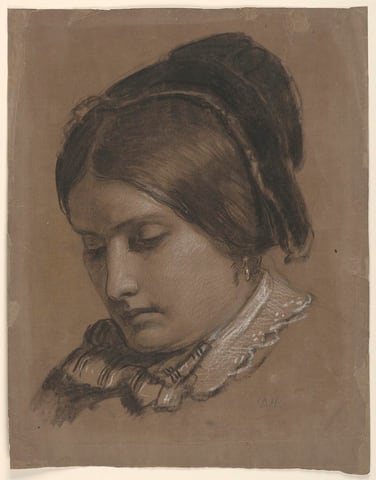
  1. THE ARTIST'S WIFE SOPHIE
    The Artist's Wife SophieDaniel Huntington, 1853Courtesy of Cooper Hewitt, Smithsonian Design Museum
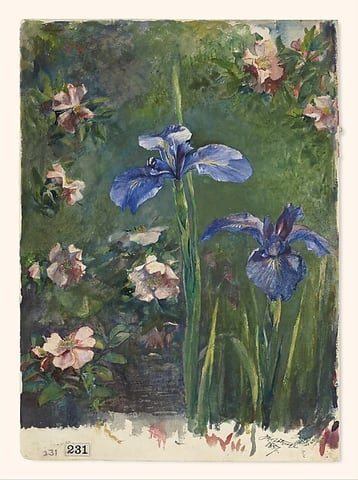
  2. Wild Roses and Irises, by John La Farge, 1887
    Wild Roses and IrisesJohn La Farge, 1887Courtesy of The Metropolitan Museum of Art
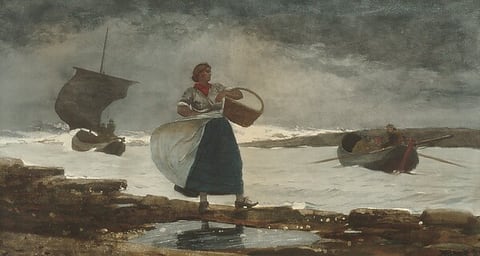
  3. Inside the Bar, by Winslow Homer, 1883
    Inside the BarWinslow Homer, 1883Courtesy of The Metropolitan Museum of Art
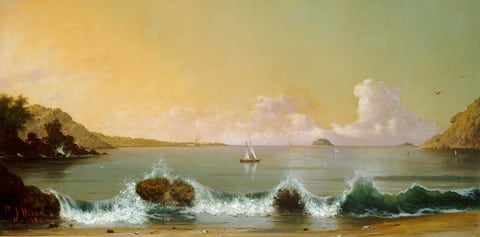
  4. Across a short stretch of sand in front of us, waves of bottle-green water break over two boulders on the shoreline, with sailboats in the water beyond, in this wide, horizontal painting. One boulder is at the left edge of the painting; the other is a short distance away, about a quarter of the way across. The water cascades down between those large rocks. Across the rest of the beach, the waves flare up to break toward us in white, foamy surf. The land curves back into view on both sides of the canvas with muted, sage-green hills and, to our left, dark green trees on more craggy boulders. A more distant finger of land to our left stretches nearly halfway across the horizon, which comes about halfway up the composition. Minuscule in scale there, smoke pours out of a chimney, which is surrounded by pale yellow buildings. A mound emerges from the horizon to our right of center. About ten sailboats float on the water. The closest one to us is near the center of the painting, and the tiny forms of people aboard can just barely be made out. The other boats become smaller as they move back to the horizon, and some are only a touch of white or gray on the canvas. White and pale lavender-purple clouds sweep up from the horizon into the sky, which glows butter yellow along the left edge. The sky cools to mint green in the upper right corner. Several white or brown birds fly across the sky or low over the water. The artist signed and dated the lower left, “M. J. Heade 1864.”
    Rio de Janeiro BayMartin Johnson Heade, 1864Courtesy National Gallery of Art, Washington

Section 3, north wall
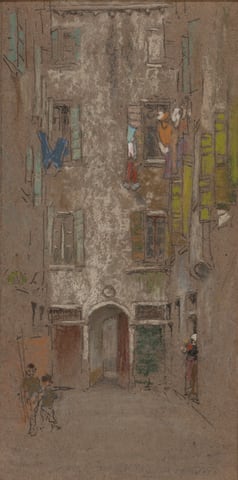
  1. A work made of pastel and black chalk on brown wove paper with fibrous inclusions.
    Corte del ParadisoJames McNeill Whistler, 1880Courtesy of the Art Institute of Chicago
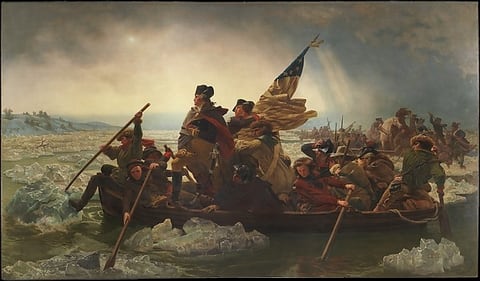
  2. Washington Crossing the Delaware, by Emanuel Leutze, 1851
    Washington Crossing the DelawareEmanuel Leutze, 1851Courtesy of The Metropolitan Museum of Art