Floor plan

Time and place19th-century United States
19th-century United States
VIEW OF VENICE, ITALY
The image shows a man sitting and facing the viewer. He has his right hand on a table. The man's hair is gray and neatly styled. He is wearing a dark coat with a high collar, a white shirt, and a yellow vest peeking through. On the table are a quill, inkwell, and papers. The background is a dark, neutral tone.
A work made of pen and brown ink, with brush and brown ink, on cream pseudo-laid paper tipped onto cream wove paper.
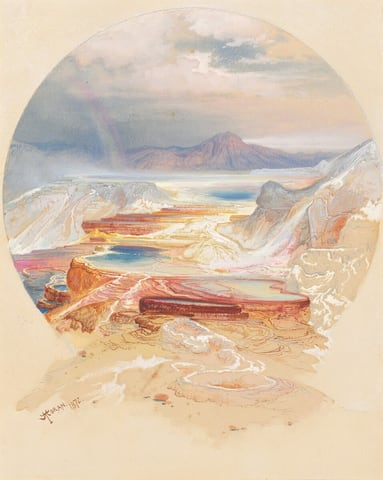
This painting shows a view looking out over a vast landscape. Most of the painting is circular, with a small part of the bottom bleeding out of the circle towards us. The top third of the circle shows a mountain range with a large purple peak in the distance. In front of the mountain is a faint rainbow. A body of water flows from in front of the mountain to the bottom of the painting, weaving in between shorter white peaks. Towards the bottom, the water appears to flow into small, layered pools of various bright colors including yellow, orange, red, pink, blue, and teal. The sky is a light blue-gray color. The background of the painting outside of the circle is plain paper.
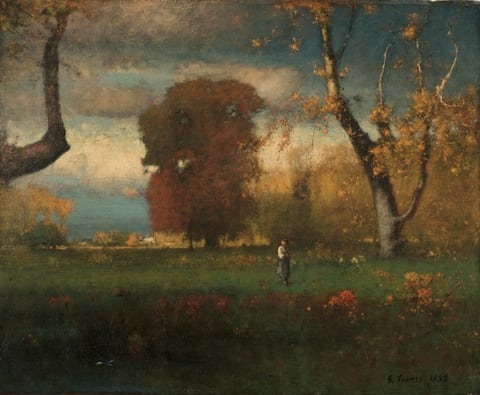
Landscape, by George Inness, 1888
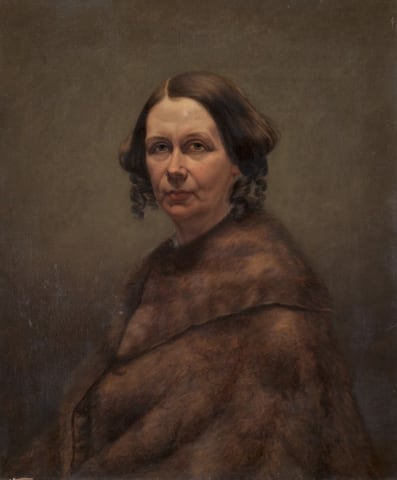
Mrs. Goss (The Woman in Fur), by Caroline L. Ransom, c. 1850s
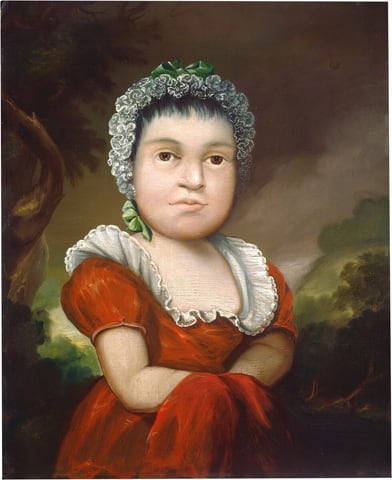
A pale-skinned child wearing a short-sleeved red dress and a white bonnet stands before a shadowy green forest under dark clouds in this vertical portrait painting. The child’s over-large head is out of scale with the rest of her body. She looks toward us with brown eyes in her wide, round-jawed face. She has a broad nose, and her pale lips are set in a line. Her lace bonnet lines her black hair like frothy seafoam and is tied with spring-green bows at the top and under her right ear, to our left. The low neckline of her crimson dress is lined with a wide white ruffle. Red fabric covers her hands, which are gathered in front of her waist. Gray clouds sweep over the hazy green forest in the background. A gnarled tree grows up the left side of the painting, framing the girl.
Musidora, by Thomas Sully, 1813–35

The works in this room are listed below.

Works in this room

Works made in the United States in the 19th century.

Section 1, north wall

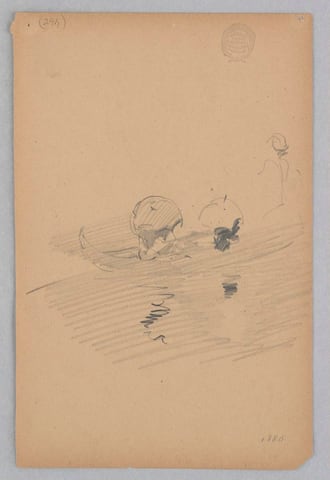
  1. VIEW OF VENICE, ITALY
    View of Venice, ItalyRobert Frederick Blum, 1880Courtesy of Cooper Hewitt, Smithsonian Design Museum
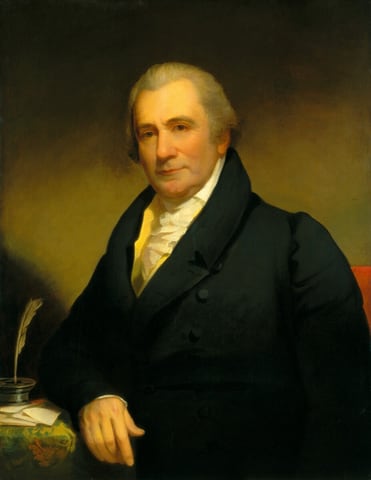
  2. The image shows a man sitting and facing the viewer. He has his right hand on a table. The man's hair is gray and neatly styled. He is wearing a dark coat with a high collar, a white shirt, and a yellow vest peeking through. On the table are a quill, inkwell, and papers. The background is a dark, neutral tone.
    Robert ColemanJacob Eichholtz, c. 1820Courtesy National Gallery of Art, Washington
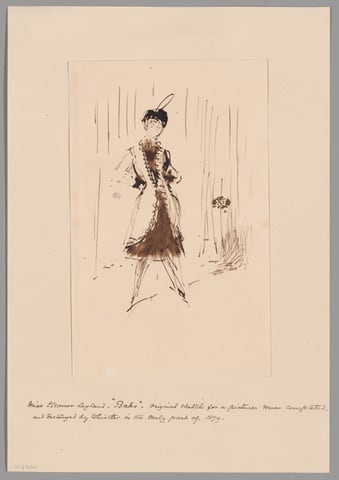
  3. A work made of pen and brown ink, with brush and brown ink, on cream pseudo-laid paper tipped onto cream wove paper.
    Study for "The Blue Girl: Portrait of Miss Elinor Leyland"James McNeill Whistler, c. 1879Courtesy of the Art Institute of Chicago
  4. This painting shows a view looking out over a vast landscape. Most of the painting is circular, with a small part of the bottom bleeding out of the circle towards us. The top third of the circle shows a mountain range with a large purple peak in the distance. In front of the mountain is a faint rainbow. A body of water flows from in front of the mountain to the bottom of the painting, weaving in between shorter white peaks. Towards the bottom, the water appears to flow into small, layered pools of various bright colors including yellow, orange, red, pink, blue, and teal. The sky is a light blue-gray color. The background of the painting outside of the circle is plain paper.
    Minerva Terrace, YellowstoneThomas Moran, 1872Courtesy National Gallery of Art, Washington

Section 1, south wall

  1. Landscape, by George Inness, 1888
    LandscapeGeorge Inness, 1888Courtesy of the Cleveland Museum of Art
  2. Mrs. Goss (The Woman in Fur), by Caroline L. Ransom, c. 1850s
    Mrs. Goss (The Woman in Fur)Caroline L. Ransom, c. 1850sCourtesy of the Cleveland Museum of Art
  3. A pale-skinned child wearing a short-sleeved red dress and a white bonnet stands before a shadowy green forest under dark clouds in this vertical portrait painting. The child’s over-large head is out of scale with the rest of her body. She looks toward us with brown eyes in her wide, round-jawed face. She has a broad nose, and her pale lips are set in a line. Her lace bonnet lines her black hair like frothy seafoam and is tied with spring-green bows at the top and under her right ear, to our left. The low neckline of her crimson dress is lined with a wide white ruffle. Red fabric covers her hands, which are gathered in front of her waist. Gray clouds sweep over the hazy green forest in the background. A gnarled tree grows up the left side of the painting, framing the girl.
    Portrait of a ChildEdward Hicks, c. 1840Courtesy National Gallery of Art, Washington
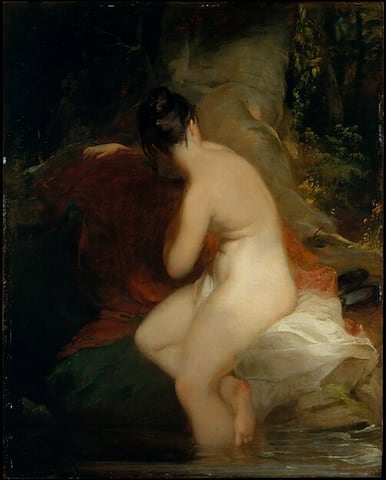
  4. Musidora, by Thomas Sully, 1813–35
    MusidoraThomas Sully, 1813–35Courtesy of The Metropolitan Museum of Art

Section 2, south wall
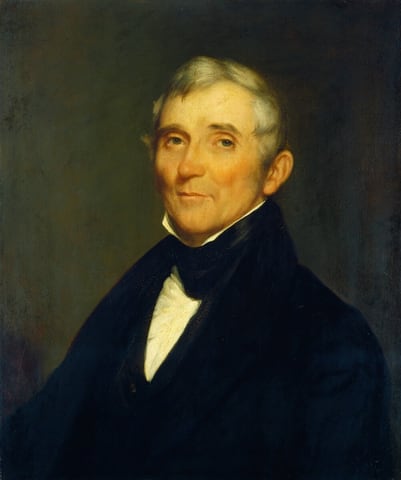
  1. The image is a portrait painting showing a man's upper body. He is positioned slightly turned to his right, with his head facing the viewer. The man has fair skin, defined cheekbones, and small, bright eyes. His hair is short, neatly combed, and grey or white. He is wearing a dark coat over a white shirt with a high collar, partially visible. The background is a muted, dark color, providing a simple setting that emphasizes the subject. There are no visible jewelry or objects in the image.
    Aaron BaldwinFrancis Alexander, c. 1835Courtesy National Gallery of Art, Washington
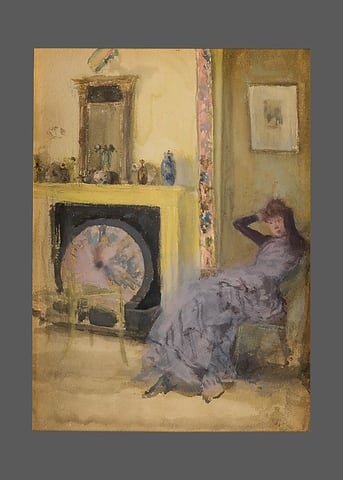
  2. The Yellow Room, by James McNeill Whistler, ca. 1883–84
    The Yellow RoomJames McNeill Whistler, ca. 1883–84Courtesy of The Metropolitan Museum of Art
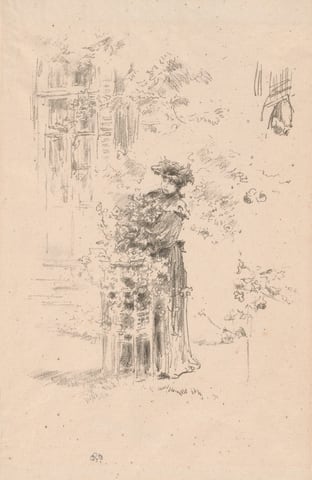
  3. A work made of transfer lithograph in black, with stumping and scraping, on cream laid paper, laid down on a heavy backing sheet.
    La Belle JardinièreJames McNeill Whistler, 1894Courtesy of the Art Institute of Chicago
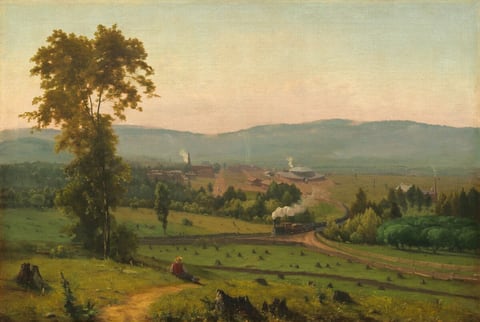
  4. We look across and down into a valley with a person sitting near a tall tree and a train puffing smoke beyond, all enclosed by a band of mountains in the distance in this horizontal landscape painting. Closest to us, several broken, jagged tree stumps are spaced across the painting’s width. A little distance away and to our left, the person wears a yellow, broad-brimmed hat, red vest, and gray pants. He reclines propped on his left elbow near a walking path beside a tall, slender tree with golden leaves. The green meadow stretching in front of him is dotted with tree stumps cut close to the ground. Beyond the meadow, puffs of white smoke trail behind a long steam locomotive that crosses a bridge spanning a tree-filled ravine, headed to our left. The ravine creates a diagonal line across the canvas, moving subtly away from us to our left. The train has climbed out of the valley, away from a cluster of brick-red buildings. The most prominent structure is a train roundhouse, a large building with a high, domed roof to the right of the tracks. Smoke rises from chimneys on long, warehouse-like buildings, and a steeple and smaller structures suggest a church and homes to our left. Hazy in the distance, a row of mountains lines the horizon, which comes about halfway up the composition. The sky above deepens from pale, shell pink over the mountains to watery, pale blue above. The artist signed the work in tiny letters in the lower left corner: “G. Inness.”
    The Lackawanna ValleyGeorge Inness, c. 1856Courtesy National Gallery of Art, Washington

Section 2, north wall
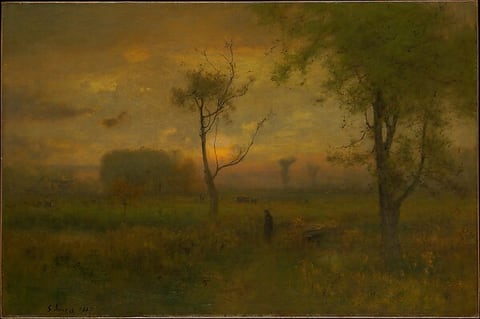
  1. Sunrise, by George Inness, 1887
    SunriseGeorge Inness, 1887Courtesy of The Metropolitan Museum of Art
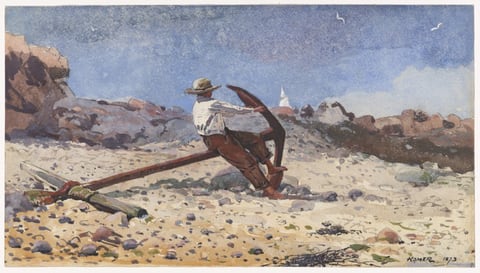
  2. Boy with Anchor, by Winslow Homer, 1873
    Boy with AnchorWinslow Homer, 1873Courtesy of the Cleveland Museum of Art

Section 3, north wall
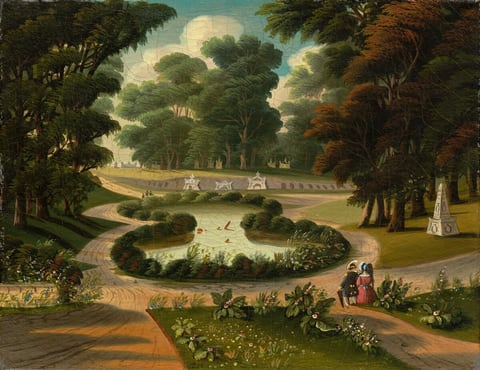
  1. This painting shows a park-like landscape with trees, flowers, bushes, and a pond, all surrounded by light brown paths. The pond is in the center of the park, with light green-blue water framed by bushes, ferns, and tall flowers. Across from the pond are three large, white structures that could be mausoleums. Behind them is a hill with trees and more white graves or mausoleums on top of it. On either side of the pond, past the paths that encircle it, are tall trees with leaves in shades of dark green and brown. On the right side is a tall white structure that could be a grave or a monument. At the bottom of the painting, the paths curve up over a small hill in front of the pond. In between the paths are sections of grass dotted with small pink and white flowers. On the right side of the painting, a couple walks down the hill towards the pond. The person on the left wears a long blue coat decorated with gold buttons and a large, plumed hat, while the person on the right wears a pink gown and blue bonnet. Above the scene, the sky is blue, with puffy white clouds.
    Mount Auburn CemeteryThomas Chambers, mid 19th centuryCourtesy National Gallery of Art, Washington
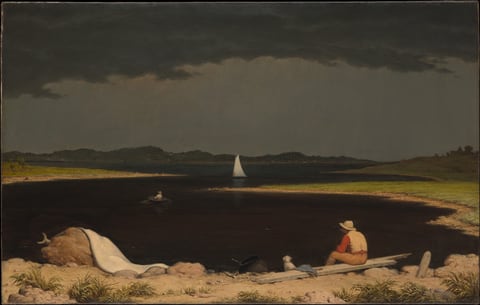
  2. Approaching Thunder Storm, by Martin Johnson Heade, 1859
    Approaching Thunder StormMartin Johnson Heade, 1859Courtesy of The Metropolitan Museum of Art