Floor plan

Time and place19th-century United States
19th-century United States
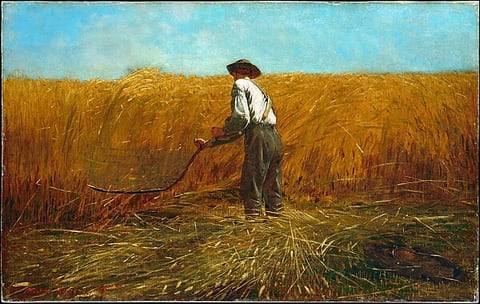
The Veteran in a New Field, by Winslow Homer, 1865
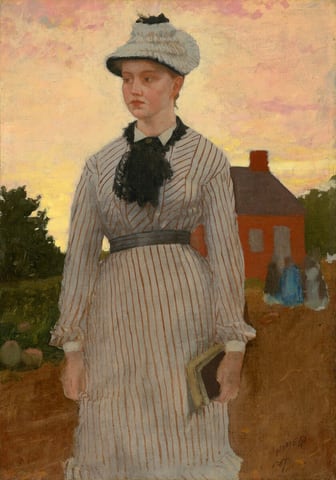
Shown from the knees up, a pale-skinned woman stands close to us with a red schoolhouse in the distance under a sunset sky in this vertical painting. The woman’s body faces us, but she turns her head to look off to the left with light brown eyes. She has a short, straight nose, full pink lips, and a round face. Her blond hair is pulled up under a round white hat layered with ruffles, which lies like a pancake over the top of her head. Her white dress is vertically striped with thin rust-red lines and has a long-sleeved, tight-fitting bodice and a long skirt. A dark gray belt is cinched around her narrow waist, and she wears a black, lacy ruffle around her neck. The woman’s arms hang by her sides, and she holds two paperback-sized books in her left hand, to our right. An earth-brown lawn stretches back to the schoolhouse, which has crimson-red walls, a chimney, and a dark gray roof. Three forms painted with a few streaks of dark or light gray or topaz blue suggest people standing near the door of the schoolhouse. Trees and a grassy lawn beyond the building are loosely painted with blended strokes. The sky is shaded pale lemon yellow and light peach with touches of rose pink. The artist signed and dated the lower right corner, “HOMER 1873.”
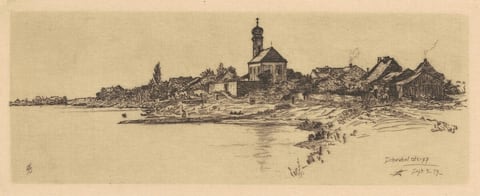
The image shows a village scene viewed from a low vantage point near a water's edge. A row of small, closely packed buildings and a church with an onion-shaped dome are prominently featured. There are gentle slopes leading towards the structures. The image uses fine, detailed line work to depict texture and depth in the buildings and natural landscape. The lines are delicate and varied, creating a sense of detail and softness. The color palette is monochromatic, with dark ink on a pale background, resulting in a classic and timeless feel.
Watercolor
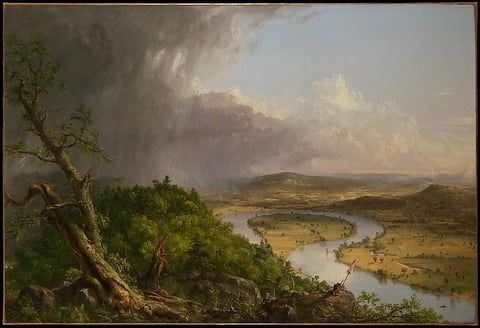
View from Mount Holyoke, Northampton, Massachusetts, after a Thunderstorm—The Oxbow, by Thomas Cole, 1836
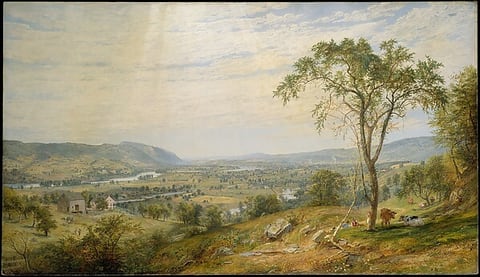
The Valley of Wyoming, by Jasper Francis Cropsey, 1865

The works in this room are listed below.

Works in this room

Works made in the United States in the 19th century.

Section 1, north wall

  1. The Veteran in a New Field, by Winslow Homer, 1865
    The Veteran in a New FieldWinslow Homer, 1865Courtesy of The Metropolitan Museum of Art
  2. Shown from the knees up, a pale-skinned woman stands close to us with a red schoolhouse in the distance under a sunset sky in this vertical painting. The woman’s body faces us, but she turns her head to look off to the left with light brown eyes. She has a short, straight nose, full pink lips, and a round face. Her blond hair is pulled up under a round white hat layered with ruffles, which lies like a pancake over the top of her head. Her white dress is vertically striped with thin rust-red lines and has a long-sleeved, tight-fitting bodice and a long skirt. A dark gray belt is cinched around her narrow waist, and she wears a black, lacy ruffle around her neck. The woman’s arms hang by her sides, and she holds two paperback-sized books in her left hand, to our right. An earth-brown lawn stretches back to the schoolhouse, which has crimson-red walls, a chimney, and a dark gray roof. Three forms painted with a few streaks of dark or light gray or topaz blue suggest people standing near the door of the schoolhouse. Trees and a grassy lawn beyond the building are loosely painted with blended strokes. The sky is shaded pale lemon yellow and light peach with touches of rose pink. The artist signed and dated the lower right corner, “HOMER 1873.”
    The Red School HouseWinslow Homer, 1873Courtesy National Gallery of Art, Washington
  3. The image shows a village scene viewed from a low vantage point near a water's edge. A row of small, closely packed buildings and a church with an onion-shaped dome are prominently featured. There are gentle slopes leading towards the structures. The image uses fine, detailed line work to depict texture and depth in the buildings and natural landscape. The lines are delicate and varied, creating a sense of detail and softness. The color palette is monochromatic, with dark ink on a pale background, resulting in a classic and timeless feel.
    SchwabelweissOtto Henry Bacher, 1879Courtesy National Gallery of Art, Washington
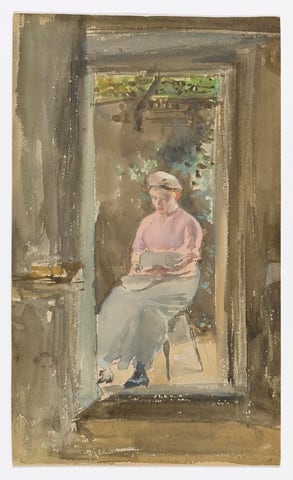
  4. Watercolor
    Pink Note–Shelling PeasJames McNeill Whistler, 1882-1884Courtesy of the National Museum of Asian Art, Smithsonian Institution

Section 1, south wall

  1. View from Mount Holyoke, Northampton, Massachusetts, after a Thunderstorm—The Oxbow, by Thomas Cole, 1836
    View from Mount Holyoke, Northampton, Massachusetts, after a Thunderstorm—The OxbowThomas Cole, 1836Courtesy of The Metropolitan Museum of Art
  2. The Valley of Wyoming, by Jasper Francis Cropsey, 1865
    The Valley of WyomingJasper Francis Cropsey, 1865Courtesy of The Metropolitan Museum of Art

Section 2, south wall
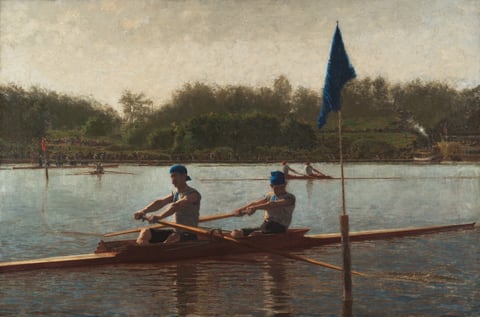
  1. The Biglin Brothers Turning the Stake, by Thomas Eakins, 1873
    The Biglin Brothers Turning the StakeThomas Eakins, 1873Courtesy of the Cleveland Museum of Art
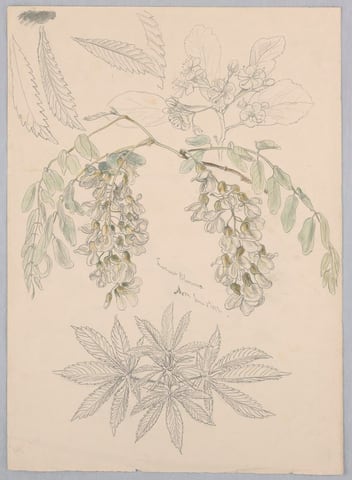
  2. LOCUST BLOSSOMS
    Locust BlossomsSamuel Colman, June 6, 1877Courtesy of Cooper Hewitt, Smithsonian Design Museum
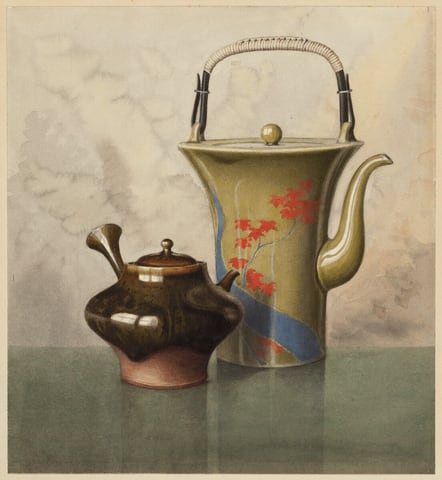
  3. There are two teapots in the image. The larger teapot has a decorative pattern of red leaves and blue curve on an olive-green background, with a white handle. The smaller teapot has a dark brown glossy finish. The color palette consists of earthy tones like browns, olive green, red, and blue. The larger teapot is positioned slightly to the right, behind the smaller one, which is in the foreground on a reflective green surface. The background has a light beige appearance.
    Asian Tea PotsHenry Farrer, n.d.Courtesy National Gallery of Art, Washington
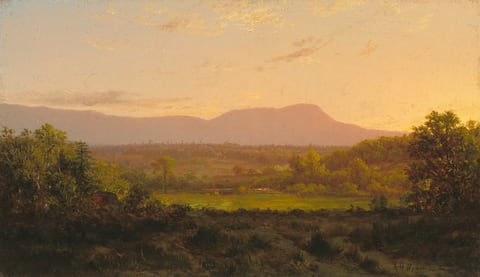
  4. The painting depicts a rural landscape at sunset or sunrise. The horizon is slightly above the center, showing distant pale-pink and purple mountains against the sky. Closest to us is an area with dark green bushes and vegetation, leading to a lighter green field surrounded by green-and-brown trees. The palette is warm and earthy, with greens and browns in the bottom transitioning to purples and pinks in the distance. The sky is a pale-yellow color that fades into light blue towards the top left corner, and faint yellow and gray clouds drift across it.
    Peaceful ValleyAlexander Helwig Wyant, c. 1872Courtesy National Gallery of Art, Washington

Section 2, north wall
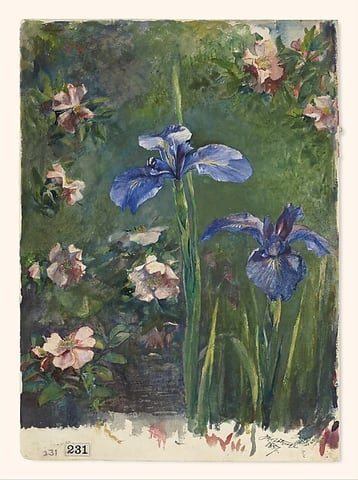
  1. Wild Roses and Irises, by John La Farge, 1887
    Wild Roses and IrisesJohn La Farge, 1887Courtesy of The Metropolitan Museum of Art
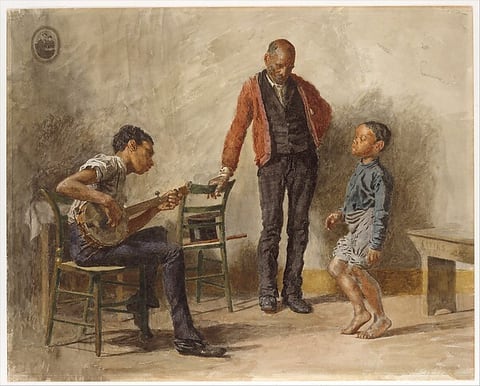
  2. The Dancing Lesson, by Thomas Eakins, 1878
    The Dancing LessonThomas Eakins, 1878Courtesy of The Metropolitan Museum of Art
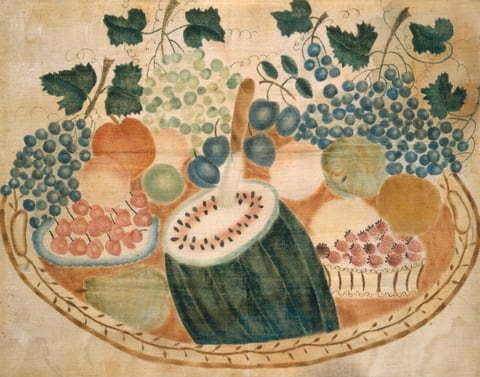
  3. The image shows a large cut watermelon in a woven basket surrounded by various fruits including grapes, peaches, and small round red fruits. The color palette includes greens, blues, oranges, and browns. The basket takes up most of the space and is filled with fruits, with grape clusters hanging above it.
    Fruit on a TrayUnrecorded American maker, c. 1840Courtesy National Gallery of Art, Washington
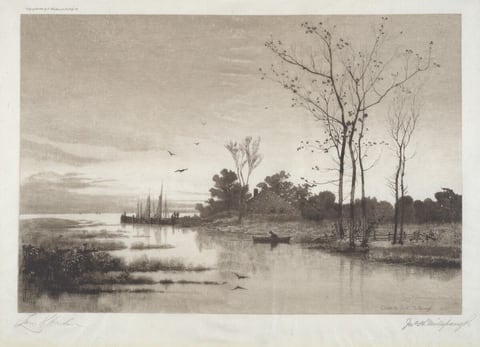
  4. The image depicts a landscape with a river flowing through it. In the foreground, there is a small boat on the water, and in the background, sailboats are docked near a strip of land. Tall trees with sparse foliage are on the right side, with a structure nestled among them near the water. The horizon is slightly above the center of the image, with a calm sky above it. The brushstrokes vary in texture, with fine strokes for the sky and water and more detailed strokes for the trees. The color palette is muted, with sepia and gray tones creating a peaceful atmosphere. Birds are scattered in the sky.
    Shrewsbury RiverJohn Hill Millspaugh, 1887Courtesy National Gallery of Art, Washington

Section 3, north wall
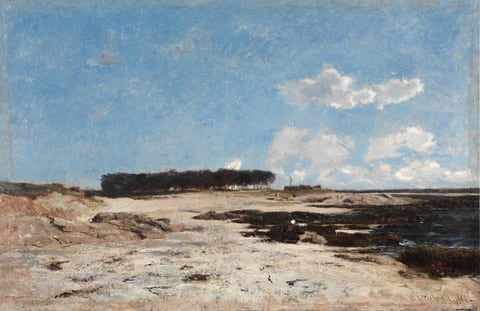
  1. Pointe de Cabellou, Brittany, by William L. Picknell, 1881
    Pointe de Cabellou, BrittanyWilliam L. Picknell, 1881Courtesy of the Cleveland Museum of Art
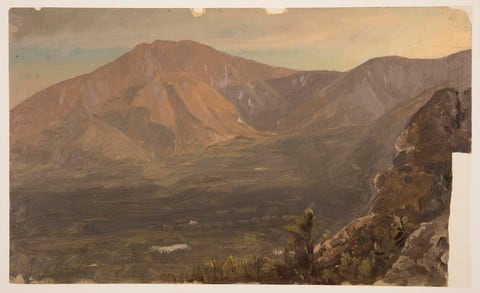
  2. MT. KATAHDIN FROM SOUTH TURNER MOUNTAIN, MAINE
    Mt. Katahdin from South Turner Mountain, MaineFrederic Edwin Church, 1877–78Courtesy of Cooper Hewitt, Smithsonian Design Museum