Floor plan

Time and place19th-century United States
19th-century United States
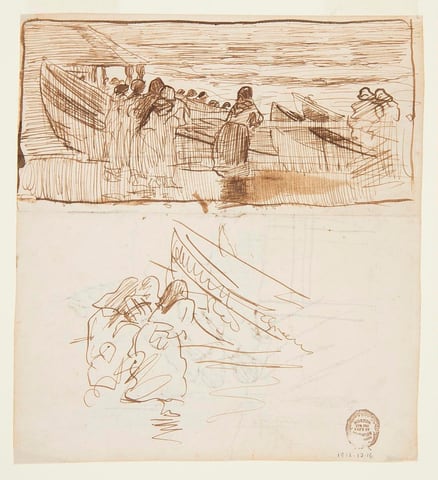
TWO STUDIES OF WOMEN STANDING BEHIND RAILING, LOOKING AT THE LAUNCHING OF DORIES, CULLERCOATS, ENGLAND
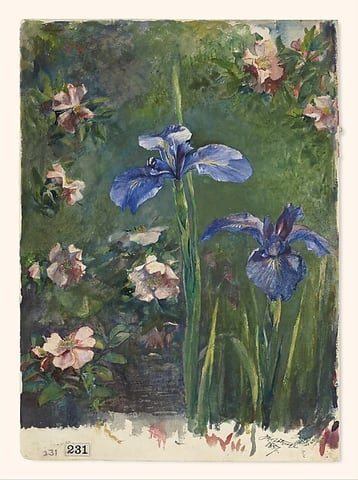
Wild Roses and Irises, by John La Farge, 1887
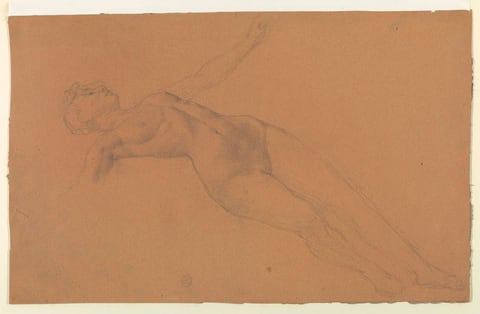
STUDY FOR "DIANA AND HER ATTENDANTS AMONG THE CONSTELLATIONS"
Mountains in Colorado, by John Frederick Kensett, 1870
Senator Thomas Hart Benton, by Matthew Harris Jouett, 1820s
Across a short stretch of sand in front of us, waves of bottle-green water break over two boulders on the shoreline, with sailboats in the water beyond, in this wide, horizontal painting. One boulder is at the left edge of the painting; the other is a short distance away, about a quarter of the way across. The water cascades down between those large rocks. Across the rest of the beach, the waves flare up to break toward us in white, foamy surf. The land curves back into view on both sides of the canvas with muted, sage-green hills and, to our left, dark green trees on more craggy boulders. A more distant finger of land to our left stretches nearly halfway across the horizon, which comes about halfway up the composition. Minuscule in scale there, smoke pours out of a chimney, which is surrounded by pale yellow buildings. A mound emerges from the horizon to our right of center. About ten sailboats float on the water. The closest one to us is near the center of the painting, and the tiny forms of people aboard can just barely be made out. The other boats become smaller as they move back to the horizon, and some are only a touch of white or gray on the canvas. White and pale lavender-purple clouds sweep up from the horizon into the sky, which glows butter yellow along the left edge. The sky cools to mint green in the upper right corner. Several white or brown birds fly across the sky or low over the water. The artist signed and dated the lower left, “M. J. Heade 1864.”
AMERICAN PLAINS WITH MOUNTAIN RANGE IN THE DISTANCE
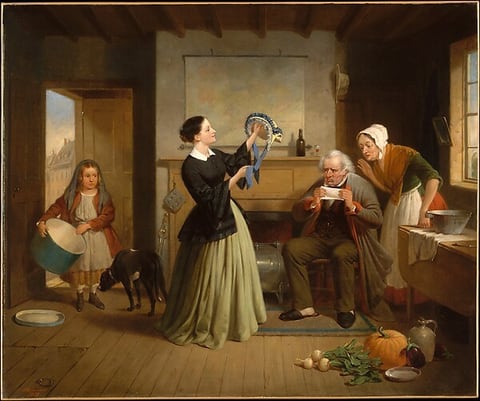
The New Bonnet, by Francis William Edmonds, 1858

The works in this room are listed below.

Works in this room

Works made in the United States in the 19th century.

Section 1, north wall

  1. TWO STUDIES OF WOMEN STANDING BEHIND RAILING, LOOKING AT THE LAUNCHING OF DORIES, CULLERCOATS, ENGLAND
    Two Studies of Women Standing behind Railing, Looking at the Launching of Dories, Cullercoats, EnglandWinslow Homer, 1881Courtesy of Cooper Hewitt, Smithsonian Design Museum
  2. Wild Roses and Irises, by John La Farge, 1887
    Wild Roses and IrisesJohn La Farge, 1887Courtesy of The Metropolitan Museum of Art
  3. STUDY FOR "DIANA AND HER ATTENDANTS AMONG THE CONSTELLATIONS"
    Study for "Diana and Her Attendants among the Constellations"Francis Augustus Lathrop, ca. 1894Courtesy of Cooper Hewitt, Smithsonian Design Museum
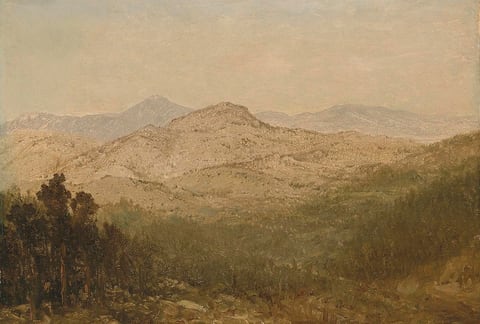
  4. Mountains in Colorado, by John Frederick Kensett, 1870
    Mountains in ColoradoJohn Frederick Kensett, 1870Courtesy of the Smithsonian American Art Museum

Section 1, south wall

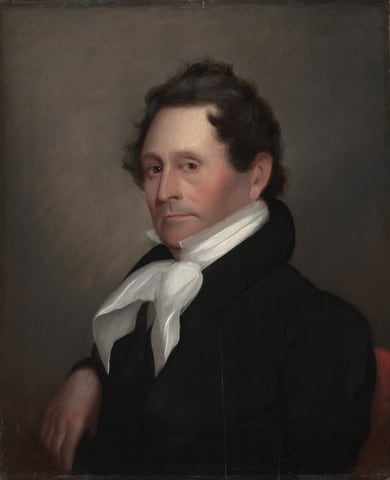
  1. Senator Thomas Hart Benton, by Matthew Harris Jouett, 1820s
    Senator Thomas Hart BentonMatthew Harris Jouett, 1820sCourtesy of the Cleveland Museum of Art
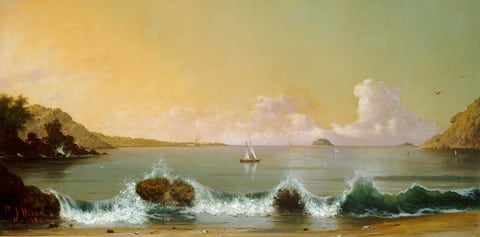
  2. Across a short stretch of sand in front of us, waves of bottle-green water break over two boulders on the shoreline, with sailboats in the water beyond, in this wide, horizontal painting. One boulder is at the left edge of the painting; the other is a short distance away, about a quarter of the way across. The water cascades down between those large rocks. Across the rest of the beach, the waves flare up to break toward us in white, foamy surf. The land curves back into view on both sides of the canvas with muted, sage-green hills and, to our left, dark green trees on more craggy boulders. A more distant finger of land to our left stretches nearly halfway across the horizon, which comes about halfway up the composition. Minuscule in scale there, smoke pours out of a chimney, which is surrounded by pale yellow buildings. A mound emerges from the horizon to our right of center. About ten sailboats float on the water. The closest one to us is near the center of the painting, and the tiny forms of people aboard can just barely be made out. The other boats become smaller as they move back to the horizon, and some are only a touch of white or gray on the canvas. White and pale lavender-purple clouds sweep up from the horizon into the sky, which glows butter yellow along the left edge. The sky cools to mint green in the upper right corner. Several white or brown birds fly across the sky or low over the water. The artist signed and dated the lower left, “M. J. Heade 1864.”
    Rio de Janeiro BayMartin Johnson Heade, 1864Courtesy National Gallery of Art, Washington
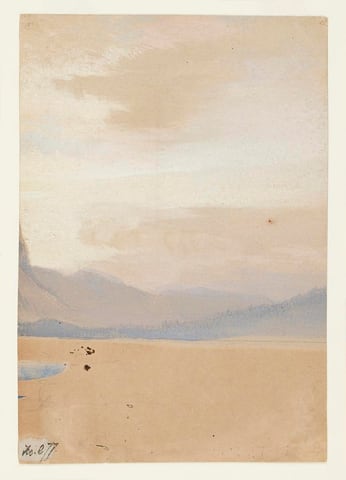
  3. AMERICAN PLAINS WITH MOUNTAIN RANGE IN THE DISTANCE
    American Plains with Mountain Range in the DistanceThomas Moran, before 1872Courtesy of Cooper Hewitt, Smithsonian Design Museum
  4. The New Bonnet, by Francis William Edmonds, 1858
    The New BonnetFrancis William Edmonds, 1858Courtesy of The Metropolitan Museum of Art

Section 2, south wall
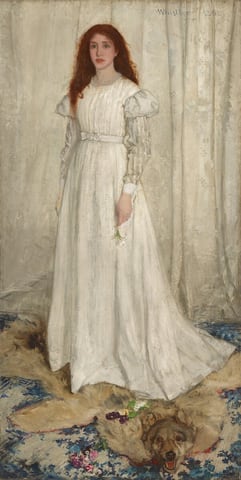
  1. A young woman with pale, peachy skin, wearing a long, flowing white dress, stands in front of a white curtain in this vertical portrait painting. Her auburn-red hair cascades down over and behind her shoulders. She looks to our left with green eyes, and her pink, full lips are closed. Her dress has puffed shoulders above a white-on-white striped pattern on the long sleeves. She stands on an animal pelt; it is not clear whether it is a wolf or a bear. The pelt spans the width of the painting and overlaps a blue patterned carpet. The animal’s mouth gapes to show sharp teeth. Its glassy eyes are wide open, and it seems to look at us. The edges of the animal skin are red. The woman holds a white lily by her side in her left hand, while yellow and purple flowers lie scattered on the pelt.
    Symphony in White, No. 1: The White GirlJames McNeill Whistler, 1861-1863, 1872Courtesy National Gallery of Art, Washington
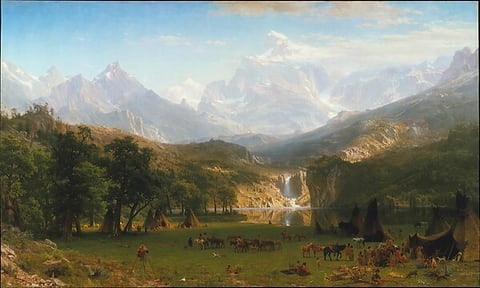
  2. The Rocky Mountains, Lander's Peak, by Albert Bierstadt, 1863
    The Rocky Mountains, Lander's PeakAlbert Bierstadt, 1863Courtesy of The Metropolitan Museum of Art

Section 2, north wall
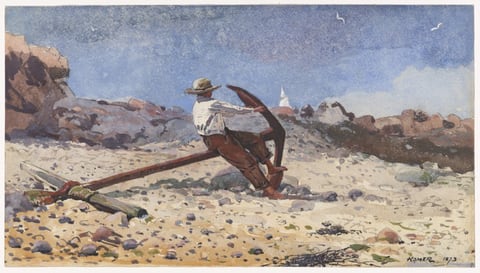
  1. Boy with Anchor, by Winslow Homer, 1873
    Boy with AnchorWinslow Homer, 1873Courtesy of the Cleveland Museum of Art
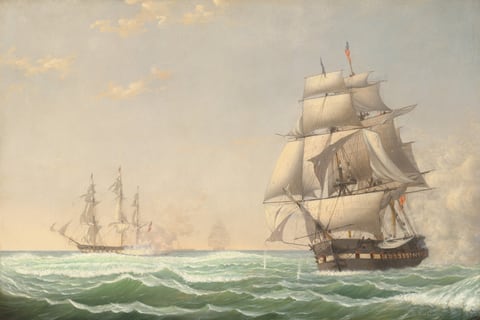
  2. This painting shows a maritime landscape with an expansive view of the ocean and sky. The horizon is positioned in the lower third of the composition, meeting a clear sky with soft, diffused clouds. Two ships appear to be engaged in a conflict on the green, wave-filled water. One large sailing ship with fully extended sails is near the bottom right corner of the painting. It has two tall masts and multiple white sails, and it flies the flag of the U.S.A in several places. The body of this ship is gray with a wide white stripe, and cannons stick out of small holes across the ship. Small people climb on ropes up into the sails, which are covered in small white and gray dots, perhaps indicating holes. Another ship is visible in the distance on the left side of the painting, and its cannons appear to be firing, with bursts of yellow flame and smoke drifting across the water. This ship flies several flags in shades of red, blue, and white. In the background, the faint gray silhouettes of other ships can be seen across the water. The ocean is depicted with smooth brushstrokes in shades of green and white, and the wide sky is a gradient, with light blue at the top and pale yellow towards the horizon. Faint white clouds drift in the top left corner of the painting.
    The United States Frigate "President" Engaging the British Squadron, 1815Fitz Henry Lane, 1850Courtesy National Gallery of Art, Washington
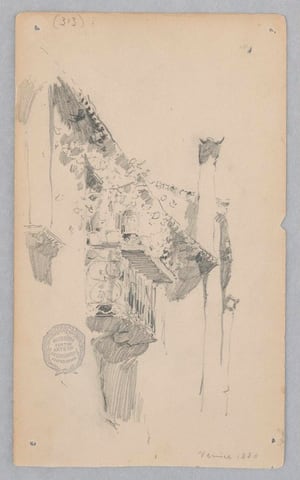
  3. BALCONY
    BalconyRobert Frederick Blum, 1880Courtesy of Cooper Hewitt, Smithsonian Design Museum

Section 3, north wall
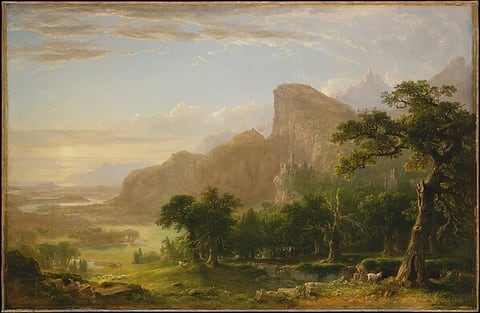
  1. Landscape—Scene from "Thanatopsis", by Asher Brown Durand, 1850
    Landscape—Scene from "Thanatopsis"Asher Brown Durand, 1850Courtesy of The Metropolitan Museum of Art
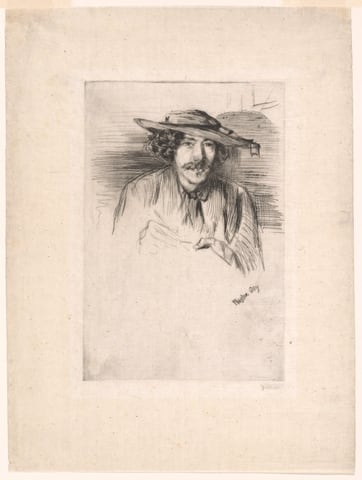
  2. A work made of drypoint with light plate tone on thin ivory japanese paper.
    Whistler with a HatJames McNeill Whistler, 1859Courtesy of the Art Institute of Chicago
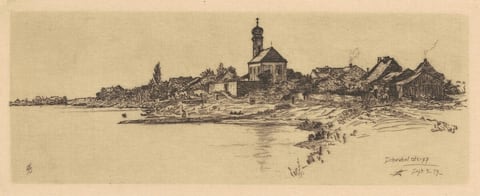
  3. The image shows a village scene viewed from a low vantage point near a water's edge. A row of small, closely packed buildings and a church with an onion-shaped dome are prominently featured. There are gentle slopes leading towards the structures. The image uses fine, detailed line work to depict texture and depth in the buildings and natural landscape. The lines are delicate and varied, creating a sense of detail and softness. The color palette is monochromatic, with dark ink on a pale background, resulting in a classic and timeless feel.
    SchwabelweissOtto Henry Bacher, 1879Courtesy National Gallery of Art, Washington