Floor plan

Time and place19th-century United States
19th-century United States
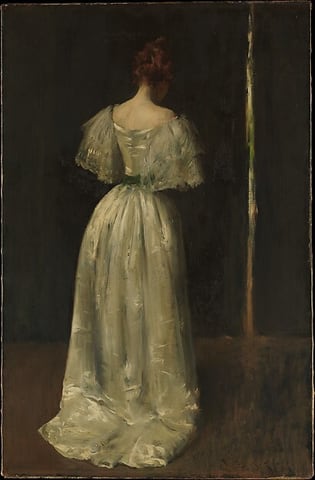
Seventeenth Century Lady, by William Merritt Chase, ca. 1895
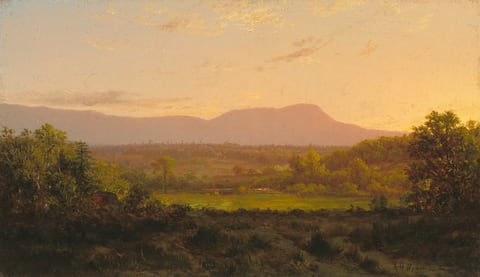
The painting depicts a rural landscape at sunset or sunrise. The horizon is slightly above the center, showing distant pale-pink and purple mountains against the sky. Closest to us is an area with dark green bushes and vegetation, leading to a lighter green field surrounded by green-and-brown trees. The palette is warm and earthy, with greens and browns in the bottom transitioning to purples and pinks in the distance. The sky is a pale-yellow color that fades into light blue towards the top left corner, and faint yellow and gray clouds drift across it.
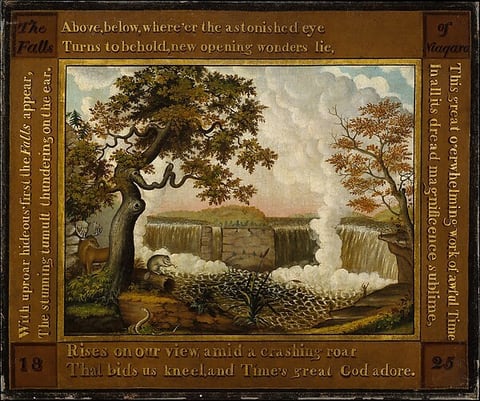
The Falls of Niagara, by Edward Hicks, ca. 1825
Pale watercolor drawing of young dancer in long sheer dress.
STUDY FOR "SCIENTIFIC GROUP"
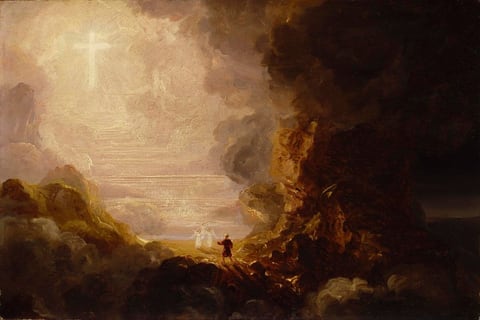
The Pilgrim of the Cross at the End of His Journey (study for series, The Cross and the World), by Thomas Cole, ca. 1846-1848
The image depicts a landscape with a river flowing through it. In the foreground, there is a small boat on the water, and in the background, sailboats are docked near a strip of land. Tall trees with sparse foliage are on the right side, with a structure nestled among them near the water. The horizon is slightly above the center of the image, with a calm sky above it. The brushstrokes vary in texture, with fine strokes for the sky and water and more detailed strokes for the trees. The color palette is muted, with sepia and gray tones creating a peaceful atmosphere. Birds are scattered in the sky.
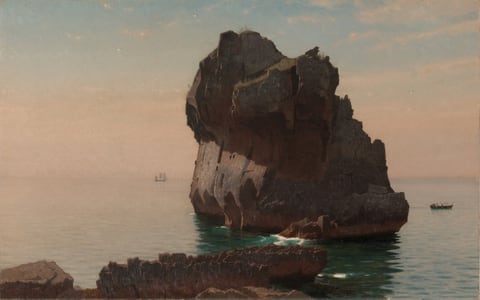
Capri, by William Stanley Haseltine, 1869

The works in this room are listed below.

Works in this room

Works made in the United States in the 19th century.

Section 1, north wall

  1. Seventeenth Century Lady, by William Merritt Chase, ca. 1895
    Seventeenth Century LadyWilliam Merritt Chase, ca. 1895Courtesy of The Metropolitan Museum of Art
  2. The painting depicts a rural landscape at sunset or sunrise. The horizon is slightly above the center, showing distant pale-pink and purple mountains against the sky. Closest to us is an area with dark green bushes and vegetation, leading to a lighter green field surrounded by green-and-brown trees. The palette is warm and earthy, with greens and browns in the bottom transitioning to purples and pinks in the distance. The sky is a pale-yellow color that fades into light blue towards the top left corner, and faint yellow and gray clouds drift across it.
    Peaceful ValleyAlexander Helwig Wyant, c. 1872Courtesy National Gallery of Art, Washington
  3. The Falls of Niagara, by Edward Hicks, ca. 1825
    The Falls of NiagaraEdward Hicks, ca. 1825Courtesy of The Metropolitan Museum of Art
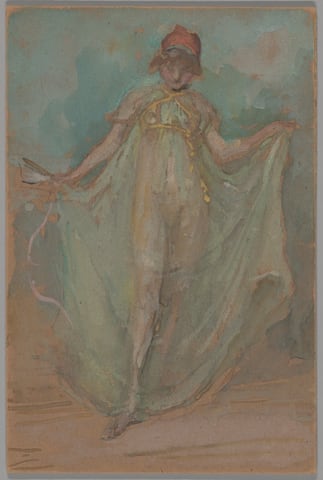
  4. Pale watercolor drawing of young dancer in long sheer dress.
    Green and Blue: The DancerJames McNeill Whistler, c. 1893Courtesy of the Art Institute of Chicago

Section 1, south wall

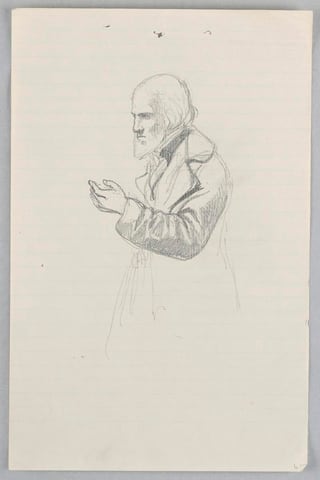
  1. STUDY FOR "SCIENTIFIC GROUP"
    Study for "Scientific Group"Daniel Huntington, 1858Courtesy of Cooper Hewitt, Smithsonian Design Museum
  2. The Pilgrim of the Cross at the End of His Journey (study for series, The Cross and the World), by Thomas Cole, ca. 1846-1848
    The Pilgrim of the Cross at the End of His Journey (study for series, The Cross and the World)Thomas Cole, ca. 1846-1848Courtesy of the Smithsonian American Art Museum
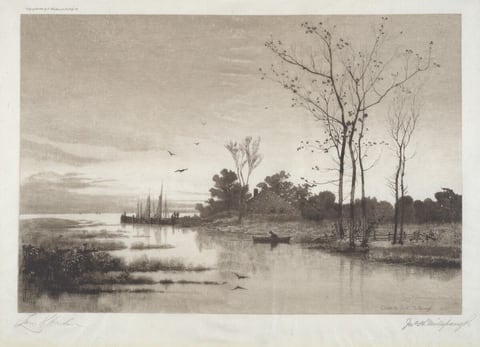
  3. The image depicts a landscape with a river flowing through it. In the foreground, there is a small boat on the water, and in the background, sailboats are docked near a strip of land. Tall trees with sparse foliage are on the right side, with a structure nestled among them near the water. The horizon is slightly above the center of the image, with a calm sky above it. The brushstrokes vary in texture, with fine strokes for the sky and water and more detailed strokes for the trees. The color palette is muted, with sepia and gray tones creating a peaceful atmosphere. Birds are scattered in the sky.
    Shrewsbury RiverJohn Hill Millspaugh, 1887Courtesy National Gallery of Art, Washington
  4. Capri, by William Stanley Haseltine, 1869
    CapriWilliam Stanley Haseltine, 1869Courtesy of the Cleveland Museum of Art

Section 2, south wall
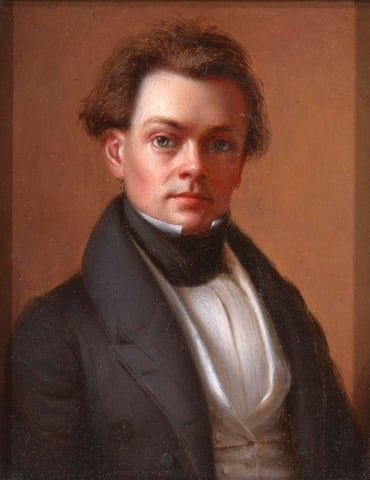
  1. Self-Portrait, by Oliver Tarbell Eddy, ca. 1850
    Self-PortraitOliver Tarbell Eddy, ca. 1850Courtesy of the Smithsonian American Art Museum
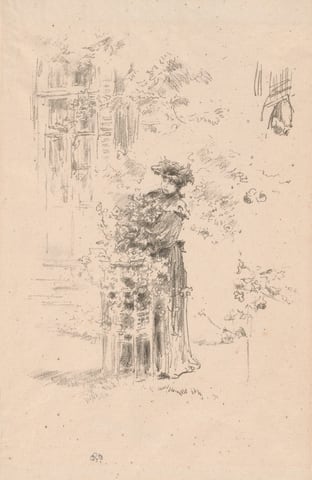
  2. A work made of transfer lithograph in black, with stumping and scraping, on cream laid paper, laid down on a heavy backing sheet.
    La Belle JardinièreJames McNeill Whistler, 1894Courtesy of the Art Institute of Chicago
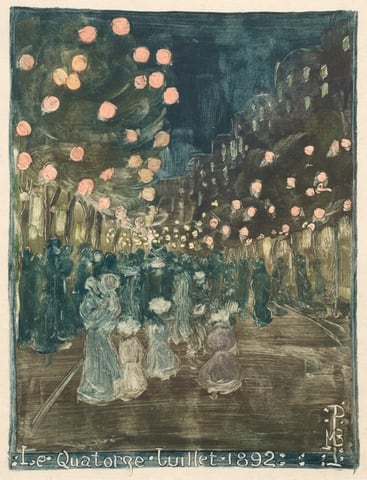
  3. Bastille Day, by Maurice Prendergast, 1892
    Bastille DayMaurice Prendergast, 1892Courtesy of the Cleveland Museum of Art
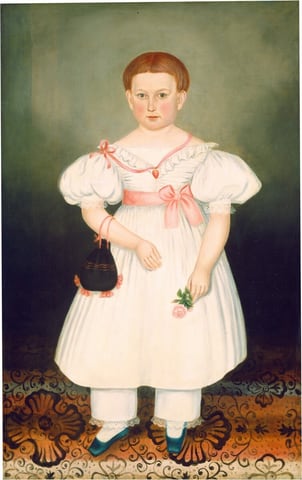
  4. The image shows a child standing upright, facing forward. They have fair skin, rounded cheeks, short reddish-brown hair, and are wearing a white dress with lace details and a pink ribbon, white pants with lace trim, blue shoes, a red necklace and a heart-shaped pendant. They hold a light pink rose in their left hand and a small black drawstring purse with red accents in their right hand. The background is a gradient from dark green to light green, with a floral-patterned carpet in black, brown, and red on the floor.
    Girl with Reticule and RoseJoseph Whiting Stock, c. 1840Courtesy National Gallery of Art, Washington

Section 2, north wall
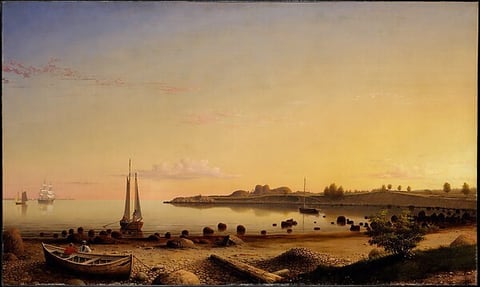
  1. Stage Fort across Gloucester Harbor, by Fitz Henry Lane, 1862
    Stage Fort across Gloucester HarborFitz Henry Lane, 1862Courtesy of The Metropolitan Museum of Art
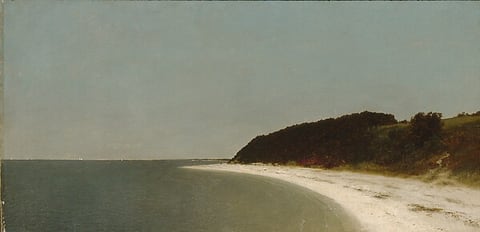
  2. Eaton's Neck, Long Island, by John Frederick Kensett, 1872
    Eaton's Neck, Long IslandJohn Frederick Kensett, 1872Courtesy of The Metropolitan Museum of Art

Section 3, north wall
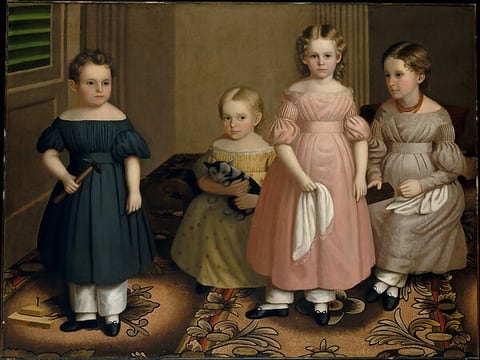
  1. The Alling Children, by Oliver Tarbell Eddy, ca. 1839
    The Alling ChildrenOliver Tarbell Eddy, ca. 1839Courtesy of The Metropolitan Museum of Art
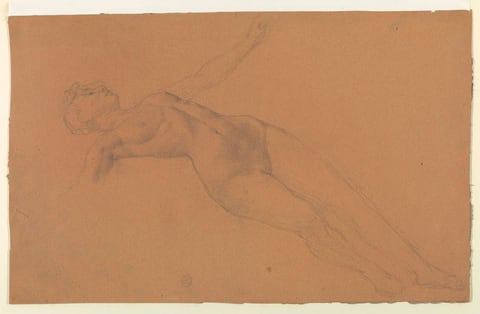
  2. STUDY FOR "DIANA AND HER ATTENDANTS AMONG THE CONSTELLATIONS"
    Study for "Diana and Her Attendants among the Constellations"Francis Augustus Lathrop, ca. 1894Courtesy of Cooper Hewitt, Smithsonian Design Museum