Floor plan

Time and place19th-century France

19th-century France

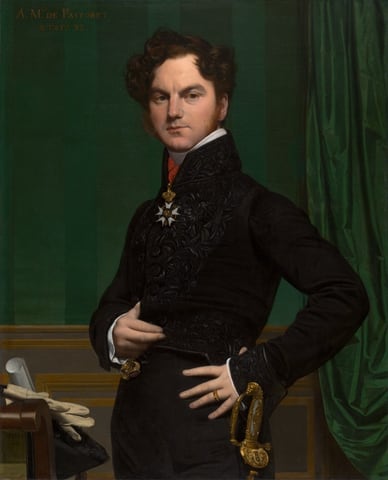
Portrait of white man dressed in all black with medallion and sword.
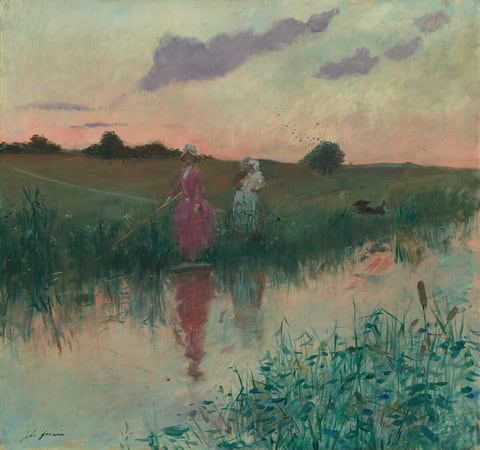
In this painting, there are two women standing near a body of water, surrounded by tall green grass and white flowers. One woman wears a bright pink dress, while the other wears a brown dress with a white apron. The woman in pink holds a long, thin rod outwards, its other end connected to a thin string and a small red lure floating on the water. The other woman stands behind her and holds a baby wearing white clothes and a white bonnet. Behind both women, on the right, is a brown shape like a small dog running towards them. The reflection of the women is visible against the still, blue water. The sky is light blue at the top, transitioning to a warm pink by the horizon, crossed by purple clouds and a flock of small birds. In the bottom right corner, across the water from the women, is a patch of more tall blue-and-green grass. The brushstrokes of the painting are light and feathery.
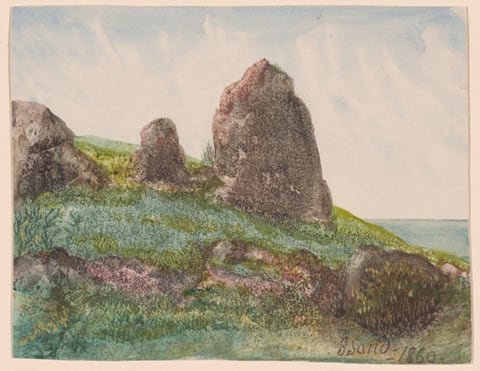
A work made of transparent and opaque watercolor on cream wove paper.
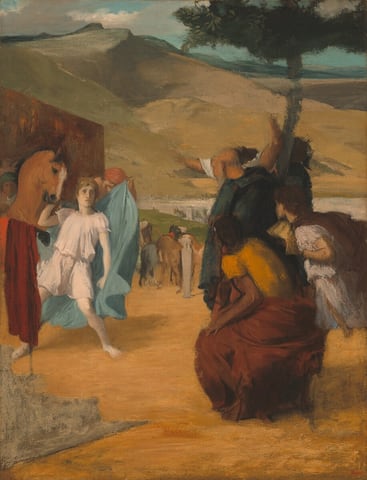
Two groups of people face off in front of a hilly landscape in this loosely painted, vertical scene. On our left, a pale young man in a white tunic looks with eyes wide and lips parted at a group of three people on our right. The young man's right hand, on our left, is raised to stroke the head of a reddish-brown horse at his right shoulder. He stands with feet planted wide, knees bent, and he curls his left hand into a fist. Behind him, a man holds up a fluttering, light blue cape. A mottled red wall forms a backdrop to this scene on our left. The tight group gathered under a tree on our right stares back at the young man. The trio is made up of a balding, older man, a light-skinned boy also wearing a white tunic, and, closest to us, a brown-skinned woman wearing a marigold-orange shirt and a maroon-red skirt. Behind this group, a pair of pale raised arms suggests a fourth person, but the head is missing or has been painted over. The ground under the people is saffron orange. In the center of the picture, beyond the people, a group of horses stands near a green bank by a river, its surface reflecting white. The far bank is lined with white buildings. Tan and olive-green slopes rise from the opposite riverbank under a pale blue sky with cream-white clouds sweeping along the top edge of the composition. The artist signed his name in red paint in the lower right corner: “Degas.”
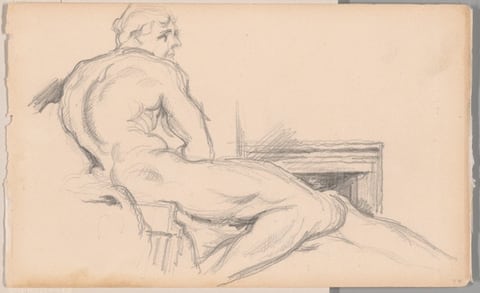
A work made of graphite on ivory wove paper.
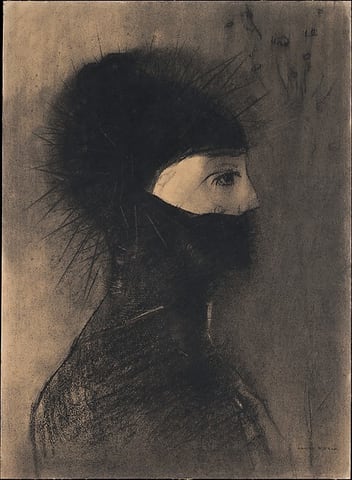
Armor, by Odilon Redon, 1891
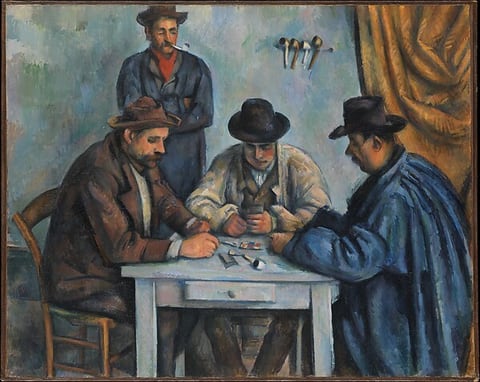
The Card Players, by Paul Cézanne, 1890–92

The works in this room are listed below.

Works in this room

Works made in France in the 19th century.

First room, north wall

  1. Portrait of white man dressed in all black with medallion and sword.
    Amédée-David, the Comte de PastoretJean Auguste Dominique Ingres, 1823–26Courtesy of the Art Institute of Chicago
  2. In this painting, there are two women standing near a body of water, surrounded by tall green grass and white flowers. One woman wears a bright pink dress, while the other wears a brown dress with a white apron. The woman in pink holds a long, thin rod outwards, its other end connected to a thin string and a small red lure floating on the water. The other woman stands behind her and holds a baby wearing white clothes and a white bonnet. Behind both women, on the right, is a brown shape like a small dog running towards them. The reflection of the women is visible against the still, blue water. The sky is light blue at the top, transitioning to a warm pink by the horizon, crossed by purple clouds and a flock of small birds. In the bottom right corner, across the water from the women, is a patch of more tall blue-and-green grass. The brushstrokes of the painting are light and feathery.
    The Artist's Wife FishingJean Louis Forain, 1896Courtesy National Gallery of Art, Washington
  3. A work made of transparent and opaque watercolor on cream wove paper.
    Landscape with RocksGeorge Sand, c. 1868/76Courtesy of the Art Institute of Chicago

First room, south wall

  1. Two groups of people face off in front of a hilly landscape in this loosely painted, vertical scene. On our left, a pale young man in a white tunic looks with eyes wide and lips parted at a group of three people on our right. The young man's right hand, on our left, is raised to stroke the head of a reddish-brown horse at his right shoulder. He stands with feet planted wide, knees bent, and he curls his left hand into a fist. Behind him, a man holds up a fluttering, light blue cape. A mottled red wall forms a backdrop to this scene on our left. The tight group gathered under a tree on our right stares back at the young man. The trio is made up of a balding, older man, a light-skinned boy also wearing a white tunic, and, closest to us, a brown-skinned woman wearing a marigold-orange shirt and a maroon-red skirt. Behind this group, a pair of pale raised arms suggests a fourth person, but the head is missing or has been painted over. The ground under the people is saffron orange. In the center of the picture, beyond the people, a group of horses stands near a green bank by a river, its surface reflecting white. The far bank is lined with white buildings. Tan and olive-green slopes rise from the opposite riverbank under a pale blue sky with cream-white clouds sweeping along the top edge of the composition. The artist signed his name in red paint in the lower right corner: “Degas.”
    Alexander and BucephalusEdgar Degas, 1861/1862Courtesy National Gallery of Art, Washington
  2. A work made of graphite on ivory wove paper.
    Hercules RestingPaul Cézanne, 1897Courtesy of the Art Institute of Chicago
  3. Armor, by Odilon Redon, 1891
    ArmorOdilon Redon, 1891Courtesy of The Metropolitan Museum of Art
  4. The Card Players, by Paul Cézanne, 1890–92
    The Card PlayersPaul Cézanne, 1890–92Courtesy of The Metropolitan Museum of Art

Second room, south wall
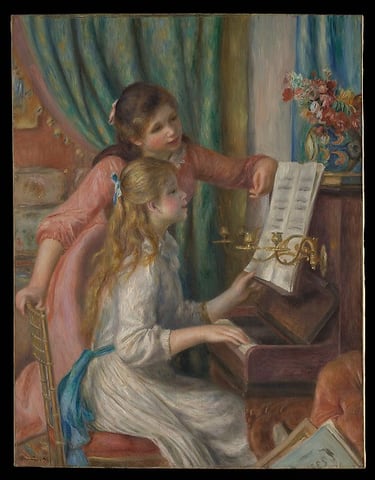
  1. Two Young Girls at the Piano, by Pierre-Auguste Renoir, 1892
    Two Young Girls at the PianoPierre-Auguste Renoir, 1892Courtesy of The Metropolitan Museum of Art
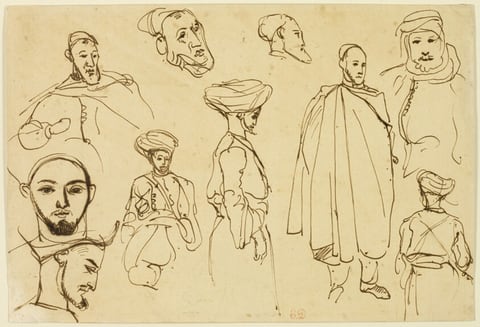
  2. A work made of pen and brown ink, with traces of graphite, on tan wove paper, laid down on cream wove paper.
    Sketches of Algerian MenEugène Delacroix, c. 1832Courtesy of the Art Institute of Chicago
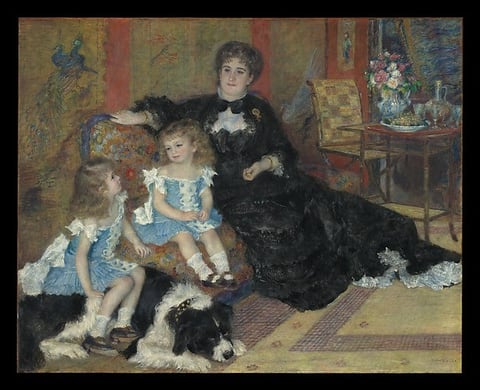
  3. Madame Georges Charpentier (Marguerite-Louise Lemonnier, 1848–1904) and Her Children, Georgette-Berthe (1872–1945) and Paul-Emile-Charles (1875–1895), by Pierre-Auguste Renoir, 1878
    Madame Georges Charpentier (Marguerite-Louise Lemonnier, 1848–1904) and Her Children, Georgette-Berthe (1872–1945) and Paul-Emile-Charles (1875–1895)Pierre-Auguste Renoir, 1878Courtesy of The Metropolitan Museum of Art

Second room, north wall
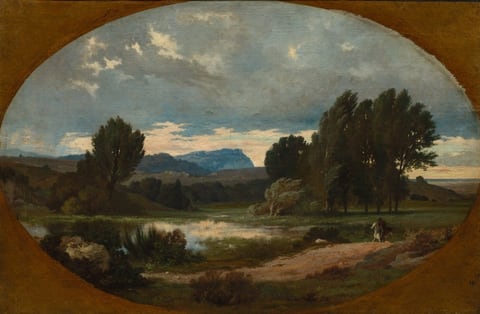
  1. Landscape with Rider on White Horse, by Jean Achille Benouville, 1846
    Landscape with Rider on White HorseJean Achille Benouville, 1846Courtesy of the Cleveland Museum of Art
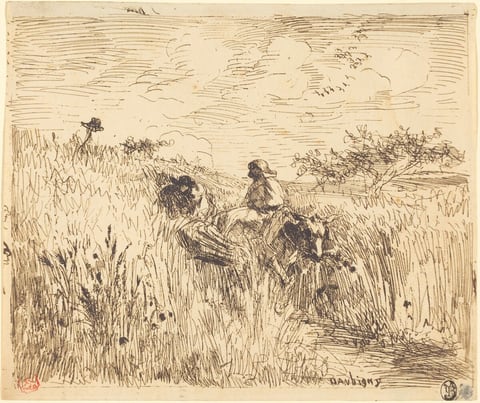
  2. This image shows an elevated view of a grassy landscape with sparse trees and vegetation at the horizon. The linear brushstrokes create texture and movement in the grass and sky. The color palette is monochromatic with sepia tones. In the foreground, a figure is on a horse amidst tall grasses, while in the distance, another figure stands on the left and a cluster of trees is on the right. The sky has wisps of clouds.
    Path through a Wheat Field (Sentier dans les bles)Charles-François Daubigny, 1862Courtesy National Gallery of Art, Washington
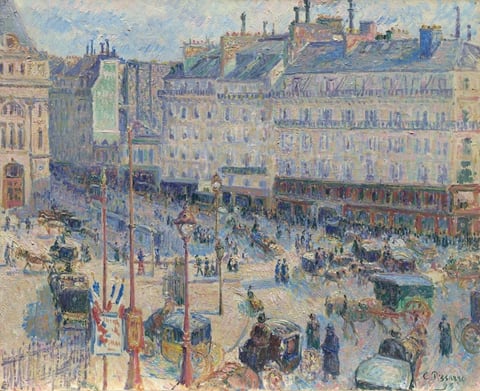
  3. A work made of oil on canvas.
    The Place du Havre, ParisCamille Pissarro, 1893Courtesy of the Art Institute of Chicago

Third room, north wall
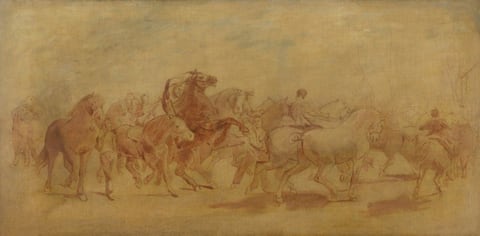
  1. A sketchy black-and-white oil painting of a dozen horses walking in a circle, some with riders. All of the figures are shadowy.
    Study for The Horse FairRosa Bonheur, c. 1850Courtesy of the Art Institute of Chicago
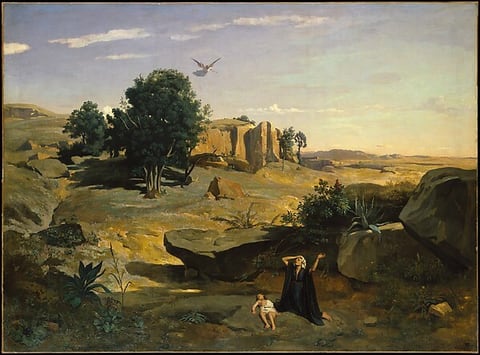
  2. Hagar in the Wilderness, by Jean Baptiste Camille Corot, 1835
    Hagar in the WildernessJean Baptiste Camille Corot, 1835Courtesy of The Metropolitan Museum of Art
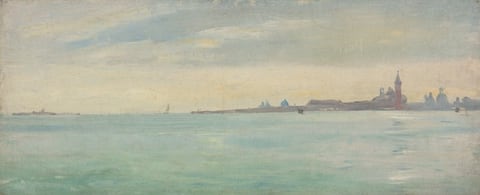
  3. A work made of oil on paper, mounted on canvas.
    Venice Seen from the Public GardenJean Jules Antoine Lecomte du Noüy, 1873Courtesy of the Art Institute of Chicago