Floor plan

Time and place19th-century France

19th-century France

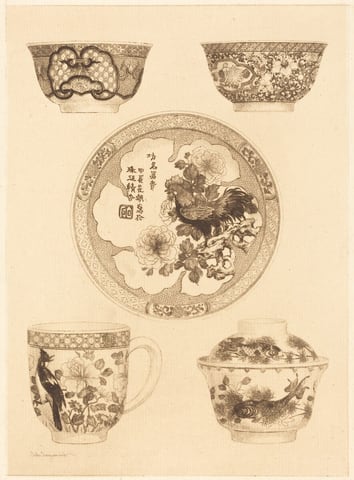
The image features a collection of ceramics, including two bowls, a plate, a mug, and a lidded cup. The color palette is sepia-toned, with shades of brown. The plate has an intricate illustration of a rooster and floral patterns. Two bowls with different designs are above the plate. A mug with floral and bird illustrations sits on the left, and a lidded cup with fish and aquatic plants is on the right.
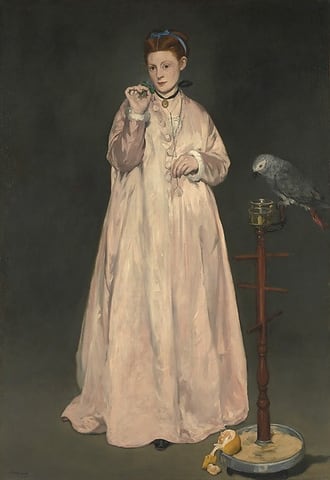
Young Lady in 1866, by Édouard Manet, 1866
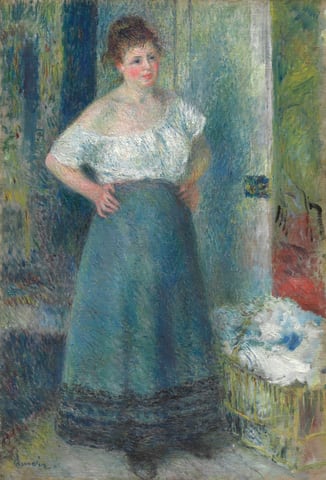
A work made of oil on canvas.
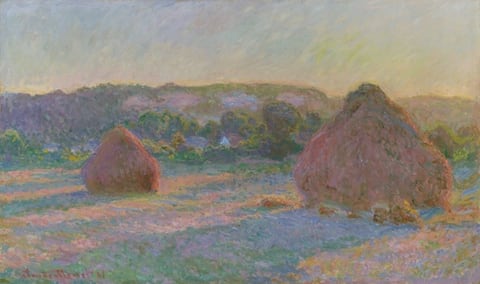
Painting composed of short, dense brushstrokes depicts two domed stacks of wheat that cast long shadows on a field. The angled light indicates either a rising or setting sun.
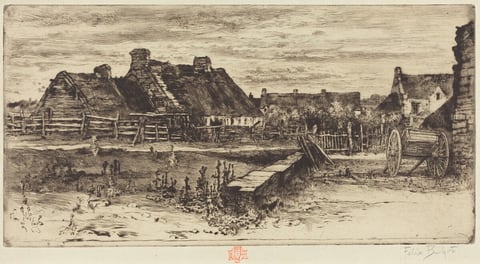
The image depicts a rustic village scene featuring thatched-roof cottages, wooden fences, and a low horizon with rooftops and chimneys. The etching showcases detailed brushstrokes capturing various textures, with a monochromatic sepia color palette. A stone or wooden wall leads into the scene, alongside grassy vegetation. The cottages create a sense of enclosure, with trees and other structures in the background. A cart is placed near the wall.
A work made of oil on canvas.

The works in this room are listed below.

Works in this room

Works made in France in the 19th century.

First room, north wall

  1. The image features a collection of ceramics, including two bowls, a plate, a mug, and a lidded cup. The color palette is sepia-toned, with shades of brown. The plate has an intricate illustration of a rooster and floral patterns. Two bowls with different designs are above the plate. A mug with floral and bird illustrations sits on the left, and a lidded cup with fish and aquatic plants is on the right.
    Five Pieces of ChinaJules-Ferdinand JacquemartCourtesy National Gallery of Art, Washington
  2. Young Lady in 1866, by Édouard Manet, 1866
    Young Lady in 1866Édouard Manet, 1866Courtesy of The Metropolitan Museum of Art
  3. A work made of oil on canvas.
    The LaundressPierre-Auguste Renoir, 1877–79Courtesy of the Art Institute of Chicago

First room, south wall

  1. Painting composed of short, dense brushstrokes depicts two domed stacks of wheat that cast long shadows on a field. The angled light indicates either a rising or setting sun.
    Stacks of Wheat (End of Summer)Claude Monet, 1890–91Courtesy of the Art Institute of Chicago
  2. The image depicts a rustic village scene featuring thatched-roof cottages, wooden fences, and a low horizon with rooftops and chimneys. The etching showcases detailed brushstrokes capturing various textures, with a monochromatic sepia color palette. A stone or wooden wall leads into the scene, alongside grassy vegetation. The cottages create a sense of enclosure, with trees and other structures in the background. A cart is placed near the wall.
    Les Grandes ChaumièresFélix-Hilaire Buhot, 1881Courtesy National Gallery of Art, Washington
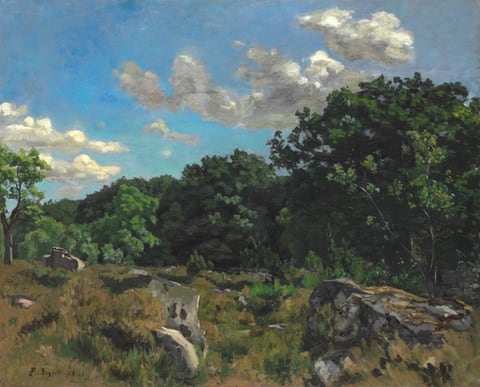
  3. A work made of oil on canvas.
    Landscape at ChaillyFrédéric Bazille, 1865Courtesy of the Art Institute of Chicago

Second room, south wall
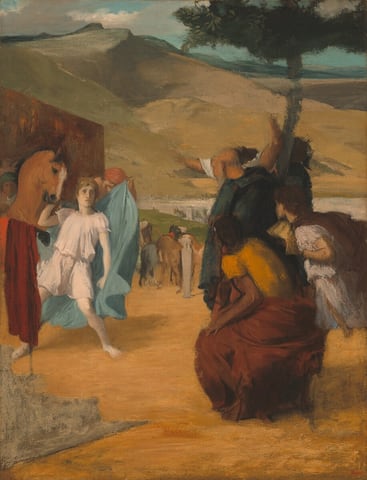
  1. Two groups of people face off in front of a hilly landscape in this loosely painted, vertical scene. On our left, a pale young man in a white tunic looks with eyes wide and lips parted at a group of three people on our right. The young man's right hand, on our left, is raised to stroke the head of a reddish-brown horse at his right shoulder. He stands with feet planted wide, knees bent, and he curls his left hand into a fist. Behind him, a man holds up a fluttering, light blue cape. A mottled red wall forms a backdrop to this scene on our left. The tight group gathered under a tree on our right stares back at the young man. The trio is made up of a balding, older man, a light-skinned boy also wearing a white tunic, and, closest to us, a brown-skinned woman wearing a marigold-orange shirt and a maroon-red skirt. Behind this group, a pair of pale raised arms suggests a fourth person, but the head is missing or has been painted over. The ground under the people is saffron orange. In the center of the picture, beyond the people, a group of horses stands near a green bank by a river, its surface reflecting white. The far bank is lined with white buildings. Tan and olive-green slopes rise from the opposite riverbank under a pale blue sky with cream-white clouds sweeping along the top edge of the composition. The artist signed his name in red paint in the lower right corner: “Degas.”
    Alexander and BucephalusEdgar Degas, 1861/1862Courtesy National Gallery of Art, Washington
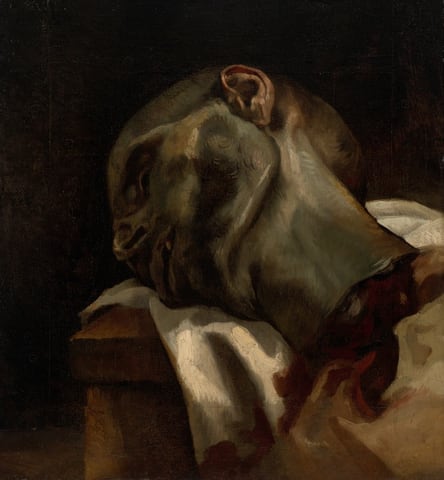
  2. A work made of oil on panel.
    Head of a Guillotined ManJean Louis André Théodore Géricault, 1818–19Courtesy of the Art Institute of Chicago
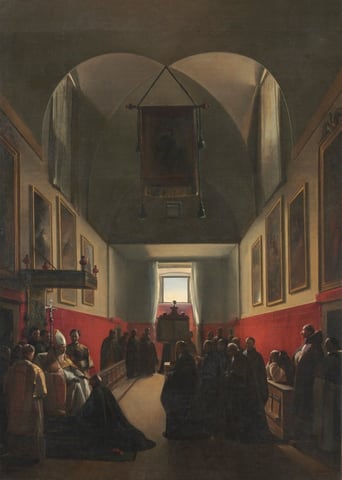
  3. Homage to a Bishop, by François Marius Granet, 1839
    Homage to a BishopFrançois Marius Granet, 1839Courtesy of the Cleveland Museum of Art

Second room, north wall
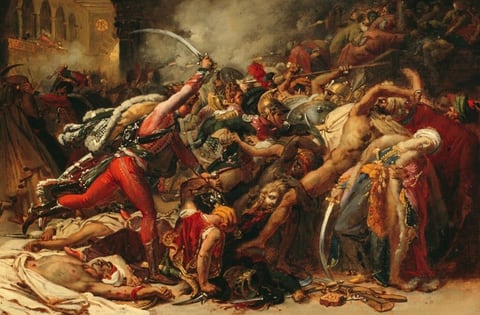
  1. A work made of oil and ink on paper, laid down on canvas.
    Sketch for The Revolt of CairoAnne-Louis Girodet de Roussy-Trioson, c. 1810Courtesy of the Art Institute of Chicago
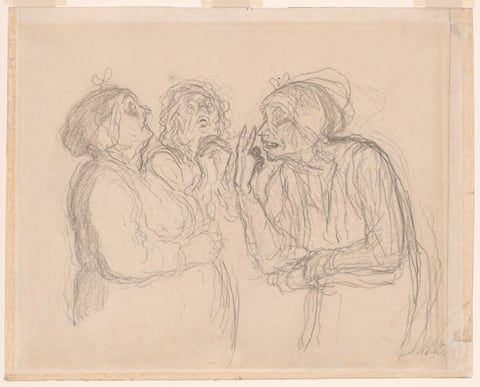
  2. A work made of black crayon and charcoal, on ivory laid paper.
    Three GossipsHonoré Daumier, 1865/1867Courtesy of the Art Institute of Chicago
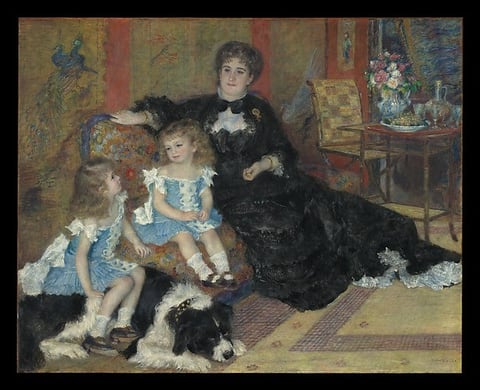
  3. Madame Georges Charpentier (Marguerite-Louise Lemonnier, 1848–1904) and Her Children, Georgette-Berthe (1872–1945) and Paul-Emile-Charles (1875–1895), by Pierre-Auguste Renoir, 1878
    Madame Georges Charpentier (Marguerite-Louise Lemonnier, 1848–1904) and Her Children, Georgette-Berthe (1872–1945) and Paul-Emile-Charles (1875–1895)Pierre-Auguste Renoir, 1878Courtesy of The Metropolitan Museum of Art

Third room, north wall
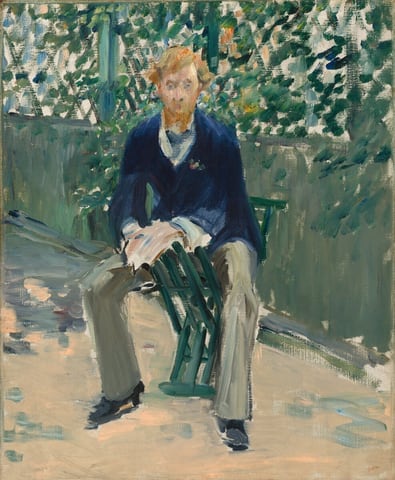
  1. A pale-skinned young man with a carrot-red beard and hair faces us, straddling a green chair in a sunny outdoor setting in this vertical painting. The scene is loosely painted so his features are indistinct. His eyes are painted as pale blue dots, and he looks out at us. His chair unfolds into an X shape, with interlacing slats to make the seat. He leans forward to rest his hands on one side of the chair, and his legs are spread wide. He wears a marine-blue jacket over a white shirt, sage-green trousers streaked with gray, and black shoes. A soft blue V-shape at the neck suggests a neckerchief. Behind him, a half wall is topped by a trellis. The wall is painted in muted tones of pale laurel green while the trellis is painted with crisscrossed strokes of pine green. Daubs of emerald, pine, and forest green suggest vines and leaves, and flicks of orange, gold, and blue could be flowers. The ground beneath the man is pale peach scattered with thin scribbles and patches of fog blue. The painting is inscribed with “E 72.” in the lower right.
    George Moore in the Artist's GardenÉdouard Manet, c. 1879Courtesy National Gallery of Art, Washington
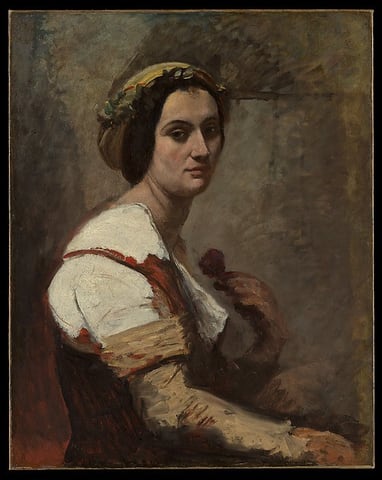
  2. Sibylle, by Jean Baptiste Camille Corot, ca. 1870
    SibylleJean Baptiste Camille Corot, ca. 1870Courtesy of The Metropolitan Museum of Art
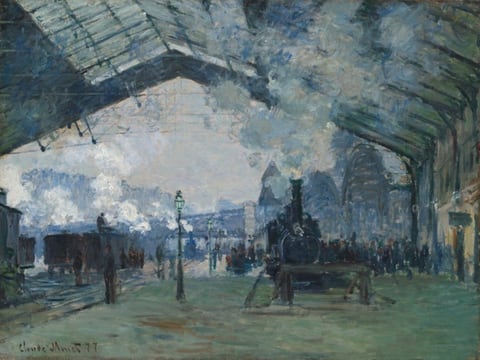
  3. Loosely painted image of an open-air train station. On the right, a parked train gives off an enormous plumb of white smoke, making the scene look as though it were full of clouds. A huddled mass of barely discernible people crowd around the train on both sides of the tracks. Blue, green, and gray tones dominate.
    Arrival of the Normandy Train, Gare Saint-LazareClaude Monet, 1877Courtesy of the Art Institute of Chicago
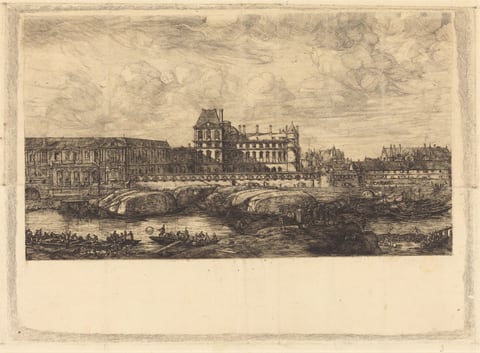
  4. The image features a riverside scene with a large building in the center and smaller structures in the background. The sky is filled with clouds, and there are boats on the water. The artwork is done in an etching style, with detailed lines showing architectural elements, boats, and water ripples. The color scheme is monochromatic in shades of brown and black.
    L'ancien Louvre d'après une peinture de Zeeman, 1651 (The Old Louvre, from a Painting by Zeeman, l651)Charles Meryon, 1866Courtesy National Gallery of Art, Washington