Floor plan

Time and place18th-century Italy

18th-century Italy

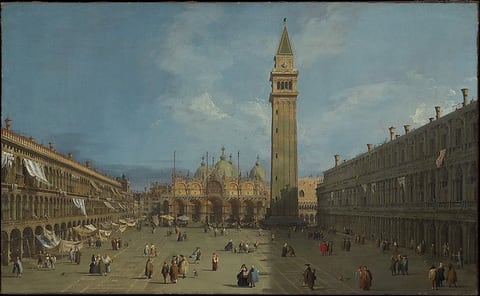
Piazza San Marco, by Canaletto, late 1720s
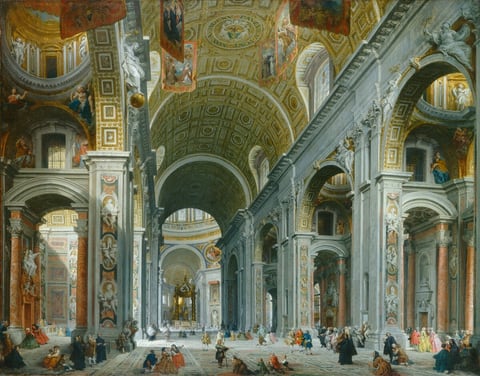
The soaring, gilded vault of a central aisle of the inside of a church fills this horizontal painting. The ceiling of the nave curves up and away from us like a tunnel. It is lined with coffers, which have inset panels, decorated with gold. The light-filled nave angles down from the top center of the composition toward the lower left as it moves away from us. The white stone pillars supporting the barrel vault are intricately carved and decorated with pudgy, winged cherubs holding portraits of men, and aisles run parallel to the central nave to our left and right. In the side aisles, pink marble columns flank altars in chapels. At the far end of the church, the nave is interrupted where it opens into the light-filled crossing, before continuing beyond. Marking the space where the long hall of the church is intersected by a shorter arm to create a cross shape is a structure made of four twisting columns supporting a pointed canopy, all cast in bronze. Tiny men and women pray or gather in pairs and small groups along the nave. Some wear tattered clothing and others are elegantly dressed.
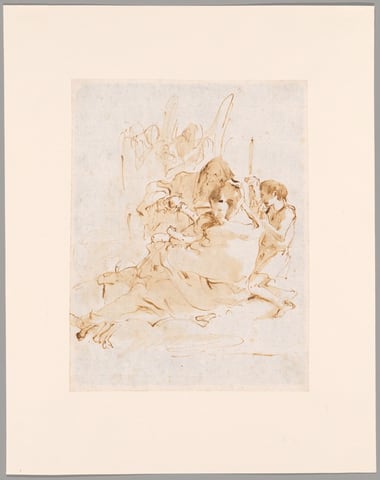
A work made of pen and brown ink and brush and brown ink wash on ivory laid paper.
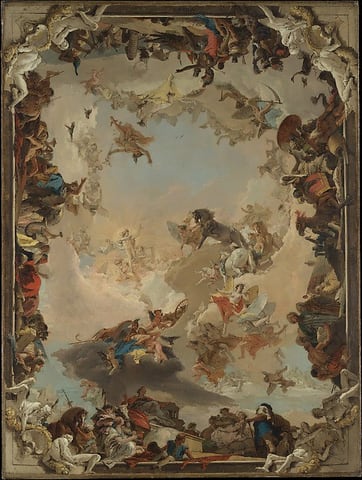
Allegory of the Planets and Continents, by Giovanni Battista Tiepolo, 1752
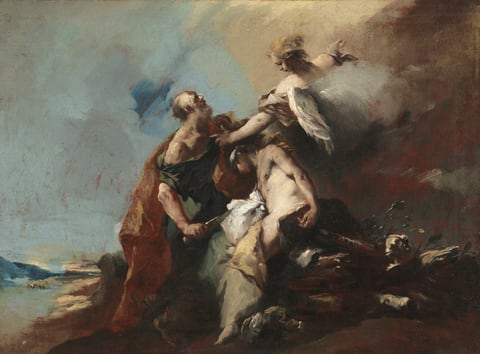
The Sacrifice of Isaac, by Francesco Guardi, 1750s

The works in this room are listed below.

Works in this room

Works made in Italy in the 18th century.

First room, north wall

  1. Piazza San Marco, by Canaletto, late 1720s
    Piazza San MarcoCanaletto, late 1720sCourtesy of The Metropolitan Museum of Art
  2. The soaring, gilded vault of a central aisle of the inside of a church fills this horizontal painting. The ceiling of the nave curves up and away from us like a tunnel. It is lined with coffers, which have inset panels, decorated with gold. The light-filled nave angles down from the top center of the composition toward the lower left as it moves away from us. The white stone pillars supporting the barrel vault are intricately carved and decorated with pudgy, winged cherubs holding portraits of men, and aisles run parallel to the central nave to our left and right. In the side aisles, pink marble columns flank altars in chapels. At the far end of the church, the nave is interrupted where it opens into the light-filled crossing, before continuing beyond. Marking the space where the long hall of the church is intersected by a shorter arm to create a cross shape is a structure made of four twisting columns supporting a pointed canopy, all cast in bronze. Tiny men and women pray or gather in pairs and small groups along the nave. Some wear tattered clothing and others are elegantly dressed.
    Interior of Saint Peter's, RomeGiovanni Paolo Panini, c. 1754Courtesy National Gallery of Art, Washington

First room, south wall

  1. A work made of pen and brown ink and brush and brown ink wash on ivory laid paper.
    Holy Family with St. John and Two AngelsGiovanni Battista Tiepolo, n.d.Courtesy of the Art Institute of Chicago
  2. Allegory of the Planets and Continents, by Giovanni Battista Tiepolo, 1752
    Allegory of the Planets and ContinentsGiovanni Battista Tiepolo, 1752Courtesy of The Metropolitan Museum of Art
  3. The Sacrifice of Isaac, by Francesco Guardi, 1750s
    The Sacrifice of IsaacFrancesco Guardi, 1750sCourtesy of the Cleveland Museum of Art

Second room, south wall
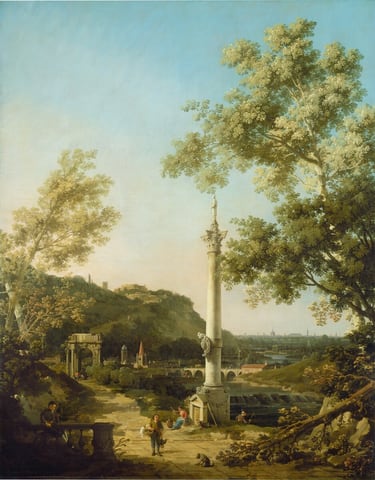
  1. We look slightly down across a sun-drenched plaza with people scattered among ruins, buildings, and around a free-standing column in this vertical landscape painting. The people we can see have light skin. Towering trees with celery, sage, and forest-green leaves frame a small plaza paved with flax-colored stones. A tree to our right almost reaches the top of the painting, and a shorter tree in front of it has toppled onto the plaza. To our left, in the lower corner, a man sits behind a shadowy balustrade, looking down. In the lower center of the painting, a man walks toward us, holding a basket over one arm and dead poultry in the other hand, and a dog sits nearby. Slightly farther back is a tall stone column with a door in its base and a statue on top. A woman wearing a red shirt and blue skirt sits on a step in front of the door. Along the left side, the plaza gives way to a tree-lined, dirt road that meanders toward a stone arch in the middle distance, and to a cluster of low buildings beyond. Two towers catch the light, one with a slate-blue dome and the other with a peach-colored steeple. Farther back from the buildings is a dark line of trees at the base of a steep green hill dotted with groves of trees, which rises high over the plaza below. Another building complex, glowing in warm tones of straw yellow, sits at its top. Small dots of red, white, and blue suggest a handful of people making their way up the hill’s wide path. A river with moss-green water pouring over a dam extends from the lower right corner into the distance along the right edge of the painting. Near the column, a man fishes at the water’s edge. The water winds back to a row of silvery-gray buildings in the far distance. Several people in red, yellow, or white, tiny in scale, dot the riverbanks and cross the bridge. A screen of thin, pale pink clouds float across the light blue sky.
    English Landscape Capriccio with a ColumnCanaletto, c. 1754Courtesy National Gallery of Art, Washington
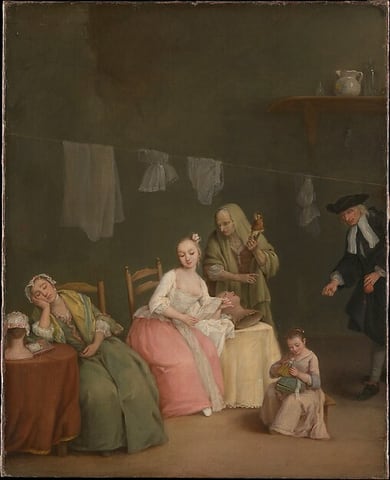
  2. The Letter, by Pietro Longhi, 1746
    The LetterPietro Longhi, 1746Courtesy of The Metropolitan Museum of Art
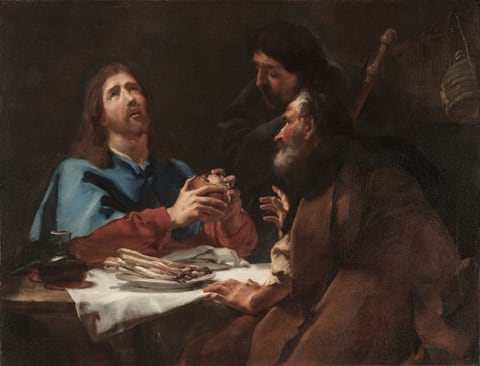
  3. The Supper at Emmaus, by Giovanni Battista Piazzetta, c. 1720
    The Supper at EmmausGiovanni Battista Piazzetta, c. 1720Courtesy of the Cleveland Museum of Art

Second room, north wall
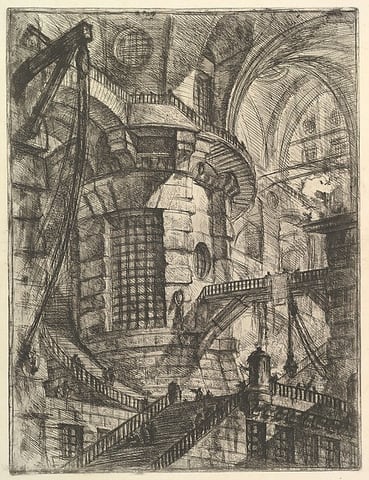
  1. The Round Tower, from "Carceri d'invenzione" (Imaginary Prisons), by Giovanni Battista Piranesi, ca. 1749–50
    The Round Tower, from "Carceri d'invenzione" (Imaginary Prisons)Giovanni Battista Piranesi, ca. 1749–50Courtesy of The Metropolitan Museum of Art
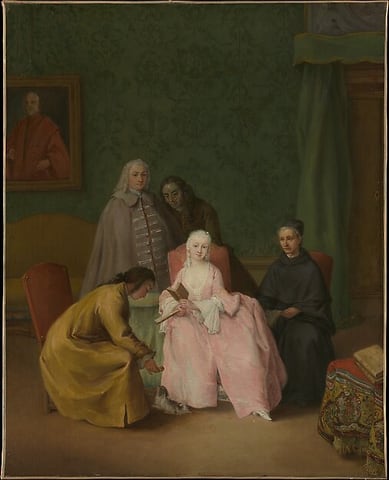
  2. The Visit, by Pietro Longhi, 1746
    The VisitPietro Longhi, 1746Courtesy of The Metropolitan Museum of Art
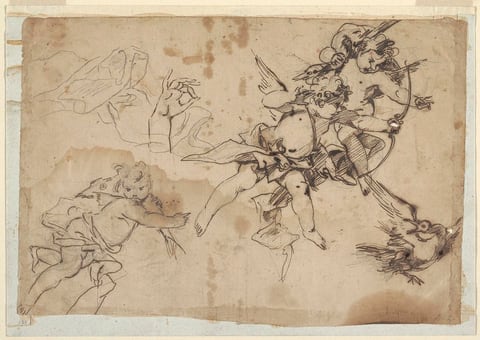
  3. STUDY FOR A PAINTING ON THEME OF CALLISTO
    Study for a Painting on Theme of CallistoFilippo Falciatore, ca. 1750Courtesy of Cooper Hewitt, Smithsonian Design Museum

Third room, north wall
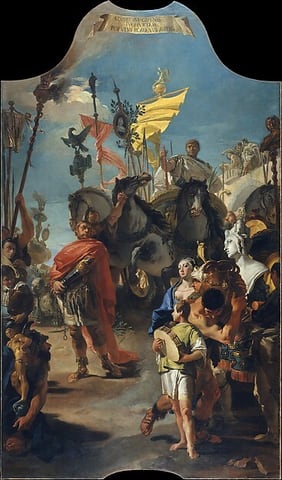
  1. The Triumph of Marius, by Giovanni Battista Tiepolo, 1729
    The Triumph of MariusGiovanni Battista Tiepolo, 1729Courtesy of The Metropolitan Museum of Art
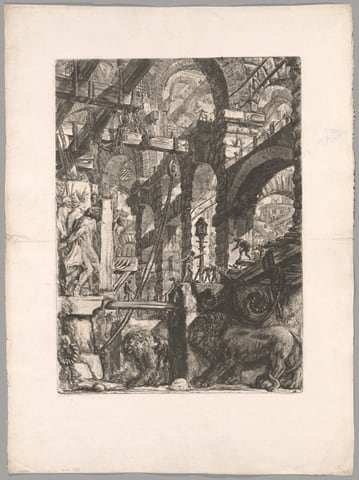
  2. A work made of etching and engraving on heavy ivory laid paper.
    The Lion Bas-Reliefs, plate 5 from Imaginary PrisonsGiovanni Battista Piranesi, 1761Courtesy of the Art Institute of Chicago
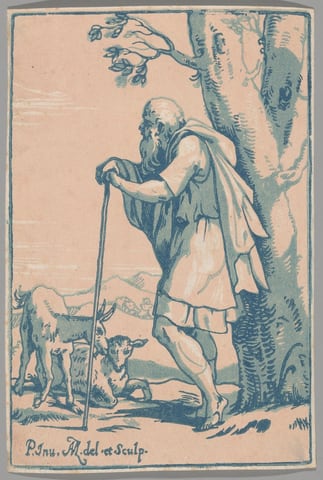
  3. A work made of chiaroscuro woodcut, from three blocks in pink, dark blue, and light blue, on cream laid paper.
    The Old ShepherdConte Antonio Maria Zanetti, the Elder, 1722Courtesy of the Art Institute of Chicago

Third room, south wall
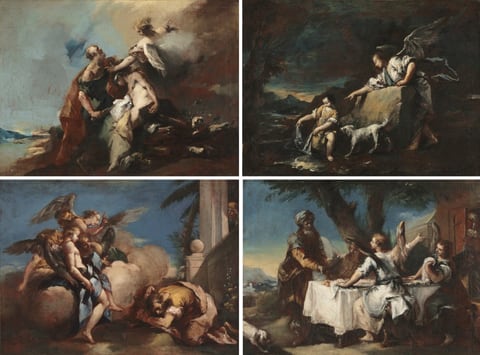
  1. The Sacrifice of Isaac, Tobias and the Angel, The Angels Appearing to Abraham, Abraham Welcoming the Three Angels (painting series), by Francesco Guardi, 1750s
    The Sacrifice of Isaac, Tobias and the Angel, The Angels Appearing to Abraham, Abraham Welcoming the Three Angels (painting series)Francesco Guardi, 1750sCourtesy of the Cleveland Museum of Art
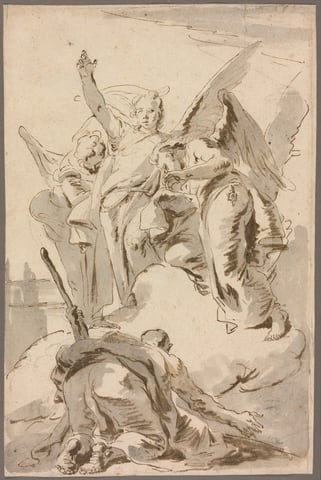
  2. A work made of pen and brown ink and brush and brown and gray wash, over black chalk, on ivory laid paper.
    Three Angels Appearing to AbrahamGiovanni Battista Tiepolo, c. 1726Courtesy of the Art Institute of Chicago