Floor plan

Time and place18th-century Britain
18th-century Britain
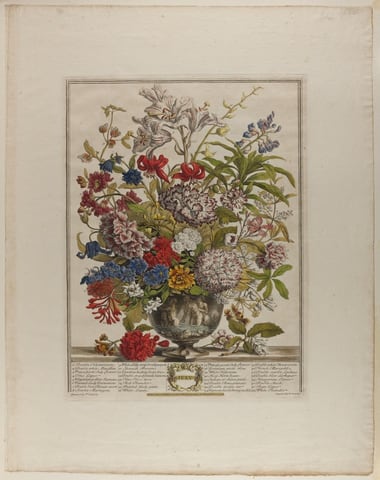
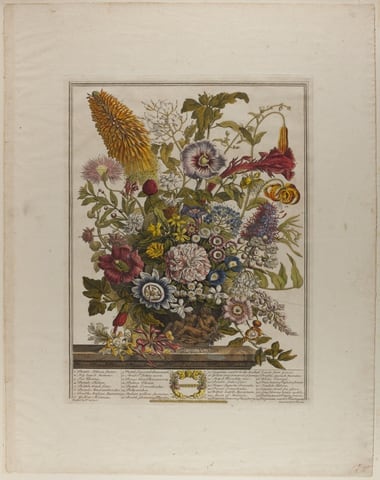
A work made of engraving in black ink with opaque and translucent watercolor on cream laid paper.
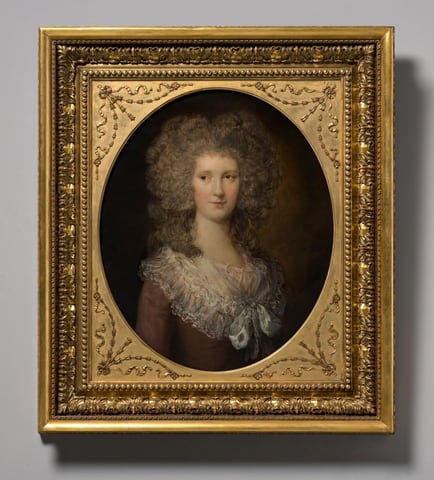
Portrait of Mary Anne Jolliffe, by Gainsborough Dupont, after 1788
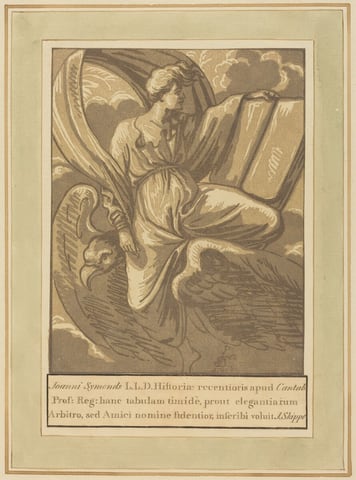
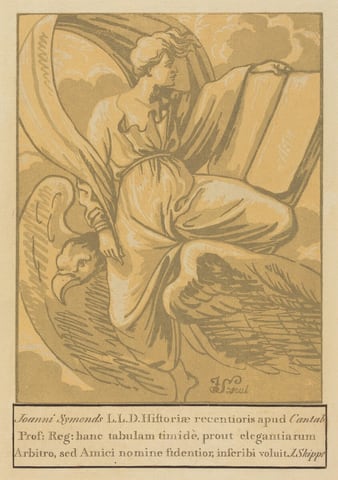
This is a drawing of a winged figure seated on a bird. The image depicts a figure with flowing robes, wings outstretched, holding an open book in one hand. The figure appears to be looking off to the side, with a serene expression. The lower part of the image includes a bird upon which the figure is seated. The bird's head is turned slightly upwards, following the direction in which the figure is gazing. The image is rendered in a warm, monochromatic palette. In the lower section of the image, there is some text, likely Latin.
A work made of engraving in black ink with opaque and translucent watercolor on cream laid paper.
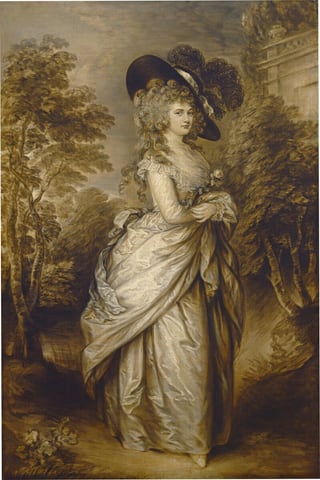
This painting is a full-length portrait of a woman with her body facing the right and her head turned toward us. She has light skin, curly gray hair, arched eyebrows, and a small mouth in a neutral expression. She wears an elegant light-colored dress with a large bow on the back and a large, dark, feathered hat, and she has a flower tucked in her arms, which also gather up some of her skirts. The background shows tall trees, with the edge of a wall visible in the upper-right corner. The color scheme of the painting is mostly olive-green, and everything has a green tint.
This is a drawing of a seated figure on a large bird. The image depicts a classically draped figure seated on a stylized bird. The figure holds an open book and gazes into the distance. The bird has sharp features and spread wings. The background contains swirling clouds. The scene is framed with a border, and there is text at the bottom. The lines are bold and the shades are muted.
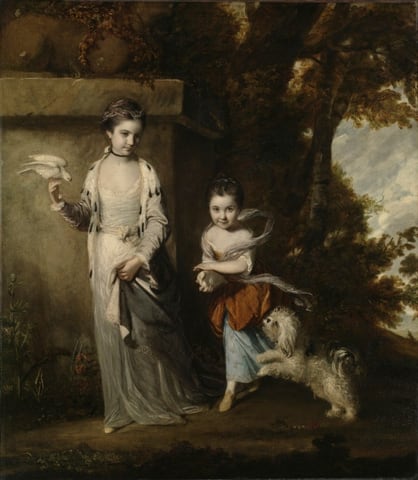
Portrait of the Ladies Amabel and Mary Jemima Yorke, by Joshua Reynolds, c. 1761

The works in this room are listed below.

Works in this room

Works made in Britain in the 18th century.

First room, north wall

  1. A work made of engraving in black ink with opaque and translucent watercolor on cream laid paper.
    August, from Twelve Months of FlowersHenry Fletcher, n.d.Courtesy of the Art Institute of Chicago
  2. Portrait of Mary Anne Jolliffe, by Gainsborough Dupont, after 1788
    Portrait of Mary Anne JolliffeGainsborough Dupont, after 1788Courtesy of the Cleveland Museum of Art
  3. This is a drawing of a winged figure seated on a bird. The image depicts a figure with flowing robes, wings outstretched, holding an open book in one hand. The figure appears to be looking off to the side, with a serene expression. The lower part of the image includes a bird upon which the figure is seated. The bird's head is turned slightly upwards, following the direction in which the figure is gazing. The image is rendered in a warm, monochromatic palette. In the lower section of the image, there is some text, likely Latin.
    Saint John the EvangelistJohn Skippe, 1771Courtesy National Gallery of Art, Washington
  4. A work made of engraving in black ink with opaque and translucent watercolor on cream laid paper.
    July, from Twelve Months of FlowersHenry Fletcher, n.d.Courtesy of the Art Institute of Chicago

First room, south wall

  1. This painting is a full-length portrait of a woman with her body facing the right and her head turned toward us. She has light skin, curly gray hair, arched eyebrows, and a small mouth in a neutral expression. She wears an elegant light-colored dress with a large bow on the back and a large, dark, feathered hat, and she has a flower tucked in her arms, which also gather up some of her skirts. The background shows tall trees, with the edge of a wall visible in the upper-right corner. The color scheme of the painting is mostly olive-green, and everything has a green tint.
    Georgiana, Duchess of DevonshireGainsborough Dupont, c. 1787/1796Courtesy National Gallery of Art, Washington
  2. This is a drawing of a seated figure on a large bird. The image depicts a classically draped figure seated on a stylized bird. The figure holds an open book and gazes into the distance. The bird has sharp features and spread wings. The background contains swirling clouds. The scene is framed with a border, and there is text at the bottom. The lines are bold and the shades are muted.
    Saint John the EvangelistJohn Skippe, 1771Courtesy National Gallery of Art, Washington
  3. Portrait of the Ladies Amabel and Mary Jemima Yorke, by Joshua Reynolds, c. 1761
    Portrait of the Ladies Amabel and Mary Jemima YorkeJoshua Reynolds, c. 1761Courtesy of the Cleveland Museum of Art

Second room, south wall
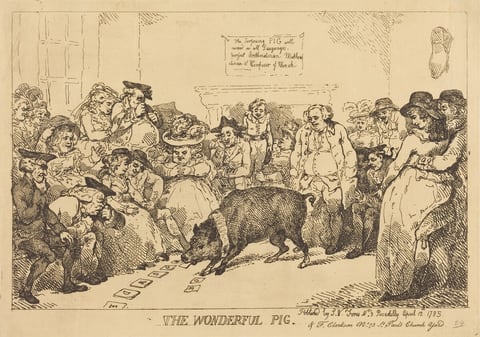
  1. This is a drawing showing a pig performing a trick for an audience. It depicts a group of people watching the pig interacting with cards on the floor. The detailed image shows the varied facial expressions of the audience members. There is text at the top of the image suggesting the pig has a unique ability, possibly related to languages. The drawing captures a moment of entertainment in a satirical style, with lines and cross-hatching used to emphasize the humor.
    The Wonderful PigThomas Rowlandson, 1785Courtesy National Gallery of Art, Washington
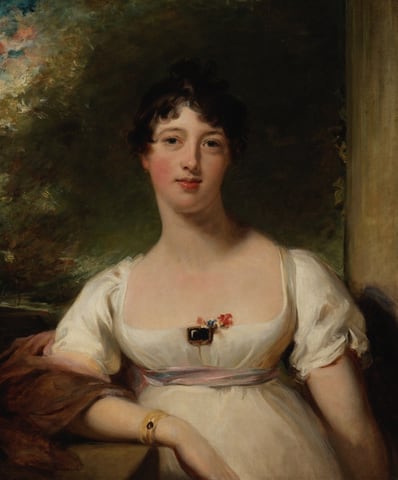
  2. A work made of oil on canvas.
    Anna Maria Dashwood, later Marchioness of ElyThomas Lawrence, c. 1805Courtesy of the Art Institute of Chicago
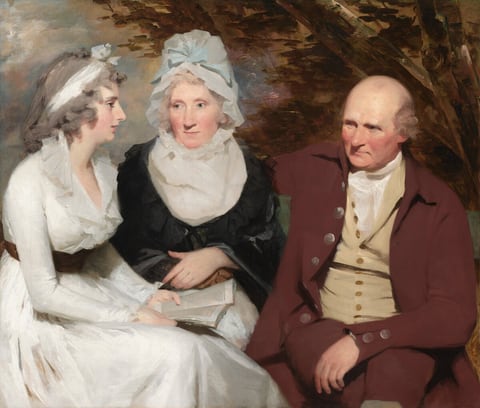
  3. John Johnstone, Betty Johnstone, and Miss Wedderburn, by Sir Henry Raeburn, c. 1790/1795
    John Johnstone, Betty Johnstone, and Miss WedderburnSir Henry Raeburn, c. 1790/1795Courtesy National Gallery of Art, Washington

Second room, north wall
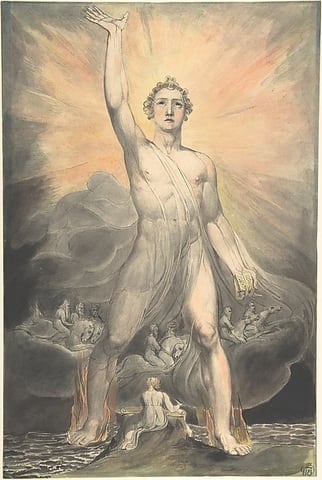
  1. Angel of the Revelation (Book of Revelation, chapter 10), by William Blake, ca. 1803–5
    Angel of the Revelation (Book of Revelation, chapter 10)William Blake, ca. 1803–5Courtesy of The Metropolitan Museum of Art
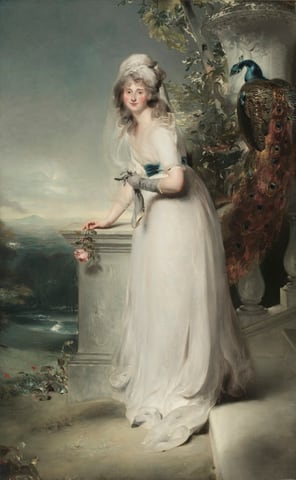
  2. Portrait of Catherine Grey, Lady Manners, by Thomas Lawrence, 1794
    Portrait of Catherine Grey, Lady MannersThomas Lawrence, 1794Courtesy of the Cleveland Museum of Art
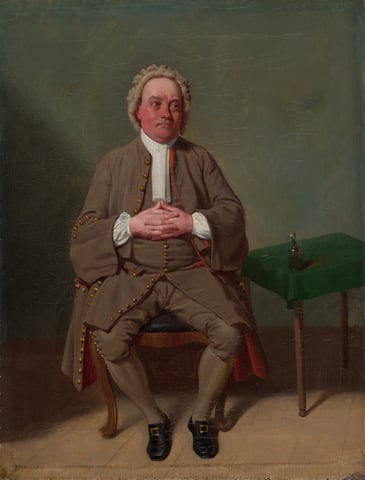
  3. A work made of oil on canvas.
    Mr. Quick as Vellum in Addison's DrummerSamuel De Wilde, 1792Courtesy of the Art Institute of Chicago

Third room, north wall
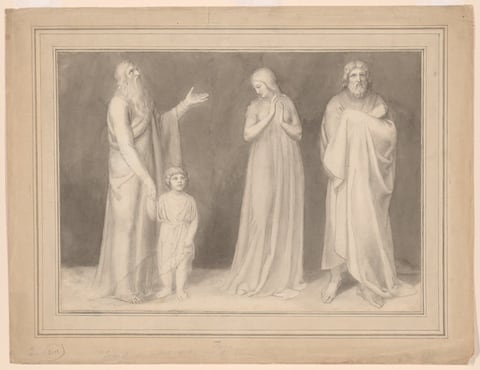
  1. A work made of pen and black ink and brush and black ink wash, with touches of pen and brown ink, on ivory laid paper.
    Hannah Presenting Samuel to EliJohn Flaxman, c. 1783Courtesy of the Art Institute of Chicago
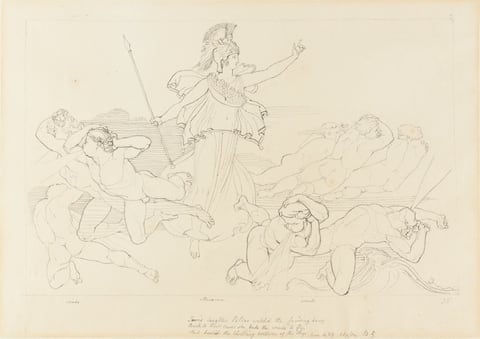
  2. A work made of pen and black ink, over traces of graphite, on tan wove paper, laid down on cream wove paper.
    Athena and the WindsJohn Flaxman, n.d.Courtesy of the Art Institute of Chicago
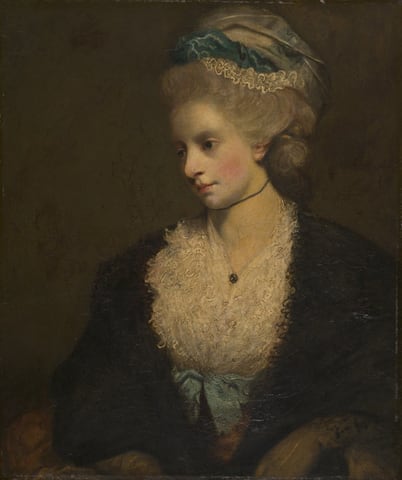
  3. A work made of oil on canvas.
    Theophilia GwatkinJoshua Reynolds, 1776–81Courtesy of the Art Institute of Chicago