Floor plan

Time and place18th-century Britain
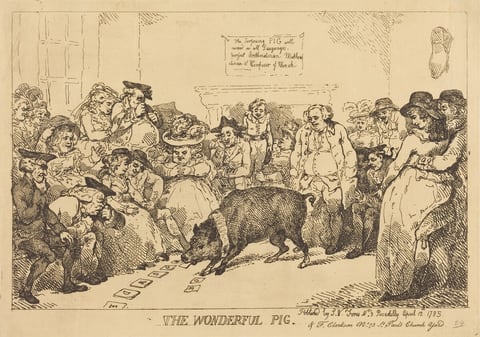
18th-century Britain
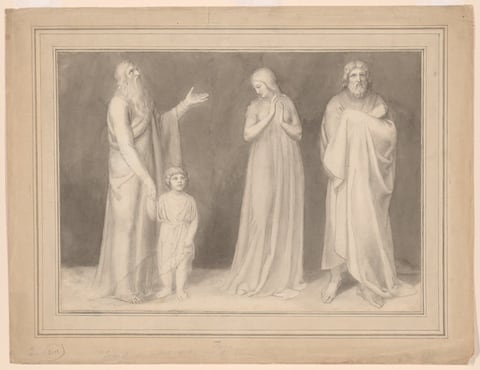
A work made of pen and black ink and brush and black ink wash, with touches of pen and brown ink, on ivory laid paper.
This is a drawing showing a pig performing a trick for an audience. It depicts a group of people watching the pig interacting with cards on the floor. The detailed image shows the varied facial expressions of the audience members. There is text at the top of the image suggesting the pig has a unique ability, possibly related to languages. The drawing captures a moment of entertainment in a satirical style, with lines and cross-hatching used to emphasize the humor.
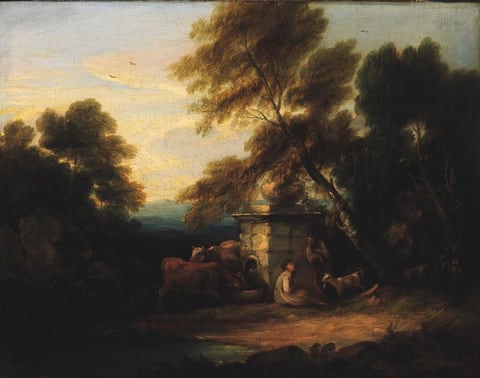
Small Landscape, ca. 1750-1800
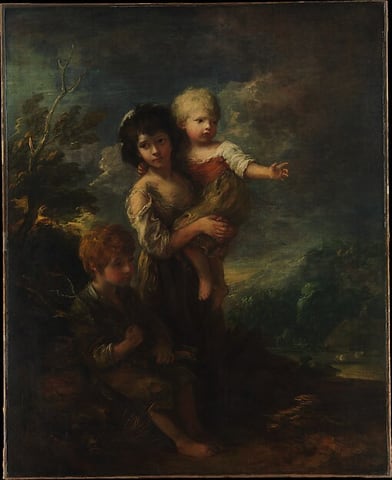
Cottage Children (The Wood Gatherers), by Thomas Gainsborough, 1787
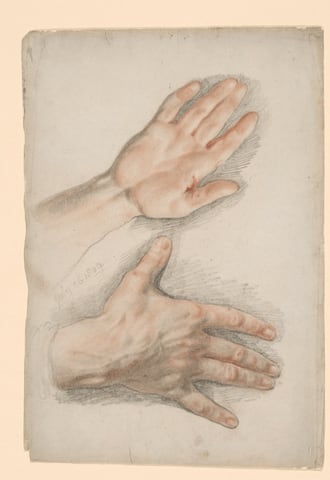
A work made of red and black chalk on gray wove paper.
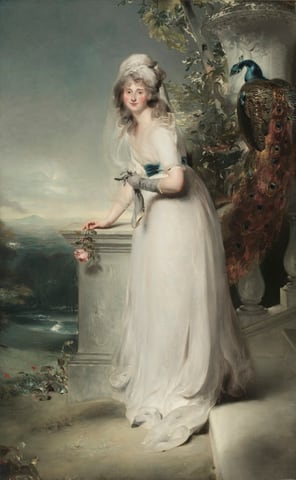
Portrait of Catherine Grey, Lady Manners, by Thomas Lawrence, 1794

The works in this room are listed below.

Works in this room

Works made in Britain in the 18th century.

First room, north wall

  1. A work made of pen and black ink and brush and black ink wash, with touches of pen and brown ink, on ivory laid paper.
    Hannah Presenting Samuel to EliJohn Flaxman, c. 1783Courtesy of the Art Institute of Chicago
  2. This is a drawing showing a pig performing a trick for an audience. It depicts a group of people watching the pig interacting with cards on the floor. The detailed image shows the varied facial expressions of the audience members. There is text at the top of the image suggesting the pig has a unique ability, possibly related to languages. The drawing captures a moment of entertainment in a satirical style, with lines and cross-hatching used to emphasize the humor.
    The Wonderful PigThomas Rowlandson, 1785Courtesy National Gallery of Art, Washington
  3. Small Landscape, ca. 1750-1800
    Small LandscapeUnrecorded British maker, ca. 1750-1800Courtesy of the Smithsonian American Art Museum

First room, south wall

  1. Cottage Children (The Wood Gatherers), by Thomas Gainsborough, 1787
    Cottage Children (The Wood Gatherers)Thomas Gainsborough, 1787Courtesy of The Metropolitan Museum of Art
  2. A work made of red and black chalk on gray wove paper.
    Two Studies of a Right HandThomas Lawrence, July 26, 1800Courtesy of the Art Institute of Chicago
  3. Portrait of Catherine Grey, Lady Manners, by Thomas Lawrence, 1794
    Portrait of Catherine Grey, Lady MannersThomas Lawrence, 1794Courtesy of the Cleveland Museum of Art

Second room, south wall
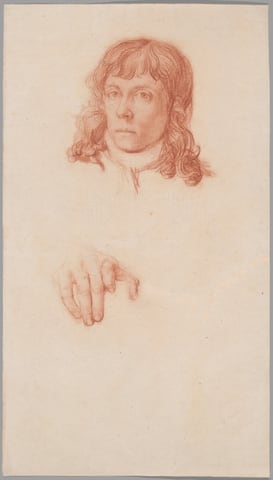
  1. A work made of red chalk on cream laid paper.
    Self-PortraitJohn Flaxman, c. 1779Courtesy of the Art Institute of Chicago
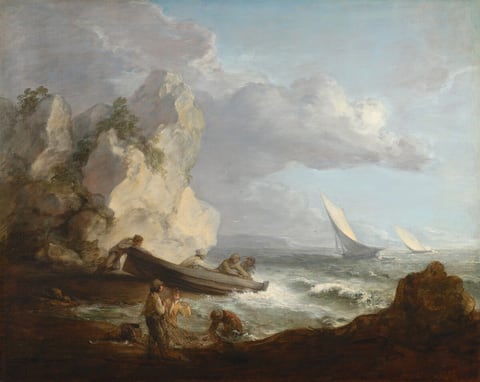
  2. From a rocky shoreline, we look on several light-skinned people working by the sea with a boat and a net in this freely painted, almost square seascape. The scene is framed by a silhouette of low boulders along the lower right corner, and a towering cream-white rock rising two-thirds of the way up the composition to our left. Scrubby, celery-green vegetation grows on the rocky outcropping. Near the center, close to the towering white rocks, three people sit, reaching for something near one end of a boat while a fourth person braces against the rock, presumably to push the boat out to the sea. Closer to us, three people on the shore work with a net. Two stand with the net hooked over their shoulders, and a third person crouches in the water with head down. The people all wear simple shirts and pants in shades of tan, mustard yellow, burnt orange, and pale blue. All but two wear hats. The sea meets the shore with frothy white foam and cresting, low waves. The sea beyond fades from pale sage green to arctic blue along the horizon, which comes about a third of the way up the composition. Two sail boats tilt against the wind in the distance. Pale, smoky lavender-purple clouds drift across the ice-blue sky.
    Seashore with FishermenThomas Gainsborough, c. 1781/1782Courtesy National Gallery of Art, Washington
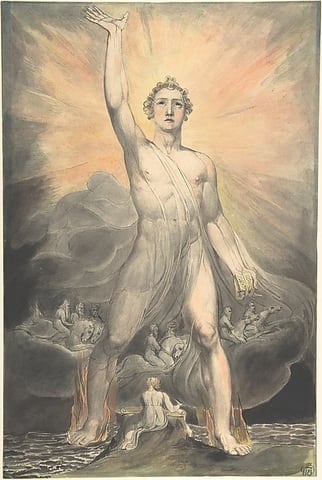
  3. Angel of the Revelation (Book of Revelation, chapter 10), by William Blake, ca. 1803–5
    Angel of the Revelation (Book of Revelation, chapter 10)William Blake, ca. 1803–5Courtesy of The Metropolitan Museum of Art
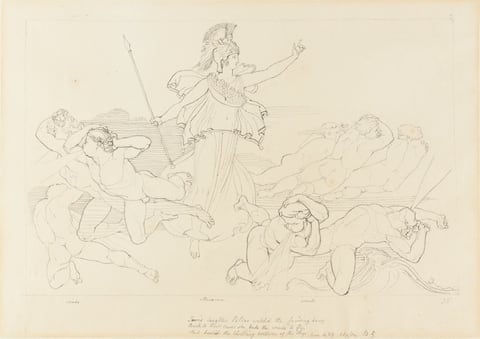
  4. A work made of pen and black ink, over traces of graphite, on tan wove paper, laid down on cream wove paper.
    Athena and the WindsJohn Flaxman, n.d.Courtesy of the Art Institute of Chicago

Second room, north wall
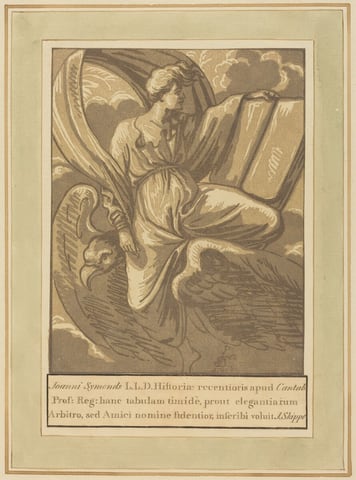
  1. This is a drawing of a seated figure on a large bird. The image depicts a classically draped figure seated on a stylized bird. The figure holds an open book and gazes into the distance. The bird has sharp features and spread wings. The background contains swirling clouds. The scene is framed with a border, and there is text at the bottom. The lines are bold and the shades are muted.
    Saint John the EvangelistJohn Skippe, 1771Courtesy National Gallery of Art, Washington
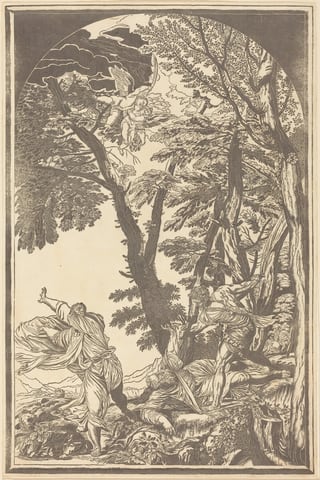
  2. This drawing depicts multiple figures in a forest setting. An angelic figure hovers at the top with wings outstretched. The forest below is filled with intricately detailed trees. Figures on the ground are in dynamic poses, one showing surprise or fear, and another reaching upwards. The composition is detailed with flowing garments and textured foliage, evoking tension and animation.
    The Death of Saint Peter MartyrJohn Baptist Jackson, 1739Courtesy National Gallery of Art, Washington
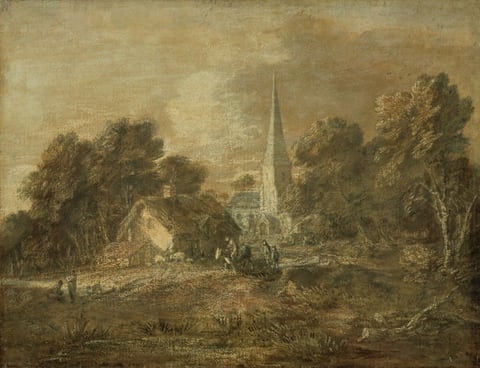
  3. A work made of varnished gouache, over black and red chalks, on cream laid paper, laid down on canvas, stretched on a wooden stretcher and varnished again.
    Wooded Landscape with Village SceneThomas Gainsborough, early 1770s (not later than 1772)Courtesy of the Art Institute of Chicago
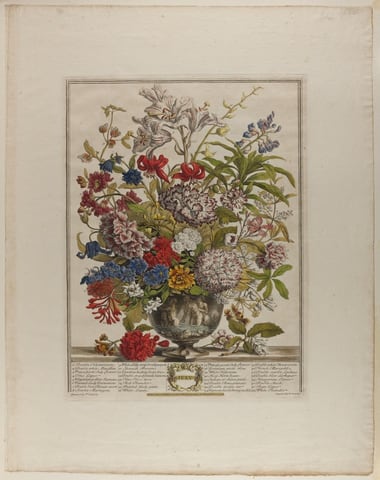
  4. A work made of engraving in black ink with opaque and translucent watercolor on cream laid paper.
    July, from Twelve Months of FlowersHenry Fletcher, n.d.Courtesy of the Art Institute of Chicago

Third room, north wall
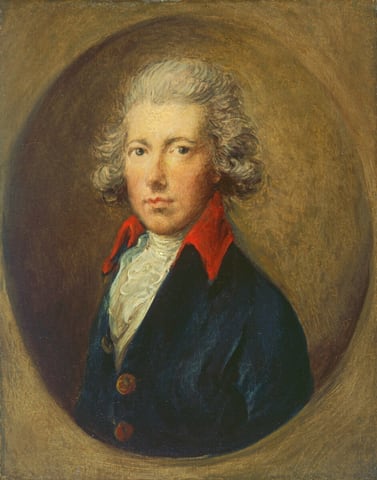
  1. The image depicts a portrait of an individual with the upper half of their body visible. The person is facing forward with their head slightly turned to the side, looking directly at the viewer. They have a fair complexion, with distinct facial features, including a rounded face and closed lips. The hair is styled in an 18th-century manner, with curls around the ears. They are wearing a dark coat with red lapels and brass buttons, over a white shirt with ruffled details. There are no visible jewelry or objects in their hands. The background is a textured, earth-toned surface.
    William PittGainsborough Dupont, 1787/1796Courtesy National Gallery of Art, Washington
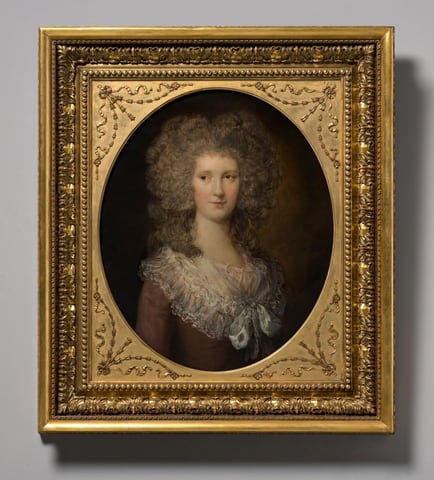
  2. Portrait of Mary Anne Jolliffe, by Gainsborough Dupont, after 1788
    Portrait of Mary Anne JolliffeGainsborough Dupont, after 1788Courtesy of the Cleveland Museum of Art