Floor plan

Time and placeThe 17th century

The 17th century

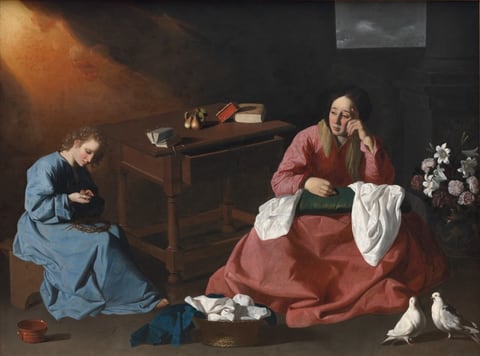
Christ and the Virgin in the House at Nazareth, by Francisco de Zurbarán, c. 1640
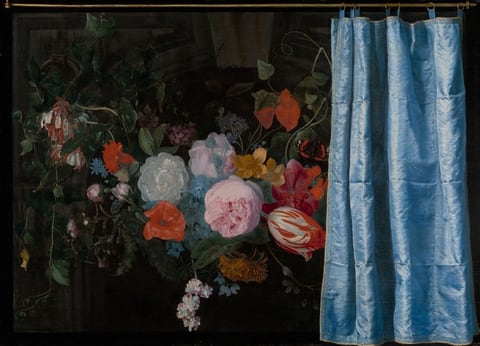
A work made of oil on panel.
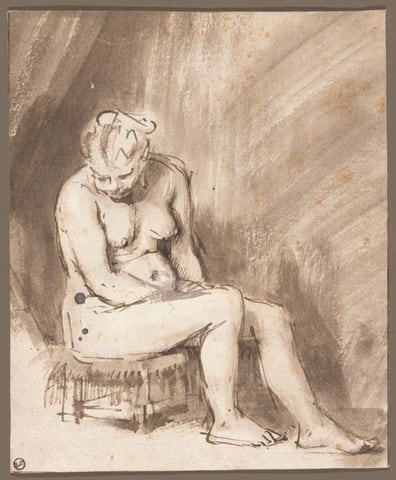
Brown-tone drawing of a nude woman seated on a small stool, looking downward.
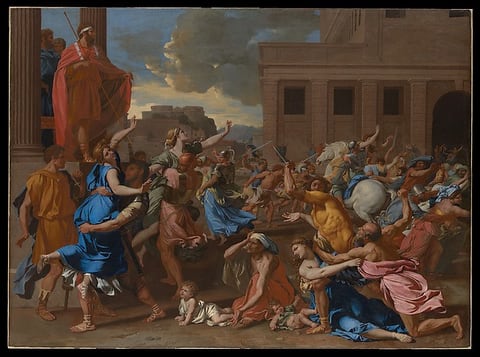
The Abduction of the Sabine Women, by Nicolas Poussin, probably 1633–34
Large painting of woman, in gold and pink dress, placing severed head on platter.

The works in this room are listed below.

Works in this room

Works made in the 17th century, anywhere in the world.

Section 1, north wall

  1. Christ and the Virgin in the House at Nazareth, by Francisco de Zurbarán, c. 1640
    Christ and the Virgin in the House at NazarethFrancisco de Zurbarán, c. 1640Courtesy of the Cleveland Museum of Art
  2. A work made of oil on panel.
    Trompe-l'Oeil Still Life with a Flower Garland and a CurtainAdriaen van der Spelt, 1658Courtesy of the Art Institute of Chicago
  3. Brown-tone drawing of a nude woman seated on a small stool, looking downward.
    Seated Female NudeRembrandt van Rijn, 1660/62Courtesy of the Art Institute of Chicago

Section 1, south wall

  1. The Abduction of the Sabine Women, by Nicolas Poussin, probably 1633–34
    The Abduction of the Sabine WomenNicolas Poussin, probably 1633–34Courtesy of The Metropolitan Museum of Art
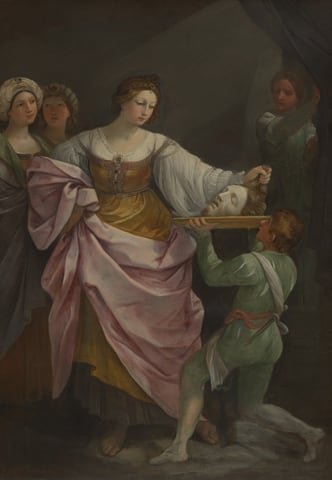
  2. Large painting of woman, in gold and pink dress, placing severed head on platter.
    Salome with the Head of Saint John the BaptistGuido Reni, c. 1639–42Courtesy of the Art Institute of Chicago

Section 2, south wall
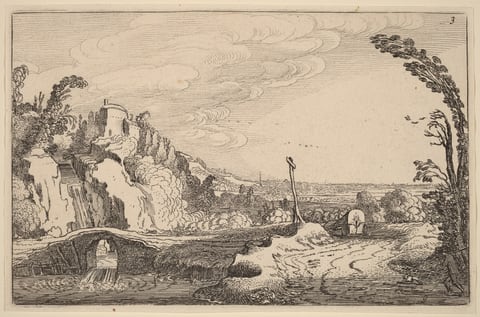
  1. The image shows a pastoral scene in black and white with fine line work. A small bridge with a circular archway crosses a stream. A dirt path winds through the landscape flanked by grass and bushes. A rocky cliff ascends on the left with a tower-like structure partially obscured by vegetation. The horizon features a cloudy sky, with swirling lines indicating motion. In the distance, a tall, thin structure, possibly a spire or chimney, stands amid faint hills and trees. The scene conveys a serene atmosphere through hatching and cross-hatching techniques.
    Cascade under a Stone BridgeJan van de Velde II, c. 1616Courtesy National Gallery of Art, Washington
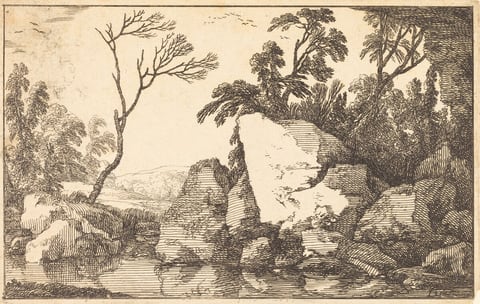
  2. The image shows a landscape with trees, rocks, and water. The perspective is slightly elevated. Rocks are prominent in the central area, with various shapes and textures. Trees and foliage are depicted with detailed brushstrokes. The color scheme is sepia, creating a warm and vintage atmosphere. The scene includes water reflecting rocks, distant hills, and faint cloud formations.
    A Rocky PondLaurent de La Hyre, 1640Courtesy National Gallery of Art, Washington
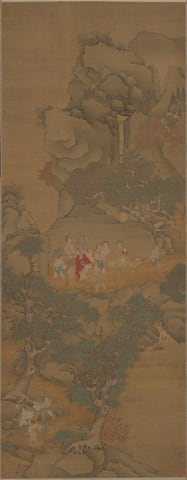
  3. Xu Jingyang Moving His Family, by Cui Zizhong, 1644
    Xu Jingyang Moving His FamilyCui Zizhong, 1644Courtesy of the Cleveland Museum of Art
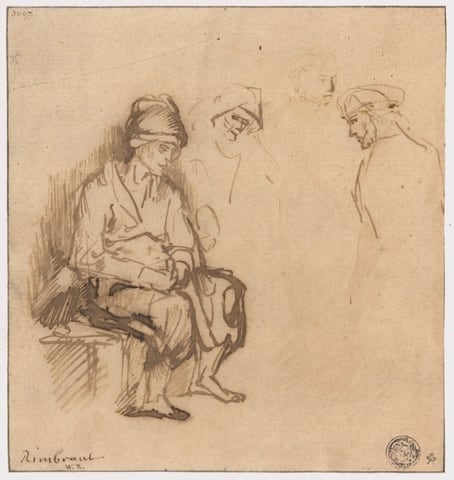
  4. A work made of pen and brown ink, with touches of brush and brown ink wash, on cream laid paper.
    Woman Seated on Bench and Three Sketches of HeadsSchool of Rembrandt van Rijn, n.d.Courtesy of the Art Institute of Chicago

Section 2, north wall
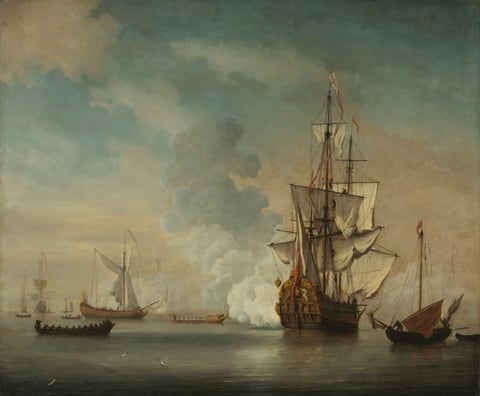
  1. English Warship Firing a Salute, 1690
    English Warship Firing a SaluteUnrecorded Dutch maker, 1690Courtesy of the Cleveland Museum of Art
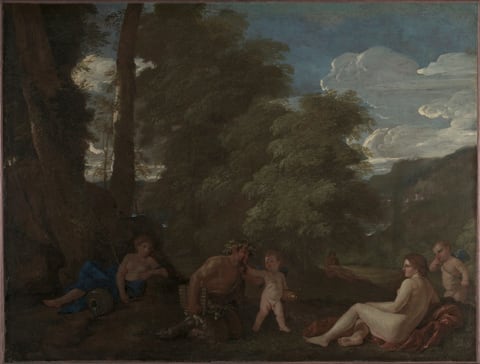
  2. Nymphs and a Satyr (Amor Vincit Omnia), by Nicolas Poussin, c. 1625–27
    Nymphs and a Satyr (Amor Vincit Omnia)Nicolas Poussin, c. 1625–27Courtesy of the Cleveland Museum of Art
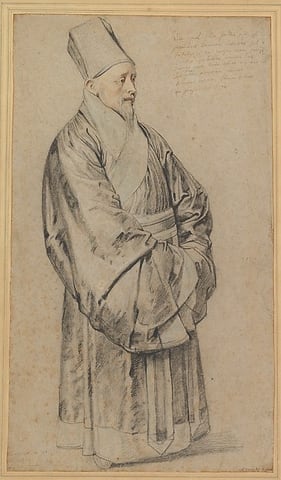
  3. Portrait of Nicolas Trigault in Chinese Costume, by Peter Paul Rubens, 1617
    Portrait of Nicolas Trigault in Chinese CostumePeter Paul Rubens, 1617Courtesy of The Metropolitan Museum of Art
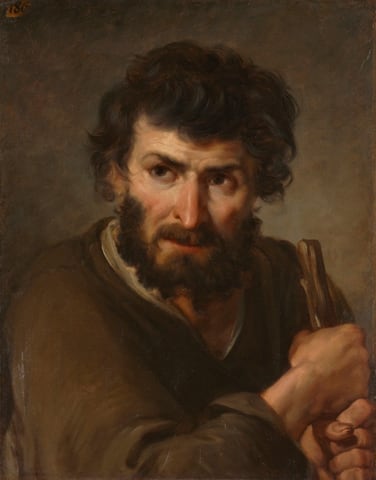
  4. Study of a Shepherd, 1700s
    Study of a ShepherdUnrecorded French maker, 1700sCourtesy of the Cleveland Museum of Art

Section 3, north wall
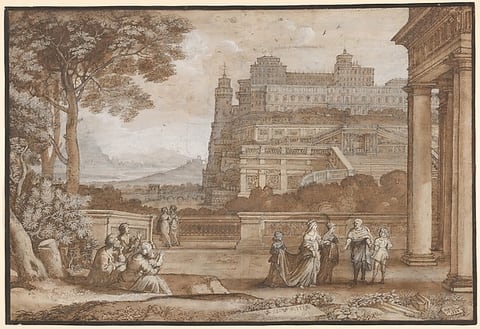
  1. Queen Esther Approaching the Palace of Ahasuerus, by Claude Lorrain (Claude Gellée), 1658
    Queen Esther Approaching the Palace of AhasuerusClaude Lorrain (Claude Gellée), 1658Courtesy of The Metropolitan Museum of Art
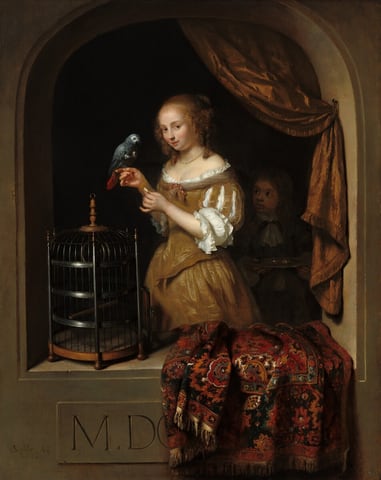
  2. Shown from about the knees up, a pale-skinned young woman stands within a stone niche, with a parrot perched on her finger as she gazes out at us in this vertical painting. The woman’s hands are raised to chest height, and she balances the spruce-blue parrot on the index finger of her far hand while her other hand holds an indistinct, white object. Her body is angled to our left, and she looks at us from the corner of her green eyes under faint brows. Her round face has a small nose, flushed cheeks, and her coral-red mouth curls up in a slight smile, her lips parted. Her honey-blond hair is gathered at the back of her head with curly tendrils framing her face and falling to her shoulders. She wears a golden-brown gown trimmed with a narrow ruffle of white fabric along the low neckline that reveals her décolletage. The bird faces the woman and lifts something, presumably a bit of food, up with one dark claw. The underside of its tail is crimson red. A light-skinned boy stands in deep shadow just to the right of the woman. He looks up at her and holds a silver tray in both hands. They stand within a light brown, arched, stone opening beyond a ledge, which comes up to about the woman’s knees. A carpet patterned with stylized flowers in ruby red, burnt orange, teal blue, white, and black is bunched up and draped over the parapet, to our right. A tall, iron-gray cage sits to our left. The rug partly covers an inscription on the front face of the niche that reads, “M. DO,” with the O cut off. A copper-colored, fringe-lined drapery hangs from the upper right of the arch and is fastened to the inner edge of the opening to create a swag. The woman is brightly lit from the upper left, and the space behind her and the boy is ink black. The artist signed and dated the lower left corner as if he had carved into the front face of the arch. It reads, “CNetscher .Ao. 16.66,” with the C and N overlapping to make a monogram.
    A Woman Feeding a Parrot, with a PageCaspar Netscher, 1666Courtesy National Gallery of Art, Washington
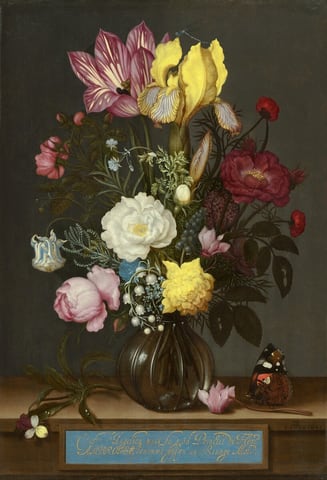
  3. Gathered in a round glass vase, a tall bouquet of flowers in shades of light and deep pink, sunshine yellow, and white with pine-green leaves nearly fills this vertical still life painting. Shown against an gray background, the vase sits on a narrow ledge, perhaps made of wood. A label with looping, cursive French text painted in gold against a baby blue background is affixed to the front of the ledge, along the bottom edge of the composition. The text reads, “C'est l'Angelicq main du grad Peinctre de Flore AMBROISE, renommé jusqu' au Rivage Moré.” A few of the flowers draw the eye, including a tulip and iris at the top of the bouquet. To our left, the tulip is mauve pink with cream-colored streaks, and one petal folds down to reveal the stamen inside. Next to it, a damselfly, an insect like a delicate dragonfly, rests on the vibrant yellow iris. The petals curling down from the iris are veined in muted burgundy red. Flowers filling in the bouquet below include a shell-pink cyclamen, a white gardenia, a closed blue and white striped columbine, a slate-blue grape hyacinth, lily of the valley, pale blue forget-me-nots, and a pink peony interspersed with leaves and greenery. The round glass vase has a narrow opening. A sprig of viola rests to our left of the vase on the ledge, and an orange, black, white, and brown butterfly perches on the stem of a pink cyclamen laying to our right of the vase. The artist signed the painting with a monogram and dated it in dark paint to our right on the face of the ledge: “AB 1621.”
    Bouquet of Flowers in a Glass VaseAmbrosius Bosschaert, 1621Courtesy National Gallery of Art, Washington