Floor plan

Time and place17th-century Spain

17th-century Spain

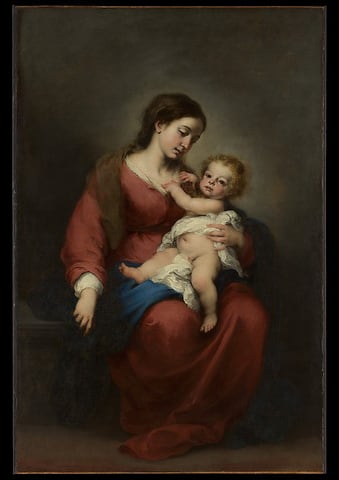
Virgin and Child, by Bartolomé Esteban Murillo, 1670s
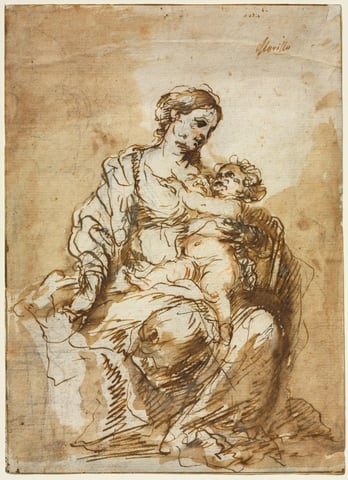
Madonna Nursing the Christ Child, by Bartolomé Esteban Murillo, c. 1670–72
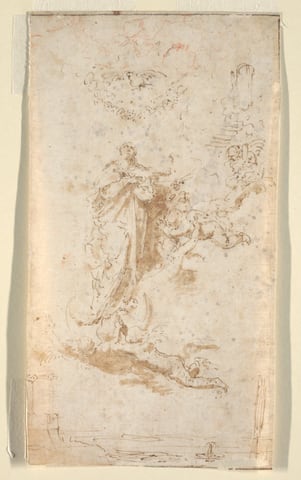
THE IMMACULATE CONCEPTION
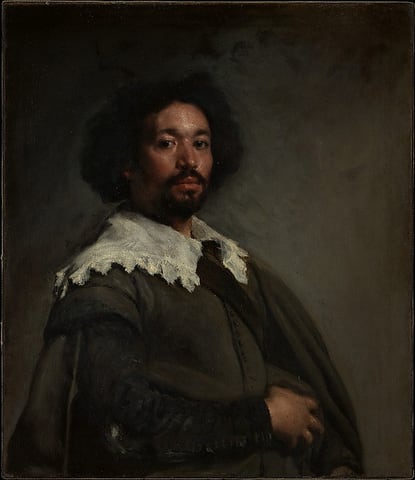
Juan de Pareja (ca. 1608–1670), by Diego Velázquez, 1650
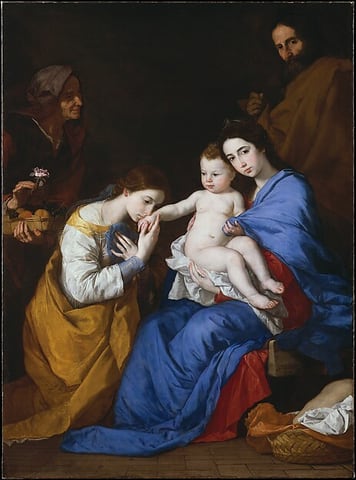
The Holy Family with Saints Anne and Catherine of Alexandria, by Jusepe de Ribera (called Lo Spagnoletto), 1648
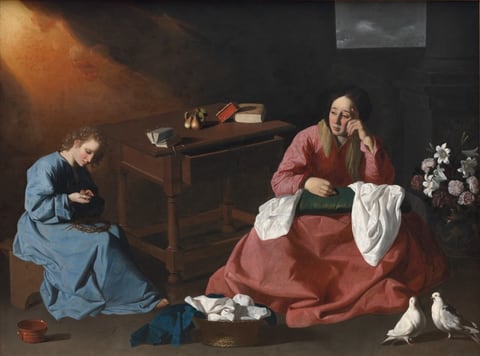
Christ and the Virgin in the House at Nazareth, by Francisco de Zurbarán, c. 1640

The works in this room are listed below.

Works in this room

Works made in Spain in the 17th century.

Section 1, north wall

  1. Virgin and Child, by Bartolomé Esteban Murillo, 1670s
    Virgin and ChildBartolomé Esteban Murillo, 1670sCourtesy of The Metropolitan Museum of Art
  2. Madonna Nursing the Christ Child, by Bartolomé Esteban Murillo, c. 1670–72
    Madonna Nursing the Christ ChildBartolomé Esteban Murillo, c. 1670–72Courtesy of the Cleveland Museum of Art
  3. THE IMMACULATE CONCEPTION
    The Immaculate ConceptionJusepe de Ribera (called Lo Spagnoletto), ca. 1640Courtesy of Cooper Hewitt, Smithsonian Design Museum
  4. Juan de Pareja (ca. 1608–1670), by Diego Velázquez, 1650
    Juan de Pareja (ca. 1608–1670)Diego Velázquez, 1650Courtesy of The Metropolitan Museum of Art

Section 1, south wall

  1. The Holy Family with Saints Anne and Catherine of Alexandria, by Jusepe de Ribera (called Lo Spagnoletto), 1648
    The Holy Family with Saints Anne and Catherine of AlexandriaJusepe de Ribera (called Lo Spagnoletto), 1648Courtesy of The Metropolitan Museum of Art
  2. Christ and the Virgin in the House at Nazareth, by Francisco de Zurbarán, c. 1640
    Christ and the Virgin in the House at NazarethFrancisco de Zurbarán, c. 1640Courtesy of the Cleveland Museum of Art

Section 2, south wall
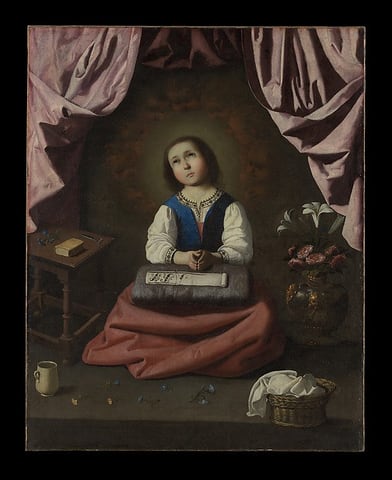
  1. The Young Virgin, by Francisco de Zurbarán, ca. 1632–33
    The Young VirginFrancisco de Zurbarán, ca. 1632–33Courtesy of The Metropolitan Museum of Art
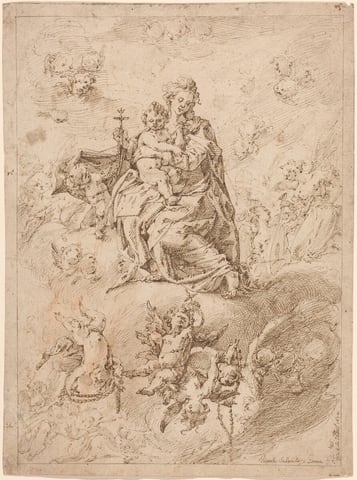
  2. The image depicts a woman seated with a child in her lap. The woman looks down at the child, who has curly hair. Both figures are intricately drawn in a detailed line drawing style. The woman wears a headdress and flowing garment, holding a cross-topped staff. The child clutches her arm. Surrounding them are cloud-like forms and cherubic figures with wings, some holding rosary beads. In the background, more clouds and angelic faces are sketched.
    The Madonna of the RosaryVicente Salvador Gómez, 1674Courtesy National Gallery of Art, Washington
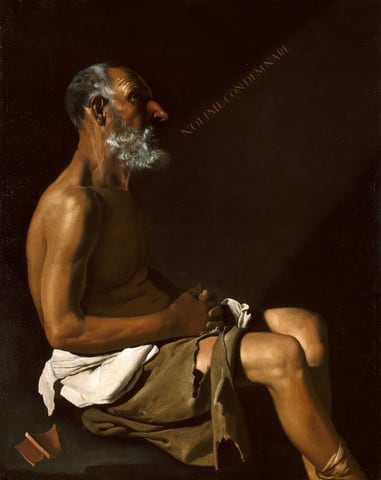
  3. A work made of oil on canvas.
    JobSpanish, c. 1618–c. 1630Courtesy of the Art Institute of Chicago

Section 2, north wall
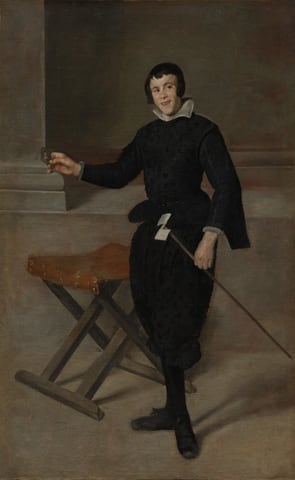
  1. Portrait of the Jester Calabazas, by Diego Velázquez, c. 1631–32
    Portrait of the Jester CalabazasDiego Velázquez, c. 1631–32Courtesy of the Cleveland Museum of Art
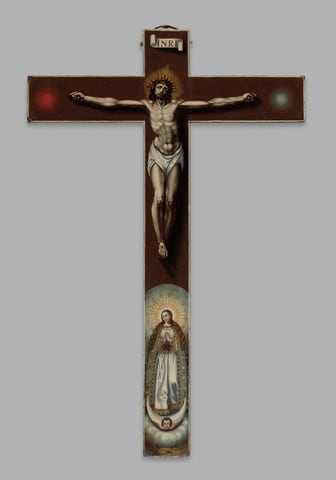
  2. A work made of oil on panel.
    CrucifixionMaría Josefa Sánchez, 1646Courtesy of the Art Institute of Chicago
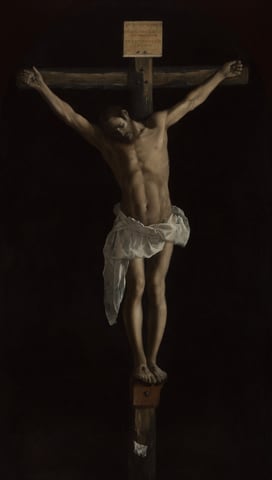
  3. A work made of oil on canvas.
    The CrucifixionFrancisco de Zurbarán, 1627Courtesy of the Art Institute of Chicago

Section 3, north wall
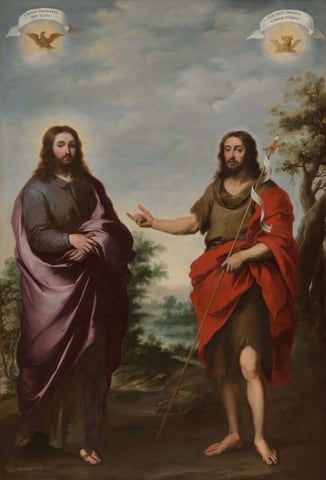
  1. A work made of oil on canvas.
    Ecce Agnus DeiBartolomé Esteban Murillo, c. 1655Courtesy of the Art Institute of Chicago
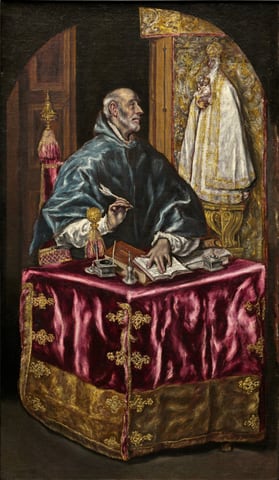
  2. A light-skinned man wearing a voluminous, ocean-blue, hooded robe sits at a cloth-draped writing table and looks up, fingers splayed over an open book and a pen held in his other hand, in this vertical painting. The man and desk take up most of the composition, which has an arched top. The man’s shoulders and body are angled to our right, and he looks off in that direction in profile. His balding head is rimmed with white hair curving over the large ear we can see, and he has a trimmed white and gray beard and mustache. His prominent nose is pointed, and his lips are closed. Light glints off the robe he wears so it shimmers in shades of topaz, aquamarine, and midnight blue. Voluminous white sleeves emerge under the mantle and are edged with narrow lace cuffs. His left hand, to our right, rests on an open book, which is propped against one or two other tomes. Near the edge of the table, two quills stand in the corners of a lidded inkwell, and a round, silver blotter, shaped like an upside-down chalice, and a lidded silver box sit nearby. The man’s chair has a tall post next to his shoulder to our left with a teardrop-shaped, gold finial. A second post, near his wrist, is lower and topped with a gold orb. The chair is draped in the same deep, raspberry-pink of the square table at which he sits. The tablecloth is edged with a wide band of gold along the bottom, and filigree-like gold decorations line the seams or folds at the corners. Brushstrokes are visible in many areas, especially in the colorfully charged blue and pink fabric. Beyond the man, to our right, a statuette of a person wearing a long, white robe over a white dress holds a baby. The clothing is edged with gold, and she wears a sphere-like gold crown. The baby also wears white and holds up one hand. The statuette stands on a platform supported by S-shaped corbels, and could have a projecting, squared awning over the top. This area is more loosely painted so some details are difficult to make out. In the background to our left, a wooden door stands open next to a dark space just behind the man’s head, so his profile is picked out against the shadow. The floor beneath is earth brown.
    Saint IldefonsoEl Greco, c. 1603/1614Courtesy National Gallery of Art, Washington
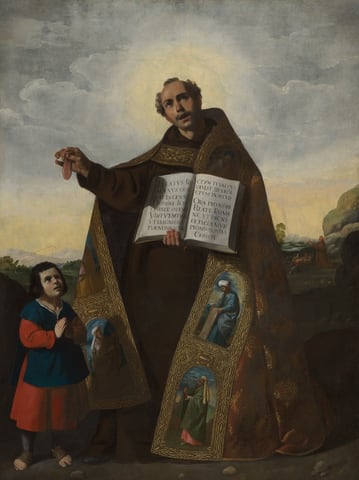
  3. A work made of oil on canvas.
    Saint Romanus of Antioch and Saint BarulasFrancisco de Zurbarán, 1638Courtesy of the Art Institute of Chicago