Floor plan

Time and place17th-century Netherlands
17th-century Netherlands
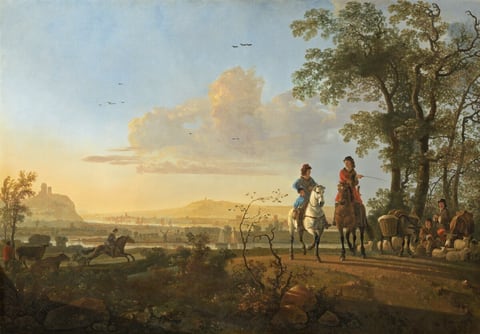
Golden sunlight pours across a landscape with three people on horseback and two more people near a flock of sheep, a cow, and a mule in this horizontal painting. The people all have pale, peachy skin. The horizon is about a third of the way up the composition and is lined with towers on distant, hazy, pale yellow hills. Two of the horses are to the right of center, both facing us. The horse on the left is white, and the rider wears an azure-blue tunic and red brimless cap. The other horse is brown with a white blaze, and its rider wears a red tunic and black cap. That second rider points with a whip to the sitting and standing people near the sheep, to the right. Those two people wear brown jackets, and the standing man has a mustache. The seated person rests a long staff over one shoulder. About half of the nine sheep there lie on the ground, and the others stand. The cow dips her head down to the sheep, and the splay-footed donkey has baskets hung to each side. This grouping is in front of a copse of tall trees that nearly reach the top edge of the composition. The third rider is to our left and a short distance away. That dark brown horse gallops to our right. A short distance away, another herdsman along the left edge of the composition wears a red tunic and brown pants, and he rests a long staff on one shoulder. One cow stands and one lies down next to that herdsman. Sunlight rakes across twigs, leafy plants, scrubby growth, and rocks in the foreground, closest to us. Sailboats float on the waterways that stretch horizontally across the painting in the distance, and the land separating those bodies of water is dotted with spires, windmills, towers, and other structures. A dozen dark birds fly high in the sky, which takes up the top two-thirds of the picture. A bank of iridescent yellow and pearly white clouds trundle across the pale blue sky. The artist signed the painting in the lower right corner, “A.cuijp.”
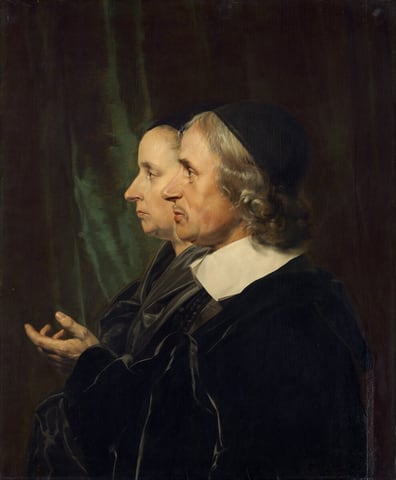
Shown from the shoulders up, a man and woman face our left in profile against a shadowy, dark green curtain in this vertical portrait painting. They both look steadily to our left, they and have pale skin and wear black. The man is closer to us so he overlaps the woman, whose profile is shifted to our left. A black cap sits on the man's curly, silver, shoulder-length hair. He has a slight double chin and soft jowls. A thin mustache curves over his upper lip, and a line of hair runs down his chin as a narrow beard. A broad, flat, white collar lies across his shoulders over a velvety black coat. He lifts his left hand, closer to us, in front of his chest with the fingers curled gently inward. The woman also has a double chin and soft jowls. Her thin lips are closed and downturned. Her hair is pulled back under a black covering, and her black garment has a sheen, suggesting satin.
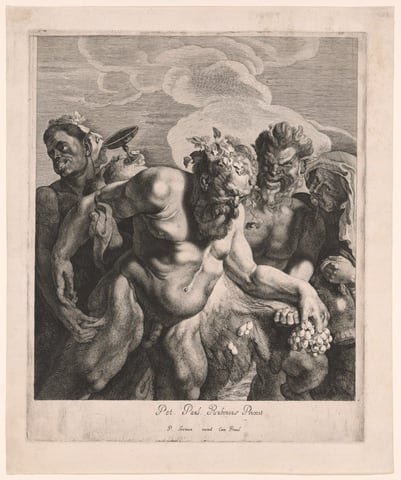
A work made of engraving in black on cream laid paper.
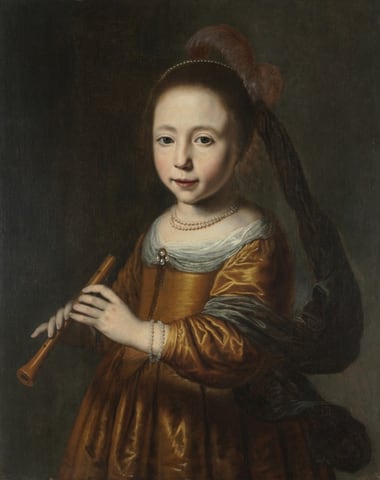
Portrait of Elizabeth Spiegel, by Dirck Dircksz. Santvoort, 1639
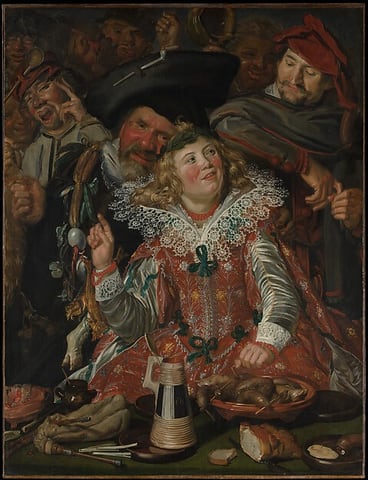
Merrymakers at Shrovetide, by Frans Hals, ca. 1616–17
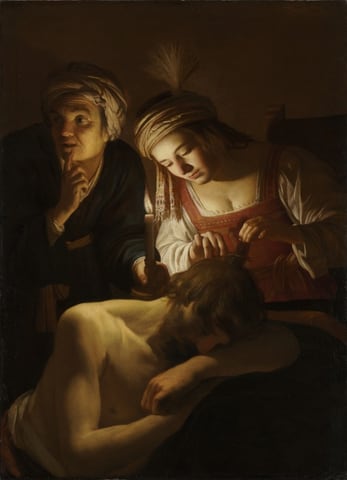
Samson and Delilah, by Gerrit van Honthorst, c. 1616

The works in this room are listed below.

Works in this room

Works made in the Netherlands in the 17th century.

First room, north wall

  1. Golden sunlight pours across a landscape with three people on horseback and two more people near a flock of sheep, a cow, and a mule in this horizontal painting. The people all have pale, peachy skin. The horizon is about a third of the way up the composition and is lined with towers on distant, hazy, pale yellow hills. Two of the horses are to the right of center, both facing us. The horse on the left is white, and the rider wears an azure-blue tunic and red brimless cap. The other horse is brown with a white blaze, and its rider wears a red tunic and black cap. That second rider points with a whip to the sitting and standing people near the sheep, to the right. Those two people wear brown jackets, and the standing man has a mustache. The seated person rests a long staff over one shoulder. About half of the nine sheep there lie on the ground, and the others stand. The cow dips her head down to the sheep, and the splay-footed donkey has baskets hung to each side. This grouping is in front of a copse of tall trees that nearly reach the top edge of the composition. The third rider is to our left and a short distance away. That dark brown horse gallops to our right. A short distance away, another herdsman along the left edge of the composition wears a red tunic and brown pants, and he rests a long staff on one shoulder. One cow stands and one lies down next to that herdsman. Sunlight rakes across twigs, leafy plants, scrubby growth, and rocks in the foreground, closest to us. Sailboats float on the waterways that stretch horizontally across the painting in the distance, and the land separating those bodies of water is dotted with spires, windmills, towers, and other structures. A dozen dark birds fly high in the sky, which takes up the top two-thirds of the picture. A bank of iridescent yellow and pearly white clouds trundle across the pale blue sky. The artist signed the painting in the lower right corner, “A.cuijp.”
    Horsemen and Herdsmen with CattleAelbert Cuyp, 1655/1660Courtesy National Gallery of Art, Washington
  2. Shown from the shoulders up, a man and woman face our left in profile against a shadowy, dark green curtain in this vertical portrait painting. They both look steadily to our left, they and have pale skin and wear black. The man is closer to us so he overlaps the woman, whose profile is shifted to our left. A black cap sits on the man's curly, silver, shoulder-length hair. He has a slight double chin and soft jowls. A thin mustache curves over his upper lip, and a line of hair runs down his chin as a narrow beard. A broad, flat, white collar lies across his shoulders over a velvety black coat. He lifts his left hand, closer to us, in front of his chest with the fingers curled gently inward. The woman also has a double chin and soft jowls. Her thin lips are closed and downturned. Her hair is pulled back under a black covering, and her black garment has a sheen, suggesting satin.
    Portrait of the Artist's Parents, Salomon de Bray and Anna WesterbaenJan de Bray, 1664Courtesy National Gallery of Art, Washington
  3. A work made of engraving in black on cream laid paper.
    Drunken SilenusJonas Suyderhoef, 1642Courtesy of the Art Institute of Chicago

First room, south wall

  1. Portrait of Elizabeth Spiegel, by Dirck Dircksz. Santvoort, 1639
    Portrait of Elizabeth SpiegelDirck Dircksz. Santvoort, 1639Courtesy of the Cleveland Museum of Art
  2. Merrymakers at Shrovetide, by Frans Hals, ca. 1616–17
    Merrymakers at ShrovetideFrans Hals, ca. 1616–17Courtesy of The Metropolitan Museum of Art
  3. Samson and Delilah, by Gerrit van Honthorst, c. 1616
    Samson and DelilahGerrit van Honthorst, c. 1616Courtesy of the Cleveland Museum of Art

Second room, south wall
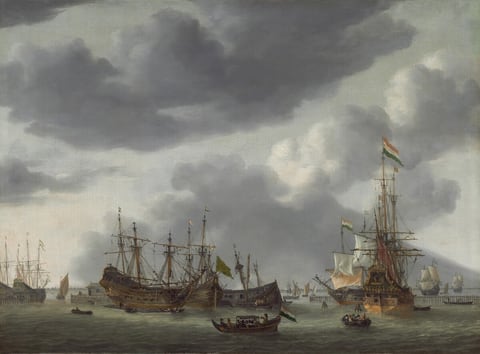
  1. A sage-green harbor teems with more than a dozen sailing ships and rowboats under a pale gray sky in this horizontal painting. The horizon comes about one-fifth of the way up the composition, and dark gray and white clouds tower above. Light filters onto the scene through the clouds from our left to fall across the ships while casting shadows on the water nearest us. Painted in tones of slate gray and warm brown, most of the ships closest to us have their sails furled so the masts and horizontal yard arms bristle against the sky. The larger ships have cannons poking out of square portholes. On our right, a war ship floats with its ornately carved and gilded stern facing us. A flag flying from the tallest of the three masts has red, white, and green stripes. The artist painted his name on that flag, “R. Zeeman.” The ship is tied to a buoy with a length of rope, and an empty rowboat is tethered to the right side of the ship. A similar ship but with the sails hanging loosely is tied to a buoy just beyond this one. A row of pickets, like a fence, extends into the water behind these two ships. To our left, a rowboat full of men has pulled up alongside a partially sunken ship, its masts tilting toward us. A few people stand on two more ships nearby. A black temporary dock floats next to the leftmost ship here. A person mixes something that smokes on the platform, and another person stands on a board lifted halfway up the ship’s side, presumably working on a repair. Two women in another rowboat next to the floating dock lean over the side, washing clothes. Another fence encloses the harbor to our left, and a hut in the middle of the harbor is surrounded by a similar structure. Two rowboats closer to us are filled with men wearing tall hats and black or brown coats, and women wearing black bonnets and white shawls. More sailing ships and rowboats move back or around beyond the harbor, out to sea. Visible cracks cover the surface of the painting.
    Amsterdam Harbor SceneReinier Nooms, called Zeeman, c. 1654/1655Courtesy National Gallery of Art, Washington
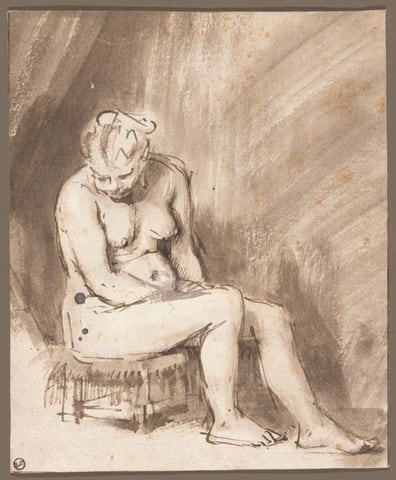
  2. Brown-tone drawing of a nude woman seated on a small stool, looking downward.
    Seated Female NudeRembrandt van Rijn, 1660/62Courtesy of the Art Institute of Chicago
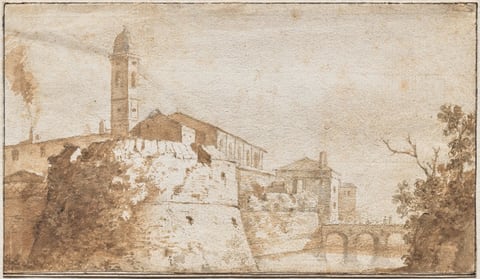
  3. A View of Bracciano with the Church of S. Maria Assunta, by Bartholomeus Breenberg, c. 1619–33
    A View of Bracciano with the Church of S. Maria AssuntaBartholomeus Breenberg, c. 1619–33Courtesy of the Cleveland Museum of Art
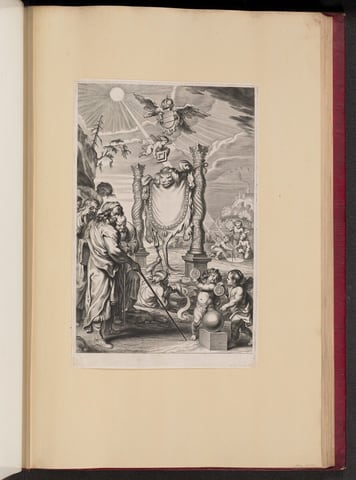
  4. This is a drawing of a mythological or allegorical scene. The scene features various figures of different ages engaged in activities around a central structure resembling an ornate draped curtain held up by columns. There is a celestial element shining down from the top, and an emblem or coat of arms held by winged figures at the very top. The figures are dressed in flowing robes and interact with each other and objects such as a globe and a staff. The composition is rich with symbolism, typical of artwork focused on narrative depth and storytelling.
    Title Page for G. de St. Vincent, Opus Geometricum Quadraturae CirculiCornelis Galle II, 1647Courtesy National Gallery of Art, Washington

Second room, north wall
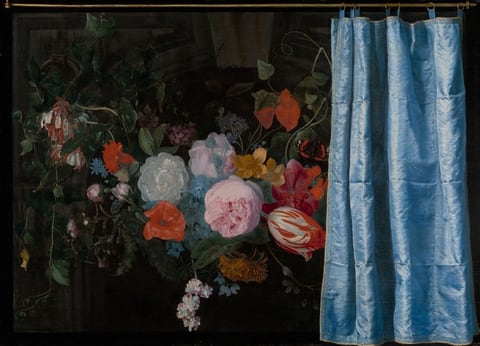
  1. A work made of oil on panel.
    Trompe-l'Oeil Still Life with a Flower Garland and a CurtainAdriaen van der Spelt, 1658Courtesy of the Art Institute of Chicago
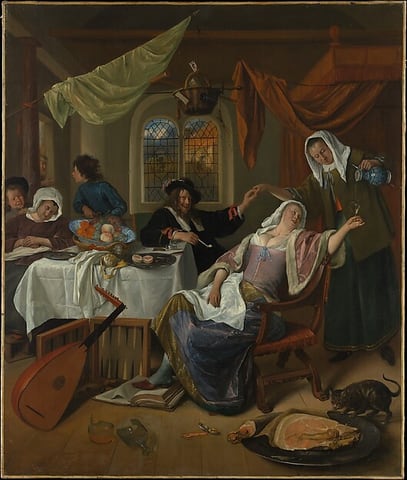
  2. The Dissolute Household, by Jan Steen, ca. 1663–64
    The Dissolute HouseholdJan Steen, ca. 1663–64Courtesy of The Metropolitan Museum of Art
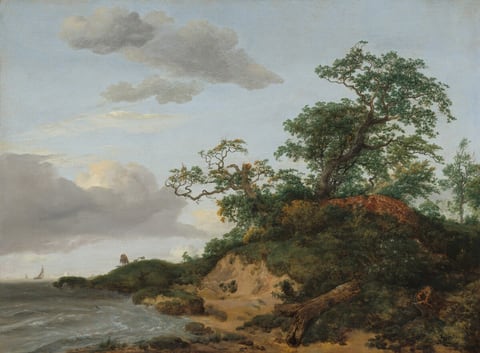
  3. Water laps at a curving shoreline in front of a steep sandy dune carpeted in grass, shrubs, and trees in this horizontal landscape painting. The dune takes up the lower right quadrant of the composition. A few broken tree trunks are overgrown with vines and plants across the top and down the sloping side of the dune facing us. A red brick wall cuts through the vegetation up the side of the dune and disappears into the shrubbery at the top. The twisting branches and canopies of three large trees reach into the upper right quadrant of the composition. The vegetation stops abruptly along the sheer edge of the dune where it faces the water. The land curves like a backward capital letter C so it almost reaches the left edge of the painting along the horizon, which comes a quarter of the way up the composition. A cow and three more animals, perhaps sheep or more cows, graze or lie on a grassy mound in the distance, and sailboats line the horizon in the deep distance. White ripples swirl in the steel-blue water. The artist signed and dated the lower center, “J Ruisdael . 1648.”
    Dunes by the SeaJacob van Ruisdael, 1648Courtesy National Gallery of Art, Washington
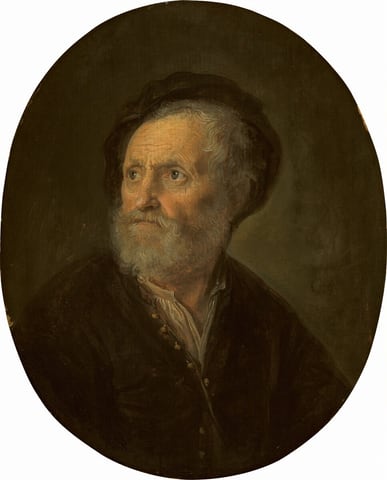
  4. Shown from the chest up, a light-skinned man with a wrinkled face and a silvery gray beard and hair gazes into the distance in this oval portrait painting. His chest is angled to our right but he turns his head to look off over his other shoulder, to our left. His slate-blue eyes are a little sunken and lined with wrinkles. Shading marks the hollows of the temple and cheek we can see. His thin lips are closed and framed by his curly mustache and beard. A dark, mahogany-brown cap is pushed back on his head, and his brown jacket has gold-colored buttons down the front. The collar of a cream-colored shirt shows through at the neckline. The background is dark olive green. The artist signed the work near the man’s shoulder, to our right: “GDOV.”
    Bust of a Bearded ManGerrit Dou, c. 1642/1645Courtesy National Gallery of Art, Washington

Third room, north wall
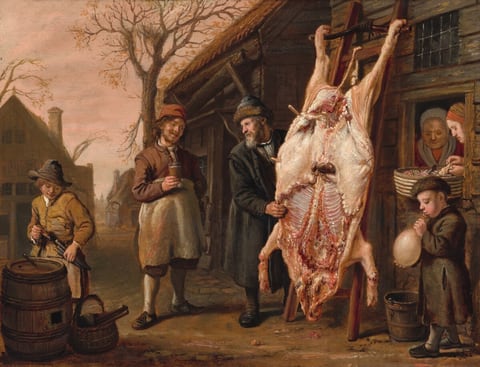
  1. In the center of this painting, a large animal carcass is hanging upside down from a wooden frame, with several people attending to it. The carcass is light pink and has been cut open to reveal white ribs, red muscles, and purple organs. On the far left, a young boy stands next to a barrel and a basket, holding several small knives. To the right, a man in a red cap and white apron observes the carcass while holding a drink. An older man in a furred cap and dark clothing looks towards him and holds one edge of the carcass. On the other side of the animal, a young boy blows up a round object. Two women peer out from the doorway of a wooden building in the background, one holding a basket full of what looks like meat. Behind this group of people are several brown structures and a bare tree against a light pink sky.
    The Slaughtered HogJan Victors, 1653Courtesy National Gallery of Art, Washington
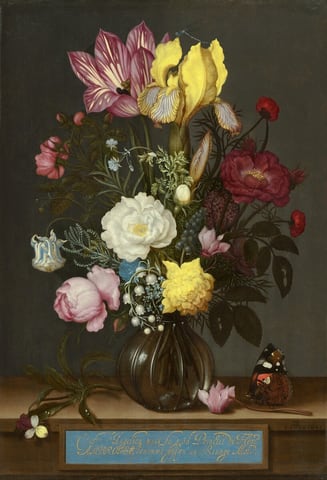
  2. Gathered in a round glass vase, a tall bouquet of flowers in shades of light and deep pink, sunshine yellow, and white with pine-green leaves nearly fills this vertical still life painting. Shown against an gray background, the vase sits on a narrow ledge, perhaps made of wood. A label with looping, cursive French text painted in gold against a baby blue background is affixed to the front of the ledge, along the bottom edge of the composition. The text reads, “C'est l'Angelicq main du grad Peinctre de Flore AMBROISE, renommé jusqu' au Rivage Moré.” A few of the flowers draw the eye, including a tulip and iris at the top of the bouquet. To our left, the tulip is mauve pink with cream-colored streaks, and one petal folds down to reveal the stamen inside. Next to it, a damselfly, an insect like a delicate dragonfly, rests on the vibrant yellow iris. The petals curling down from the iris are veined in muted burgundy red. Flowers filling in the bouquet below include a shell-pink cyclamen, a white gardenia, a closed blue and white striped columbine, a slate-blue grape hyacinth, lily of the valley, pale blue forget-me-nots, and a pink peony interspersed with leaves and greenery. The round glass vase has a narrow opening. A sprig of viola rests to our left of the vase on the ledge, and an orange, black, white, and brown butterfly perches on the stem of a pink cyclamen laying to our right of the vase. The artist signed the painting with a monogram and dated it in dark paint to our right on the face of the ledge: “AB 1621.”
    Bouquet of Flowers in a Glass VaseAmbrosius Bosschaert, 1621Courtesy National Gallery of Art, Washington