Floor plan

Time and place17th-century Netherlands
17th-century Netherlands
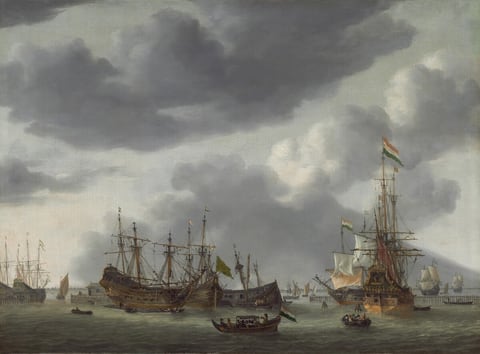
A sage-green harbor teems with more than a dozen sailing ships and rowboats under a pale gray sky in this horizontal painting. The horizon comes about one-fifth of the way up the composition, and dark gray and white clouds tower above. Light filters onto the scene through the clouds from our left to fall across the ships while casting shadows on the water nearest us. Painted in tones of slate gray and warm brown, most of the ships closest to us have their sails furled so the masts and horizontal yard arms bristle against the sky. The larger ships have cannons poking out of square portholes. On our right, a war ship floats with its ornately carved and gilded stern facing us. A flag flying from the tallest of the three masts has red, white, and green stripes. The artist painted his name on that flag, “R. Zeeman.” The ship is tied to a buoy with a length of rope, and an empty rowboat is tethered to the right side of the ship. A similar ship but with the sails hanging loosely is tied to a buoy just beyond this one. A row of pickets, like a fence, extends into the water behind these two ships. To our left, a rowboat full of men has pulled up alongside a partially sunken ship, its masts tilting toward us. A few people stand on two more ships nearby. A black temporary dock floats next to the leftmost ship here. A person mixes something that smokes on the platform, and another person stands on a board lifted halfway up the ship’s side, presumably working on a repair. Two women in another rowboat next to the floating dock lean over the side, washing clothes. Another fence encloses the harbor to our left, and a hut in the middle of the harbor is surrounded by a similar structure. Two rowboats closer to us are filled with men wearing tall hats and black or brown coats, and women wearing black bonnets and white shawls. More sailing ships and rowboats move back or around beyond the harbor, out to sea. Visible cracks cover the surface of the painting.
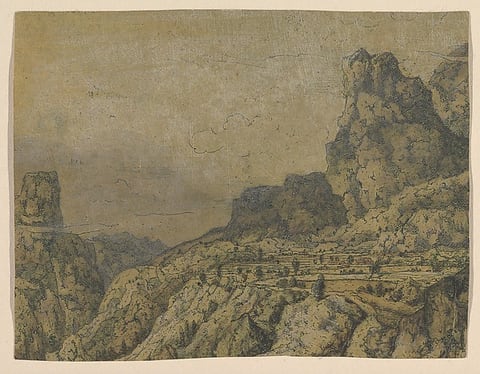
Mountain Valley with a Plateau, by Hercules Segers, ca. 1625–30
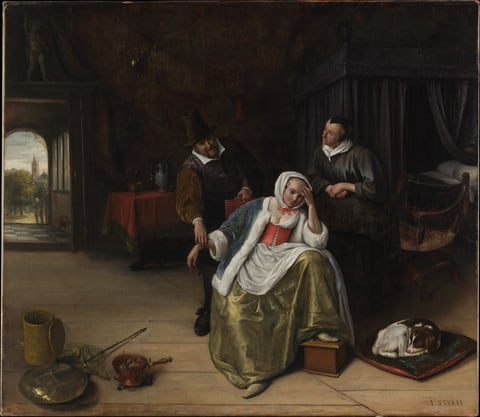
The Lovesick Maiden, by Jan Steen, ca. 1660
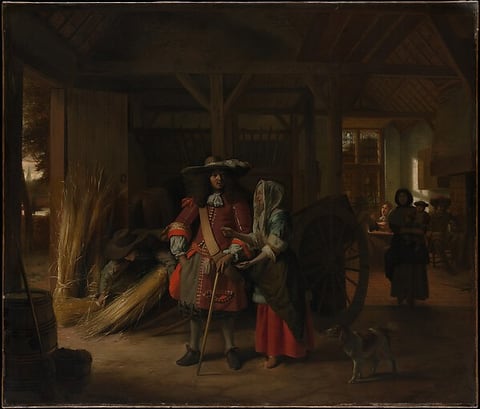
Paying the Hostess, by Pieter de Hooch, ca. 1670
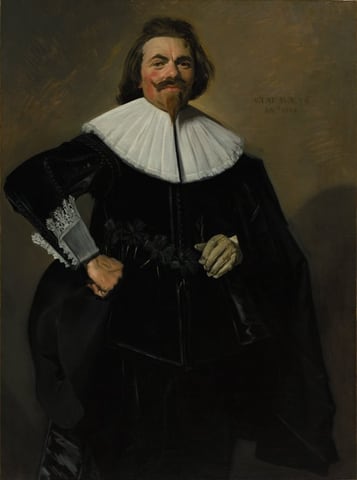
Portrait of Tieleman Roosterman, by Frans Hals, 1634
A Cottage in the Woods, by Meindert Hobbema, c. 1662

The works in this room are listed below.

Works in this room

Works made in the Netherlands in the 17th century.

First room, north wall

  1. A sage-green harbor teems with more than a dozen sailing ships and rowboats under a pale gray sky in this horizontal painting. The horizon comes about one-fifth of the way up the composition, and dark gray and white clouds tower above. Light filters onto the scene through the clouds from our left to fall across the ships while casting shadows on the water nearest us. Painted in tones of slate gray and warm brown, most of the ships closest to us have their sails furled so the masts and horizontal yard arms bristle against the sky. The larger ships have cannons poking out of square portholes. On our right, a war ship floats with its ornately carved and gilded stern facing us. A flag flying from the tallest of the three masts has red, white, and green stripes. The artist painted his name on that flag, “R. Zeeman.” The ship is tied to a buoy with a length of rope, and an empty rowboat is tethered to the right side of the ship. A similar ship but with the sails hanging loosely is tied to a buoy just beyond this one. A row of pickets, like a fence, extends into the water behind these two ships. To our left, a rowboat full of men has pulled up alongside a partially sunken ship, its masts tilting toward us. A few people stand on two more ships nearby. A black temporary dock floats next to the leftmost ship here. A person mixes something that smokes on the platform, and another person stands on a board lifted halfway up the ship’s side, presumably working on a repair. Two women in another rowboat next to the floating dock lean over the side, washing clothes. Another fence encloses the harbor to our left, and a hut in the middle of the harbor is surrounded by a similar structure. Two rowboats closer to us are filled with men wearing tall hats and black or brown coats, and women wearing black bonnets and white shawls. More sailing ships and rowboats move back or around beyond the harbor, out to sea. Visible cracks cover the surface of the painting.
    Amsterdam Harbor SceneReinier Nooms, called Zeeman, c. 1654/1655Courtesy National Gallery of Art, Washington
  2. Mountain Valley with a Plateau, by Hercules Segers, ca. 1625–30
    Mountain Valley with a PlateauHercules Segers, ca. 1625–30Courtesy of The Metropolitan Museum of Art
  3. The Lovesick Maiden, by Jan Steen, ca. 1660
    The Lovesick MaidenJan Steen, ca. 1660Courtesy of The Metropolitan Museum of Art

First room, south wall

  1. Paying the Hostess, by Pieter de Hooch, ca. 1670
    Paying the HostessPieter de Hooch, ca. 1670Courtesy of The Metropolitan Museum of Art
  2. Portrait of Tieleman Roosterman, by Frans Hals, 1634
    Portrait of Tieleman RoostermanFrans Hals, 1634Courtesy of the Cleveland Museum of Art
  3. A Cottage in the Woods, by Meindert Hobbema, c. 1662
    A Cottage in the WoodsMeindert Hobbema, c. 1662Courtesy of the Cleveland Museum of Art

Second room, south wall
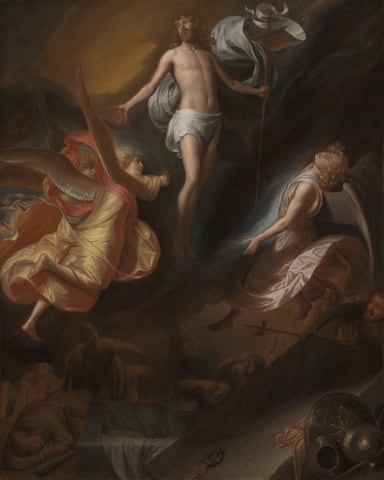
  1. A work made of oil on canvas.
    Resurrection of ChristSamuel van Hoogstraten, c. 1665Courtesy of the Art Institute of Chicago
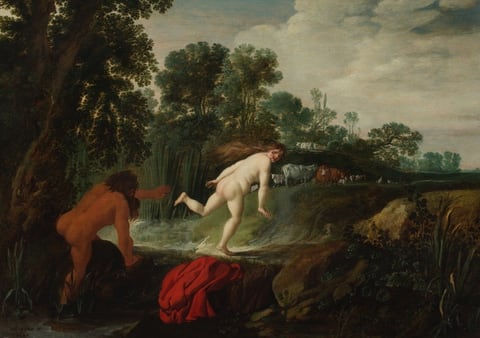
  2. A work made of oil on panel.
    Alpheus and ArethusaMoses van Uyttenbroeck, 1626Courtesy of the Art Institute of Chicago
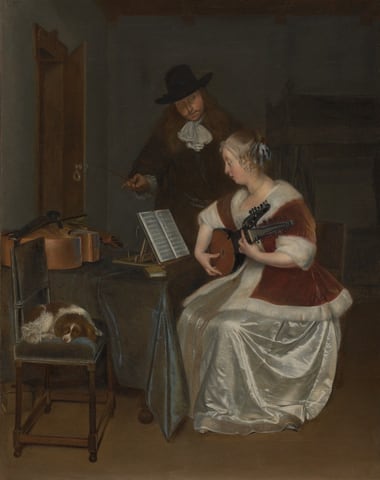
  3. A work made of oil on canvas.
    The Music LessonGerard ter Borch the Younger, c. 1670Courtesy of the Art Institute of Chicago
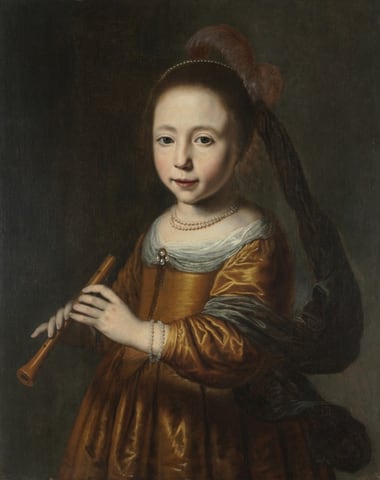
  4. Portrait of Elizabeth Spiegel, by Dirck Dircksz. Santvoort, 1639
    Portrait of Elizabeth SpiegelDirck Dircksz. Santvoort, 1639Courtesy of the Cleveland Museum of Art

Second room, north wall
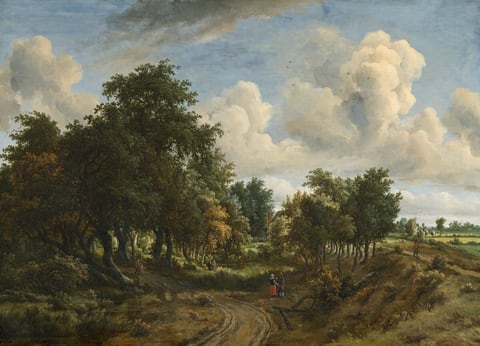
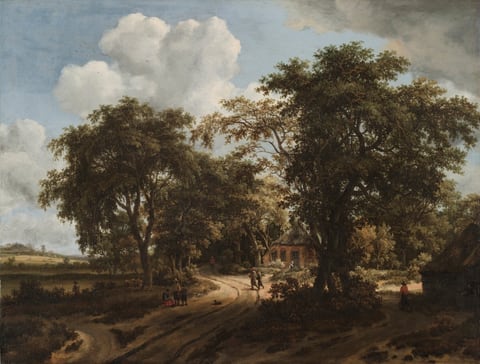
  1. A rutted, dirt road curves from the bottom center of the canvas toward and behind a grove of tall trees to our left, beneath a pale blue sky with fluffy white clouds that fills the top two-thirds of this horizontal landscape painting. The broad, green canopies of the trees to our left create deep shade over twisting trunks, shrubs, and grasses. A narrow stream meandering alongside the road to our left reflects the moss, pine, and sage greens of the leaves. The land rises in a sloping bank to our right, and leads back to open fields with hedgerows that stretch to the horizon. Shorter, more spindly trees cluster along the bank in the distance. Tiny in scale, people are sprinkled throughout the landscape, either singly or in small groups. In the shade of the grove to our left, a man with dark pantaloons, a brown hat and coat, and a walking stick strolls along the road with a woman wearing a red skirt, a dark shirt, and a white apron and cap. Just off the curve of the road to our right, another man with a walking stick, tan hat, and dark gray pantaloons talks to a woman also wearing red, black, and white. Another person, slightly smaller in stature, stands between them. At a pond farther back from this trio, a man with a broad-brimmed hat sits fishing at the edge of the water. Barely visible, a house with a pitched roof, a tall, brick-red chimney, and a white picket fence peeks out from behind the trees beyond the pond. Finally, a man wearing a rust-orange coat, gray pantaloons with white stockings, and a tall hat, carrying a pole propped on his shoulder, walks toward us on a footpath running alongside the fields. Tall, cream-white clouds dot the pale blue sky above, and tiny dots of dark paint suggest flying birds. Soft sunlight pours across the countryside. The artist signed and dated the painting in small script in the lower right corner: “meijndert Hobbema F 1663.”
    A Wooded LandscapeMeindert Hobbema, 1663Courtesy National Gallery of Art, Washington
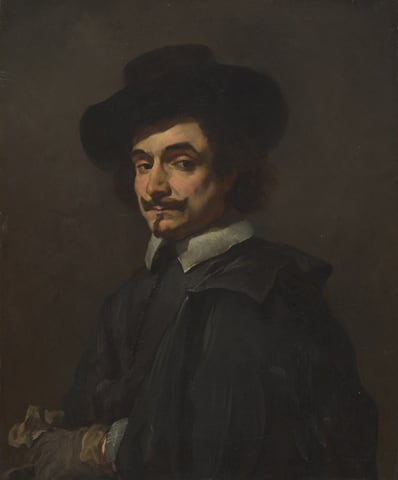
  2. A work made of oil on copper.
    Portrait of a ManJan Baptist Weenix, c. 1650Courtesy of the Art Institute of Chicago
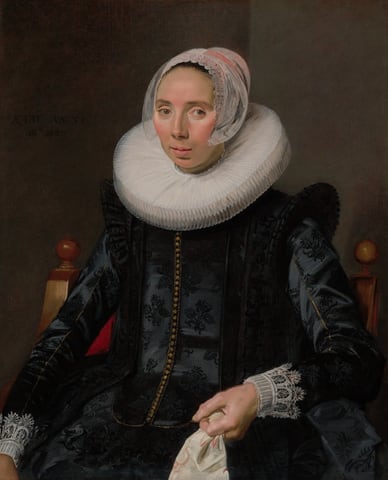
  3. A work made of oil on canvas.
    Portrait of a LadyFrans Hals, 1627Courtesy of the Art Institute of Chicago

Third room, north wall
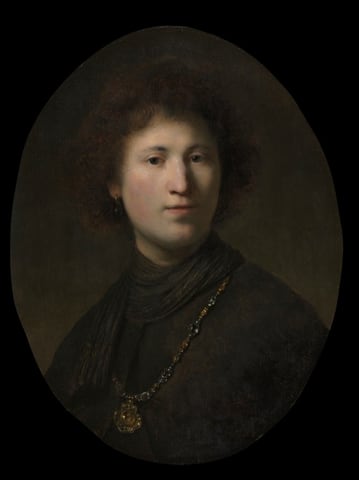
  1. A Young Man with a Chain, by Rembrandt van Rijn, c. 1629 or 1632
    A Young Man with a ChainRembrandt van Rijn, c. 1629 or 1632Courtesy of the Cleveland Museum of Art
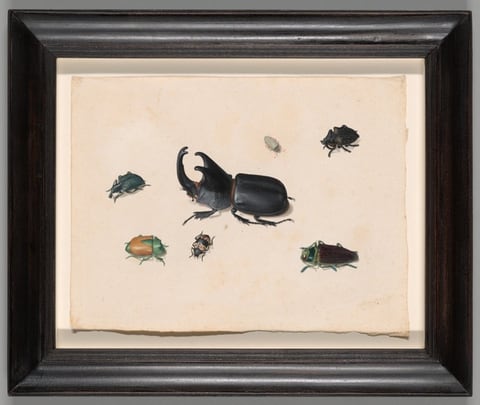
  2. A work made of watercolor and opaque watercolor on cream laid paper.
    Megasoma Elephas or Megaceras Jason and Six Other InsectsPieter Holsteyn, the younger, 1640/80Courtesy of the Art Institute of Chicago
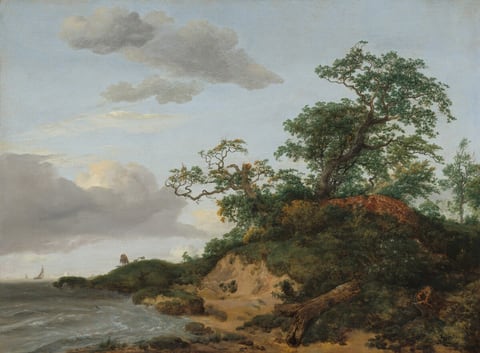
  3. Water laps at a curving shoreline in front of a steep sandy dune carpeted in grass, shrubs, and trees in this horizontal landscape painting. The dune takes up the lower right quadrant of the composition. A few broken tree trunks are overgrown with vines and plants across the top and down the sloping side of the dune facing us. A red brick wall cuts through the vegetation up the side of the dune and disappears into the shrubbery at the top. The twisting branches and canopies of three large trees reach into the upper right quadrant of the composition. The vegetation stops abruptly along the sheer edge of the dune where it faces the water. The land curves like a backward capital letter C so it almost reaches the left edge of the painting along the horizon, which comes a quarter of the way up the composition. A cow and three more animals, perhaps sheep or more cows, graze or lie on a grassy mound in the distance, and sailboats line the horizon in the deep distance. White ripples swirl in the steel-blue water. The artist signed and dated the lower center, “J Ruisdael . 1648.”
    Dunes by the SeaJacob van Ruisdael, 1648Courtesy National Gallery of Art, Washington