Floor plan

Time and place17th-century Netherlands
17th-century Netherlands
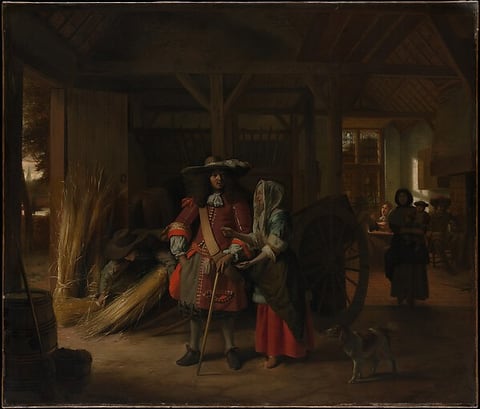
Paying the Hostess, by Pieter de Hooch, ca. 1670
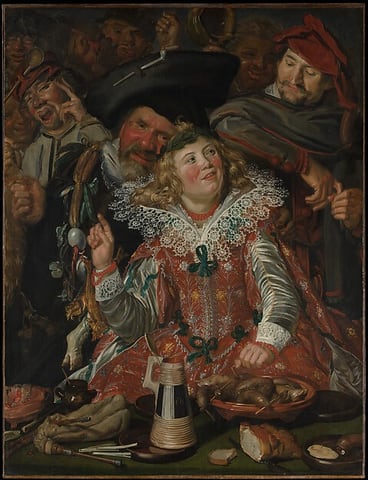
Merrymakers at Shrovetide, by Frans Hals, ca. 1616–17
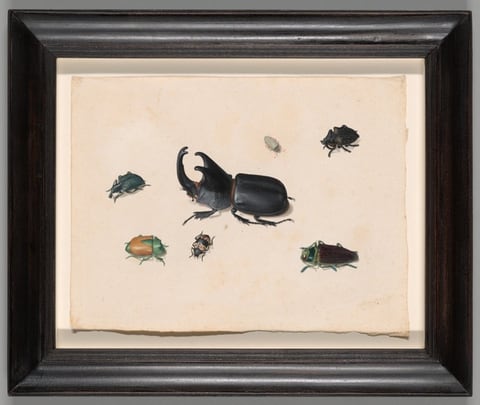
A work made of watercolor and opaque watercolor on cream laid paper.
The image shows a pastoral scene in black and white with fine line work. A small bridge with a circular archway crosses a stream. A dirt path winds through the landscape flanked by grass and bushes. A rocky cliff ascends on the left with a tower-like structure partially obscured by vegetation. The horizon features a cloudy sky, with swirling lines indicating motion. In the distance, a tall, thin structure, possibly a spire or chimney, stands amid faint hills and trees. The scene conveys a serene atmosphere through hatching and cross-hatching techniques.
A work made of oil on canvas.
Rush Gatherers, by Nicolaes Berchem, 1657

The works in this room are listed below.

Works in this room

Works made in the Netherlands in the 17th century.

First room, north wall

  1. Paying the Hostess, by Pieter de Hooch, ca. 1670
    Paying the HostessPieter de Hooch, ca. 1670Courtesy of The Metropolitan Museum of Art
  2. Merrymakers at Shrovetide, by Frans Hals, ca. 1616–17
    Merrymakers at ShrovetideFrans Hals, ca. 1616–17Courtesy of The Metropolitan Museum of Art
  3. A work made of watercolor and opaque watercolor on cream laid paper.
    Megasoma Elephas or Megaceras Jason and Six Other InsectsPieter Holsteyn, the younger, 1640/80Courtesy of the Art Institute of Chicago

First room, south wall

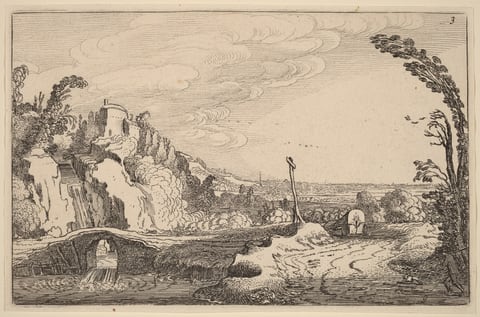
  1. The image shows a pastoral scene in black and white with fine line work. A small bridge with a circular archway crosses a stream. A dirt path winds through the landscape flanked by grass and bushes. A rocky cliff ascends on the left with a tower-like structure partially obscured by vegetation. The horizon features a cloudy sky, with swirling lines indicating motion. In the distance, a tall, thin structure, possibly a spire or chimney, stands amid faint hills and trees. The scene conveys a serene atmosphere through hatching and cross-hatching techniques.
    Cascade under a Stone BridgeJan van de Velde II, c. 1616Courtesy National Gallery of Art, Washington
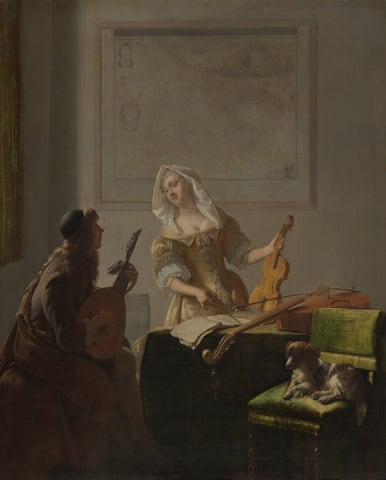
  2. A work made of oil on canvas.
    The Music LessonJacob Ochtervelt, 1671Courtesy of the Art Institute of Chicago
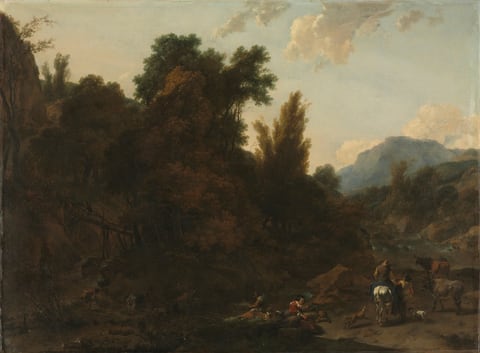
  3. Rush Gatherers, by Nicolaes Berchem, 1657
    Rush GatherersNicolaes Berchem, 1657Courtesy of the Cleveland Museum of Art

Second room, south wall
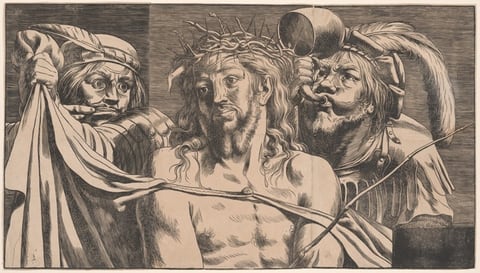
  1. A work made of woodcut on three joined sheets of ivory laid paper.
    The Mocking of ChristWerner van den Valckert, c. 1620Courtesy of the Art Institute of Chicago
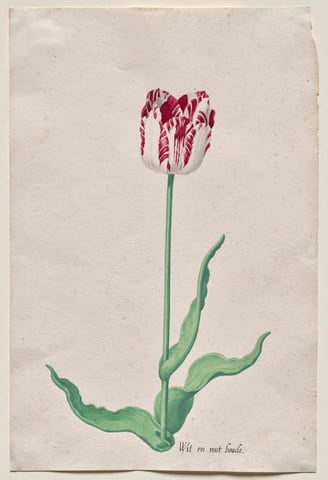
  2. Study of a Tulip (Wit en root boode), by Pieter Holsteyn II, c. 1645
    Study of a Tulip (Wit en root boode)Pieter Holsteyn II, c. 1645Courtesy of the Cleveland Museum of Art
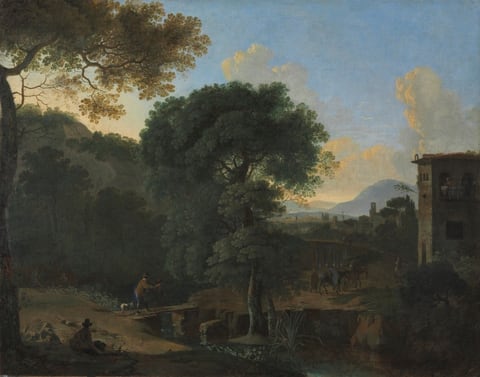
  3. Landscape with Travelers, by Herman van Swanevelt, 1630s
    Landscape with TravelersHerman van Swanevelt, 1630sCourtesy of the Cleveland Museum of Art

Second room, north wall
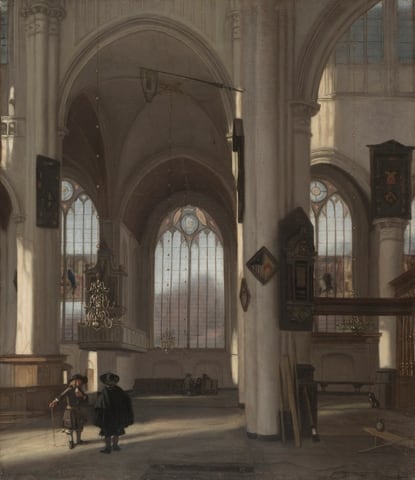
  1. Interior of a Church, by Emanuel de Witte, c. 1680
    Interior of a ChurchEmanuel de Witte, c. 1680Courtesy of the Cleveland Museum of Art
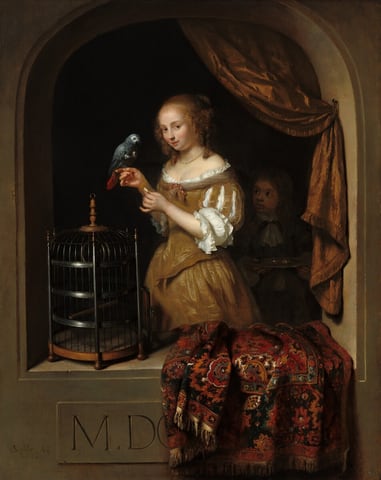
  2. Shown from about the knees up, a pale-skinned young woman stands within a stone niche, with a parrot perched on her finger as she gazes out at us in this vertical painting. The woman’s hands are raised to chest height, and she balances the spruce-blue parrot on the index finger of her far hand while her other hand holds an indistinct, white object. Her body is angled to our left, and she looks at us from the corner of her green eyes under faint brows. Her round face has a small nose, flushed cheeks, and her coral-red mouth curls up in a slight smile, her lips parted. Her honey-blond hair is gathered at the back of her head with curly tendrils framing her face and falling to her shoulders. She wears a golden-brown gown trimmed with a narrow ruffle of white fabric along the low neckline that reveals her décolletage. The bird faces the woman and lifts something, presumably a bit of food, up with one dark claw. The underside of its tail is crimson red. A light-skinned boy stands in deep shadow just to the right of the woman. He looks up at her and holds a silver tray in both hands. They stand within a light brown, arched, stone opening beyond a ledge, which comes up to about the woman’s knees. A carpet patterned with stylized flowers in ruby red, burnt orange, teal blue, white, and black is bunched up and draped over the parapet, to our right. A tall, iron-gray cage sits to our left. The rug partly covers an inscription on the front face of the niche that reads, “M. DO,” with the O cut off. A copper-colored, fringe-lined drapery hangs from the upper right of the arch and is fastened to the inner edge of the opening to create a swag. The woman is brightly lit from the upper left, and the space behind her and the boy is ink black. The artist signed and dated the lower left corner as if he had carved into the front face of the arch. It reads, “CNetscher .Ao. 16.66,” with the C and N overlapping to make a monogram.
    A Woman Feeding a Parrot, with a PageCaspar Netscher, 1666Courtesy National Gallery of Art, Washington
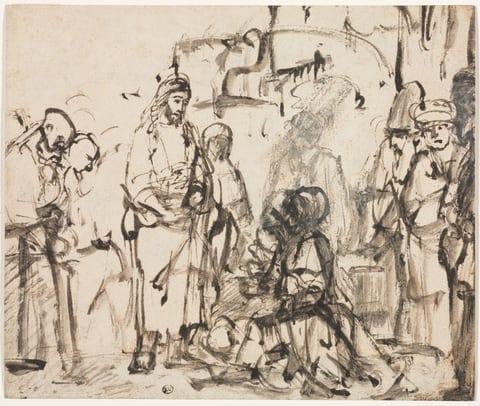
  3. The Meeting of Christ with Martha and Mary after the Death of Lazarus, by Rembrandt van Rijn, c. 1662–65
    The Meeting of Christ with Martha and Mary after the Death of LazarusRembrandt van Rijn, c. 1662–65Courtesy of the Cleveland Museum of Art
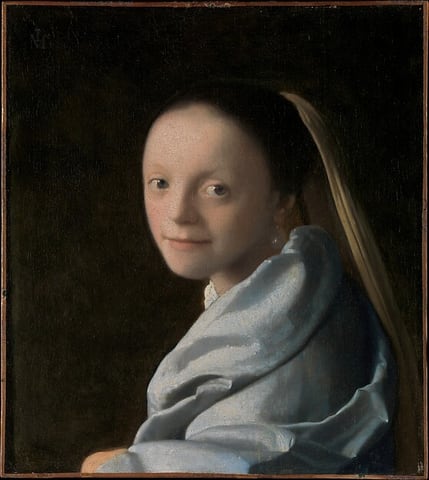
  4. Study of a Young Woman, by Johannes Vermeer, ca. 1665–67
    Study of a Young WomanJohannes Vermeer, ca. 1665–67Courtesy of The Metropolitan Museum of Art

Third room, north wall
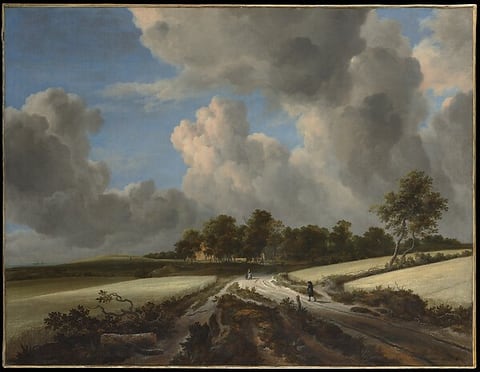
  1. Wheat Fields, by Jacob van Ruisdael, ca. 1670
    Wheat FieldsJacob van Ruisdael, ca. 1670Courtesy of The Metropolitan Museum of Art
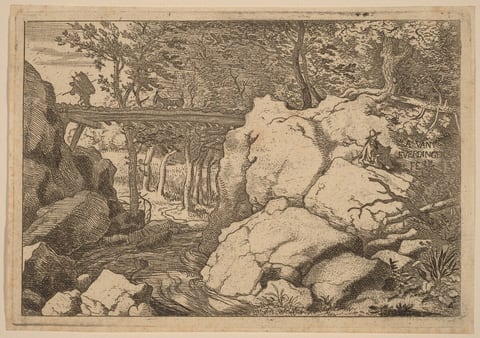
  2. The image shows a landscape with rocky terrain, trees, and a stream. In the foreground, there is a bridge with a traveler and a dog crossing over the stream. The scene features detailed linework and cross-hatching to depict texture. The color palette is monochrome brown, resembling an etching or drawing style.
    Goat on a small BridgeAllart van Everdingen, probably c. 1645/1656Courtesy National Gallery of Art, Washington
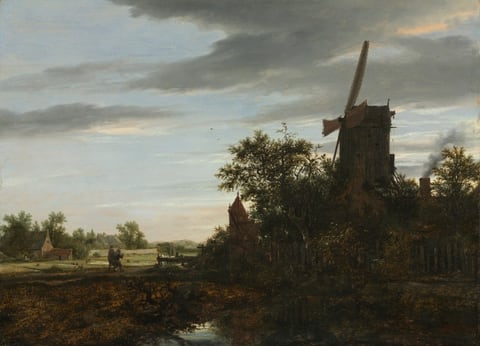
  3. Landscape with a Windmill, by Jacob van Ruisdael, 1646
    Landscape with a WindmillJacob van Ruisdael, 1646Courtesy of the Cleveland Museum of Art