Floor plan

Time and placeThe 16th century

The 16th century

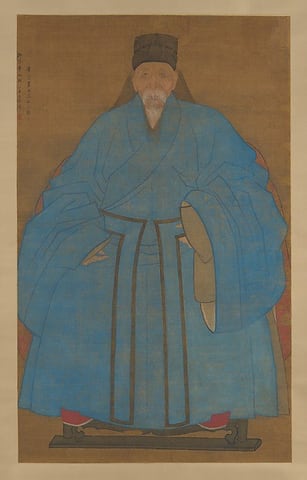
Portrait of the artist’s great-granduncle Yizhai at the age of eighty-five, by Ruan Zude, dated 1561 or 1621
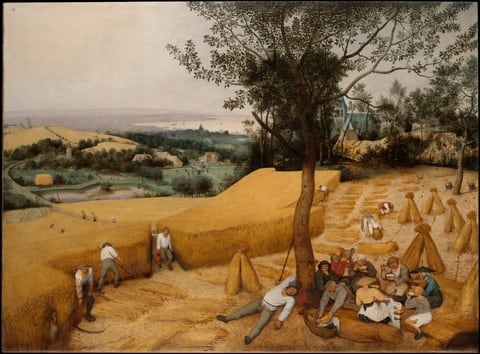
The Harvesters, by Pieter Bruegel, 1565
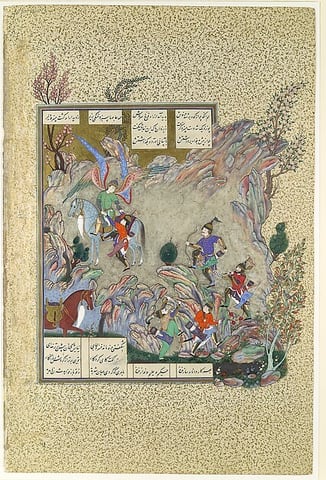
"The Angel Surush Rescues Khusrau Parviz from a Cul-de-sac", Folio 708v from the Shahnama (Book of Kings) of Shah Tahmasp, by Abu'l Qasim Firdausi, ca. 1530–35
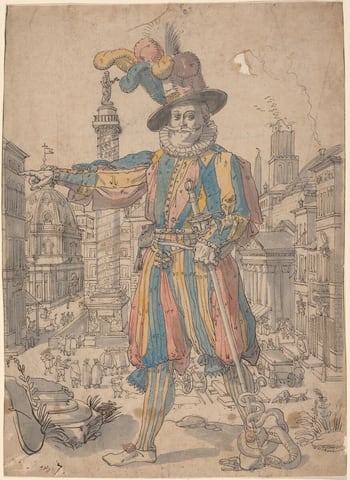
The artwork features a person standing prominently in front of an architectural scene. The individual has one arm extended out to the side, pointing with a gloved hand. The other hand holds a staff with a snake wrapped around it. The person has a stern facial expression, a beard and mustache, and wears a large hat with colorful feathers. They are dressed in a colorful suit with vertical stripes in red, blue, and yellow, paired with a ruffled collar and cuffs. The person also has an oversized sword at their hip. In the background, there is a Renaissance-style cityscape with architectural elements, people, and horse-drawn carriages.
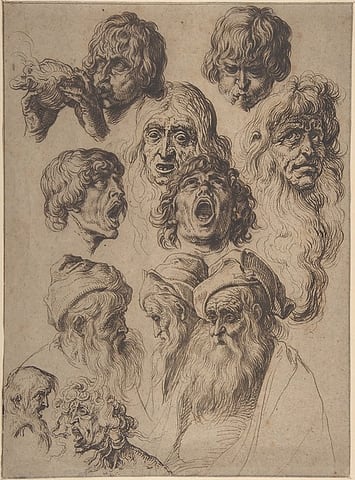
Study of Eleven Heads, by Jacques de Gheyn II, late 16th–early 17th century
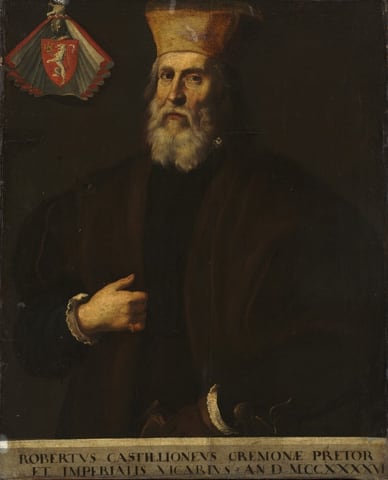
Portrait of Roberto Castiglione, early 1600s
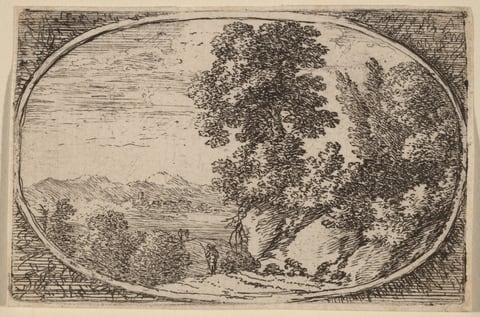
The image shows a landscape viewed from above. The scene is oval, framed by tree branches on each side. Distant mountains form a boundary near the top. Delicate, finely executed lines create detailed foliage and landscape features. A winding path with a small figure adds scale. Lush trees climb upwards, with a muted color palette of the paper and dark brown and black lines providing contrast.

The works in this room are listed below.

Works in this room

Works made in the 16th century, anywhere in the world.

First room, north wall

  1. Portrait of the artist’s great-granduncle Yizhai at the age of eighty-five, by Ruan Zude, dated 1561 or 1621
    Portrait of the artist’s great-granduncle Yizhai at the age of eighty-fiveRuan Zude, dated 1561 or 1621Courtesy of The Metropolitan Museum of Art
  2. The Harvesters, by Pieter Bruegel, 1565
    The HarvestersPieter Bruegel, 1565Courtesy of The Metropolitan Museum of Art
  3. "The Angel Surush Rescues Khusrau Parviz from a Cul-de-sac", Folio 708v from the Shahnama (Book of Kings) of Shah Tahmasp, by Abu'l Qasim Firdausi, ca. 1530–35
    "The Angel Surush Rescues Khusrau Parviz from a Cul-de-sac", Folio 708v from the Shahnama (Book of Kings) of Shah TahmaspAbu'l Qasim Firdausi, ca. 1530–35Courtesy of The Metropolitan Museum of Art

First room, south wall

  1. The artwork features a person standing prominently in front of an architectural scene. The individual has one arm extended out to the side, pointing with a gloved hand. The other hand holds a staff with a snake wrapped around it. The person has a stern facial expression, a beard and mustache, and wears a large hat with colorful feathers. They are dressed in a colorful suit with vertical stripes in red, blue, and yellow, paired with a ruffled collar and cuffs. The person also has an oversized sword at their hip. In the background, there is a Renaissance-style cityscape with architectural elements, people, and horse-drawn carriages.
    Giovanni Grosso of the Swiss Guards Standing before a View of RomeUnrecorded Swiss makerCourtesy National Gallery of Art, Washington
  2. Study of Eleven Heads, by Jacques de Gheyn II, late 16th–early 17th century
    Study of Eleven HeadsJacques de Gheyn II, late 16th–early 17th centuryCourtesy of The Metropolitan Museum of Art
  3. Portrait of Roberto Castiglione, early 1600s
    Portrait of Roberto CastiglioneUnrecorded Italian maker, early 1600sCourtesy of the Cleveland Museum of Art
  4. The image shows a landscape viewed from above. The scene is oval, framed by tree branches on each side. Distant mountains form a boundary near the top. Delicate, finely executed lines create detailed foliage and landscape features. A winding path with a small figure adds scale. Lush trees climb upwards, with a muted color palette of the paper and dark brown and black lines providing contrast.
    The Boulder Crowned with TreesHerman van SwaneveltCourtesy National Gallery of Art, Washington

Second room, south wall
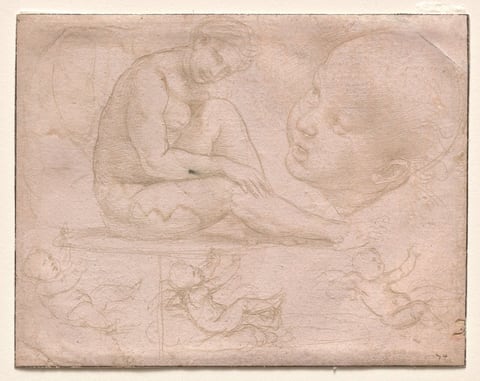
  1. Studies of a Seated Female, Child's Head, and Three Studies of a Baby, by Raphael, c. 1507–8
    Studies of a Seated Female, Child's Head, and Three Studies of a BabyRaphael, c. 1507–8Courtesy of the Cleveland Museum of Art
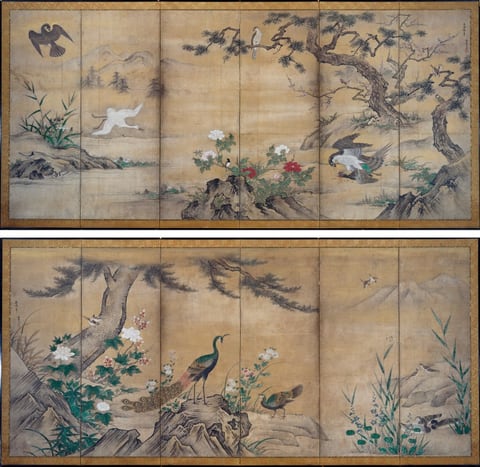
  2. Birds and Flowers, by Kano Mitsunobu, late 1500s
    Birds and FlowersKano Mitsunobu, late 1500sCourtesy of the Cleveland Museum of Art
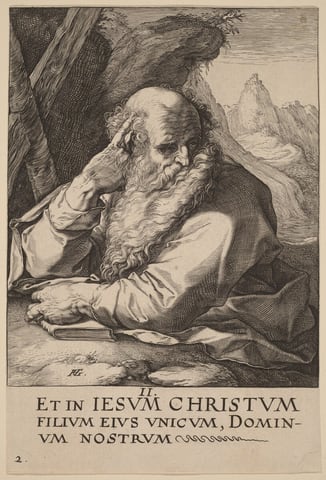
  3. The image shows an elderly man seated from the waist up. He is angled slightly away from the viewer, resting his head on one hand and leaning on the other arm. The man has a deeply lined face, a large beard, curly hair, and appears focused on something outside the frame. He wears flowing garments and a book is under his arm. In the background, there are rugged, mountainous rock formations. Ornate text frames the image at the bottom.
    Saint AndrewHendrick Goltzius, probably 1589Courtesy National Gallery of Art, Washington

Second room, north wall
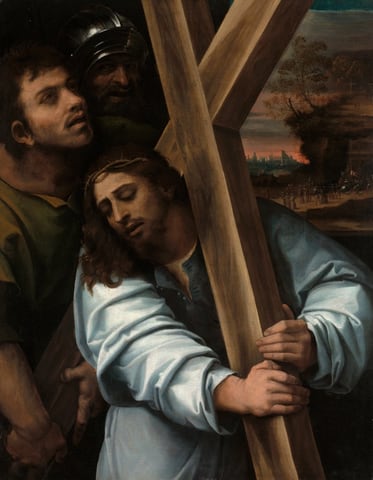
  1. A work made of oil on panel.
    Christ Carrying the CrossSebastiano del Piombo, c. 1515–17Courtesy of the Art Institute of Chicago
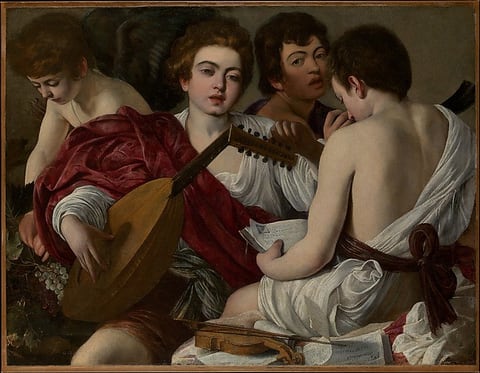
  2. The Musicians, by Caravaggio, 1597
    The MusiciansCaravaggio, 1597Courtesy of The Metropolitan Museum of Art
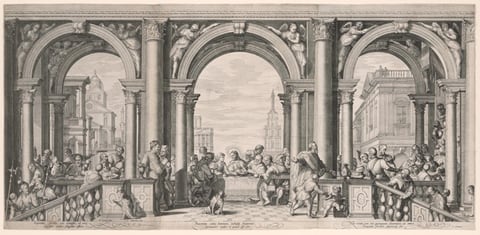
  3. A work made of engraving on three joined sheets of ivory laid paper.
    Christ at the Feast of SimonJan Saenredam, c. 1590-1600Courtesy of the Art Institute of Chicago

Third room, north wall
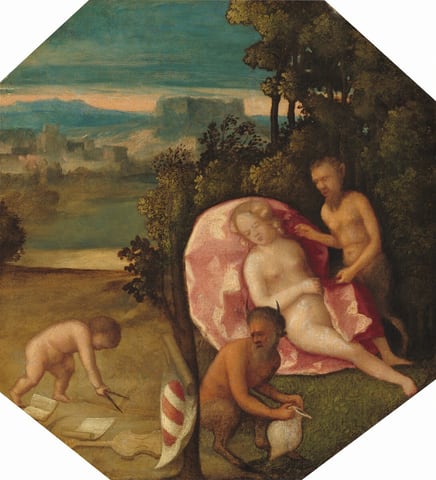
  1. A nude woman, pudgy child, and two satyrs, which have men’s heads and torsos with goat’s legs and horns, are in a landscape in this octagonal painting. The scene is divided in half by a tree stump which only reaches to the center of the composition. To the left of the stump, the pale-skinned, nude child stands and hunches over to draw on the ground with a V-shaped compass. Two pieces of paper and a violin lie nearby. The landscape behind him has a body of water leading back to a town with buildings streaked with peach, perhaps flames. A band of peach sky separates the blue silhouettes of mountains lining the horizon from the vivid blue sky above. At the bottom center of the painting, a shield with an oval horizontally striped with red and white leans on the boy’s side of the tree, which has one leafy branch growing on the left side. One satyr holds a jug and kneels close to the tree with his back to it as he looks back over one shoulder. He and the other satyr both have dark, peach-toned skin and full beards. The second satyr hovers to the right of the nude, sleeping woman, both hands reaching for her or the rose-pink cloth surrounding her. The woman has blond curls, a round face, and she sleeps with one hand resting across her belly and her head tipped to our left. The trio are on a grassy area enclosed by dense, dark-green bushes and trees.
    AllegoryPietro degli Ingannati, c. 1515-1525Courtesy National Gallery of Art, Washington
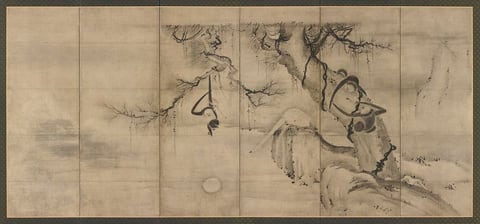
  2. Screens (six-panel)
    Monkeys and trees on a river bankSesson Shūkei, 1568-1615Courtesy of the National Museum of Asian Art, Smithsonian Institution
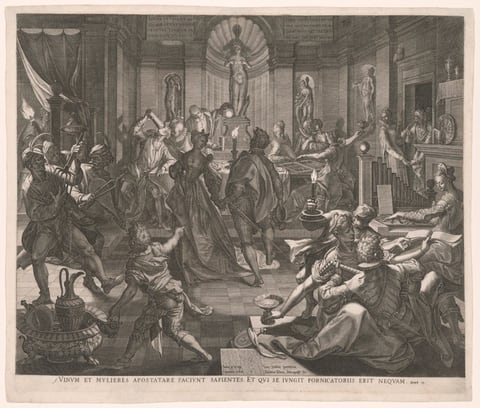
  3. A work made of engraving in black on cream laid paper.
    The Carnival (or the Prodigal Son)Jan Sadeler, I, 1588Courtesy of the Art Institute of Chicago