Floor plan

Time and placeThe 16th century

The 16th century

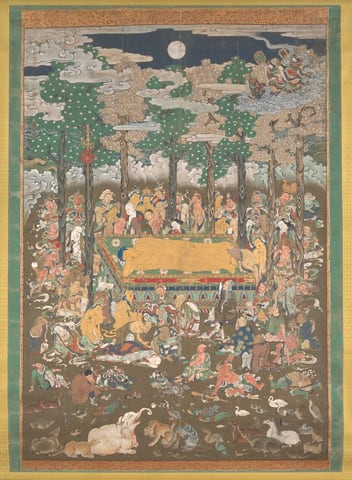
A work made of hanging scroll; ink, colors, and gold on silk.
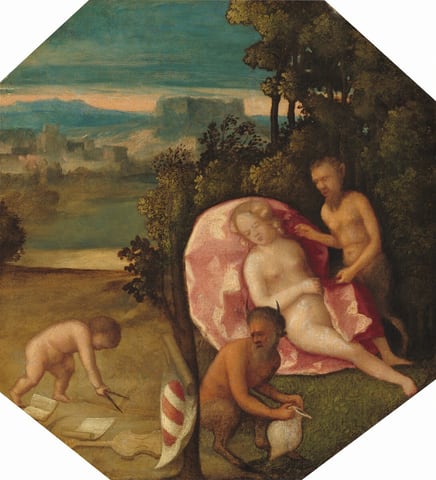
A nude woman, pudgy child, and two satyrs, which have men’s heads and torsos with goat’s legs and horns, are in a landscape in this octagonal painting. The scene is divided in half by a tree stump which only reaches to the center of the composition. To the left of the stump, the pale-skinned, nude child stands and hunches over to draw on the ground with a V-shaped compass. Two pieces of paper and a violin lie nearby. The landscape behind him has a body of water leading back to a town with buildings streaked with peach, perhaps flames. A band of peach sky separates the blue silhouettes of mountains lining the horizon from the vivid blue sky above. At the bottom center of the painting, a shield with an oval horizontally striped with red and white leans on the boy’s side of the tree, which has one leafy branch growing on the left side. One satyr holds a jug and kneels close to the tree with his back to it as he looks back over one shoulder. He and the other satyr both have dark, peach-toned skin and full beards. The second satyr hovers to the right of the nude, sleeping woman, both hands reaching for her or the rose-pink cloth surrounding her. The woman has blond curls, a round face, and she sleeps with one hand resting across her belly and her head tipped to our left. The trio are on a grassy area enclosed by dense, dark-green bushes and trees.
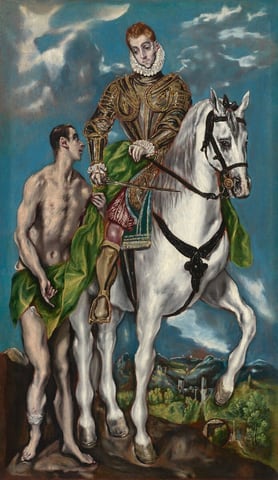
A nearly nude man with peachy skin stands next to and looks up at a man with ashen, ivory-colored skin, wearing armor and riding a bright white horse in this vertical painting. The horizon line comes less than a quarter of the way up the composition, and the sky behind the men and horse is vivid, aqua blue with a few silvery-gray and pale, yellow clouds floating along the top edge of the composition. The painting is created with long, blended brushstrokes, and the limbs and features of the two men and horse are elongated and have delicate, dark outlines. The horse’s body is angled to our right but it looks at us from the corners of its dark eyes. One front leg is raised. The rider looks down toward the man on foot at his side, to our left. The rider has dark, arched eyebrows, a long, straight nose, a pointed chin, and short, copper-orange hair. Wide ruffs pleated into figure-eights encircle his neck and wrists. His chest and arms are covered with plates of steel-gray armor edged and decorated with gold bands and medallions. He wears crimson-red pantaloons and stockings with mustard-yellow boots. With his right hand, to our left, he holds the gold hilt of a long, thin sword along the horse’s body. With his other hand, he holds a swath of lime-green fabric, which drapes down the side of the horse and across the hips of the man standing next to the rider. The sheen of the fabric is suggested with canary-yellow highlights where it catches the light. The standing man has short, dark brown hair and eyebrows. He looks to our right in profile, toward the rider, with pink lips parted. He holds the green fabric with his left hand, to our right, and he has a bandage around his leg near his right ankle. The horse and man stand on a spit of dark brown land, with a landscape of trees, buildings, and mountains deep in the distance beyond.
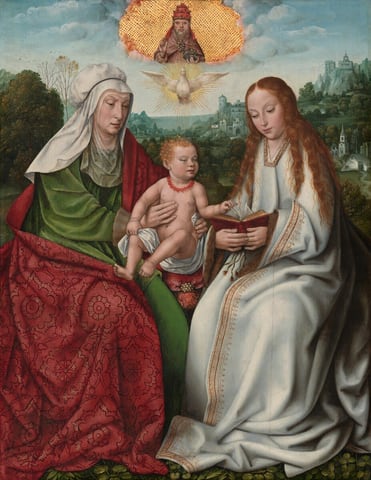
This painting depicts three people seated side-by-side outdoors. The central person is a young, nude child with curly, reddish hair and a red beaded necklace, sitting on a red cushion. Their head is turned to the right. The woman on the left wears a white head covering, a sheer veil around her neck, a green dress, and a red cloak with floral designs. She holds the torso of the child and drapes a white cloth around its legs. The woman on the right has long, flowing reddish hair and wears a white dress or robe with gold detailing down the front, on the neckline, and on the wrists. She holds an open red book, and the child is turning one of the thin pages. All three people have pale skin. Above them, in the cloudy blue sky, there is a white dove with its wings outstretched, gold lines radiating from it. Above the dove, there is an image of a crowned bearded man with pale skin, wearing red robes and holding an orb. He is against a golden background with red dots that breaks through the pale clouds. The background shows a landscape with green trees, hills, and pale blue buildings.
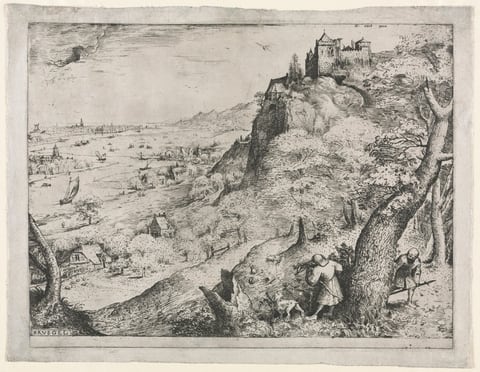
The Rabbit Hunt, by Pieter Bruegel, 1560
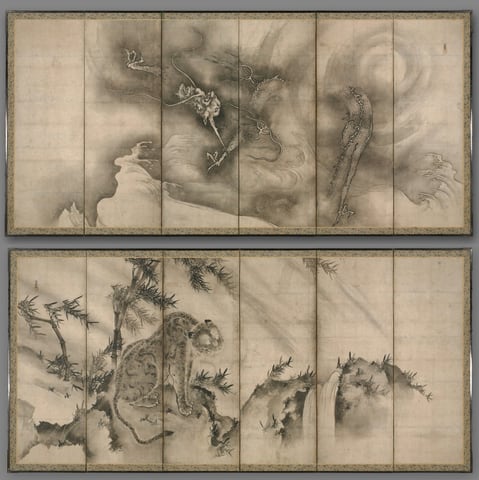
Dragon and Tiger, by Sesson Shūkei, c. 1546–56

The works in this room are listed below.

Works in this room

Works made in the 16th century, anywhere in the world.

First room, north wall

  1. A work made of hanging scroll; ink, colors, and gold on silk.
    Nehan: Death of the BuddhaUnrecorded Japanese maker, late 17th/early 18th centuryCourtesy of the Art Institute of Chicago
  2. A nude woman, pudgy child, and two satyrs, which have men’s heads and torsos with goat’s legs and horns, are in a landscape in this octagonal painting. The scene is divided in half by a tree stump which only reaches to the center of the composition. To the left of the stump, the pale-skinned, nude child stands and hunches over to draw on the ground with a V-shaped compass. Two pieces of paper and a violin lie nearby. The landscape behind him has a body of water leading back to a town with buildings streaked with peach, perhaps flames. A band of peach sky separates the blue silhouettes of mountains lining the horizon from the vivid blue sky above. At the bottom center of the painting, a shield with an oval horizontally striped with red and white leans on the boy’s side of the tree, which has one leafy branch growing on the left side. One satyr holds a jug and kneels close to the tree with his back to it as he looks back over one shoulder. He and the other satyr both have dark, peach-toned skin and full beards. The second satyr hovers to the right of the nude, sleeping woman, both hands reaching for her or the rose-pink cloth surrounding her. The woman has blond curls, a round face, and she sleeps with one hand resting across her belly and her head tipped to our left. The trio are on a grassy area enclosed by dense, dark-green bushes and trees.
    AllegoryPietro degli Ingannati, c. 1515-1525Courtesy National Gallery of Art, Washington
  3. A nearly nude man with peachy skin stands next to and looks up at a man with ashen, ivory-colored skin, wearing armor and riding a bright white horse in this vertical painting. The horizon line comes less than a quarter of the way up the composition, and the sky behind the men and horse is vivid, aqua blue with a few silvery-gray and pale, yellow clouds floating along the top edge of the composition. The painting is created with long, blended brushstrokes, and the limbs and features of the two men and horse are elongated and have delicate, dark outlines. The horse’s body is angled to our right but it looks at us from the corners of its dark eyes. One front leg is raised. The rider looks down toward the man on foot at his side, to our left. The rider has dark, arched eyebrows, a long, straight nose, a pointed chin, and short, copper-orange hair. Wide ruffs pleated into figure-eights encircle his neck and wrists. His chest and arms are covered with plates of steel-gray armor edged and decorated with gold bands and medallions. He wears crimson-red pantaloons and stockings with mustard-yellow boots. With his right hand, to our left, he holds the gold hilt of a long, thin sword along the horse’s body. With his other hand, he holds a swath of lime-green fabric, which drapes down the side of the horse and across the hips of the man standing next to the rider. The sheen of the fabric is suggested with canary-yellow highlights where it catches the light. The standing man has short, dark brown hair and eyebrows. He looks to our right in profile, toward the rider, with pink lips parted. He holds the green fabric with his left hand, to our right, and he has a bandage around his leg near his right ankle. The horse and man stand on a spit of dark brown land, with a landscape of trees, buildings, and mountains deep in the distance beyond.
    Saint Martin and the BeggarUnrecorded Greek maker, 1600/1614Courtesy National Gallery of Art, Washington

First room, south wall

  1. This painting depicts three people seated side-by-side outdoors. The central person is a young, nude child with curly, reddish hair and a red beaded necklace, sitting on a red cushion. Their head is turned to the right. The woman on the left wears a white head covering, a sheer veil around her neck, a green dress, and a red cloak with floral designs. She holds the torso of the child and drapes a white cloth around its legs. The woman on the right has long, flowing reddish hair and wears a white dress or robe with gold detailing down the front, on the neckline, and on the wrists. She holds an open red book, and the child is turning one of the thin pages. All three people have pale skin. Above them, in the cloudy blue sky, there is a white dove with its wings outstretched, gold lines radiating from it. Above the dove, there is an image of a crowned bearded man with pale skin, wearing red robes and holding an orb. He is against a golden background with red dots that breaks through the pale clouds. The background shows a landscape with green trees, hills, and pale blue buildings.
    Saint Anne with the Virgin and the Christ ChildMaster of Frankfurt, c. 1511/1515Courtesy National Gallery of Art, Washington
  2. The Rabbit Hunt, by Pieter Bruegel, 1560
    The Rabbit HuntPieter Bruegel, 1560Courtesy of the Cleveland Museum of Art
  3. Dragon and Tiger, by Sesson Shūkei, c. 1546–56
    Dragon and TigerSesson Shūkei, c. 1546–56Courtesy of the Cleveland Museum of Art

Second room, south wall
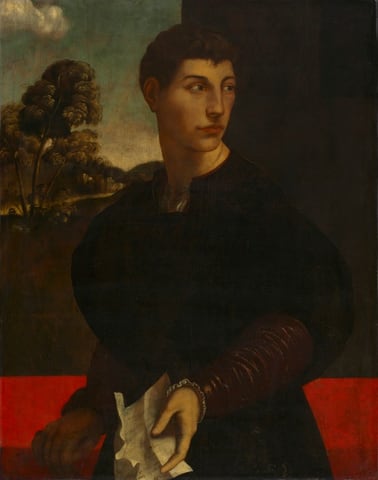
  1. Portrait of a Young Man, by Dosso Dossi, c. 1530
    Portrait of a Young ManDosso Dossi, c. 1530Courtesy of the Cleveland Museum of Art
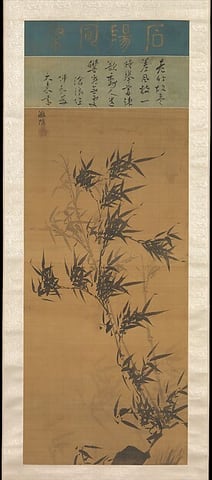
  2. Bamboo in the Wind, by Yi Jeong (artist name: Taneun), early 17th century
    Bamboo in the WindYi Jeong (artist name: Taneun), early 17th centuryCourtesy of The Metropolitan Museum of Art
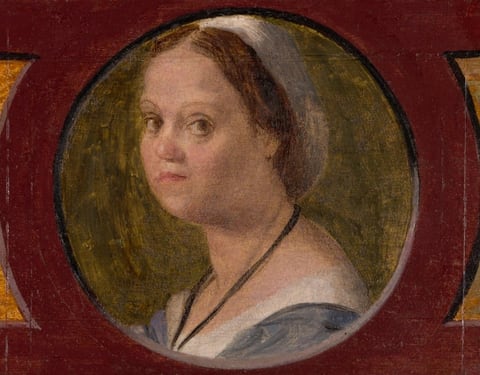
  3. A work made of oil on panel.
    Lucrezia di Lippo di Iacopo GuidiAndrea del Sarto, 1525–28Courtesy of the Art Institute of Chicago
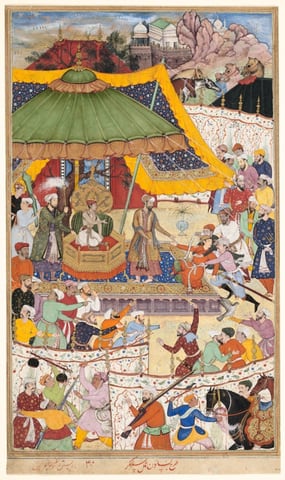
  4. A work made of opaque watercolor and gold on paper.
    The Young Emperor Akbar Arrests the Insolent Shah Abu’l-Maali, Page from a Manuscript of the AkbarnamaBasawan, Mughal dynasty (1526-1857), c. 1590-1595Courtesy of the Art Institute of Chicago

Second room, north wall
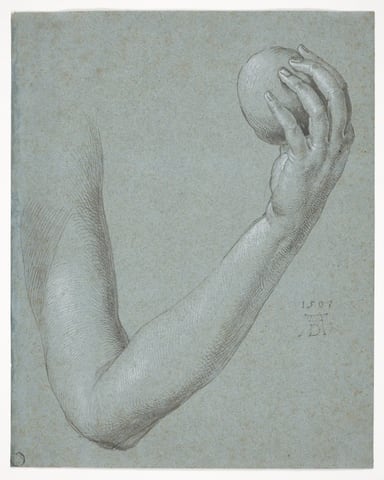
  1. Arm of Eve, by Albrecht Dürer, 1507
    Arm of EveAlbrecht Dürer, 1507Courtesy of the Cleveland Museum of Art
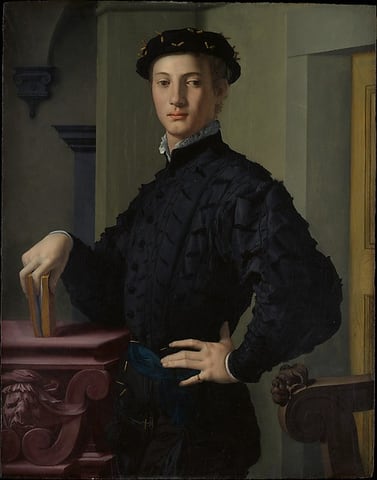
  2. Portrait of a Young Man, by Agnolo Bronzino, 1530s
    Portrait of a Young ManAgnolo Bronzino, 1530sCourtesy of The Metropolitan Museum of Art
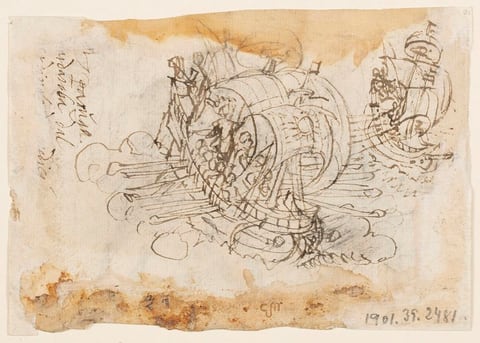
  3. TWO GALLEYS AT SEA
    Two Galleys at SeaJan van der Straet, called Stradanus, ca. 1587 – 1590Courtesy of Cooper Hewitt, Smithsonian Design Museum
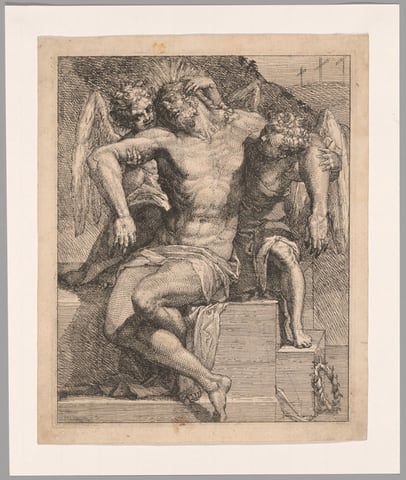
  4. A work made of etching in black on cream laid paper.
    Dead Christ Held by AngelsOrazio Samacchini, 1580/1620Courtesy of the Art Institute of Chicago

Third room, north wall
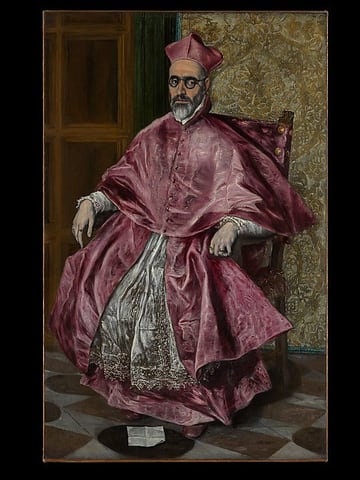
  1. Cardinal Fernando Niño de Guevara (1541–1609), by El Greco, ca. 1600
    Cardinal Fernando Niño de Guevara (1541–1609)El Greco, ca. 1600Courtesy of The Metropolitan Museum of Art
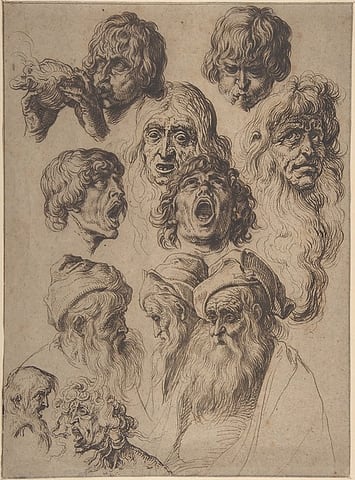
  2. Study of Eleven Heads, by Jacques de Gheyn II, late 16th–early 17th century
    Study of Eleven HeadsJacques de Gheyn II, late 16th–early 17th centuryCourtesy of The Metropolitan Museum of Art