Floor plan

Time and place16th-century Italy

16th-century Italy

A work made of oil on panel.
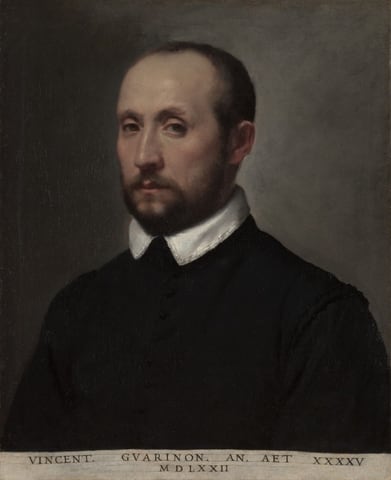
Portrait of Vincenzo Guarignoni, by Giovanni Battista Moroni, c. 1572
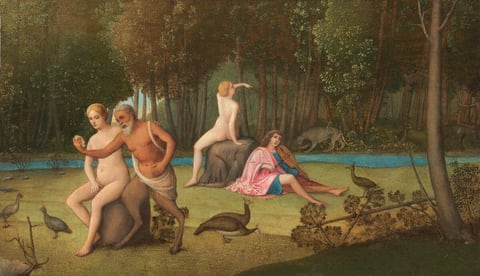
Two women, a man, and a satyr, a man with goat’s legs, are in two pairs in a forested landscape in this horizontal painting. The pale-skinned women are nude, and their blond hair is tied up and back. One woman sits on a brown boulder to the left of center. One hand covers her groin, and the other hand rests on the satyr’s shoulder. The satyr has deeply tanned skin, short white hair, and a long white beard. A white cloth wraps over one shoulder and across his hips. He holds up an object, perhaps a shell, with one hand. That arm crosses over the woman’s breasts. His other hand is by his lower belly, and he looks at the shell. A bit farther back and to our right, a second nude woman also sits on a boulder. She faces away from us and holds up a long stick with her left arm, which arcs over her body. A clean-shaven, pale-skinned man sits with his back against the boulder. He has long brown hair and looks off to the distance to our right. He wears a carnation-pink robe over a sapphire-blue tunic. His legs splay in front of him, his feet bare, as he holds a bow to a violin-like instrument tucked under his chin. The two pairs sit in a grassy glade occupied also by five pheasant- or peacock-like birds. A thin river running behind the glade is lined with spindly trees that together make an impenetrable bronze-brown and laurel-green canopy. The second woman’s stick points or is directed to a gray, mountain lion-like cat on the far bank. Closer inspection reveals deer and another person, who points, tucked among the trunks. A glimpse of blue sky is visible through a break in the tree trunks.
A work made of etching in black on cream laid paper.
Portrait of Roberto Castiglione, early 1600s
A work made of black chalk (recto), and black chalk and pen and black ink (verso), on ivory laid paper.
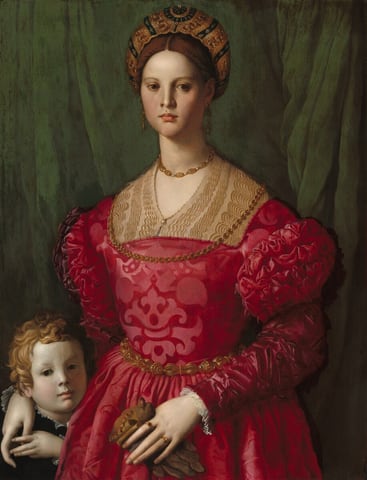
A woman wearing a crimson-red brocade dress and gold jewelry fills most of this vertical portrait, but her right hand, on our left, rests on the shoulder of a young boy tucked into the lower left corner of the panel. The woman and boy both have pale, white skin, and both face and look out at us against an emerald-green curtain that falls behind them. The woman has brown eyes, a straight nose, full pink lips, smooth cheeks, and a long neck. Her brown hair is pulled back under a turban densely embroidered with gold. The woman’s dress has puffed shoulders and decorative slashes on the sleeves. One gold chain rests on her throat and the other falls over her chest. She wears long gold earrings, a gold belt, and two gold rings. She holds a brown leather glove in her left hand. The boy’s face is even with the woman’s waist, and he raises his left hand to hold hers, which is draped over his shoulder. He has curly blond hair and dark eyes, and he wears black with a ruffled white shirt just visible at his collar.
A work made of black chalk on laid paper, laid down on tan laid pulp board.

The works in this room are listed below.

Works in this room

Works made in Italy in the 16th century.

First room, north wall

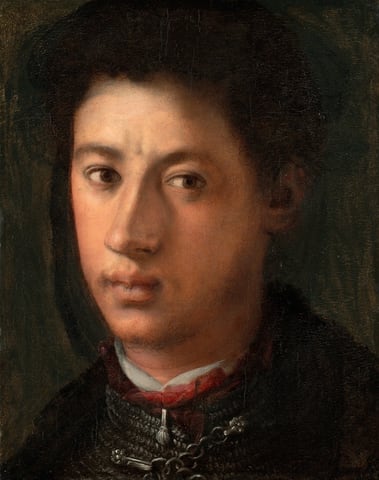
  1. A work made of oil on panel.
    Alessandro de' MediciPontormo, (Jacopo Carrucci), 1534–35Courtesy of the Art Institute of Chicago
  2. Portrait of Vincenzo Guarignoni, by Giovanni Battista Moroni, c. 1572
    Portrait of Vincenzo GuarignoniGiovanni Battista Moroni, c. 1572Courtesy of the Cleveland Museum of Art
  3. Two women, a man, and a satyr, a man with goat’s legs, are in two pairs in a forested landscape in this horizontal painting. The pale-skinned women are nude, and their blond hair is tied up and back. One woman sits on a brown boulder to the left of center. One hand covers her groin, and the other hand rests on the satyr’s shoulder. The satyr has deeply tanned skin, short white hair, and a long white beard. A white cloth wraps over one shoulder and across his hips. He holds up an object, perhaps a shell, with one hand. That arm crosses over the woman’s breasts. His other hand is by his lower belly, and he looks at the shell. A bit farther back and to our right, a second nude woman also sits on a boulder. She faces away from us and holds up a long stick with her left arm, which arcs over her body. A clean-shaven, pale-skinned man sits with his back against the boulder. He has long brown hair and looks off to the distance to our right. He wears a carnation-pink robe over a sapphire-blue tunic. His legs splay in front of him, his feet bare, as he holds a bow to a violin-like instrument tucked under his chin. The two pairs sit in a grassy glade occupied also by five pheasant- or peacock-like birds. A thin river running behind the glade is lined with spindly trees that together make an impenetrable bronze-brown and laurel-green canopy. The second woman’s stick points or is directed to a gray, mountain lion-like cat on the far bank. Closer inspection reveals deer and another person, who points, tucked among the trunks. A glimpse of blue sky is visible through a break in the tree trunks.
    OrpheusUnrecorded Italian maker, c. 1515Courtesy National Gallery of Art, Washington
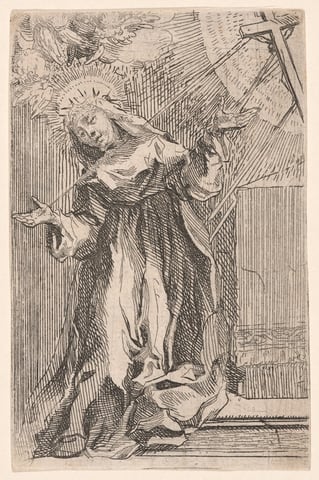
  4. A work made of etching in black on cream laid paper.
    Saint Catherine of Siena Receiving the StigmataFrancesco Vanni, c. 1595Courtesy of the Art Institute of Chicago

First room, south wall

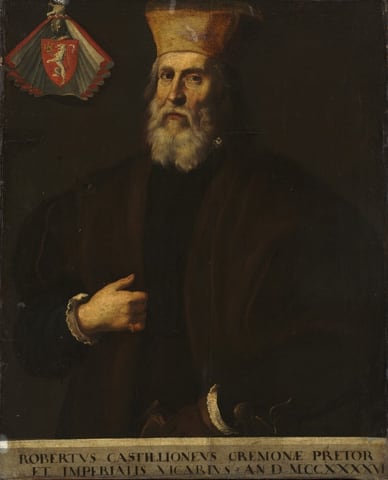
  1. Portrait of Roberto Castiglione, early 1600s
    Portrait of Roberto CastiglioneUnrecorded Italian maker, early 1600sCourtesy of the Cleveland Museum of Art
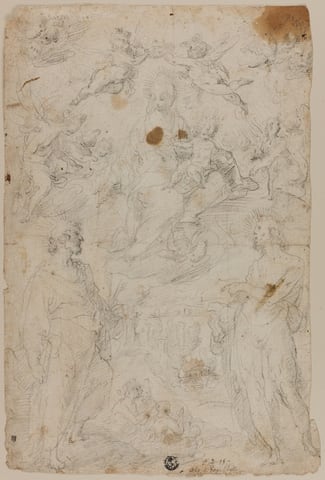
  2. A work made of black chalk (recto), and black chalk and pen and black ink (verso), on ivory laid paper.
    Virgin and Child with Saints Peter and John the Baptist (recto); Saint John the Baptist (verso)Pietro d' Asaro, n.d.Courtesy of the Art Institute of Chicago
  3. A woman wearing a crimson-red brocade dress and gold jewelry fills most of this vertical portrait, but her right hand, on our left, rests on the shoulder of a young boy tucked into the lower left corner of the panel. The woman and boy both have pale, white skin, and both face and look out at us against an emerald-green curtain that falls behind them. The woman has brown eyes, a straight nose, full pink lips, smooth cheeks, and a long neck. Her brown hair is pulled back under a turban densely embroidered with gold. The woman’s dress has puffed shoulders and decorative slashes on the sleeves. One gold chain rests on her throat and the other falls over her chest. She wears long gold earrings, a gold belt, and two gold rings. She holds a brown leather glove in her left hand. The boy’s face is even with the woman’s waist, and he raises his left hand to hold hers, which is draped over his shoulder. He has curly blond hair and dark eyes, and he wears black with a ruffled white shirt just visible at his collar.
    A Young Woman and Her Little BoyAgnolo Bronzino, c. 1540Courtesy National Gallery of Art, Washington
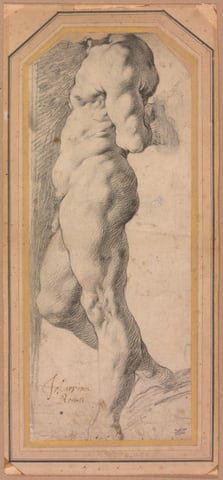
  4. A work made of black chalk on laid paper, laid down on tan laid pulp board.
    Study of a Standing Male NudeGiuseppe Cesari, called Cavaliere d'Arpino, 1595/96Courtesy of the Art Institute of Chicago

Second room, south wall
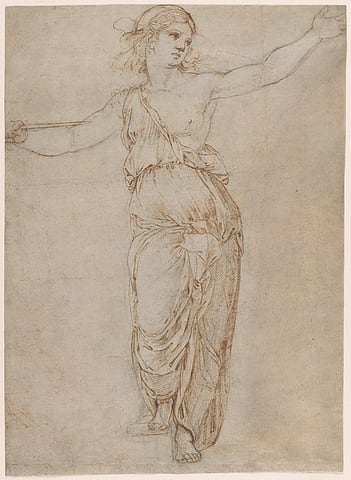
  1. Lucretia, by Raphael, 1508–10
    LucretiaRaphael, 1508–10Courtesy of The Metropolitan Museum of Art
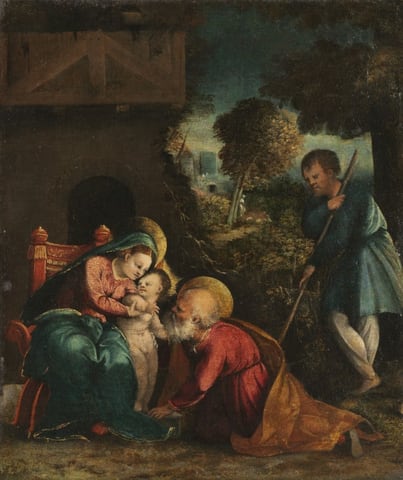
  2. Holy Family with a Shepherd, by Battista Dossi, early 1520s
    Holy Family with a ShepherdBattista Dossi, early 1520sCourtesy of the Cleveland Museum of Art
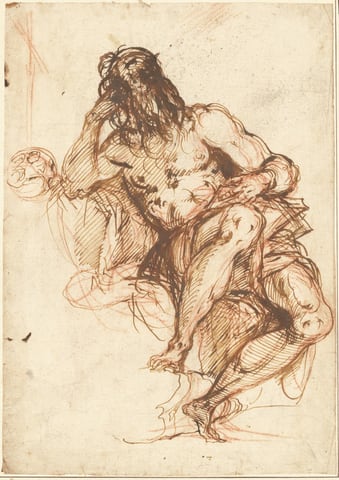
  3. The image shows a sketch of a seated bearded figure holding an orb. The figure appears muscular, with a beard merging into long hair. The face is not detailed, and draped fabric covers part of the body. There is no jewelry, and the background is plain.
    Saint JeromeAlessandro Vittoria, 1565/1570Courtesy National Gallery of Art, Washington
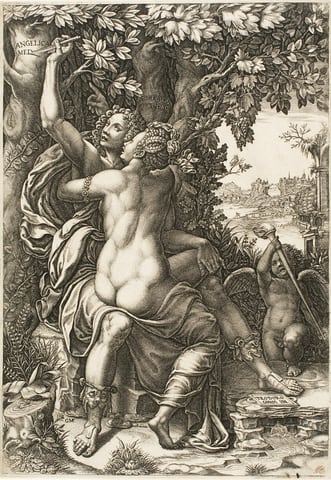
  4. A work made of engraving in black on ivory laid paper.
    Angelica and MedoroGiorgio Ghisi, c. 1570Courtesy of the Art Institute of Chicago

Second room, north wall
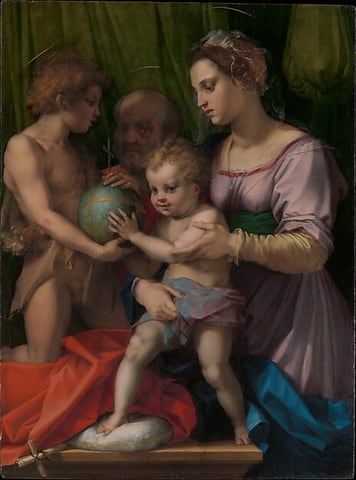
  1. The Holy Family with the Young Saint John the Baptist, by Andrea del Sarto, ca. 1528
    The Holy Family with the Young Saint John the BaptistAndrea del Sarto, ca. 1528Courtesy of The Metropolitan Museum of Art
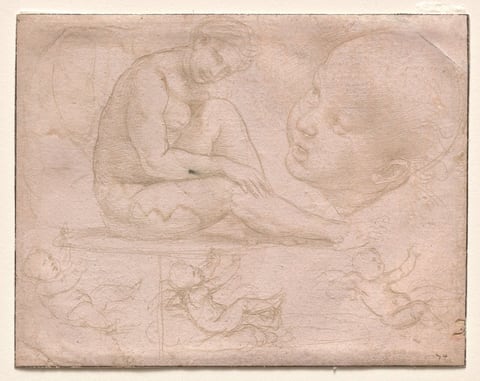
  2. Studies of a Seated Female, Child's Head, and Three Studies of a Baby, by Raphael, c. 1507–8
    Studies of a Seated Female, Child's Head, and Three Studies of a BabyRaphael, c. 1507–8Courtesy of the Cleveland Museum of Art
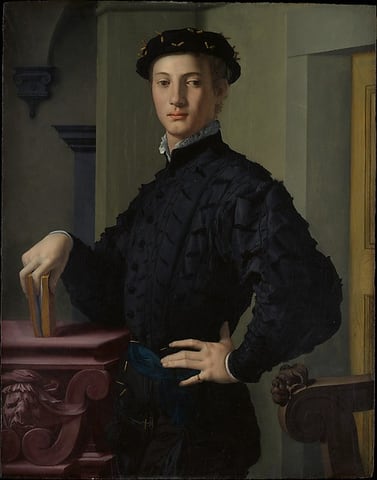
  3. Portrait of a Young Man, by Agnolo Bronzino, 1530s
    Portrait of a Young ManAgnolo Bronzino, 1530sCourtesy of The Metropolitan Museum of Art
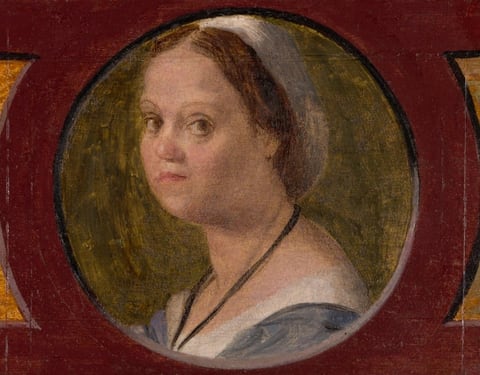
  4. A work made of oil on panel.
    Lucrezia di Lippo di Iacopo GuidiAndrea del Sarto, 1525–28Courtesy of the Art Institute of Chicago