Floor plan

South wing: ThemesThe Sea

The Sea

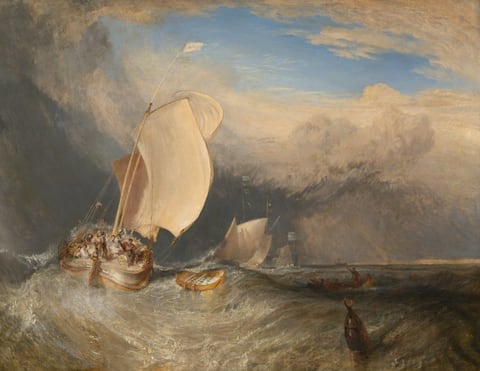
Large marine landscape of boats on rough waves, storm clouds.
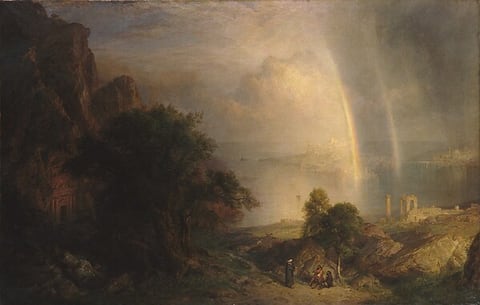
The Aegean Sea, by Frederic Edwin Church, ca. 1877
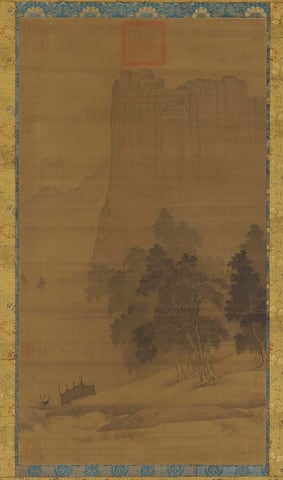
Hanging scroll (mounted on panel)
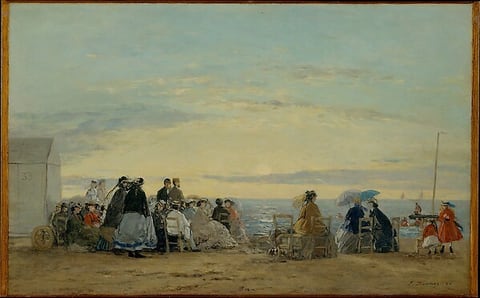
On the Beach, Sunset, by Eugène Boudin, 1865
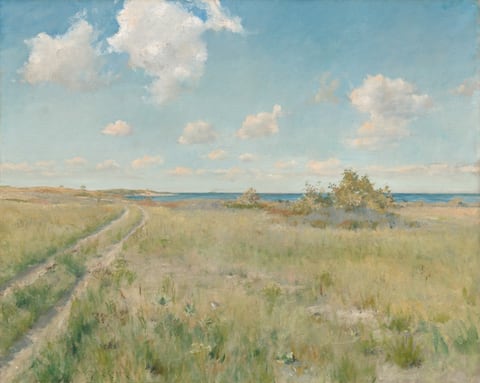
The Old Road to the Sea, by William Merritt Chase, c. 1893

The works in this room are listed below.

Works in this room

Harbours, beaches and open water, from Dutch ships under heavy cloud to American coasts at midday. Painters went to the sea for its weather as much as its boats, and the shoreline became one of the places where open-air painting was worked out.

Section 1, north wall

  1. Large marine landscape of boats on rough waves, storm clouds.
    Fishing Boats with Hucksters Bargaining for FishJoseph Mallord William Turner, 1837–38Courtesy of the Art Institute of Chicago
  2. The Aegean Sea, by Frederic Edwin Church, ca. 1877
    The Aegean SeaFrederic Edwin Church, ca. 1877Courtesy of The Metropolitan Museum of Art

Section 1, south wall

  1. Hanging scroll (mounted on panel)
    After the rain: fishing nets drying on the shoreTraditionally attributed to Li Tang, 1368-1644Courtesy of the National Museum of Asian Art, Smithsonian Institution
  2. On the Beach, Sunset, by Eugène Boudin, 1865
    On the Beach, SunsetEugène Boudin, 1865Courtesy of The Metropolitan Museum of Art
  3. The Old Road to the Sea, by William Merritt Chase, c. 1893
    The Old Road to the SeaWilliam Merritt Chase, c. 1893Courtesy of the Cleveland Museum of Art

Section 2, south wall
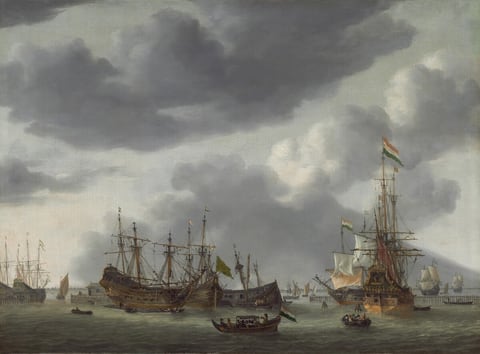
  1. A sage-green harbor teems with more than a dozen sailing ships and rowboats under a pale gray sky in this horizontal painting. The horizon comes about one-fifth of the way up the composition, and dark gray and white clouds tower above. Light filters onto the scene through the clouds from our left to fall across the ships while casting shadows on the water nearest us. Painted in tones of slate gray and warm brown, most of the ships closest to us have their sails furled so the masts and horizontal yard arms bristle against the sky. The larger ships have cannons poking out of square portholes. On our right, a war ship floats with its ornately carved and gilded stern facing us. A flag flying from the tallest of the three masts has red, white, and green stripes. The artist painted his name on that flag, “R. Zeeman.” The ship is tied to a buoy with a length of rope, and an empty rowboat is tethered to the right side of the ship. A similar ship but with the sails hanging loosely is tied to a buoy just beyond this one. A row of pickets, like a fence, extends into the water behind these two ships. To our left, a rowboat full of men has pulled up alongside a partially sunken ship, its masts tilting toward us. A few people stand on two more ships nearby. A black temporary dock floats next to the leftmost ship here. A person mixes something that smokes on the platform, and another person stands on a board lifted halfway up the ship’s side, presumably working on a repair. Two women in another rowboat next to the floating dock lean over the side, washing clothes. Another fence encloses the harbor to our left, and a hut in the middle of the harbor is surrounded by a similar structure. Two rowboats closer to us are filled with men wearing tall hats and black or brown coats, and women wearing black bonnets and white shawls. More sailing ships and rowboats move back or around beyond the harbor, out to sea. Visible cracks cover the surface of the painting.
    Amsterdam Harbor SceneReinier Nooms, called Zeeman, c. 1654/1655Courtesy National Gallery of Art, Washington
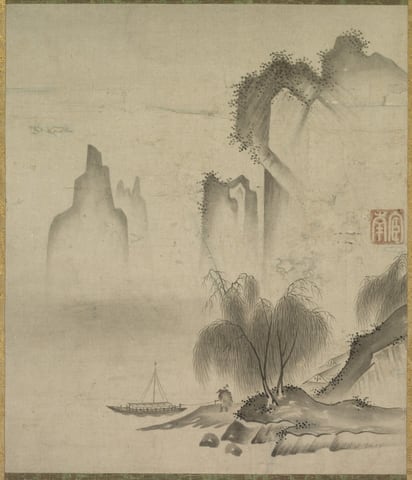
  2. Figure Mooring a Boat, by Kannan, mid-1500s
    Figure Mooring a BoatKannan, mid-1500sCourtesy of the Cleveland Museum of Art
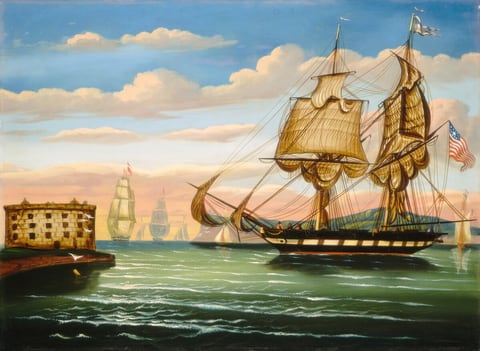
  3. Bay of New York, Sunset, by Thomas Chambers, mid 19th century
    Bay of New York, SunsetThomas Chambers, mid 19th centuryCourtesy National Gallery of Art, Washington

Section 2, north wall
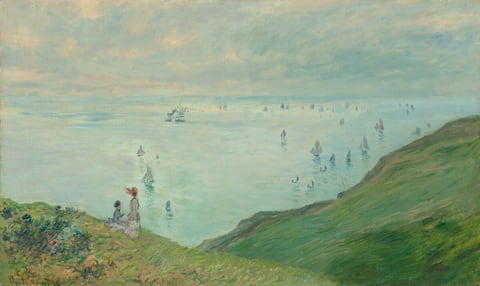
  1. From a high perspective, we look beyond two overlapping, emerald-green hills to a body of powder-blue water dotted with sailboats in this loosely painted horizontal landscape. Closest to us, the hills create a shallow V that spans the lower third of the composition, with the right-hand hill rising to more than halfway up the right edge. The hills are painted with dashes and long strokes mostly in seafoam, shamrock, and celery green, with some swipes of peach, goldenrod yellow, and royal blue. On the hill to our left, one woman sits and the other stands next to her. They wear hats, long-sleeved, fitted jackets, and long skirts in tones of dusky pink and dove gray. A touch of peach on the seated woman, to our left, gives the impression of a pale face. A red veil or scarf at the back of the other woman’s hat is lifted, as if in the wind. The water is painted with blended strokes of pale blue, light turquoise, smoky mauve pink, and touches of soft peach. The horizon comes two-thirds of the way up the composition, and the sky is painted with the same tones of blue, green, and peach to suggest a screen of clouds. Triangles and dashes of slate blue suggest about three dozen sailboats, rowboats, and one steamship in the rippling water. Squiggles of teal and sage green create reflections for some of the boats. The brushstrokes are visible throughout. In some areas, the paint is so thinly applied that the texture of the canvas shows through, especially in the sky. The artist signed the work in the lower left corner: “Claude Monet 82.”
    Cliffs at PourvilleClaude Monet, 1882Courtesy National Gallery of Art, Washington
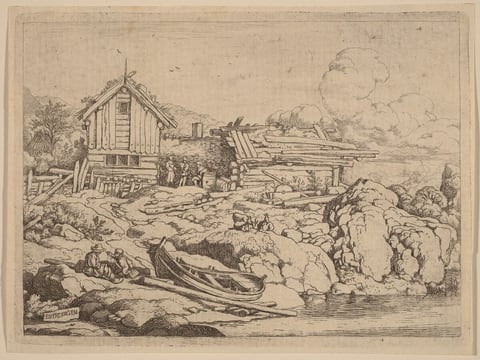
  2. The image shows a landscape with figures near a body of water. There are buildings made of logs, people gathered near a structure, and trees in the background. The style is detailed with precise linework, shading, and hatching. The color palette is monochrome, emphasizing light and shadow.
    Boat at a River Bank with Three GoatsAllart van Everdingen, probably c. 1645/1656Courtesy National Gallery of Art, Washington
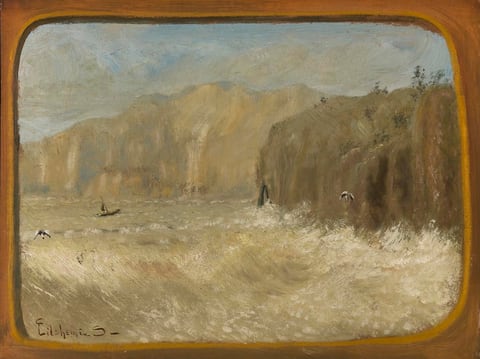
  3. Two Gulls and Cliffs, by Louis M. Eilshemius, ca. 1913-1921
    Two Gulls and CliffsLouis M. Eilshemius, ca. 1913-1921Courtesy of the Smithsonian American Art Museum

Section 3, north wall
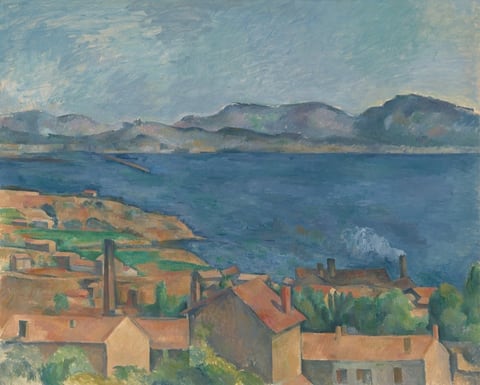
  1. Impressionist sea landscape, tan houses, blue ocean, distant mountains.
    The Bay of Marseille, Seen from L'EstaquePaul Cézanne, c. 1885Courtesy of the Art Institute of Chicago
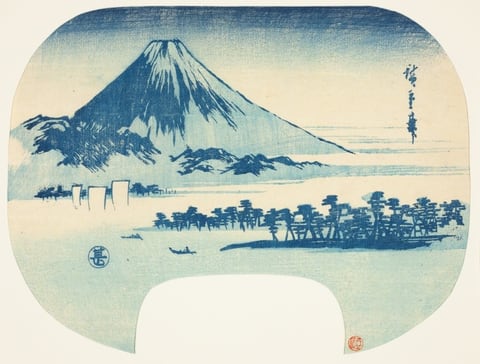
  2. A work made of color woodblock print; uchiwa-e, aizuri-e.
    Mount Fuji Rising beyond Miho BeachUtagawa Hiroshige, c. 1838/42Courtesy of the Art Institute of Chicago
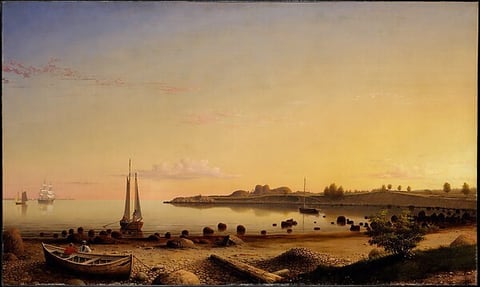
  3. Stage Fort across Gloucester Harbor, by Fitz Henry Lane, 1862
    Stage Fort across Gloucester HarborFitz Henry Lane, 1862Courtesy of The Metropolitan Museum of Art

Section 3, south wall
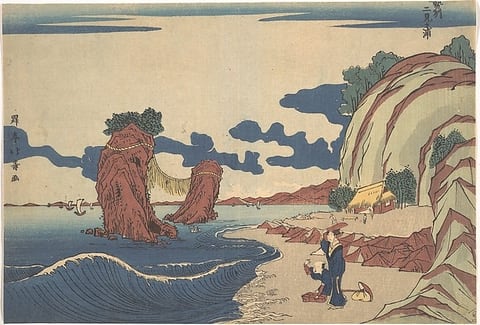
  1. View of Futami Beach at Ise, by Shōtei Hokuju, ca. 1810–1820
    View of Futami Beach at IseShōtei Hokuju, ca. 1810–1820Courtesy of The Metropolitan Museum of Art
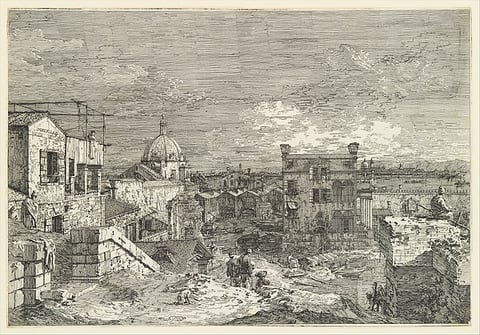
  2. Imaginary View of Venice, houses at left with figures on terraces, a domed church at center in the background, boats and boat-sheds below, and a seated man observing from a wall at right in the foreground, from "Views" (Vedute altre prese da i luoghi altre ideate da Antonio Canal), by Canaletto, 1741
    Imaginary View of Venice, houses at left with figures on terraces, a domed church at center in the background, boats and boat-sheds below, and a seated man observing from a wall at right in the foreground, from "Views" (Vedute altre prese da i luoghi altre ideate da Antonio Canal)Canaletto, 1741Courtesy of The Metropolitan Museum of Art