Floor plan

Style galleriesPrints of the 19th century
Prints of the 19th century
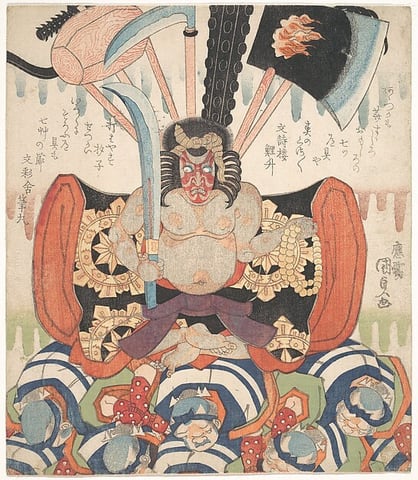
Danjūrō VII's Benkei as Fudō Myōō, by Utagawa Kunisada, ca. 1824
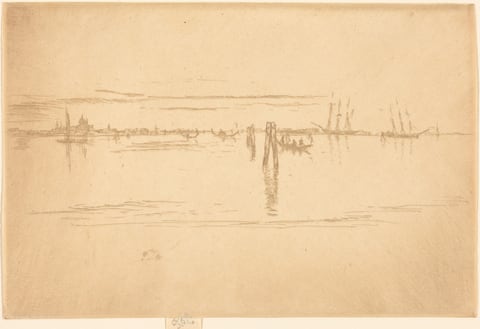
The image shows a landscape with a waterscape. The horizon separates the water and the sky. In the distance, there are buildings, structures, and ships with tall masts. Close to us, there are reflections of the ships and structures in the water with fine brushstrokes. The style is impressionistic with thin lines conveying details. The color palette is monochromatic with sepia tones.
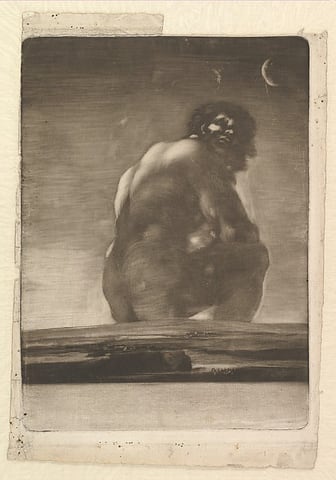
Seated Giant, by Francisco Goya, by 1818 (possibly 1814–18)
The image shows a sparse drawing of a landscape. A tree with elongated branches is on the left side, with a twist in its trunk. Near the horizon, there are several sailing boats on calm water. The composition suggests a vast openness and distance. The sketching is subtle and precise, focusing on gentle contouring and minimal detail. The color palette is monochromatic, dominated by a muted brown tone. The overall impact is serene and understated, inviting the viewer to focus on the hints of narrative within the scene.
A work made of engraving and etching in black on ivory wove paper.
A work made of photogravure in dark brown retouched with soft varnish (vernis mou), roulette and blue handcoloring on thick cream wove paper.

The works in this room are listed below.

Works in this room

Prints made in the 19th century, from every museum.

Section 1, north wall

  1. Danjūrō VII's Benkei as Fudō Myōō, by Utagawa Kunisada, ca. 1824
    Danjūrō VII's Benkei as Fudō MyōōUtagawa Kunisada, ca. 1824Courtesy of The Metropolitan Museum of Art
  2. The image shows a landscape with a waterscape. The horizon separates the water and the sky. In the distance, there are buildings, structures, and ships with tall masts. Close to us, there are reflections of the ships and structures in the water with fine brushstrokes. The style is impressionistic with thin lines conveying details. The color palette is monochromatic with sepia tones.
    Long LagoonJames McNeill Whistler, 1880Courtesy National Gallery of Art, Washington
  3. Seated Giant, by Francisco Goya, by 1818 (possibly 1814–18)
    Seated GiantFrancisco Goya, by 1818 (possibly 1814–18)Courtesy of The Metropolitan Museum of Art

Section 1, south wall

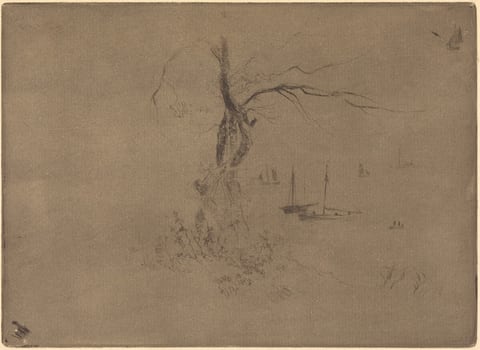
  1. The image shows a sparse drawing of a landscape. A tree with elongated branches is on the left side, with a twist in its trunk. Near the horizon, there are several sailing boats on calm water. The composition suggests a vast openness and distance. The sketching is subtle and precise, focusing on gentle contouring and minimal detail. The color palette is monochromatic, dominated by a muted brown tone. The overall impact is serene and understated, inviting the viewer to focus on the hints of narrative within the scene.
    Arbres et Bateaux (Trees and Boats)Félix-Hilaire BuhotCourtesy National Gallery of Art, Washington
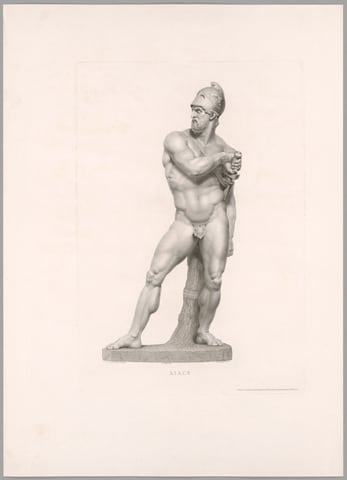
  2. A work made of engraving and etching in black on ivory wove paper.
    Ajax, Front View, from Oeuvre de CanovaAntonio Canova, 1817Courtesy of the Art Institute of Chicago
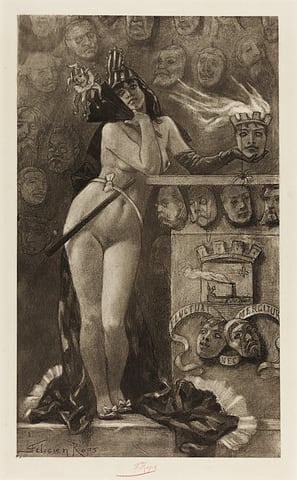
  3. A work made of photogravure in dark brown retouched with soft varnish (vernis mou), roulette and blue handcoloring on thick cream wove paper.
    Modern MasksFélicien Rops, 1889Courtesy of the Art Institute of Chicago

Section 2, south wall
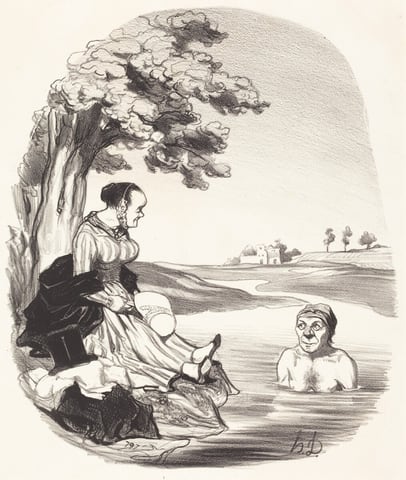
  1. The image shows a woman sitting beside a body of water, under a tree. She is wearing a long dress and holding a bonnet by her side. In the water, a person is visible from the shoulders up with short hair. The background includes a landscape with trees, water, and a distant structure that resembles a house or castle.
    L'Eau est délicieuse... je t'assure...Honoré Daumier, 1845Courtesy National Gallery of Art, Washington
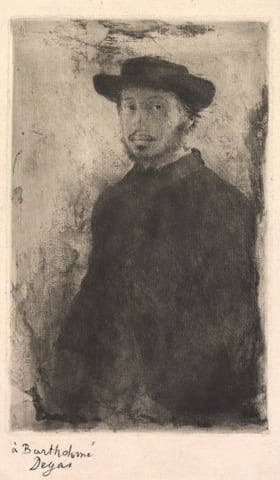
  2. Self-Portrait, by Edgar Degas, 1857
    Self-PortraitEdgar Degas, 1857Courtesy of the Cleveland Museum of Art
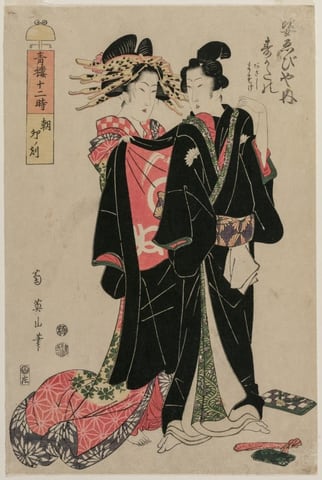
  3. Sugatano of Sugata Ebisuya in the Morning, Hour of the Rabbit, from the series The Twelve Hours in the Pleasure Quarters, by Kikukawa Eizan, 1812
    Sugatano of Sugata Ebisuya in the Morning, Hour of the Rabbit, from the series The Twelve Hours in the Pleasure QuartersKikukawa Eizan, 1812Courtesy of the Cleveland Museum of Art

Section 2, north wall
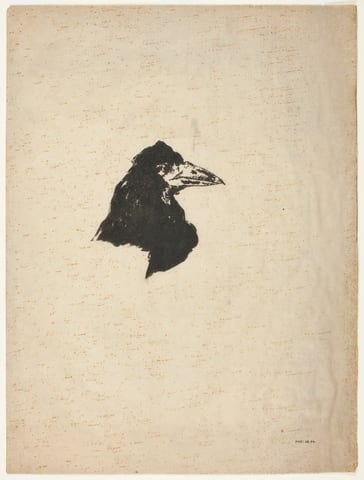
  1. A work made of transfer lithograph in black on tan simili-parchment paper.
    Head of a Raven in Profile, from The Raven (Le Corbeau)Édouard Manet, 1875Courtesy of the Art Institute of Chicago
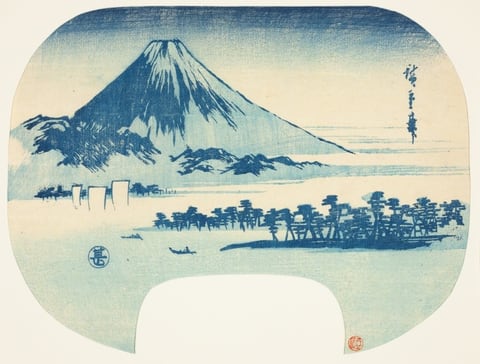
  2. A work made of color woodblock print; uchiwa-e, aizuri-e.
    Mount Fuji Rising beyond Miho BeachUtagawa Hiroshige, c. 1838/42Courtesy of the Art Institute of Chicago

Section 3, north wall
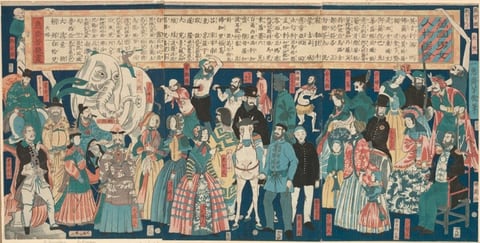
  1. A work made of color woodblock print; oban triptych.
    Picture of Men and Women from Many Countries (Bankoku danjo jinbutsu zue)Utagawa Yoshiiku, 1861Courtesy of the Art Institute of Chicago
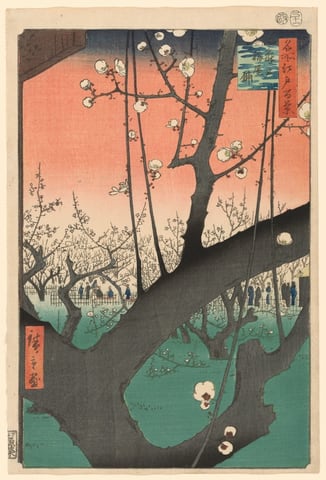
  2. A work made of color woodblock print; ōban.
    Plum Garden at Kameido (Kameido Umeyashiki), from the series "One Hundred Famous Views of Edo (Meisho Edo hyakkei)"Utagawa Hiroshige, 1857Courtesy of the Art Institute of Chicago

Section 3, south wall
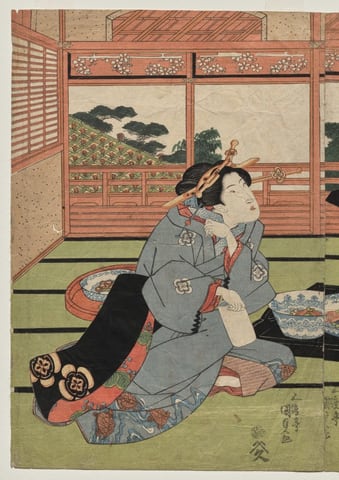
  1. A View of the Large New Room at Sakurai, by Utagawa Kunisada, early or mid 1830s
    A View of the Large New Room at SakuraiUtagawa Kunisada, early or mid 1830sCourtesy of the Cleveland Museum of Art
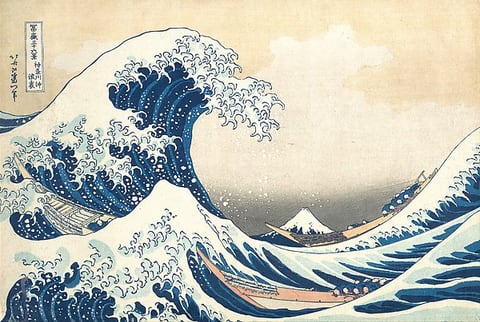
  2. Under the Wave off Kanagawa (Kanagawa oki nami ura), also known as The Great Wave, from the series Thirty-six Views of Mount Fuji (Fugaku sanjūrokkei), by Katsushika Hokusai, ca. 1830–32
    Under the Wave off Kanagawa (Kanagawa oki nami ura), also known as The Great Wave, from the series Thirty-six Views of Mount Fuji (Fugaku sanjūrokkei)Katsushika Hokusai, ca. 1830–32Courtesy of The Metropolitan Museum of Art
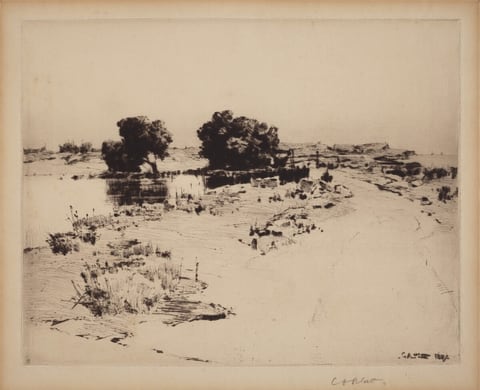
  3. The image depicts a landscape seen from a slightly elevated perspective, with a tranquil scene. The horizon is high in the composition, showing a vast view. There are a few distant trees and silhouettes blending into the sky. The brushstrokes are expressive and fluid, with a sketch-like quality depicting texture and movement in the trees and ground. The color palette is primarily monochrome, using shades of black and grey. Near the viewer, there are low plants and shrubs on sandy ground, leading to a small body of water reflecting dense trees. In the distance, the landscape becomes more open and sparse towards the horizon.
    Cape Ann WillowsCharles A. Platt, 1887Courtesy National Gallery of Art, Washington