Floor plan

Style galleriesPaintings

Paintings

A work made of oil on canvas.
A work made of oil on panel.
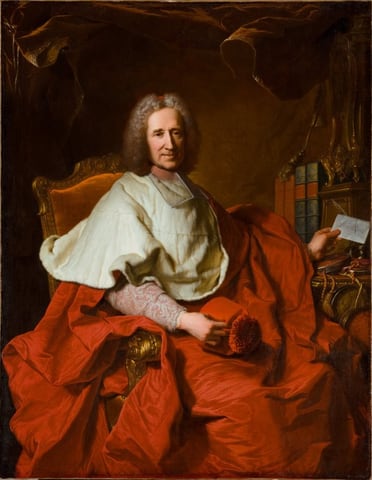
Portrait of Cardinal Guillaume Dubois, by Hyacinthe Rigaud, 1723
A work made of oil on canvas.
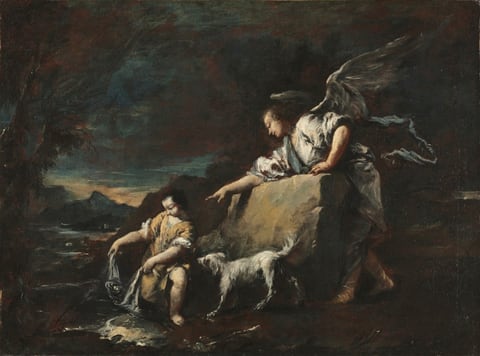
Tobias and the Angel, by Francesco Guardi, 1750s
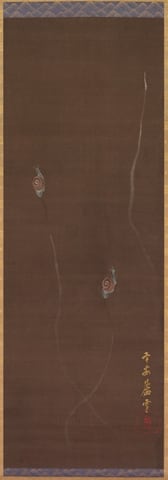
Snails, by Nagasawa Rosetsu, c. 1788–89
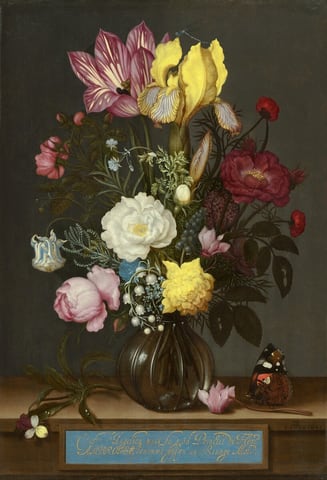
Gathered in a round glass vase, a tall bouquet of flowers in shades of light and deep pink, sunshine yellow, and white with pine-green leaves nearly fills this vertical still life painting. Shown against an gray background, the vase sits on a narrow ledge, perhaps made of wood. A label with looping, cursive French text painted in gold against a baby blue background is affixed to the front of the ledge, along the bottom edge of the composition. The text reads, “C'est l'Angelicq main du grad Peinctre de Flore AMBROISE, renommé jusqu' au Rivage Moré.” A few of the flowers draw the eye, including a tulip and iris at the top of the bouquet. To our left, the tulip is mauve pink with cream-colored streaks, and one petal folds down to reveal the stamen inside. Next to it, a damselfly, an insect like a delicate dragonfly, rests on the vibrant yellow iris. The petals curling down from the iris are veined in muted burgundy red. Flowers filling in the bouquet below include a shell-pink cyclamen, a white gardenia, a closed blue and white striped columbine, a slate-blue grape hyacinth, lily of the valley, pale blue forget-me-nots, and a pink peony interspersed with leaves and greenery. The round glass vase has a narrow opening. A sprig of viola rests to our left of the vase on the ledge, and an orange, black, white, and brown butterfly perches on the stem of a pink cyclamen laying to our right of the vase. The artist signed the painting with a monogram and dated it in dark paint to our right on the face of the ledge: “AB 1621.”

The works in this room are listed below.

Works in this room

Every one of the collection's paintings, in today's hang.

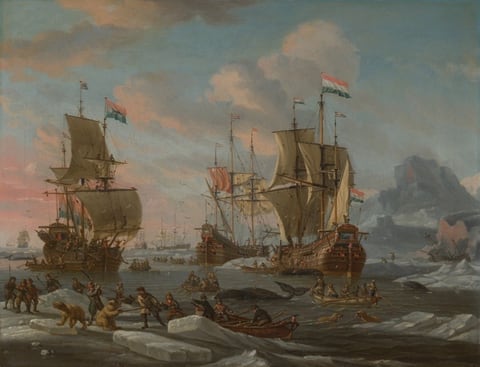
First room, north wall

  1. A work made of oil on canvas.
    The Dutch Whaling FleetAbraham Storck, c. 1695Courtesy of the Art Institute of Chicago
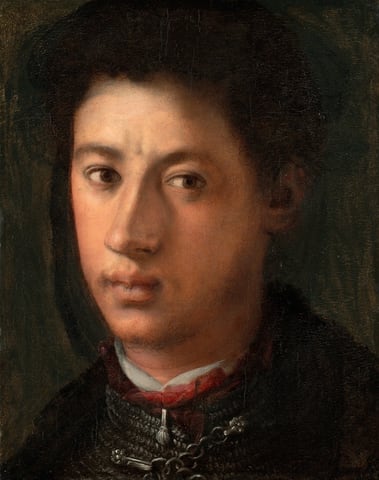
  2. A work made of oil on panel.
    Alessandro de' MediciPontormo, (Jacopo Carrucci), 1534–35Courtesy of the Art Institute of Chicago
  3. Portrait of Cardinal Guillaume Dubois, by Hyacinthe Rigaud, 1723
    Portrait of Cardinal Guillaume DuboisHyacinthe Rigaud, 1723Courtesy of the Cleveland Museum of Art

First room, south wall

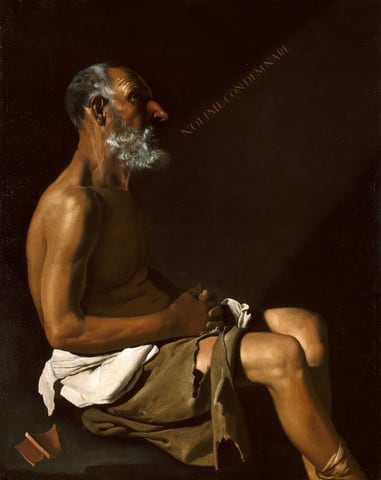
  1. A work made of oil on canvas.
    JobSpanish, c. 1618–c. 1630Courtesy of the Art Institute of Chicago
  2. Tobias and the Angel, by Francesco Guardi, 1750s
    Tobias and the AngelFrancesco Guardi, 1750sCourtesy of the Cleveland Museum of Art
  3. Snails, by Nagasawa Rosetsu, c. 1788–89
    SnailsNagasawa Rosetsu, c. 1788–89Courtesy of the Cleveland Museum of Art
  4. Gathered in a round glass vase, a tall bouquet of flowers in shades of light and deep pink, sunshine yellow, and white with pine-green leaves nearly fills this vertical still life painting. Shown against an gray background, the vase sits on a narrow ledge, perhaps made of wood. A label with looping, cursive French text painted in gold against a baby blue background is affixed to the front of the ledge, along the bottom edge of the composition. The text reads, “C'est l'Angelicq main du grad Peinctre de Flore AMBROISE, renommé jusqu' au Rivage Moré.” A few of the flowers draw the eye, including a tulip and iris at the top of the bouquet. To our left, the tulip is mauve pink with cream-colored streaks, and one petal folds down to reveal the stamen inside. Next to it, a damselfly, an insect like a delicate dragonfly, rests on the vibrant yellow iris. The petals curling down from the iris are veined in muted burgundy red. Flowers filling in the bouquet below include a shell-pink cyclamen, a white gardenia, a closed blue and white striped columbine, a slate-blue grape hyacinth, lily of the valley, pale blue forget-me-nots, and a pink peony interspersed with leaves and greenery. The round glass vase has a narrow opening. A sprig of viola rests to our left of the vase on the ledge, and an orange, black, white, and brown butterfly perches on the stem of a pink cyclamen laying to our right of the vase. The artist signed the painting with a monogram and dated it in dark paint to our right on the face of the ledge: “AB 1621.”
    Bouquet of Flowers in a Glass VaseAmbrosius Bosschaert, 1621Courtesy National Gallery of Art, Washington

Second room, south wall
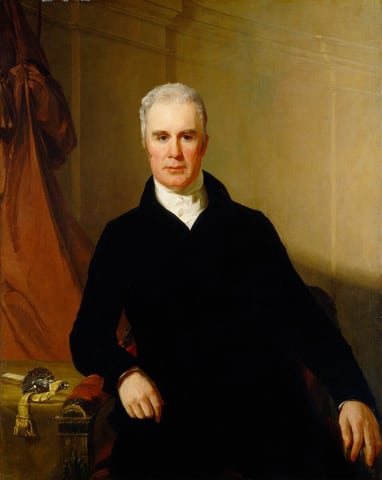
  1. The image shows an upper-body portrait of a man seated in a formal position. The man is depicted with a slight turn of his head, directly facing the viewer with a composed expression. He has short gray hair that is neatly styled. His facial features include a high forehead and firm jawline. He is dressed in a dark formal jacket with a high-collared white shirt visible at the neckline. His left hand rests on the arm of the chair, which is ornately carved with a scroll design. A fabric with an intricate pattern is draped over the back of the chair. There is no visible jewelry. In the background, there is a muted backdrop with a warm hue. On the left side of the image, a flowing drapery in a rich reddish tone adds depth to the setting.
    Charles Carnan RidgelyThomas Sully, 1820Courtesy National Gallery of Art, Washington
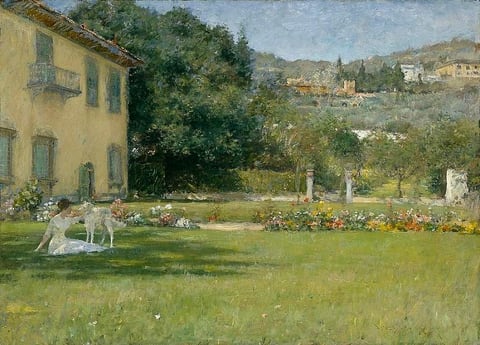
  2. William Merritt Chase
    Good FriendsWilliam Merritt Chase, (c. 1909)Courtesy of the Hirshhorn Museum and Sculpture Garden, Smithsonian Institution
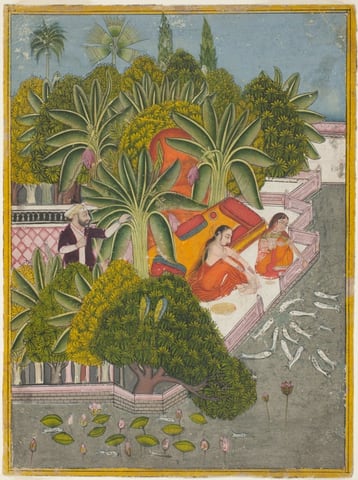
  3. A work made of opaque watercolor on paper.
    Royal Women Feeding FishUnrecorded Indian maker, c. 1740Courtesy of the Art Institute of Chicago

Second room, north wall
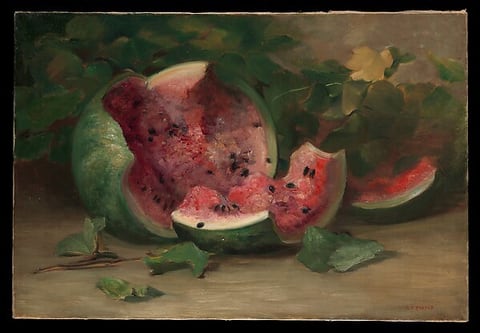
  1. Untitled (Cracked Watermelon), by Charles Ethan Porter, ca. 1890
    Untitled (Cracked Watermelon)Charles Ethan Porter, ca. 1890Courtesy of The Metropolitan Museum of Art
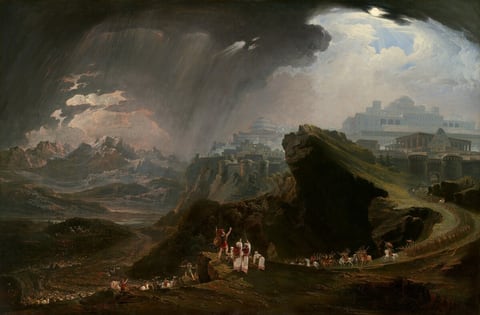
  2. Armies of men march and battle along a rocky outcropping set among huge rock formations and massive buildings under a stormy sky in this horizontal landscape painting. The people we can see all have pale skin. Sheets of rain fall from flint-gray clouds on our left into a valley, though hints of peach brighten the clouds along the mountainous horizon there. In the right half of the sky, light pours down from a brilliant white sun that breaks through white clouds to reveal topaz-blue patches of sky. The horizon comes about halfway up the composition and is lined with rugged white, pale pink, and olive-green mountains on our left and silvery-white buildings along the right half. These structures include two domed buildings and a colosseum among many others. The buildings are all enclosed within city walls buttressed with towers. The land dips precipitously from the rocky cliffs supporting the buildings, to sweep down toward us. A huge outcropping angles up like a ramp between us and the buildings in the distance. A road runs from the walled town toward us, down along the ridge and in front of the outcropping. Countless warriors march in rows of four or five across on the road past a man wearing a feathered helmet and armored breastplate. This man, Joshua, stands on a rocky precipice facing away from us with his right hand raised. He wears a scarlet-red toga under his breastplate, and a royal-blue cape flutters at his left side. He holds a round, copper-colored shield and a spear in his other hand. Two men with gray beards stand near Joshua with their backs to us. Both gesture up to the sky. One holds a slender staff and the other a curling horn. They and another pair of men, who stoop to hold poles used to carry a chest, all wear long, ivory-white robes, cherry-red drapery, and white turbans. The column of soldiers on foot and horseback pass in front of Joshua to a massive battlefield to our left. The fight takes place in a valley that leads back to a river. A bolt of lightning zigzags from the storm clouds and strikes a city in the deep distance. The artist signed the painting in the lower right, “J. Martin.”
    Joshua Commanding the Sun to Stand Still upon GibeonJohn Martin, 1816Courtesy National Gallery of Art, Washington

Third room, north wall
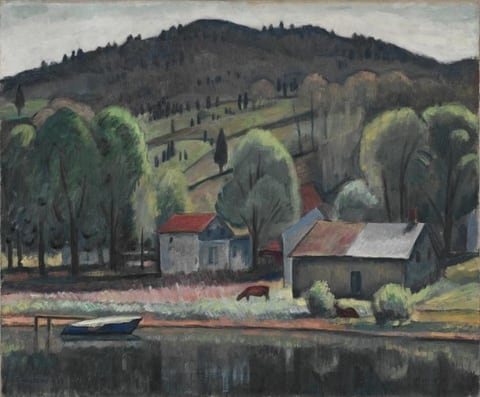
  1. Eddyville, by Samuel Halpert, 1917
    EddyvilleSamuel Halpert, 1917Courtesy of the Cleveland Museum of Art
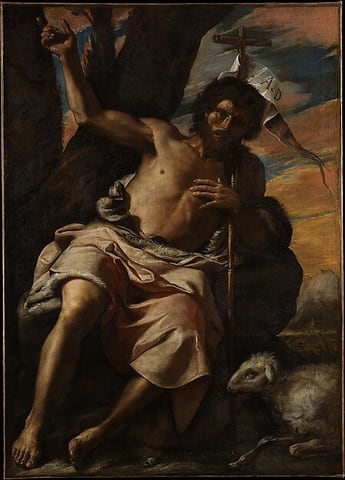
  2. Saint John the Baptist Preaching, by Mattia Preti (Il Cavalier Calabrese), ca. 1650
    Saint John the Baptist PreachingMattia Preti (Il Cavalier Calabrese), ca. 1650Courtesy of The Metropolitan Museum of Art

Third room, south wall
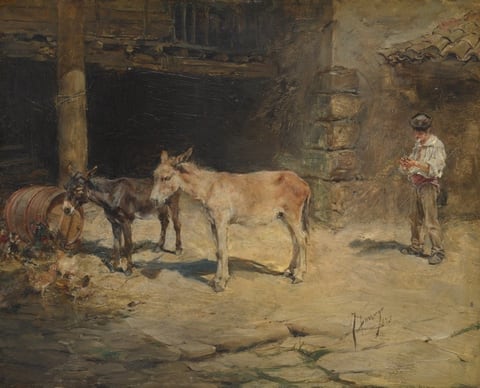
  1. A work made of oil on panel.
    SpainFrancisco Domingo y Marqués, 1878Courtesy of the Art Institute of Chicago
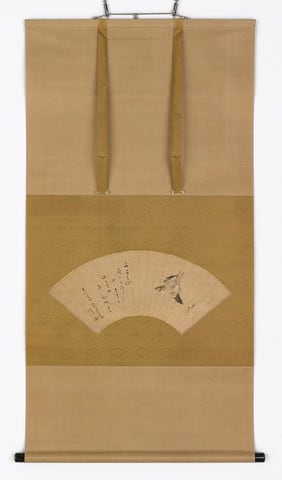
  2. Fan (mounted as a hanging scroll)
    Flying CuckooKatsushika Hokusai, ca. 1809Courtesy of the National Museum of Asian Art, Smithsonian Institution