Floor plan

Style galleriesPaintings of the 19th century
Paintings of the 19th century
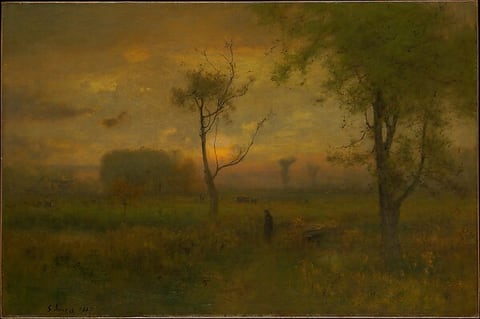
Sunrise, by George Inness, 1887
A work made of oil on canvas.
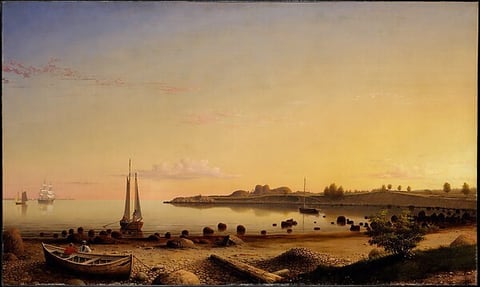
Stage Fort across Gloucester Harbor, by Fitz Henry Lane, 1862
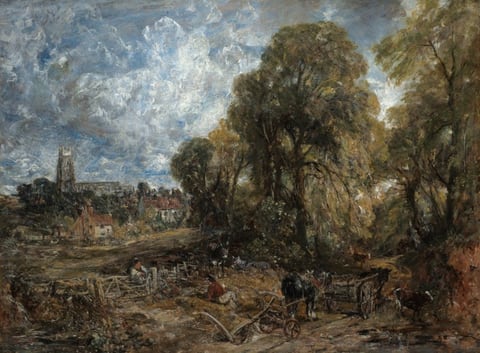
Large English country landscape painting, farmers with horses, green trees.
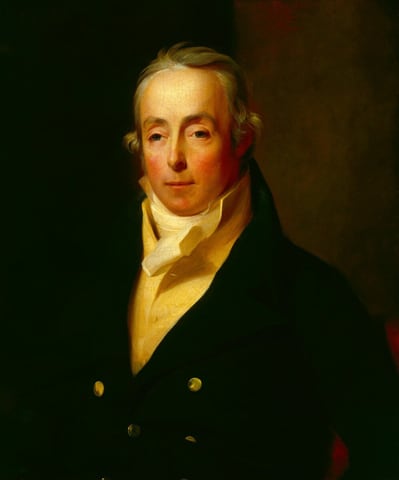
This painting is a portrait of a man from the waist up. He is facing us, with pale skin, thin lips, rosy cheeks, light green eyes, and gray hair styled into curls around his ears. He has a neutral expression. The man is wearing a dark coat with gold buttons on the front, with a pale-yellow shirt underneath and a white cravat around his neck. The background is a dark and indistinct brown color.
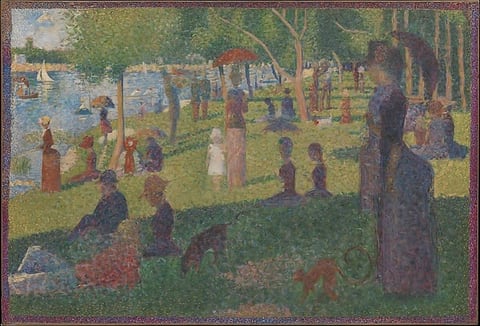
Study for "A Sunday on La Grande Jatte", by Georges Seurat, 1884

The works in this room are listed below.

Works in this room

Paintings made in the 19th century, from every museum.

Section 1, north wall

  1. Sunrise, by George Inness, 1887
    SunriseGeorge Inness, 1887Courtesy of The Metropolitan Museum of Art
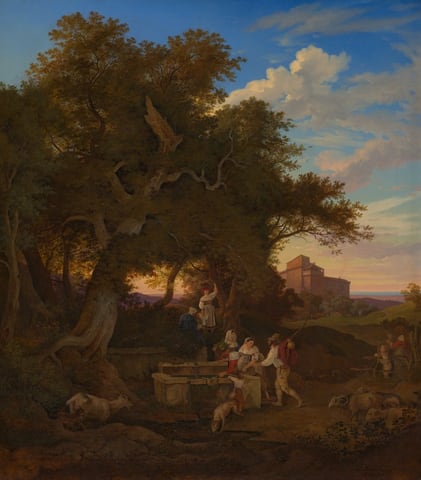
  2. A work made of oil on canvas.
    The Fountain at GrottaferrataAdrian Ludwig (Ludwig) Richter, 1832Courtesy of the Art Institute of Chicago
  3. Stage Fort across Gloucester Harbor, by Fitz Henry Lane, 1862
    Stage Fort across Gloucester HarborFitz Henry Lane, 1862Courtesy of The Metropolitan Museum of Art

Section 1, south wall

  1. Large English country landscape painting, farmers with horses, green trees.
    Stoke-by-NaylandJohn Constable, 1836Courtesy of the Art Institute of Chicago
  2. This painting is a portrait of a man from the waist up. He is facing us, with pale skin, thin lips, rosy cheeks, light green eyes, and gray hair styled into curls around his ears. He has a neutral expression. The man is wearing a dark coat with gold buttons on the front, with a pale-yellow shirt underneath and a white cravat around his neck. The background is a dark and indistinct brown color.
    Abraham KintzingThomas Sully, 1815Courtesy National Gallery of Art, Washington
  3. Study for "A Sunday on La Grande Jatte", by Georges Seurat, 1884
    Study for "A Sunday on La Grande Jatte"Georges Seurat, 1884Courtesy of The Metropolitan Museum of Art

Section 2, south wall
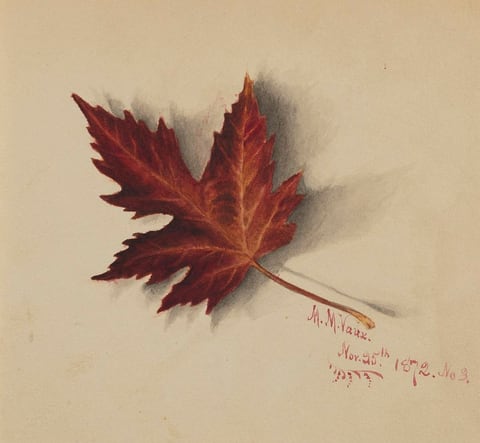
  1. Untitled (Autumn Leaf), by Mary Vaux Walcott, 1872
    Untitled (Autumn Leaf)Mary Vaux Walcott, 1872Courtesy of the Smithsonian American Art Museum
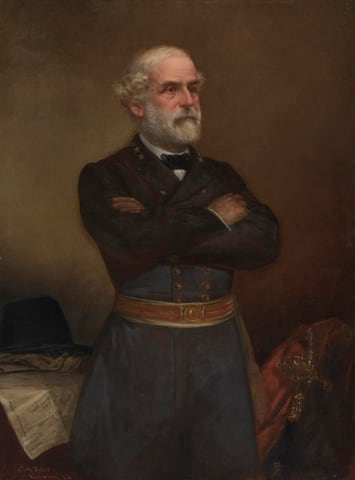
  2. Artist: John Adams Elder, Sitter: Robert Edward Lee, Current owner: National Portrait Gallery, Smithsonian Institution
    Robert Edward LeeJohn Adams Elder, 1876Courtesy of the National Portrait Gallery, Smithsonian Institution
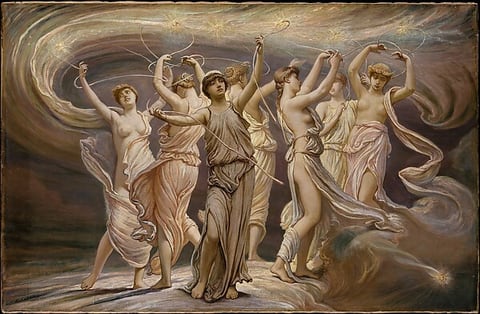
  3. The Pleiades, by Elihu Vedder, 1885
    The PleiadesElihu Vedder, 1885Courtesy of The Metropolitan Museum of Art
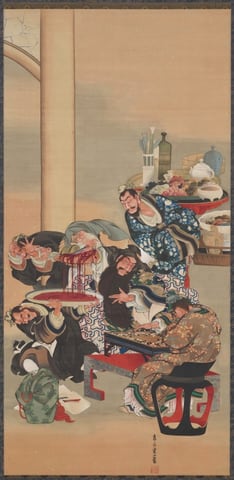
  4. Operating on Guan Yu's Arm, by Katsushika Ōi, 1840s
    Operating on Guan Yu's ArmKatsushika Ōi, 1840sCourtesy of the Cleveland Museum of Art

Section 2, north wall
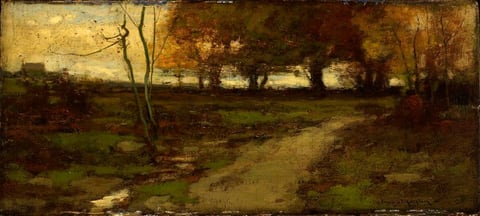
  1. Landscape, by J. Francis Murphy, ca. 1880-1890
    LandscapeJ. Francis Murphy, ca. 1880-1890Courtesy of the Smithsonian American Art Museum
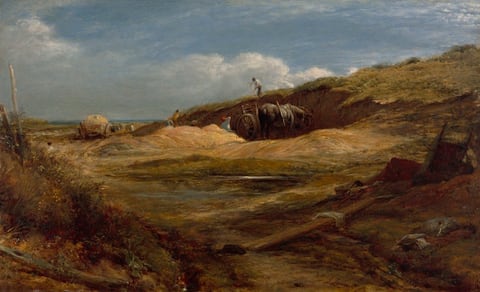
  2. A work made of oil on panel.
    The Sand Pits, Hampstead HeathJohn Linnell, 1834Courtesy of the Art Institute of Chicago
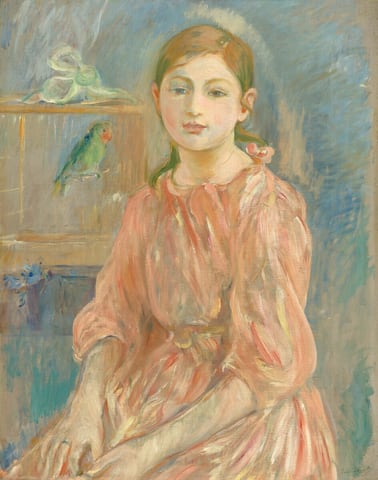
  3. Shown from the knees up, a young girl with pale skin, wearing a coral-peach dress, sits facing and looking at us in this loosely painted, vertical portrait. Her knees are angled slightly to our left, and her hands rest in her lap. She has a round face and smooth, lightly flushed cheeks. She has brown eyes under arched brows, a delicate, snub nose, and her rose-pink lips are closed. Her hair, which is painted with broad strokes of caramel brown and moss green, is parted on one side and pulled smoothly back, presumably tied behind her head. Tendrils fall over her shoulders. Her dress is gathered around her neck and tied with a bow at the back. The loose sleeves fall to just below her elbows, and the dress is belted around the waist. A curving swipe of canary-yellow paint could be a buckle at the front. The fabric of the dress is painted with long, visible strokes of shell and rose pink, butter yellow, and ivory white, and a few touches of sage green and periwinkle blue for shadows. She wears a ring on the middle finger of her right hand. The space around her is loosely painted with strokes of electric and cobalt blue, with unpainted canvas visible at some of the edges. To our left, over the girl's shoulder, a wooden bird cage holds an emerald-green parakeet. The bird is streaked with royal blue along its back, and the area around its hooked beak is apple red. The cage has a mint-green bow and ribbon along the top. The artist signed the painting in green on the lower right corner: “Berthe Morisot.”
    The Artist's Daughter with a ParakeetBerthe Morisot, 1890Courtesy National Gallery of Art, Washington
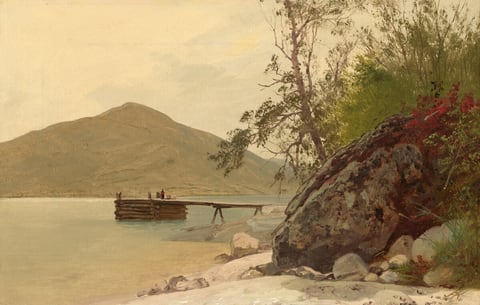
  4. The painting depicts a tranquil lake scene with a low horizon line showing a pale green hill in the background under a pale, cloudy sky. Closer to us, on the right, there is a large, textured rock surrounded by greenery and red flowers. In the distance, a wooden dock extends into the lake on the left, and a person wearing red appears to sit or stand with their back to us.
    Landing at Sabbath Day PointJohn Frederick Kensett, c. 1853Courtesy National Gallery of Art, Washington

Section 3, north wall
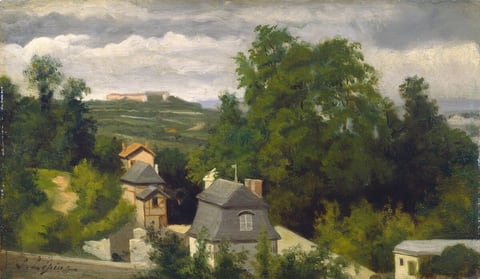
  1. The painting shows an elevated perspective overlooking a landscape with green hills and leafy trees. Closest to us, there are cream-colored buildings among dense foliage. These buildings have roofs in shades of pale blue-gray and reddish-brown, and the one in the center has wispy white smoke coming out of a chimney. In the distance on the left, a large, low structure sits atop a hill, with faint paths winding towards it through the green landscape. Beyond the trees, the distant landscape on the right is painted in shades of pale blue and green. The sky above is filled with puffy clouds in shades of gray.
    View on the Outskirts of CaenStanislas Lépine, 1872/1875Courtesy National Gallery of Art, Washington
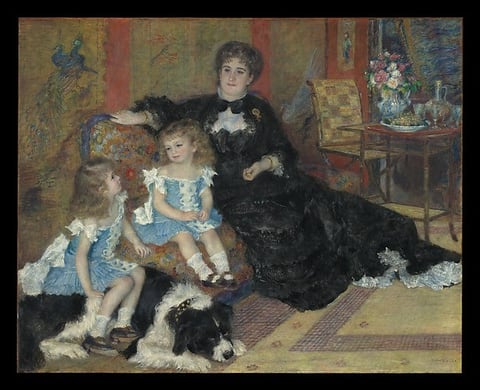
  2. Madame Georges Charpentier (Marguerite-Louise Lemonnier, 1848–1904) and Her Children, Georgette-Berthe (1872–1945) and Paul-Emile-Charles (1875–1895), by Pierre-Auguste Renoir, 1878
    Madame Georges Charpentier (Marguerite-Louise Lemonnier, 1848–1904) and Her Children, Georgette-Berthe (1872–1945) and Paul-Emile-Charles (1875–1895)Pierre-Auguste Renoir, 1878Courtesy of The Metropolitan Museum of Art