Floor plan

Style galleriesThe Northern Renaissance
The Northern Renaissance
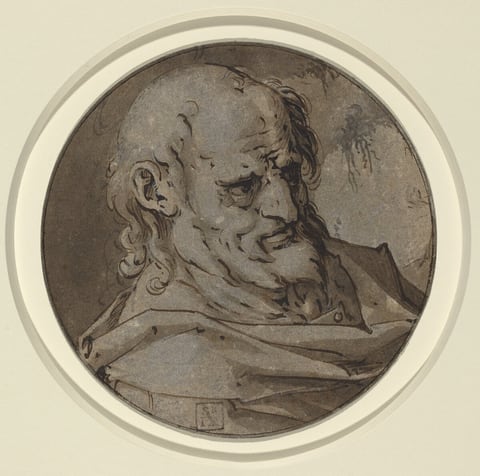
The image features the upper body and head of a man in a circular frame. The man is facing slightly to the side and downward, with his body oriented to the left and his head turned towards the viewer. He has a prominent forehead, a defined nose, a furrowed brow, and a scrunched face. His hair is thinning on top, with longer strands curling around the back and sides of his head. The man has a beard with similar curled texture as his hair. He is wearing a garment that drapes over his shoulders, with visible folds and a texture that suggests a substantial fabric. No jewelry or objects are in his hands, as they are not visible in this image. The background is plain with a light, sketchy look, focusing attention on the man as the central figure in the circular composition.
A work made of engraving on laid paper.
The Seed Received among the Thorns, from the Parable of the Sower, by Gerard P. van Groningen, c. 1573
This is a drawing of a group of medieval figures and a tree. The image depicts a dense gathering of figures, all wearing elaborate period costumes, including helmets, robes, and armor. Their expressions vary. At the top, a leafy tree dominates the background alongside swirling clouds. The foreground hints at an interaction among the individuals, possibly a scene of discourse or judgment. Several personal items and tools are on the ground. The attention to detail and the use of line to create intricate patterns and textures are notable features of this work. This is in the style of Albrecht Dürer.
Amya Petitioning Faustus for the Custody of Saint Mamas, by Jean Cousin the Elder, ca. 1543
Three insects are depicted in the image: a butterfly with dark blue and red wings on the bottom left, a larger butterfly with white, black, and blue patterns at the top center, and a dragonfly with brown and gold tones on the bottom right. The color palette includes rich blues, reds, browns, and golds against a neutral background. The central butterfly is positioned higher than the other two insects, with the left butterfly and right dragonfly symmetrically arranged below.

The works in this room are listed below.

Works in this room

Dürer's prints, Holbein's portraits and the art of northern Europe in the 1500s.

Section 1, north wall

  1. The image features the upper body and head of a man in a circular frame. The man is facing slightly to the side and downward, with his body oriented to the left and his head turned towards the viewer. He has a prominent forehead, a defined nose, a furrowed brow, and a scrunched face. His hair is thinning on top, with longer strands curling around the back and sides of his head. The man has a beard with similar curled texture as his hair. He is wearing a garment that drapes over his shoulders, with visible folds and a texture that suggests a substantial fabric. No jewelry or objects are in his hands, as they are not visible in this image. The background is plain with a light, sketchy look, focusing attention on the man as the central figure in the circular composition.
    Head of an ApostleHendrick GoltziusCourtesy National Gallery of Art, Washington
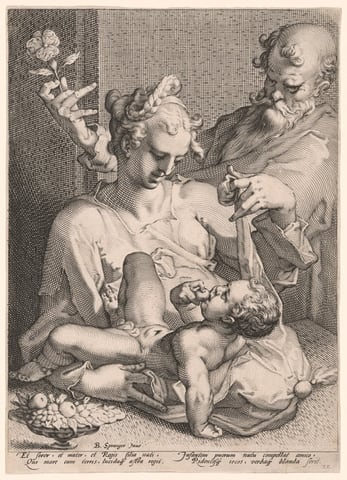
  2. A work made of engraving on laid paper.
    The Holy FamilyPieter de Jode, I, c. 1585-1595Courtesy of the Art Institute of Chicago
  3. The Seed Received among the Thorns, from the Parable of the Sower, by Gerard P. van Groningen, c. 1573
    The Seed Received among the Thorns, from the Parable of the SowerGerard P. van Groningen, c. 1573Courtesy of the Cleveland Museum of Art

Section 1, south wall

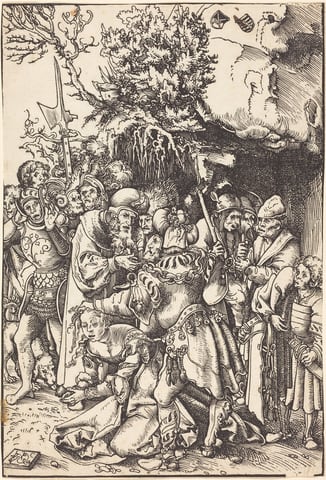
  1. This is a drawing of a group of medieval figures and a tree. The image depicts a dense gathering of figures, all wearing elaborate period costumes, including helmets, robes, and armor. Their expressions vary. At the top, a leafy tree dominates the background alongside swirling clouds. The foreground hints at an interaction among the individuals, possibly a scene of discourse or judgment. Several personal items and tools are on the ground. The attention to detail and the use of line to create intricate patterns and textures are notable features of this work. This is in the style of Albrecht Dürer.
    The Martyrdom of Saint BarbaraLucas Cranach the ElderCourtesy National Gallery of Art, Washington
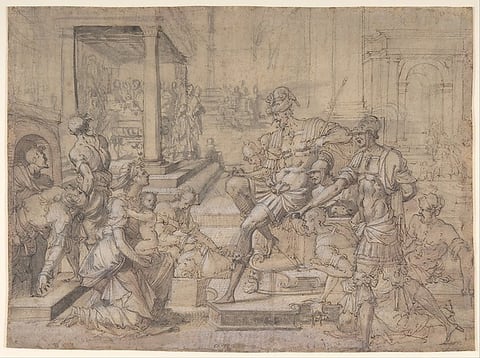
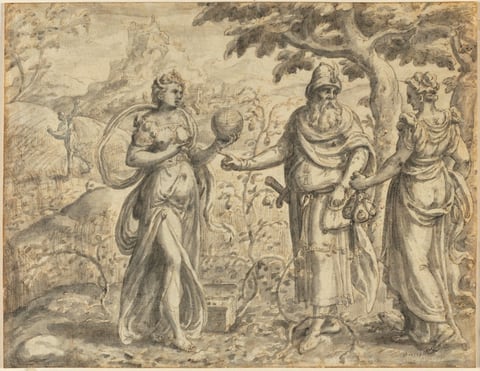
  2. Amya Petitioning Faustus for the Custody of Saint Mamas, by Jean Cousin the Elder, ca. 1543
    Amya Petitioning Faustus for the Custody of Saint MamasJean Cousin the Elder, ca. 1543Courtesy of The Metropolitan Museum of Art
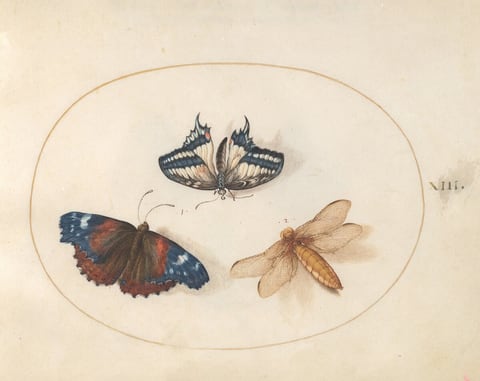
  3. Three insects are depicted in the image: a butterfly with dark blue and red wings on the bottom left, a larger butterfly with white, black, and blue patterns at the top center, and a dragonfly with brown and gold tones on the bottom right. The color palette includes rich blues, reds, browns, and golds against a neutral background. The central butterfly is positioned higher than the other two insects, with the left butterfly and right dragonfly symmetrically arranged below.
    Plate 13: Yellow Swallowtail and Red Admiral Butterflies with a Dragonfly (Broad-Bodied Chaser?)Joris Hoefnagel, c.1575/1590sCourtesy National Gallery of Art, Washington

Section 2, south wall
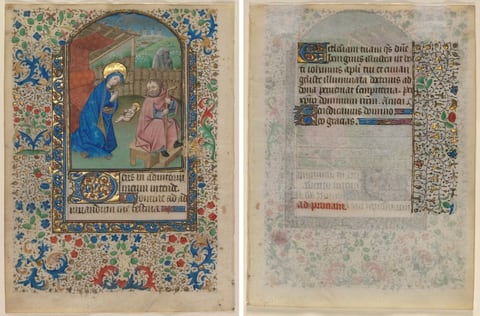
  1. Leaf from a Book of Hours: The Nativity (recto) and Text (verso), c. 1430
    Leaf from a Book of Hours: The Nativity (recto) and Text (verso)Unrecorded French maker, c. 1430Courtesy of the Cleveland Museum of Art
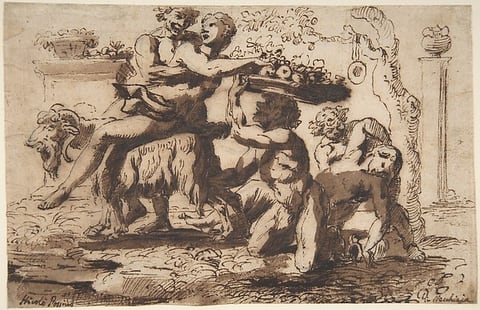
  2. Bacchanal, by Nicolas Poussin, ca. 1635–36
    BacchanalNicolas Poussin, ca. 1635–36Courtesy of The Metropolitan Museum of Art

Section 2, north wall
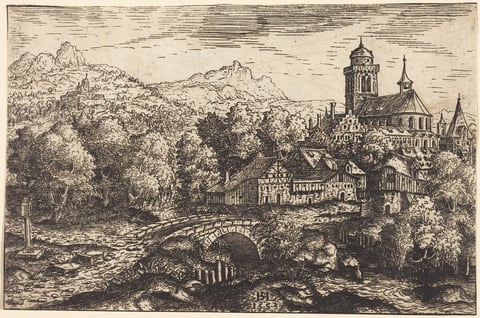
  1. The image features a landscape view of a medieval village scene. It includes a stone bridge over a river, buildings, a church with a tower, trees, hills, mountains, and cloudy sky. The image is depicted in intricate detail using a monochromatic palette, focusing on contrasts of light and shadow.
    Mountainous Landscape with a VillageHanns Lautensack, 1553Courtesy National Gallery of Art, Washington
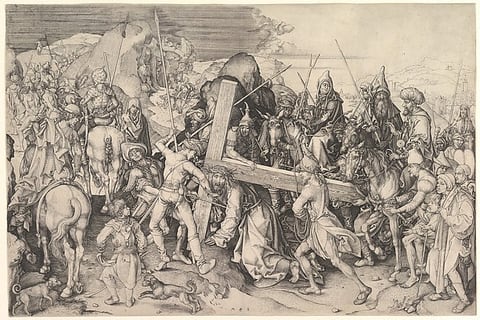
  2. Christ Carrying the Cross, by Martin Schongauer, ca. 1475–80
    Christ Carrying the CrossMartin Schongauer, ca. 1475–80Courtesy of The Metropolitan Museum of Art

Section 3, north wall
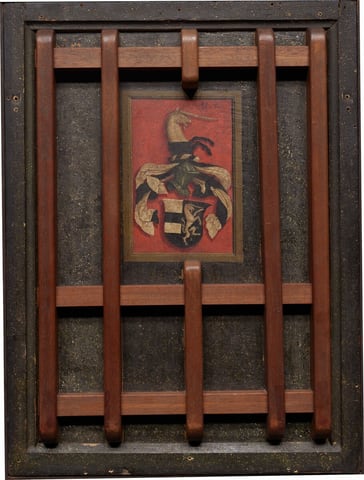
  1. This is a painting depicting a heraldic coat of arms. The image features a detailed coat of arms with a central shield, adorned with black and gold sections, and additional decorative elements above it. There is a figure resembling a unicorn emerging from the crest. The background is a deep red hue. The artwork is displayed within a wooden frame with crossbars. This style is associated with displaying family crests and lineage.
    Hans Roth [reverse]Bernhard Strigel, 1527Courtesy National Gallery of Art, Washington
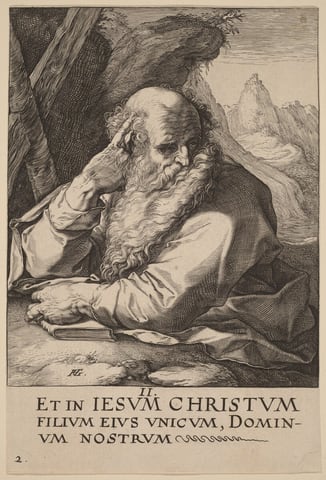
  2. The image shows an elderly man seated from the waist up. He is angled slightly away from the viewer, resting his head on one hand and leaning on the other arm. The man has a deeply lined face, a large beard, curly hair, and appears focused on something outside the frame. He wears flowing garments and a book is under his arm. In the background, there are rugged, mountainous rock formations. Ornate text frames the image at the bottom.
    Saint AndrewHendrick Goltzius, probably 1589Courtesy National Gallery of Art, Washington
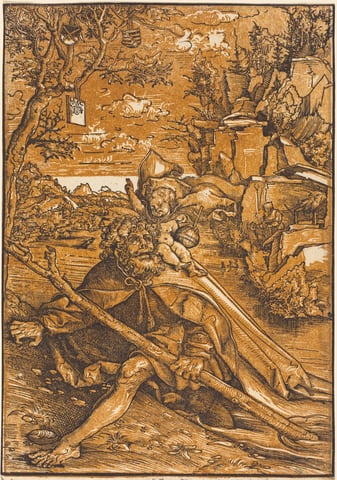
  3. This is a drawing of a wilderness setting by a river. The scene features rocky cliffs, lush vegetation, a large bearded figure holding a staff, and a small cherubic figure beside them. In the background, there is a village against a mountainous backdrop. The drawing has rich texture and intricate details, with a contrast of dark lines and lighter hues.
    Saint ChristopherLucas Cranach the Elder, 1506Courtesy National Gallery of Art, Washington

Section 3, south wall
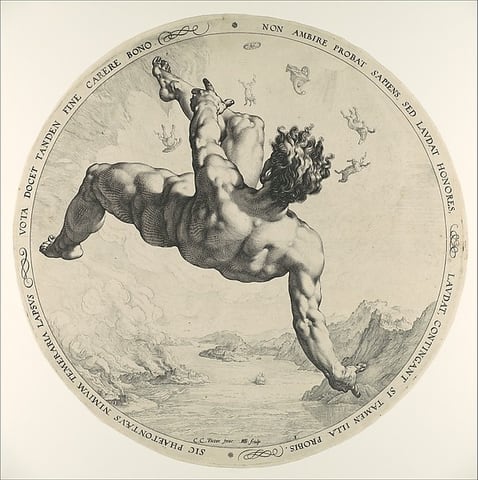
  1. Phaeton, from "The Four Disgracers", by Hendrick Goltzius, 1588
    Phaeton, from "The Four Disgracers"Hendrick Goltzius, 1588Courtesy of The Metropolitan Museum of Art
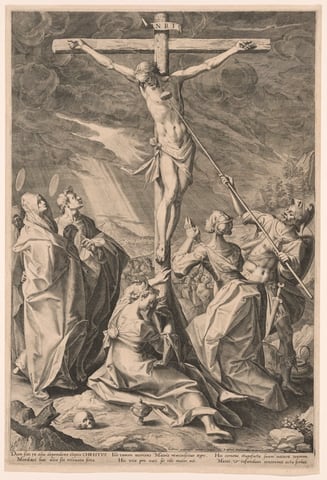
  2. A work made of engraving in black on cream laid paper.
    Christ on the CrossRaphael Sadeler, I, 1590Courtesy of the Art Institute of Chicago
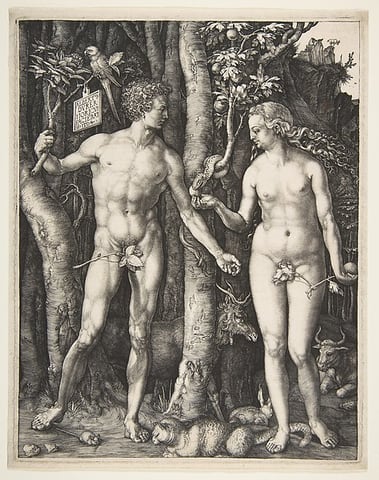
  3. Adam and Eve, by Albrecht Dürer, 1504
    Adam and EveAlbrecht Dürer, 1504Courtesy of The Metropolitan Museum of Art