Floor plan

Style galleriesGeorgian Britain

Georgian Britain

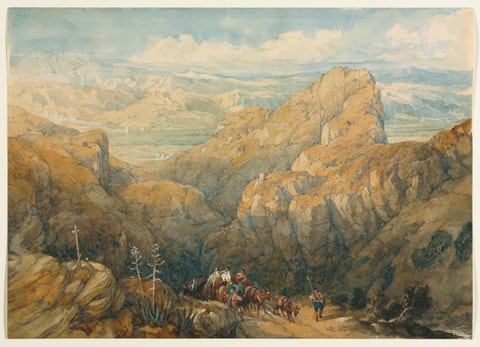
Descent into the Plain of Granada, by David Roberts, 1834
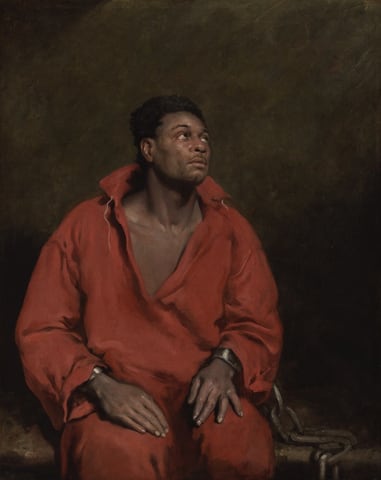
Painting of a dark-skinned man seated and wearing a red open-necked tunic. He looks up to the right. His wrists are shackled and a large chain rests at his right, running down the bench he sits upon.
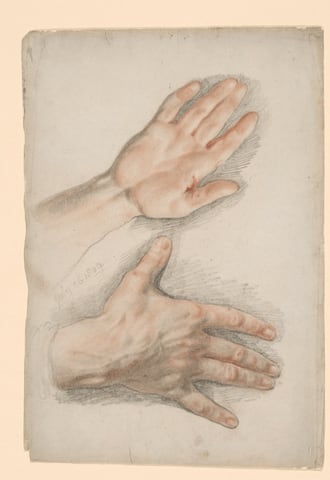
A work made of red and black chalk on gray wove paper.
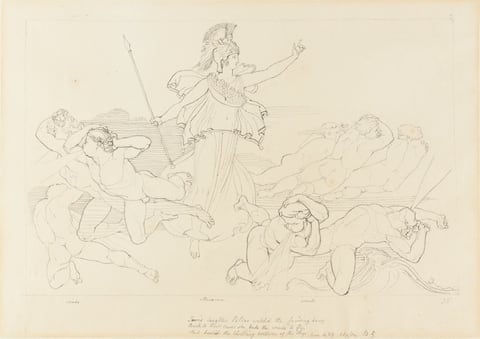
A work made of pen and black ink, over traces of graphite, on tan wove paper, laid down on cream wove paper.
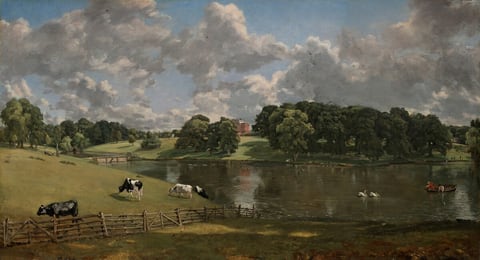
We look out onto a landscape with low, grassy hills to the left, a lake to the right, and a brick building in the center distance below a sky filled with towering white clouds in this horizontal painting. A wooden fence closer to us crosses the landscape from the lower left corner and disappears where the land slopes down to meet the water at the center of the painting. Several black and white cows graze in the field beyond the fence to our left. Two men in a wooden boat pull in nets on the lake to our right near a pair of swans. The lake crosses the composition in the near distance, disappearing into a culvert farther back. A donkey pulls a small carriage with two people near a bridge that crosses the lake in the distance to our left. The brick manor house is visible through a break in the full, deep green trees that line the horizon, which comes halfway up the composition. The clouds cast noticeable shadows in the brightly sunlit scene.
A work made of red chalk on cream laid paper.
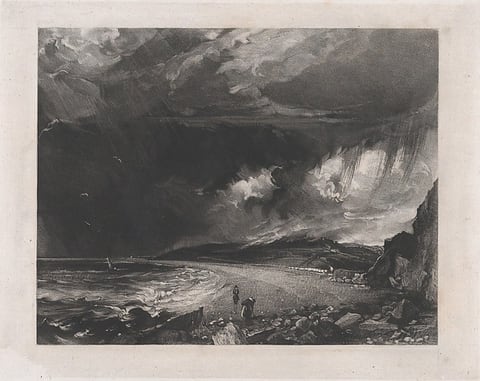
Weymouth Bay, by David Lucas, 1830
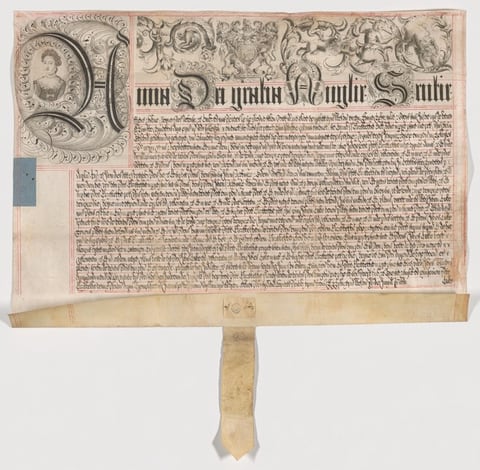
A work made of engraved letterhead, pen and ink calligraphy, and graphite ruling on parchment, folded with strap and (missing) seal.

The works in this room are listed below.

Works in this room

Portraits, conversation pieces and watercolour landscapes from Hogarth to Constable.

Section 1, north wall

  1. Descent into the Plain of Granada, by David Roberts, 1834
    Descent into the Plain of GranadaDavid Roberts, 1834Courtesy of the Cleveland Museum of Art
  2. Painting of a dark-skinned man seated and wearing a red open-necked tunic. He looks up to the right. His wrists are shackled and a large chain rests at his right, running down the bench he sits upon.
    The Captive Slave (Ira Aldridge)John Philip Simpson, 1827Courtesy of the Art Institute of Chicago
  3. A work made of red and black chalk on gray wove paper.
    Two Studies of a Right HandThomas Lawrence, July 26, 1800Courtesy of the Art Institute of Chicago
  4. A work made of pen and black ink, over traces of graphite, on tan wove paper, laid down on cream wove paper.
    Athena and the WindsJohn Flaxman, n.d.Courtesy of the Art Institute of Chicago

Section 1, south wall

  1. We look out onto a landscape with low, grassy hills to the left, a lake to the right, and a brick building in the center distance below a sky filled with towering white clouds in this horizontal painting. A wooden fence closer to us crosses the landscape from the lower left corner and disappears where the land slopes down to meet the water at the center of the painting. Several black and white cows graze in the field beyond the fence to our left. Two men in a wooden boat pull in nets on the lake to our right near a pair of swans. The lake crosses the composition in the near distance, disappearing into a culvert farther back. A donkey pulls a small carriage with two people near a bridge that crosses the lake in the distance to our left. The brick manor house is visible through a break in the full, deep green trees that line the horizon, which comes halfway up the composition. The clouds cast noticeable shadows in the brightly sunlit scene.
    Wivenhoe Park, EssexJohn Constable, 1816Courtesy National Gallery of Art, Washington
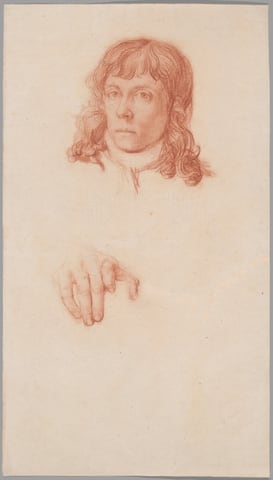
  2. A work made of red chalk on cream laid paper.
    Self-PortraitJohn Flaxman, c. 1779Courtesy of the Art Institute of Chicago
  3. Weymouth Bay, by David Lucas, 1830
    Weymouth BayDavid Lucas, 1830Courtesy of The Metropolitan Museum of Art
  4. A work made of engraved letterhead, pen and ink calligraphy, and graphite ruling on parchment, folded with strap and (missing) seal.
    Recovery Document (Land Title Grant)Unrecorded British maker, 1702/14 (Queen Anne period)Courtesy of the Art Institute of Chicago

Section 2, south wall
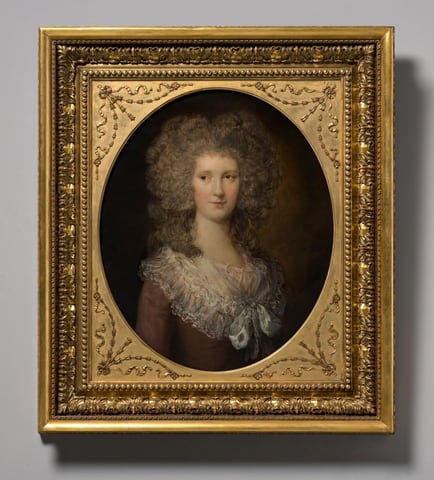
  1. Portrait of Mary Anne Jolliffe, by Gainsborough Dupont, after 1788
    Portrait of Mary Anne JolliffeGainsborough Dupont, after 1788Courtesy of the Cleveland Museum of Art
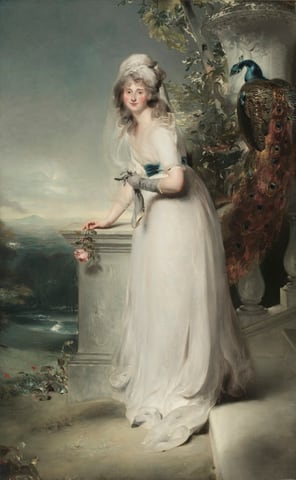
  2. Portrait of Catherine Grey, Lady Manners, by Thomas Lawrence, 1794
    Portrait of Catherine Grey, Lady MannersThomas Lawrence, 1794Courtesy of the Cleveland Museum of Art
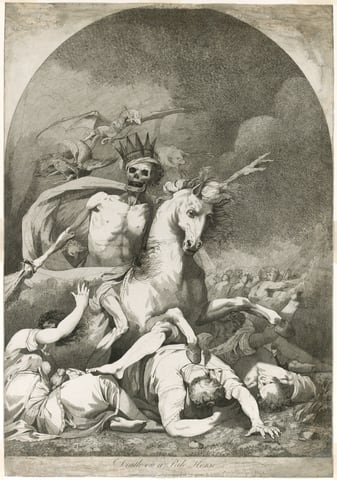
  3. A work made of etching on ivory laid paper.
    Death on a Pale HorseJoseph Haynes, 1784, after the drawing of 1775Courtesy of the Art Institute of Chicago

Section 2, north wall
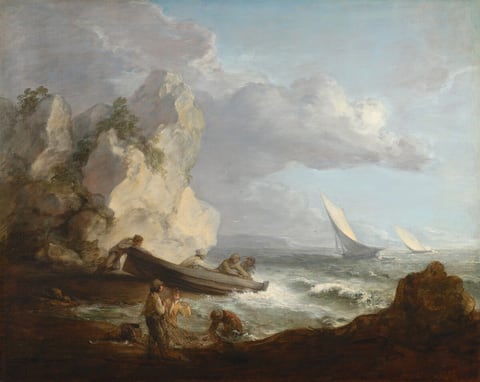
  1. From a rocky shoreline, we look on several light-skinned people working by the sea with a boat and a net in this freely painted, almost square seascape. The scene is framed by a silhouette of low boulders along the lower right corner, and a towering cream-white rock rising two-thirds of the way up the composition to our left. Scrubby, celery-green vegetation grows on the rocky outcropping. Near the center, close to the towering white rocks, three people sit, reaching for something near one end of a boat while a fourth person braces against the rock, presumably to push the boat out to the sea. Closer to us, three people on the shore work with a net. Two stand with the net hooked over their shoulders, and a third person crouches in the water with head down. The people all wear simple shirts and pants in shades of tan, mustard yellow, burnt orange, and pale blue. All but two wear hats. The sea meets the shore with frothy white foam and cresting, low waves. The sea beyond fades from pale sage green to arctic blue along the horizon, which comes about a third of the way up the composition. Two sail boats tilt against the wind in the distance. Pale, smoky lavender-purple clouds drift across the ice-blue sky.
    Seashore with FishermenThomas Gainsborough, c. 1781/1782Courtesy National Gallery of Art, Washington
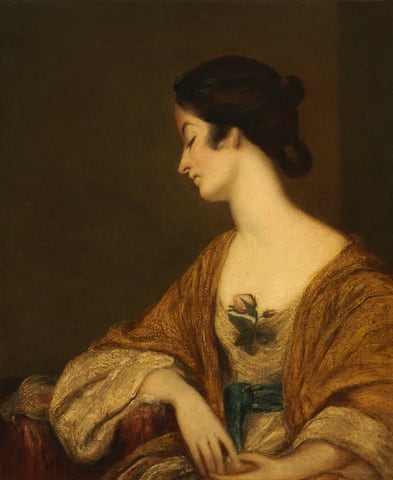
  2. Portrait of Mrs. George Collier, by Joshua Reynolds, 18th century
    Portrait of Mrs. George CollierJoshua Reynolds, 18th centuryCourtesy of the Cleveland Museum of Art

Section 3, north wall
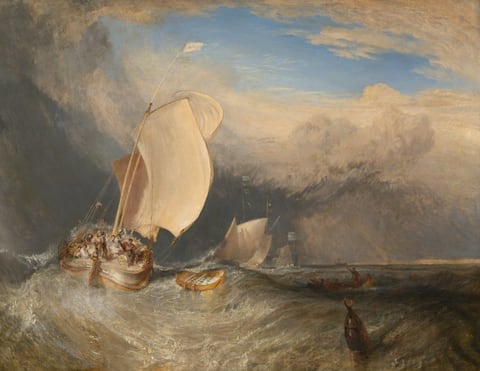
  1. Large marine landscape of boats on rough waves, storm clouds.
    Fishing Boats with Hucksters Bargaining for FishJoseph Mallord William Turner, 1837–38Courtesy of the Art Institute of Chicago
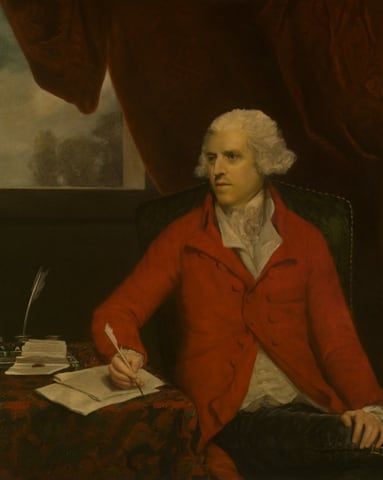
  2. A work made of oil on canvas.
    Sir Thomas Rumbold, Bt.Joshua Reynolds, 1788Courtesy of the Art Institute of Chicago
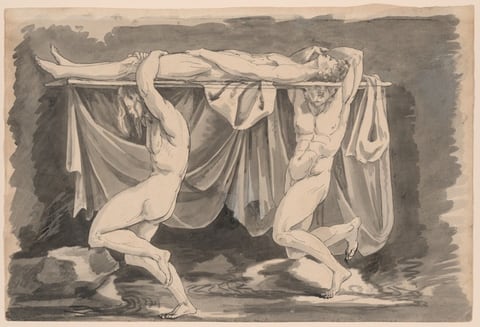
  3. A work made of brush and black ink wash, with pen and black ink and opaque white and gray watercolor, on cream laid paper.
    A Hero Born on a Bier, from The Master of Giants PortfolioPrince Hoare, 1779Courtesy of the Art Institute of Chicago