Floor plan

Style galleriesThe French eighteenth century
The French eighteenth century
This is a drawing of anthropomorphic butterflies engaged in a duel with fencing swords. The butterflies have human-like bodies with wings resembling cloaks or capes. They stand on an ornate structure featuring decorative architectural elements like columns with floral and leaf motifs. Above them are arches, canopies, and hanging vines, creating a theatrical setting. The drawing combines fantasy and nature elements, showcasing elegance and imagination.
A work made of crayon manner engraving in red and black on cream laid paper.
A work made of black chalk, with stumping and black crayon, red and brown chalk, heightened with white chalk, on buff laid paper, laid down on cream laid paper.
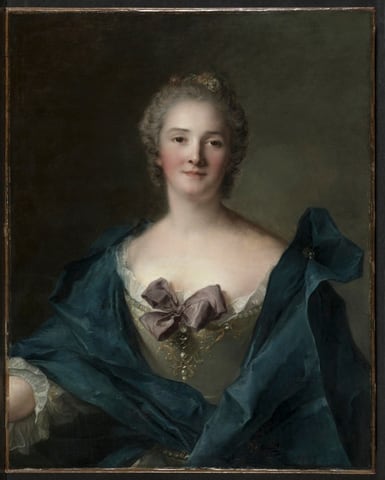
Portrait of a Woman, by Jean-Marc Nattier, c. 1748
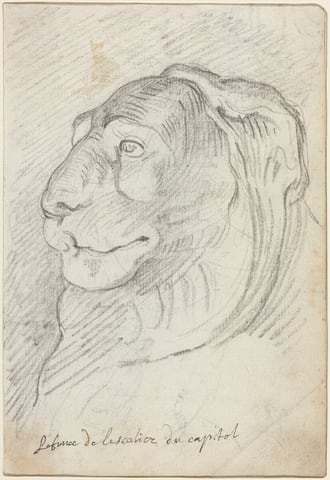
This is a detailed sketch of a lion's head, positioned to show its profile. The drawing features the lion's broad nose, rounded mouth, large eye, and flowing mane. The facial features are depicted with various curves and lines. The sketch is on textured paper with pencil shading creating variations in the background. Handwritten text at the bottom reads "Leone de l'Escalier du capitol."
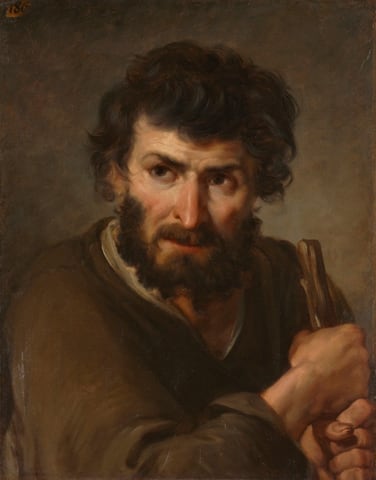
Study of a Shepherd, 1700s
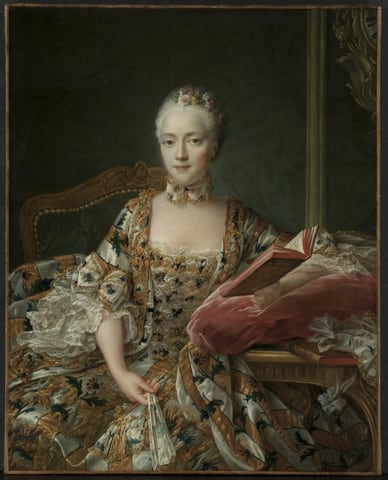
Portrait of the Marquise d'Aguirandes, by François Hubert Drouais, 1759
Portrait of a Woman as Diana, by Jean-Marc Nattier, 1752

The works in this room are listed below.

Works in this room

Fêtes, portraits and still lifes from the France of the Regency and Louis XV.

First room, north wall

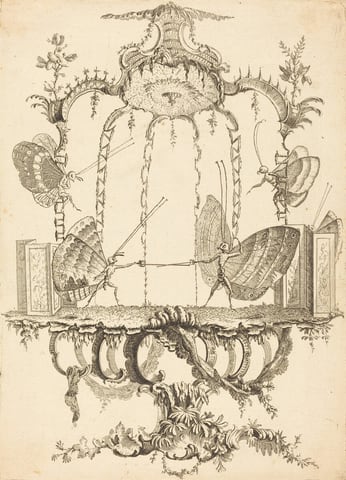
  1. This is a drawing of anthropomorphic butterflies engaged in a duel with fencing swords. The butterflies have human-like bodies with wings resembling cloaks or capes. They stand on an ornate structure featuring decorative architectural elements like columns with floral and leaf motifs. Above them are arches, canopies, and hanging vines, creating a theatrical setting. The drawing combines fantasy and nature elements, showcasing elegance and imagination.
    Le Duel (The Duel)Charles Germain de Saint-Aubin, in or after 1756Courtesy National Gallery of Art, Washington
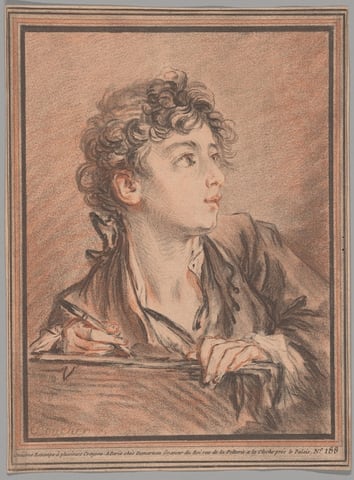
  2. A work made of crayon manner engraving in red and black on cream laid paper.
    The Young DraftsmanGilles Demarteau, 1750/70Courtesy of the Art Institute of Chicago
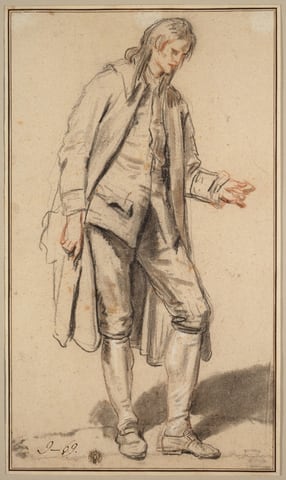
  3. A work made of black chalk, with stumping and black crayon, red and brown chalk, heightened with white chalk, on buff laid paper, laid down on cream laid paper.
    Study of a GroomJean Baptiste Greuze, c. 1760Courtesy of the Art Institute of Chicago
  4. Portrait of a Woman, by Jean-Marc Nattier, c. 1748
    Portrait of a WomanJean-Marc Nattier, c. 1748Courtesy of the Cleveland Museum of Art

First room, south wall

  1. This is a detailed sketch of a lion's head, positioned to show its profile. The drawing features the lion's broad nose, rounded mouth, large eye, and flowing mane. The facial features are depicted with various curves and lines. The sketch is on textured paper with pencil shading creating variations in the background. Handwritten text at the bottom reads "Leone de l'Escalier du capitol."
    Lion's Head from the Capitoline StaircaseAugustin Pajou, 1752/1756Courtesy National Gallery of Art, Washington
  2. Study of a Shepherd, 1700s
    Study of a ShepherdUnrecorded French maker, 1700sCourtesy of the Cleveland Museum of Art
  3. Portrait of the Marquise d'Aguirandes, by François Hubert Drouais, 1759
    Portrait of the Marquise d'AguirandesFrançois Hubert Drouais, 1759Courtesy of the Cleveland Museum of Art
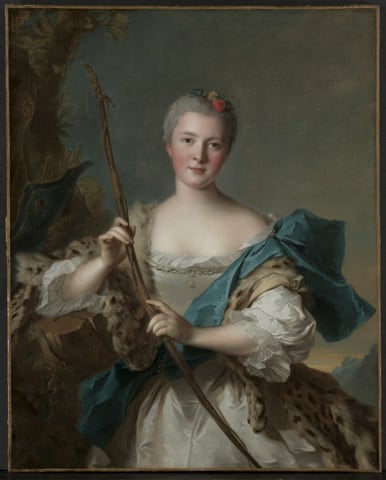
  4. Portrait of a Woman as Diana, by Jean-Marc Nattier, 1752
    Portrait of a Woman as DianaJean-Marc Nattier, 1752Courtesy of the Cleveland Museum of Art

Second room, south wall
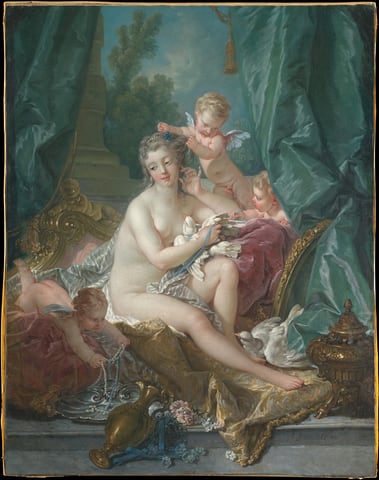
  1. The Toilette of Venus, by François Boucher, 1751
    The Toilette of VenusFrançois Boucher, 1751Courtesy of The Metropolitan Museum of Art
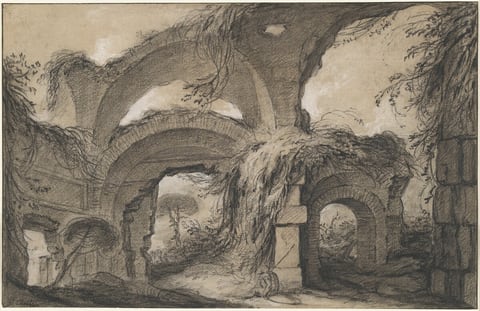
  2. The image shows an ancient ruin with arches and crumbling stonework surrounded by overgrown vegetation. The horizon is slightly elevated, emphasizing the towering remnants of the architecture. Expressive brushstrokes and textures are notable, especially in the vines and leaves on the stone. The color palette is subdued, mainly earthy tones and black, creating contrast and suggesting openings into the distance, enhancing the old, abandoned feel of the ruins.
    Arches of the Larger Baths at Hadrian's VillaCharles Michel-Ange Challe, c. 1748Courtesy National Gallery of Art, Washington
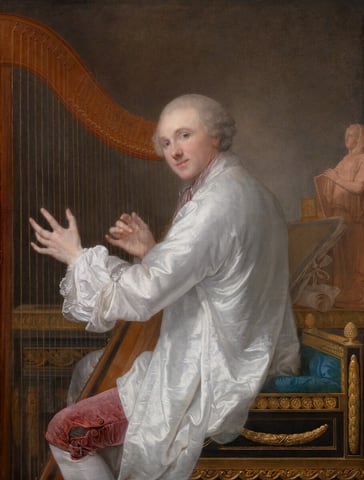
  3. A pale-skinned man sits facing our left as he plays a harp while turning his face to smile at us in this vertical portrait painting. He looks out the corners of his light blue eyes under arched, gray brows. He has a rounded nose, pale pink lips, and a round face. Gray hair is brushed back from his high forehead and curls around his ears. His long fingers rest on the strings of the harp, and the ends of strings curl like wind-loosened strands of hair along the top edge. The man wears a pale mauve-purple cravat, and his snow-white, long-sleeved chemise is untucked and loose around his thighs. The cuff we see is open and folded back over a bright white shirt edged with lace. His dusky rose-pink breeches are unbuttoned at the knee over white stockings. The square-seated chair on which he sits is carved with garlands and floral patterns, which are gilded gold. The seat itself is topaz blue, and it has a low back. A similarly ornamented and gilded table along the back of the room holds a portfolio and roll of papers, the tooled and gilded spines of books, and a statuette to the right. The pale pinkish-orange statuette shows a woman holding a tablet and wearing a long, loose robe and head covering. Her body angles to our left and she looks off in that direction. The wall behind the table is mottled with smoky shades of gray and tan.
    Ange Laurent de La Live de JullyJean Baptiste Greuze, probably 1759Courtesy National Gallery of Art, Washington

Second room, north wall
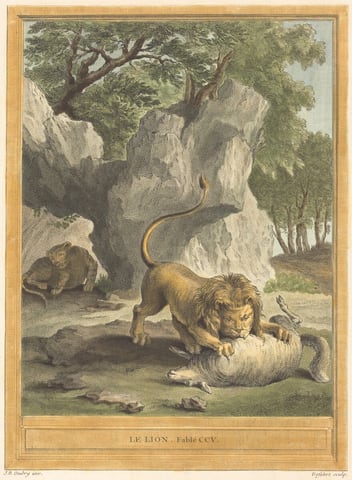
  1. This is a drawing of a lion in a forested rocky landscape. The lion is seen standing over a defeated animal. In the background, a forest with dense trees frames the scene. One monkey is visible among the rocks watching the lion. The setting conveys a wild, rugged terrain with rocky formations and scattered vegetation. Light and shadow emphasize textures in the lion's mane and the surrounding rocks. The composition focuses on the lion and its prey.
    Le lion (The Lion)A.-J. de Fehrt, published 1759Courtesy National Gallery of Art, Washington
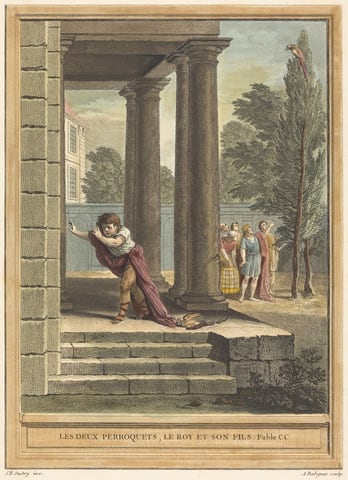
  2. This painting depicts a classical architectural scene with a bird and multiple individuals. It is done in the style of Jean-Baptiste Oudry. The image includes a large building with stone columns and stairs. A parrot is perched on a tree, catching attention with its colorful feathers. In the foreground, a person in classical clothing appears to be in motion. In the background, a group of people are gathered with varied expressions and gestures directed towards the person in the foreground. The architectural elements and foliage add depth and context to the scene.
    Les deux perroquets, le roi et son fils (Two Parrots, the King, and His Son)Antoine Radigues, published 1759Courtesy National Gallery of Art, Washington
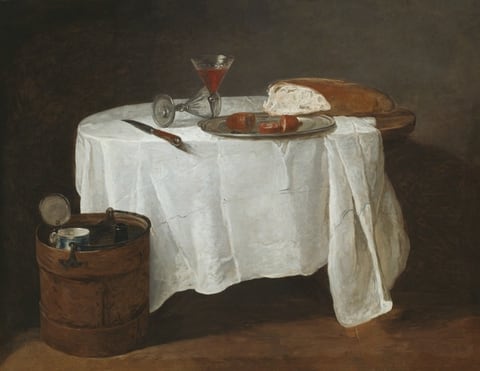
  3. A work made of oil on canvas.
    The White TableclothJean Siméon Chardin, c. 1731–32Courtesy of the Art Institute of Chicago

Third room, north wall
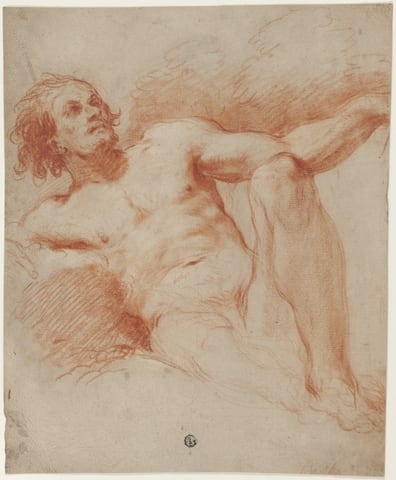
  1. A work made of red chalk, with stumping, on tan laid paper.
    Seated Male NudeFrançois Le Moyne, n.d.Courtesy of the Art Institute of Chicago
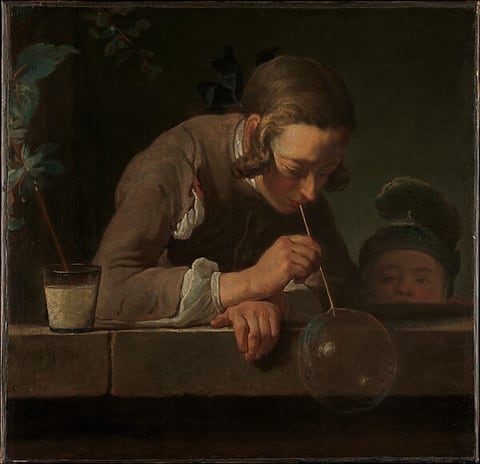
  2. Soap Bubbles, by Jean Siméon Chardin, ca. 1733–34
    Soap BubblesJean Siméon Chardin, ca. 1733–34Courtesy of The Metropolitan Museum of Art