Floor plan

Style galleriesThe French eighteenth century, room 2
The French eighteenth century, room 2
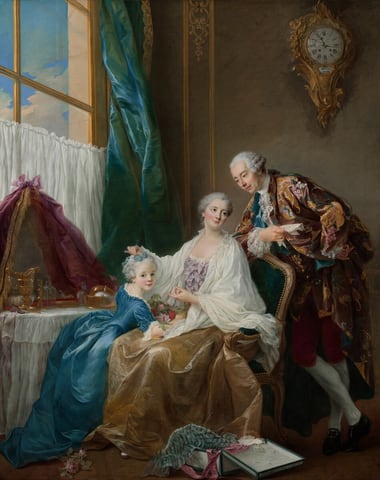
A woman sitting in an upholstered chair near a vanity table touches the hair of the little girl leaning against her lap to our left, as a man leans onto the back of her chair to our right in this vertical portrait painting. The people all have pale skin, flushed cheeks, and their pale gray hair is pulled back and curled. Their pink lips curve in slight smiles, and light glinting off of much of the fabric suggests they wear satin or silk. The woman’s body is angled to our left, toward the girl, but she turns her head back to look up over her other shoulder with gray eyes. A voluminous, cream-white cloth drapes over her shoulders and lap, over a bodice covered in lilac-purple bows and ribbons. Her gold satin skirt falls around her feet. The little girl leans onto one arm on the woman’s lap as she turns to look at us with pale blue eyes. The girl’s forget-me-not-blue dress has a fitted bodice, elbow-length sleeves over white cuffs, a long, full skirt, and white ruffles along the collar. The woman holds blue flowers in the girl’s hair, and the girl’s forearm wraps around a bundle of pink and red flowers in the woman’s lap. The chair is upholstered in teal blue and has a gold frame and a row of gold nail heads along the padded back and arm. The man leans one forearm against the back of the chair as he looks down at the girl. In that hand, he holds a folded piece of paper with writing. He wears a loose jacket decorated with gold pagodas, pink and yellow flowers, and spruce-green leaves against a brown background. Foamy white lace falls back from his cuffs and hangs down from the high white collar of his undershirt. He wears brick-red, knee-length britches, white stockings, and black shoes with silver buckles. His other hand is planted against his hip, and one ankle is crossed in front of the other. A vanity draped with a white cloth sits on the far side of the woman and girl, along the left edge of the painting. It holds gold and glass vessels and boxes, and a rounded mirror at the back is draped with dark pink cloth. The lower half of a window behind the vanity is covered by a white cloth, and the panes continue beyond the top of the canvas. A teal-blue curtain hangs along the right edge of the window, at the corner of the room. A clock with a gold case of swirling, carved designs hangs high on the peanut-brown wall behind the man. On the floor near the chair, blue and white striped tissue paper, a rose-pink ribbon, and a strand of pearls drape over the edges of an open box. Writing along the front edge of the lid of the box reads, “Fs. Drouais. Ce 1 avril. 1756.” A pink rose lies near the girl’s feet, to our left.
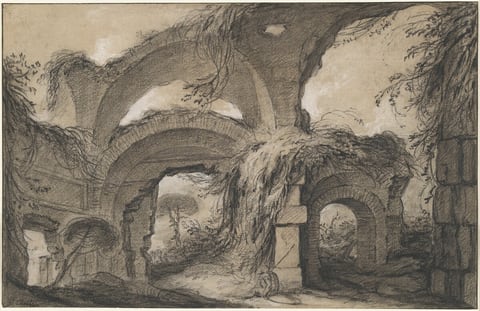
The image shows an ancient ruin with arches and crumbling stonework surrounded by overgrown vegetation. The horizon is slightly elevated, emphasizing the towering remnants of the architecture. Expressive brushstrokes and textures are notable, especially in the vines and leaves on the stone. The color palette is subdued, mainly earthy tones and black, creating contrast and suggesting openings into the distance, enhancing the old, abandoned feel of the ruins.
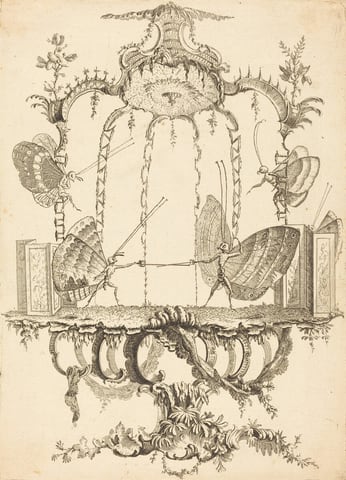
This is a drawing of anthropomorphic butterflies engaged in a duel with fencing swords. The butterflies have human-like bodies with wings resembling cloaks or capes. They stand on an ornate structure featuring decorative architectural elements like columns with floral and leaf motifs. Above them are arches, canopies, and hanging vines, creating a theatrical setting. The drawing combines fantasy and nature elements, showcasing elegance and imagination.
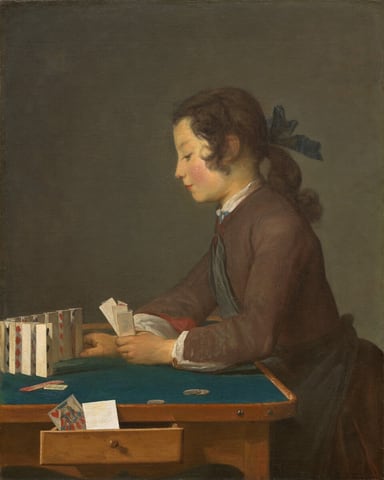
Shown from about the lap up, a young person with brown hair and a peachy complexion faces our left in profile as he leans onto a table and sets folded playing cards up in a row in this vertical painting. Shown against a dark background, his long, brown hair curls by his ears and is pulled back with a navy-blue ribbon at the nape of his neck. He has a delicately sloping nose, his pink lips are closed, the cheek facing us is flushed, and he looks down at the tabletop under lowered lids. He wears a chestnut-brown, long-sleeved coat with a dark blue sash across his chest and tied around his waist. The white of his undershirt peeks out at the high neck and wrists, and the brick-red lining of the sleeve of his jacket rolls back at his right wrist. The wooden table is lined with teal-blue fabric on its surface, and three coins lie near his left hand, closer to us. In that hand he holds three nested, vertically folded playing cards. With his right hand he places the last in a line of ten cards, standing vertically but close together like dominoes, in a curving row in front of him. Scarlet-red diamonds and hearts and the edges of some black shapes are visible within the bent cards. A jack of hearts and a piece of paper or the back of another card sit in a drawer that opens toward us along the side of the table. The artist signed the work in dark brown paint in the lower right corner: “J. Chardin.”
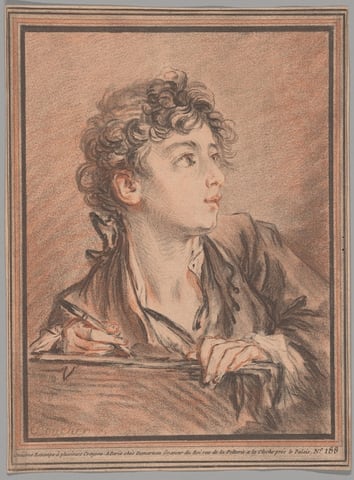
A work made of crayon manner engraving in red and black on cream laid paper.
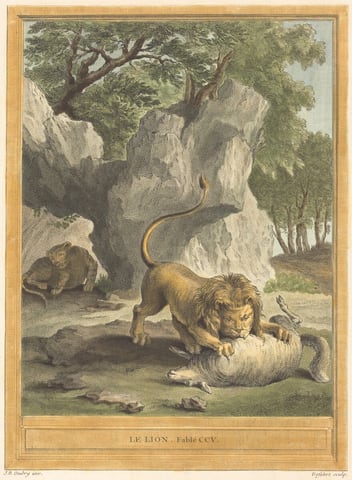
This is a drawing of a lion in a forested rocky landscape. The lion is seen standing over a defeated animal. In the background, a forest with dense trees frames the scene. One monkey is visible among the rocks watching the lion. The setting conveys a wild, rugged terrain with rocky formations and scattered vegetation. Light and shadow emphasize textures in the lion's mane and the surrounding rocks. The composition focuses on the lion and its prey.
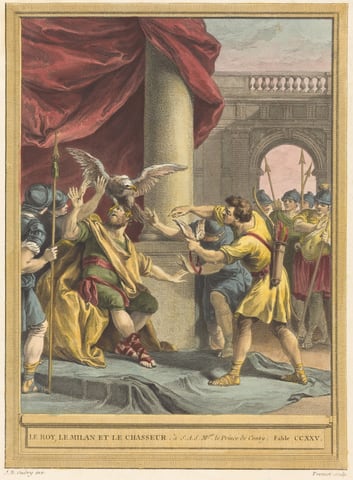
This is a painting of a king, a hawk, and a hunter in a classical architectural setting with columns and arches. In the image, a figure in royal clothing is seated beneath draped red fabric, facing a man in hunting attire holding a bird. A hawk perches on the royal figure's head, wings spread, while the hunter reaches toward the hawk. Surrounding them are other figures in armor, holding spears and shields. The style is reminiscent of classic European paintings with themes of mythology or allegory.

The works in this room are listed below.

Works in this room

Fêtes, portraits and still lifes from the France of the Regency and Louis XV.

First room, north wall

  1. A woman sitting in an upholstered chair near a vanity table touches the hair of the little girl leaning against her lap to our left, as a man leans onto the back of her chair to our right in this vertical portrait painting. The people all have pale skin, flushed cheeks, and their pale gray hair is pulled back and curled. Their pink lips curve in slight smiles, and light glinting off of much of the fabric suggests they wear satin or silk. The woman’s body is angled to our left, toward the girl, but she turns her head back to look up over her other shoulder with gray eyes. A voluminous, cream-white cloth drapes over her shoulders and lap, over a bodice covered in lilac-purple bows and ribbons. Her gold satin skirt falls around her feet. The little girl leans onto one arm on the woman’s lap as she turns to look at us with pale blue eyes. The girl’s forget-me-not-blue dress has a fitted bodice, elbow-length sleeves over white cuffs, a long, full skirt, and white ruffles along the collar. The woman holds blue flowers in the girl’s hair, and the girl’s forearm wraps around a bundle of pink and red flowers in the woman’s lap. The chair is upholstered in teal blue and has a gold frame and a row of gold nail heads along the padded back and arm. The man leans one forearm against the back of the chair as he looks down at the girl. In that hand, he holds a folded piece of paper with writing. He wears a loose jacket decorated with gold pagodas, pink and yellow flowers, and spruce-green leaves against a brown background. Foamy white lace falls back from his cuffs and hangs down from the high white collar of his undershirt. He wears brick-red, knee-length britches, white stockings, and black shoes with silver buckles. His other hand is planted against his hip, and one ankle is crossed in front of the other. A vanity draped with a white cloth sits on the far side of the woman and girl, along the left edge of the painting. It holds gold and glass vessels and boxes, and a rounded mirror at the back is draped with dark pink cloth. The lower half of a window behind the vanity is covered by a white cloth, and the panes continue beyond the top of the canvas. A teal-blue curtain hangs along the right edge of the window, at the corner of the room. A clock with a gold case of swirling, carved designs hangs high on the peanut-brown wall behind the man. On the floor near the chair, blue and white striped tissue paper, a rose-pink ribbon, and a strand of pearls drape over the edges of an open box. Writing along the front edge of the lid of the box reads, “Fs. Drouais. Ce 1 avril. 1756.” A pink rose lies near the girl’s feet, to our left.
    Family PortraitFrançois Hubert Drouais, 1756Courtesy National Gallery of Art, Washington
  2. The image shows an ancient ruin with arches and crumbling stonework surrounded by overgrown vegetation. The horizon is slightly elevated, emphasizing the towering remnants of the architecture. Expressive brushstrokes and textures are notable, especially in the vines and leaves on the stone. The color palette is subdued, mainly earthy tones and black, creating contrast and suggesting openings into the distance, enhancing the old, abandoned feel of the ruins.
    Arches of the Larger Baths at Hadrian's VillaCharles Michel-Ange Challe, c. 1748Courtesy National Gallery of Art, Washington
  3. This is a drawing of anthropomorphic butterflies engaged in a duel with fencing swords. The butterflies have human-like bodies with wings resembling cloaks or capes. They stand on an ornate structure featuring decorative architectural elements like columns with floral and leaf motifs. Above them are arches, canopies, and hanging vines, creating a theatrical setting. The drawing combines fantasy and nature elements, showcasing elegance and imagination.
    Le Duel (The Duel)Charles Germain de Saint-Aubin, in or after 1756Courtesy National Gallery of Art, Washington

First room, south wall

  1. Shown from about the lap up, a young person with brown hair and a peachy complexion faces our left in profile as he leans onto a table and sets folded playing cards up in a row in this vertical painting. Shown against a dark background, his long, brown hair curls by his ears and is pulled back with a navy-blue ribbon at the nape of his neck. He has a delicately sloping nose, his pink lips are closed, the cheek facing us is flushed, and he looks down at the tabletop under lowered lids. He wears a chestnut-brown, long-sleeved coat with a dark blue sash across his chest and tied around his waist. The white of his undershirt peeks out at the high neck and wrists, and the brick-red lining of the sleeve of his jacket rolls back at his right wrist. The wooden table is lined with teal-blue fabric on its surface, and three coins lie near his left hand, closer to us. In that hand he holds three nested, vertically folded playing cards. With his right hand he places the last in a line of ten cards, standing vertically but close together like dominoes, in a curving row in front of him. Scarlet-red diamonds and hearts and the edges of some black shapes are visible within the bent cards. A jack of hearts and a piece of paper or the back of another card sit in a drawer that opens toward us along the side of the table. The artist signed the work in dark brown paint in the lower right corner: “J. Chardin.”
    The House of CardsJean Siméon Chardin, probably 1737Courtesy National Gallery of Art, Washington
  2. A work made of crayon manner engraving in red and black on cream laid paper.
    The Young DraftsmanGilles Demarteau, 1750/70Courtesy of the Art Institute of Chicago
  3. This is a drawing of a lion in a forested rocky landscape. The lion is seen standing over a defeated animal. In the background, a forest with dense trees frames the scene. One monkey is visible among the rocks watching the lion. The setting conveys a wild, rugged terrain with rocky formations and scattered vegetation. Light and shadow emphasize textures in the lion's mane and the surrounding rocks. The composition focuses on the lion and its prey.
    Le lion (The Lion)A.-J. de Fehrt, published 1759Courtesy National Gallery of Art, Washington
  4. This is a painting of a king, a hawk, and a hunter in a classical architectural setting with columns and arches. In the image, a figure in royal clothing is seated beneath draped red fabric, facing a man in hunting attire holding a bird. A hawk perches on the royal figure's head, wings spread, while the hunter reaches toward the hawk. Surrounding them are other figures in armor, holding spears and shields. The style is reminiscent of classic European paintings with themes of mythology or allegory.
    Le roi, le milan, et le chasseur (The King, the Kite, and the Hunter)Benoît-Louis Prévost, published 1759Courtesy National Gallery of Art, Washington

Second room, south wall
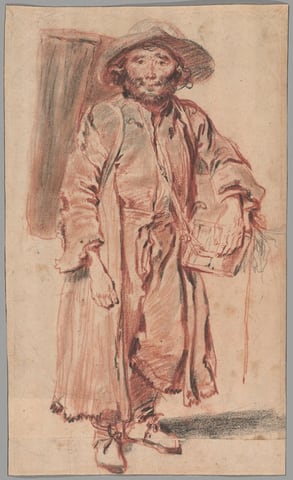
  1. Chalk drawing with red and black shading of man carrying crate and pack.
    The Old SavoyardAntoine Watteau, c. 1715Courtesy of the Art Institute of Chicago
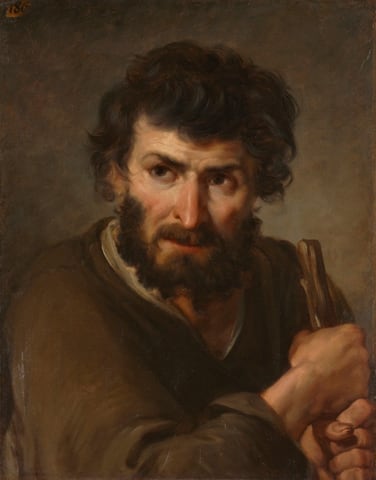
  2. Study of a Shepherd, 1700s
    Study of a ShepherdUnrecorded French maker, 1700sCourtesy of the Cleveland Museum of Art
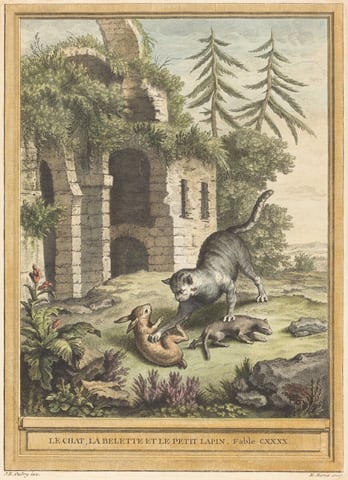
  3. This is a painting of animals in front of a ruined structure. The painting features a cat, a weasel, and a small rabbit gathered on a patch of grass. The cat has its paw over the rabbit, with the weasel observing. They are in front of an ancient stone structure surrounded by vegetation. In the background are trees against a sky. The foreground has detailed foliage and flowers.
    Le chat, la balette et le petit lapin (The Cat, the Weasel, and the Rabbit)Martin Marvie, published 1756Courtesy National Gallery of Art, Washington
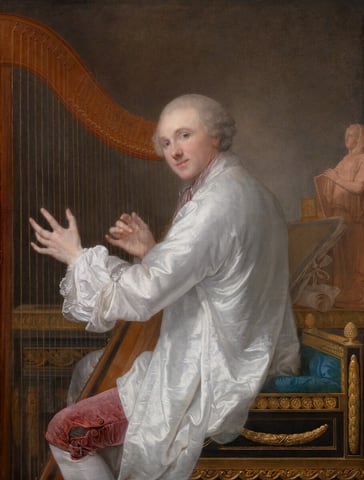
  4. A pale-skinned man sits facing our left as he plays a harp while turning his face to smile at us in this vertical portrait painting. He looks out the corners of his light blue eyes under arched, gray brows. He has a rounded nose, pale pink lips, and a round face. Gray hair is brushed back from his high forehead and curls around his ears. His long fingers rest on the strings of the harp, and the ends of strings curl like wind-loosened strands of hair along the top edge. The man wears a pale mauve-purple cravat, and his snow-white, long-sleeved chemise is untucked and loose around his thighs. The cuff we see is open and folded back over a bright white shirt edged with lace. His dusky rose-pink breeches are unbuttoned at the knee over white stockings. The square-seated chair on which he sits is carved with garlands and floral patterns, which are gilded gold. The seat itself is topaz blue, and it has a low back. A similarly ornamented and gilded table along the back of the room holds a portfolio and roll of papers, the tooled and gilded spines of books, and a statuette to the right. The pale pinkish-orange statuette shows a woman holding a tablet and wearing a long, loose robe and head covering. Her body angles to our left and she looks off in that direction. The wall behind the table is mottled with smoky shades of gray and tan.
    Ange Laurent de La Live de JullyJean Baptiste Greuze, probably 1759Courtesy National Gallery of Art, Washington

Second room, north wall
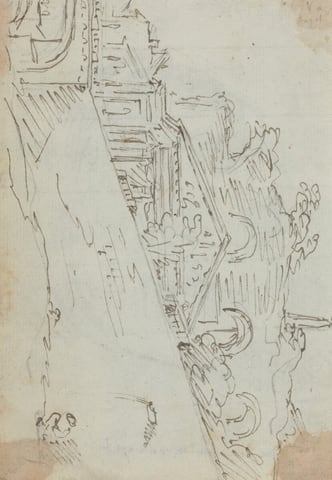
  1. The image shows a sketch of an architectural scene with structures lining a road or pathway. The horizon is not clearly defined, and the sketch focuses on architectural details. The drawing features loose, freehand lines outlining buildings and trees, with classical elements like columns and entablatures. The color palette is monochromatic, with light parchment and dark ink strokes creating contrast. Close-up details are lightly shaded for depth, while distant details are less defined. The composition is open and airy, emphasizing architectural features over precision.
    Ancient Ruins on the Bank of the TiberAugustin Pajou, 1752/1756Courtesy National Gallery of Art, Washington
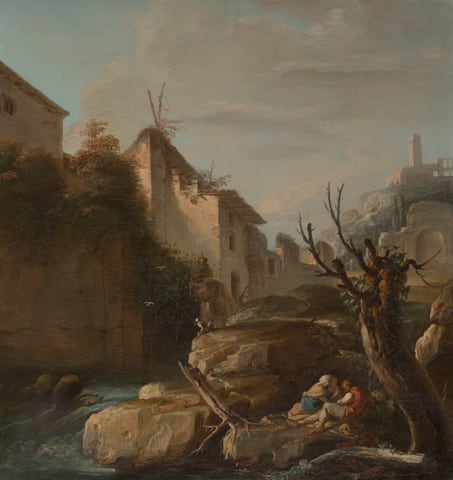
  2. A work made of oil on canvas.
    Appenine LandscapeFrançois Le Moyne, c. 1730Courtesy of the Art Institute of Chicago
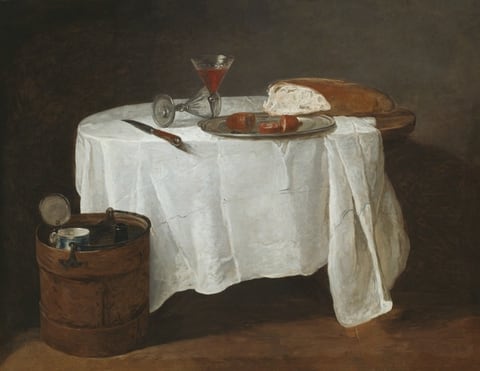
  3. A work made of oil on canvas.
    The White TableclothJean Siméon Chardin, c. 1731–32Courtesy of the Art Institute of Chicago

Third room, north wall
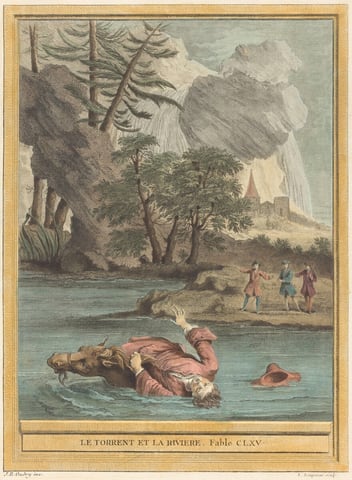
  1. The image shows a man in a red coat in a river, holding on to a horse. A hat floats nearby. Three figures in 18th-century clothing stand on a rocky riverbank looking concerned. In the background, there are trees, a castle-like structure, and large clouds. The brushstrokes are detailed, capturing movement and textures. The color palette includes muted tones like earthy browns, greens, soft blue, and subtle reds.
    Le torrent et la riviere (The Torrent and theRiver)Louis-Simon Lempereur, published 1756Courtesy National Gallery of Art, Washington
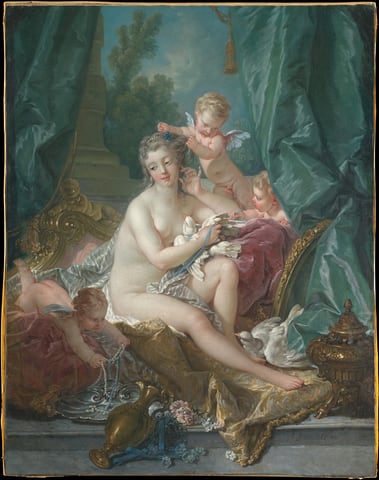
  2. The Toilette of Venus, by François Boucher, 1751
    The Toilette of VenusFrançois Boucher, 1751Courtesy of The Metropolitan Museum of Art