Floor plan

Style galleriesThe Etching Revival

The Etching Revival

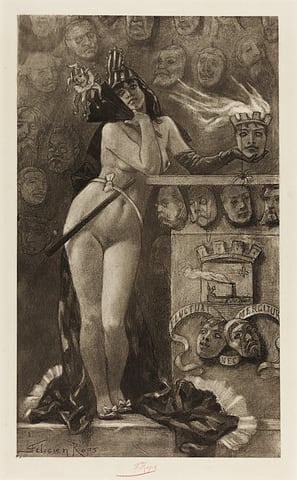
A work made of photogravure in dark brown retouched with soft varnish (vernis mou), roulette and blue handcoloring on thick cream wove paper.
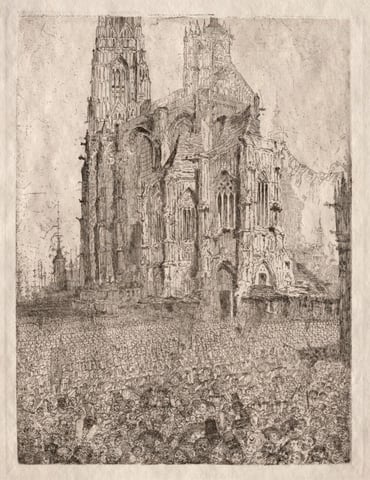
The Cathedral, by James Ensor, 1886
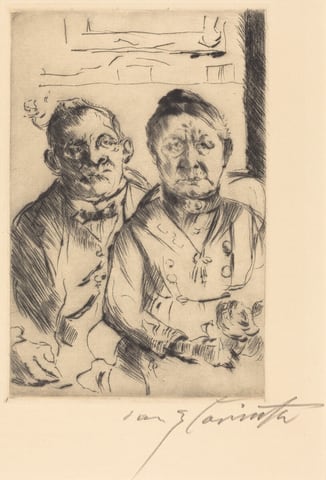
The image depicts two individuals from the waist up. The person on the left has a round face and is slightly behind the person on the right who has a slightly elongated face. Both individuals appear to be seated and have short, neatly combed hair. They have neutral facial expressions and their features are indistinct. The person on the left wears a suit with a bow tie, while the person on the right is dressed in clothing with detailed patterns and holds a flower-like object in their left hand. The background shows simple line sketches that suggest an interior setting.
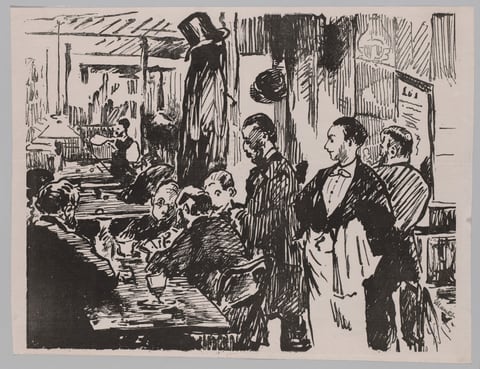
At the Café, by Édouard Manet, 1874
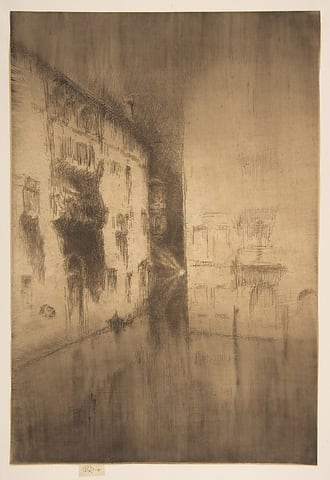
Nocturne: Palaces, by James McNeill Whistler, 1879–80

The works in this room are listed below.

Works in this room

Artists who took up the etching needle again, from Whistler to the Paris printmakers.

Section 1, north wall

  1. A work made of photogravure in dark brown retouched with soft varnish (vernis mou), roulette and blue handcoloring on thick cream wove paper.
    Modern MasksFélicien Rops, 1889Courtesy of the Art Institute of Chicago
  2. The Cathedral, by James Ensor, 1886
    The CathedralJames Ensor, 1886Courtesy of the Cleveland Museum of Art
  3. The image depicts two individuals from the waist up. The person on the left has a round face and is slightly behind the person on the right who has a slightly elongated face. Both individuals appear to be seated and have short, neatly combed hair. They have neutral facial expressions and their features are indistinct. The person on the left wears a suit with a bow tie, while the person on the right is dressed in clothing with detailed patterns and holds a flower-like object in their left hand. The background shows simple line sketches that suggest an interior setting.
    Ostpreussisches Ehepaar (Couple from East Prussia)Lovis Corinth, 1916Courtesy National Gallery of Art, Washington

Section 1, south wall

  1. At the Café, by Édouard Manet, 1874
    At the CaféÉdouard Manet, 1874Courtesy of the Cleveland Museum of Art
  2. Nocturne: Palaces, by James McNeill Whistler, 1879–80
    Nocturne: PalacesJames McNeill Whistler, 1879–80Courtesy of The Metropolitan Museum of Art

Section 2, south wall
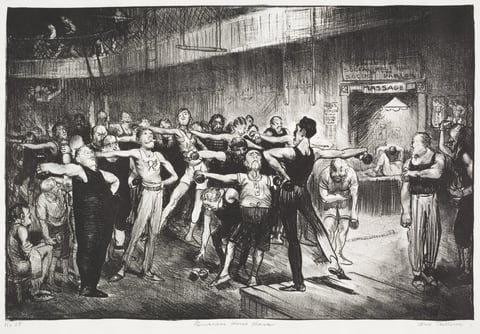
  1. Business Men's Class, by George Bellows, 1916
    Business Men's ClassGeorge Bellows, 1916Courtesy of the Cleveland Museum of Art
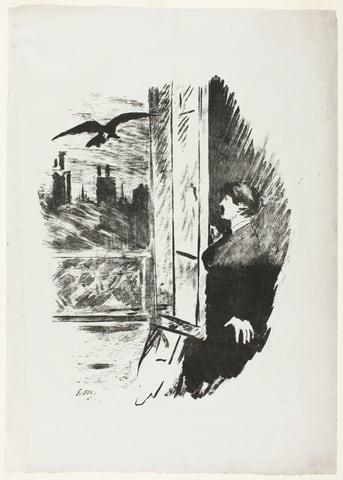
  2. A work made of transfer lithograph in black on gray china paper.
    At the window ("Open here I flung the shutter..."), from The Raven (Le Corbeau)Édouard Manet, 1875Courtesy of the Art Institute of Chicago

Section 2, north wall
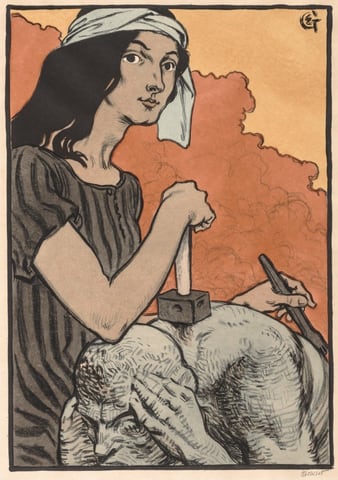
  1. Sculptress, by Eugène Grasset, 1897
    SculptressEugène Grasset, 1897Courtesy of the Cleveland Museum of Art
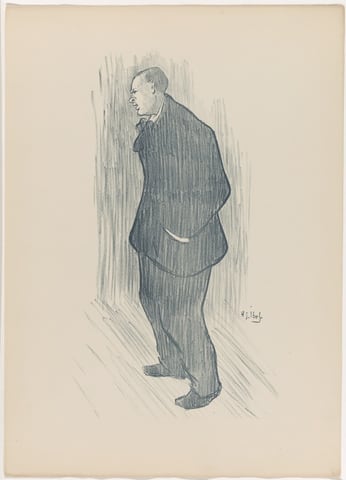
  2. A work made of lithograph in dark green on cream wove paper.
    Mévisto, from Le Café-ConcertHenri-Gabriel Ibels, 1893Courtesy of the Art Institute of Chicago
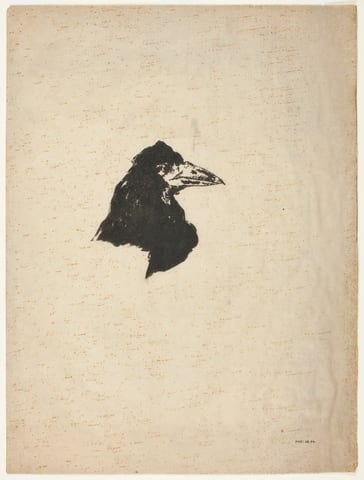
  3. A work made of transfer lithograph in black on tan simili-parchment paper.
    Head of a Raven in Profile, from The Raven (Le Corbeau)Édouard Manet, 1875Courtesy of the Art Institute of Chicago

Section 3, north wall
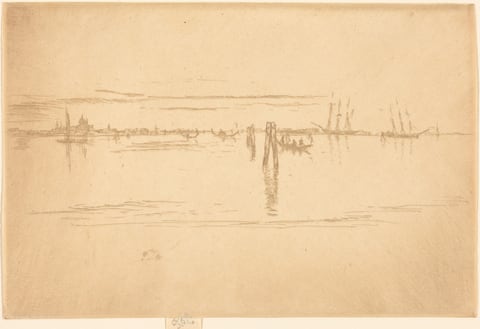
  1. The image shows a landscape with a waterscape. The horizon separates the water and the sky. In the distance, there are buildings, structures, and ships with tall masts. Close to us, there are reflections of the ships and structures in the water with fine brushstrokes. The style is impressionistic with thin lines conveying details. The color palette is monochromatic with sepia tones.
    Long LagoonJames McNeill Whistler, 1880Courtesy National Gallery of Art, Washington
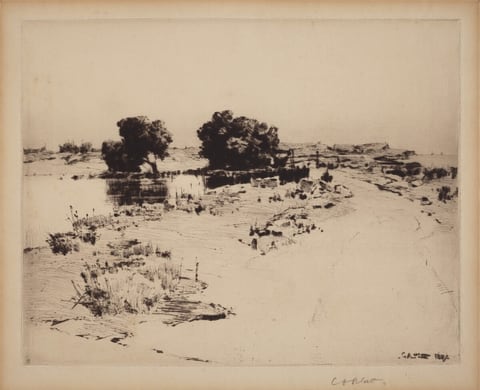
  2. The image depicts a landscape seen from a slightly elevated perspective, with a tranquil scene. The horizon is high in the composition, showing a vast view. There are a few distant trees and silhouettes blending into the sky. The brushstrokes are expressive and fluid, with a sketch-like quality depicting texture and movement in the trees and ground. The color palette is primarily monochrome, using shades of black and grey. Near the viewer, there are low plants and shrubs on sandy ground, leading to a small body of water reflecting dense trees. In the distance, the landscape becomes more open and sparse towards the horizon.
    Cape Ann WillowsCharles A. Platt, 1887Courtesy National Gallery of Art, Washington
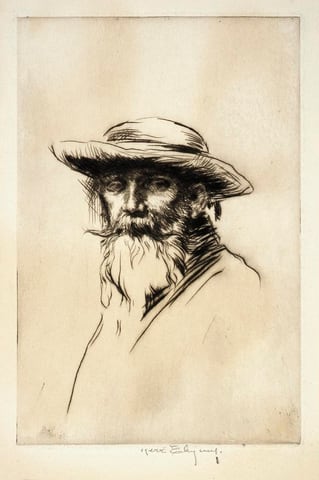
  3. Head of an Old Man, by Kerr Eby, ca. 1918
    Head of an Old ManKerr Eby, ca. 1918Courtesy of the Smithsonian American Art Museum

Section 3, south wall
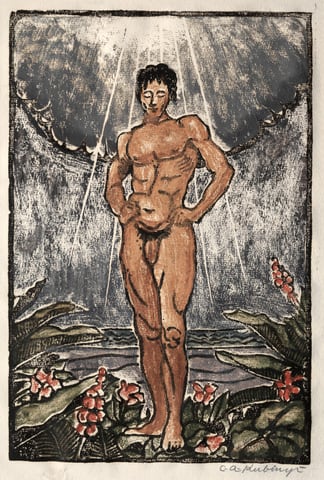
  1. The Creation, by Kálmán Kubinyi, before 1927
    The CreationKálmán Kubinyi, before 1927Courtesy of the Cleveland Museum of Art
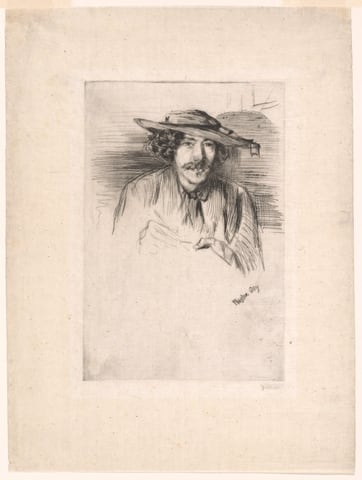
  2. A work made of drypoint with light plate tone on thin ivory japanese paper.
    Whistler with a HatJames McNeill Whistler, 1859Courtesy of the Art Institute of Chicago
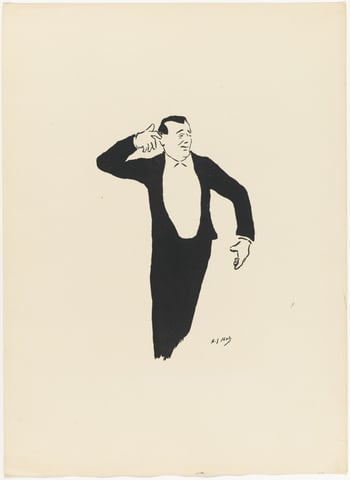
  3. A work made of lithograph on ivory wove paper.
    Paulus, from Le Café-ConcertHenri-Gabriel Ibels, 1893Courtesy of the Art Institute of Chicago