Floor plan

Style galleriesThe Etching Revival

The Etching Revival

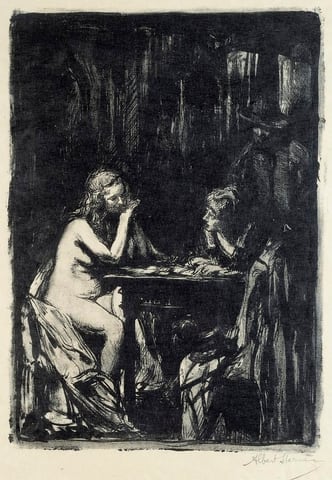
The Stranger, by Albert Sterner, 1916
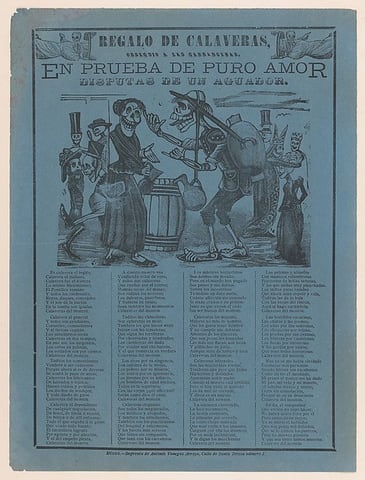
In proof of true love, a watercarrier skeleton arguing with a woman (Posada); two skeleton angels in upper corners (Manilla), by José Guadalupe Posada, ca. 1890–96
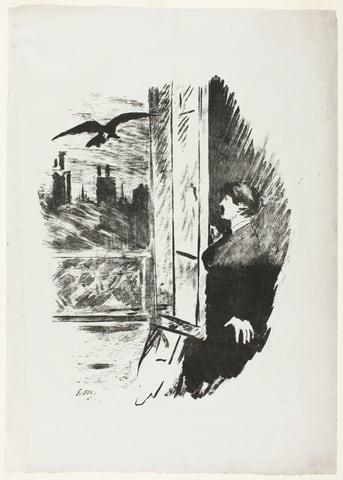
A work made of transfer lithograph in black on gray china paper.
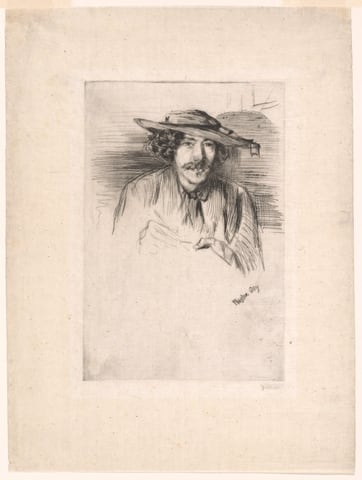
A work made of drypoint with light plate tone on thin ivory japanese paper.
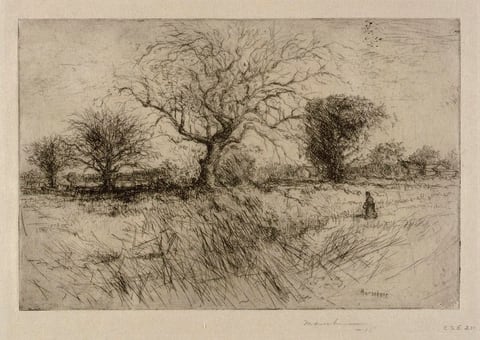
The Old Orchard, by Arthur A. Marschner, 1915
Untitled, by Mildred McMillen, 1915

The works in this room are listed below.

Works in this room

Artists who took up the etching needle again, from Whistler to the Paris printmakers.

Section 1, north wall

  1. The Stranger, by Albert Sterner, 1916
    The StrangerAlbert Sterner, 1916Courtesy of the Smithsonian American Art Museum
  2. In proof of true love, a watercarrier skeleton arguing with a woman (Posada); two skeleton angels in upper corners (Manilla), by José Guadalupe Posada, ca. 1890–96
    In proof of true love, a watercarrier skeleton arguing with a woman (Posada); two skeleton angels in upper corners (Manilla)José Guadalupe Posada, ca. 1890–96Courtesy of The Metropolitan Museum of Art
  3. A work made of transfer lithograph in black on gray china paper.
    At the window ("Open here I flung the shutter..."), from The Raven (Le Corbeau)Édouard Manet, 1875Courtesy of the Art Institute of Chicago

Section 1, south wall

  1. A work made of drypoint with light plate tone on thin ivory japanese paper.
    Whistler with a HatJames McNeill Whistler, 1859Courtesy of the Art Institute of Chicago
  2. The Old Orchard, by Arthur A. Marschner, 1915
    The Old OrchardArthur A. Marschner, 1915Courtesy of the Smithsonian American Art Museum
  3. Untitled, by Mildred McMillen, 1915
    UntitledMildred McMillen, 1915Courtesy of the Smithsonian American Art Museum

Section 2, south wall
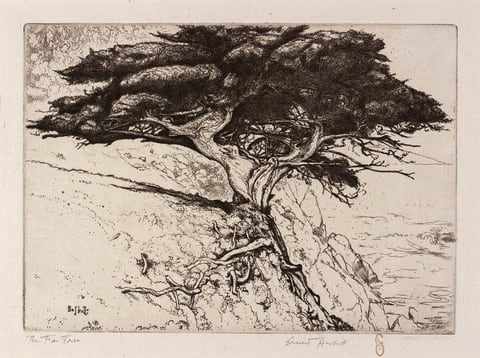
  1. The Fan Tree, by Ernest Haskell, ca. 1915
    The Fan TreeErnest Haskell, ca. 1915Courtesy of the Smithsonian American Art Museum
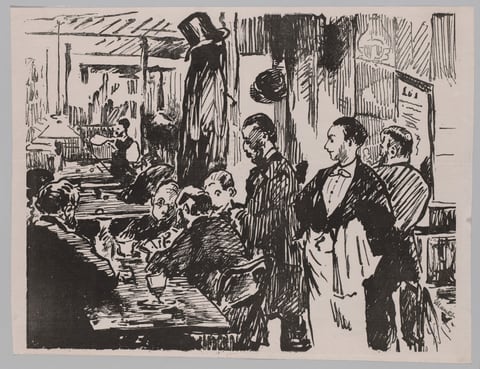
  2. At the Café, by Édouard Manet, 1874
    At the CaféÉdouard Manet, 1874Courtesy of the Cleveland Museum of Art
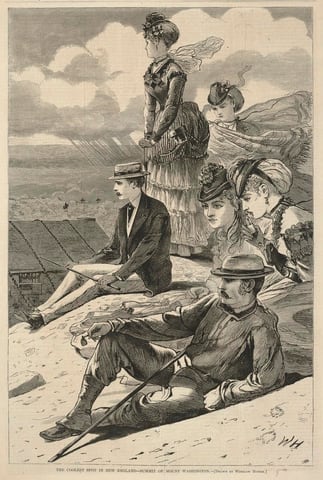
  3. The Coolest Spot in New England--Summit of Mount Washington, from Harper's Bazar, July 23, 1870, by Winslow Homer, 1870
    The Coolest Spot in New England--Summit of Mount Washington, from Harper's Bazar, July 23, 1870Winslow Homer, 1870Courtesy of the Smithsonian American Art Museum

Section 2, north wall
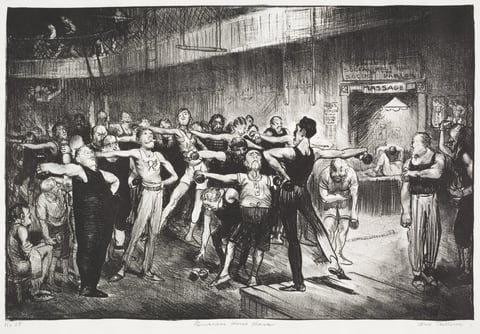
  1. Business Men's Class, by George Bellows, 1916
    Business Men's ClassGeorge Bellows, 1916Courtesy of the Cleveland Museum of Art
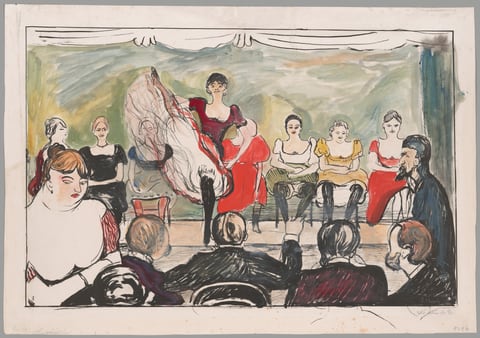
  2. A work made of lithograph in black ink, with additions in brush and red, blue, yellow, green, orange-brown and gray watercolor on ivory wove paper.
    TingletangleEdvard Munch, 1895Courtesy of the Art Institute of Chicago

Section 3, north wall
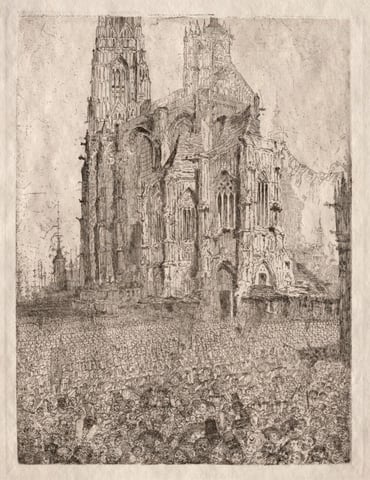
  1. The Cathedral, by James Ensor, 1886
    The CathedralJames Ensor, 1886Courtesy of the Cleveland Museum of Art
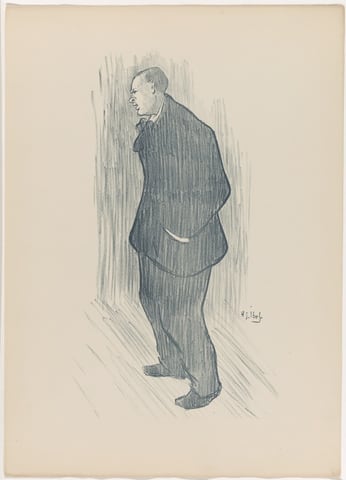
  2. A work made of lithograph in dark green on cream wove paper.
    Mévisto, from Le Café-ConcertHenri-Gabriel Ibels, 1893Courtesy of the Art Institute of Chicago
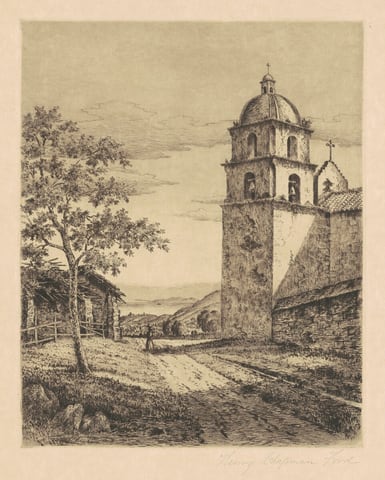
  3. The image features a large building with a domed tower on the right side. The horizon shows hills, trees, and the sky. The brushstrokes give detailed texture to the scene, with a focus on the landscape and architecture. The color palette is sepia-toned. A tree, fence, smaller buildings, and a figure on a path add depth and perspective to the scene.
    Mission Santa Barbara, Looking SouthHenry Chapman Ford, 1888Courtesy National Gallery of Art, Washington

Section 3, south wall
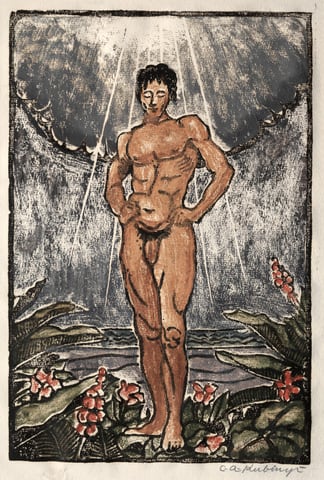
  1. The Creation, by Kálmán Kubinyi, before 1927
    The CreationKálmán Kubinyi, before 1927Courtesy of the Cleveland Museum of Art
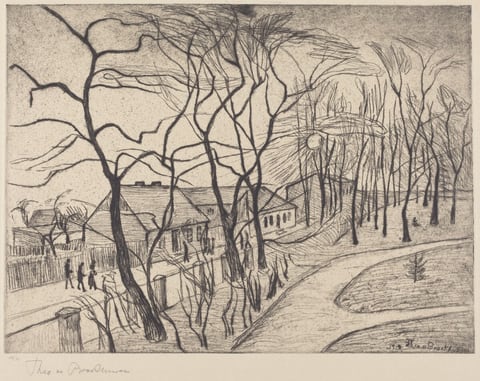
  2. The image shows a residential area with barren trees, rooftops of houses, and people walking along fences. The trees sway in the wind, their branches extending in various directions. The scene is depicted in a monochromatic black and white style, with expressive lines creating a sense of movement and a sketch-like quality. The horizon is high, showing rooftops and the sun above it.
    LandscapeTheo von BrockhusenCourtesy National Gallery of Art, Washington