Floor plan

Style galleriesThe Etching Revival

The Etching Revival

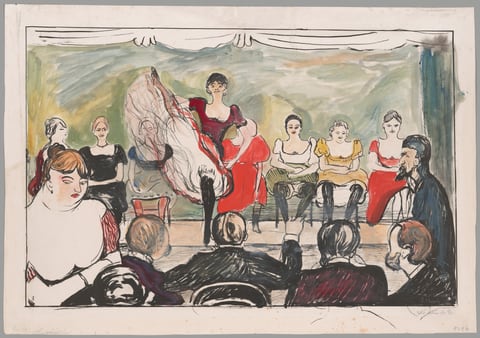
A work made of lithograph in black ink, with additions in brush and red, blue, yellow, green, orange-brown and gray watercolor on ivory wove paper.
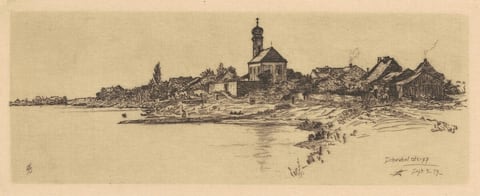
The image shows a village scene viewed from a low vantage point near a water's edge. A row of small, closely packed buildings and a church with an onion-shaped dome are prominently featured. There are gentle slopes leading towards the structures. The image uses fine, detailed line work to depict texture and depth in the buildings and natural landscape. The lines are delicate and varied, creating a sense of detail and softness. The color palette is monochromatic, with dark ink on a pale background, resulting in a classic and timeless feel.
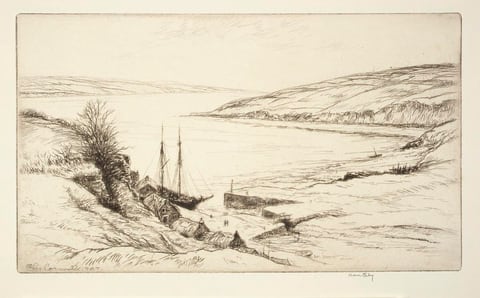
Cornwall, by Kerr Eby, 1927
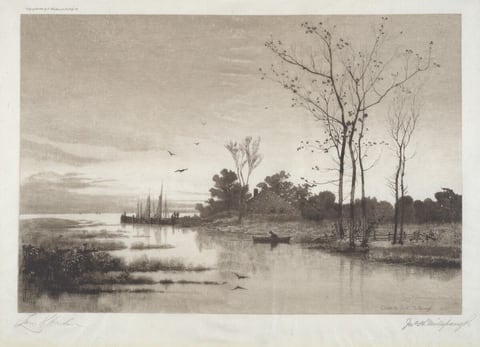
The image depicts a landscape with a river flowing through it. In the foreground, there is a small boat on the water, and in the background, sailboats are docked near a strip of land. Tall trees with sparse foliage are on the right side, with a structure nestled among them near the water. The horizon is slightly above the center of the image, with a calm sky above it. The brushstrokes vary in texture, with fine strokes for the sky and water and more detailed strokes for the trees. The color palette is muted, with sepia and gray tones creating a peaceful atmosphere. Birds are scattered in the sky.

The works in this room are listed below.

Works in this room

Artists who took up the etching needle again, from Whistler to the Paris printmakers.

Section 1, north wall

  1. A work made of lithograph in black ink, with additions in brush and red, blue, yellow, green, orange-brown and gray watercolor on ivory wove paper.
    TingletangleEdvard Munch, 1895Courtesy of the Art Institute of Chicago
  2. The image shows a village scene viewed from a low vantage point near a water's edge. A row of small, closely packed buildings and a church with an onion-shaped dome are prominently featured. There are gentle slopes leading towards the structures. The image uses fine, detailed line work to depict texture and depth in the buildings and natural landscape. The lines are delicate and varied, creating a sense of detail and softness. The color palette is monochromatic, with dark ink on a pale background, resulting in a classic and timeless feel.
    SchwabelweissOtto Henry Bacher, 1879Courtesy National Gallery of Art, Washington

Section 1, south wall

  1. Cornwall, by Kerr Eby, 1927
    CornwallKerr Eby, 1927Courtesy of the Smithsonian American Art Museum
  2. The image depicts a landscape with a river flowing through it. In the foreground, there is a small boat on the water, and in the background, sailboats are docked near a strip of land. Tall trees with sparse foliage are on the right side, with a structure nestled among them near the water. The horizon is slightly above the center of the image, with a calm sky above it. The brushstrokes vary in texture, with fine strokes for the sky and water and more detailed strokes for the trees. The color palette is muted, with sepia and gray tones creating a peaceful atmosphere. Birds are scattered in the sky.
    Shrewsbury RiverJohn Hill Millspaugh, 1887Courtesy National Gallery of Art, Washington

Section 2, south wall
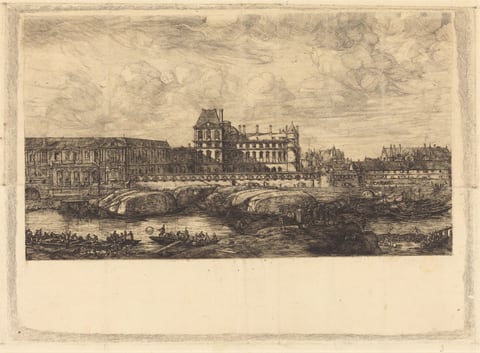
  1. The image features a riverside scene with a large building in the center and smaller structures in the background. The sky is filled with clouds, and there are boats on the water. The artwork is done in an etching style, with detailed lines showing architectural elements, boats, and water ripples. The color scheme is monochromatic in shades of brown and black.
    L'ancien Louvre d'après une peinture de Zeeman, 1651 (The Old Louvre, from a Painting by Zeeman, l651)Charles Meryon, 1866Courtesy National Gallery of Art, Washington
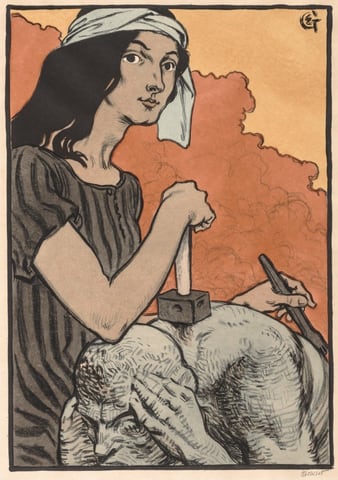
  2. Sculptress, by Eugène Grasset, 1897
    SculptressEugène Grasset, 1897Courtesy of the Cleveland Museum of Art
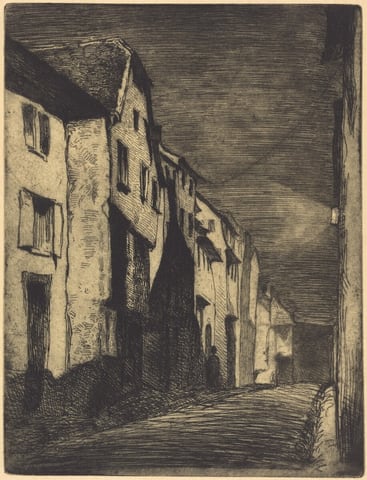
  3. The image shows a street scene from a close perspective down a narrow alleyway. The horizon is not visible, with buildings on both sides. The style features detailed etching with fine lines and shading for depth and texture. The color palette is monochromatic with black, gray, and off-white tones. The houses have worn facades, and there is a distant figure. The sky is dark and overcast, enhancing the shadow-filled scene.
    Street in SaverneJames McNeill Whistler, 1858Courtesy National Gallery of Art, Washington

Section 2, north wall
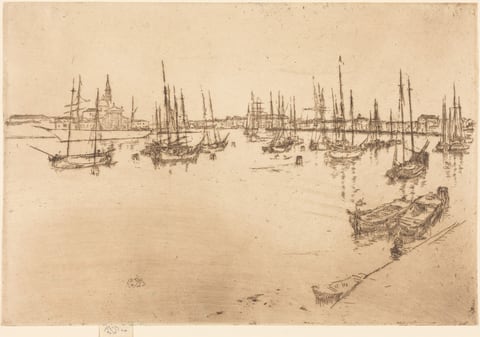
  1. The image displays a harbor filled with boats and ships. The perspective is slightly elevated, likely from a dock, with a partially visible boat and dock at the forefront. The horizon is in the upper third of the image, showing a distant cityscape with spires and structures. The brushwork is delicate, with fine, linear strokes typical of etching. The color palette is monochromatic, sepia tones creating a vintage and serene mood. The ships with tall masts populate the water, with reflections giving a sense of stillness. In the distance, faint impressions of buildings line the harbor, blending into the horizon.
    San GiorgioJames McNeill Whistler, 1880Courtesy National Gallery of Art, Washington
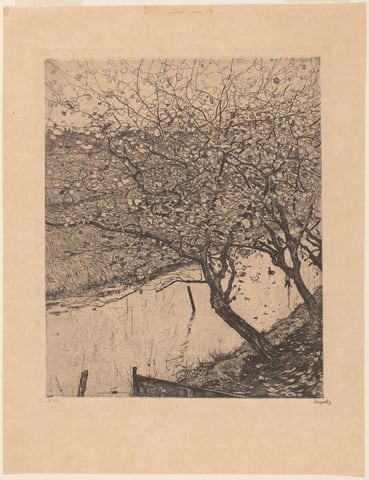
  2. The image shows a small body of water with grass-covered banks on either side. The viewpoint is slightly elevated, looking down at the scene. The horizon is in the upper third of the composition, separating the sky from the land. The artwork features intricate linework and stippling to create texture and detail, particularly in the tree branches. The color palette is monochrome, with shades of sepia and brown. A tree dominates the right side of the scene, leaning over the water. In the distance, more trees and fields are visible with minimal detail in the far background.
    Apple Trees along the Side of a DitchPieter Dupont, 1894Courtesy National Gallery of Art, Washington
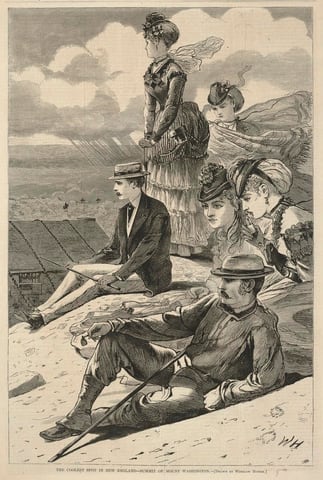
  3. The Coolest Spot in New England--Summit of Mount Washington, from Harper's Bazar, July 23, 1870, by Winslow Homer, 1870
    The Coolest Spot in New England--Summit of Mount Washington, from Harper's Bazar, July 23, 1870Winslow Homer, 1870Courtesy of the Smithsonian American Art Museum

Section 3, north wall
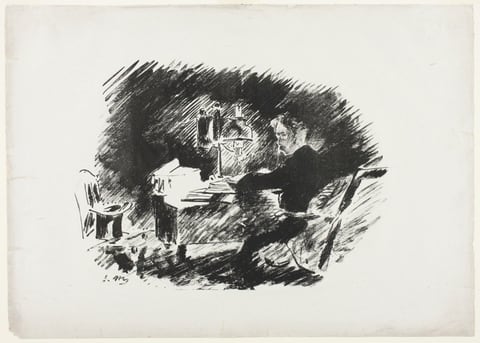
  1. A work made of transfer lithograph in black on gray china paper.
    Under the Lamp ("Once upon a midnight dreary..."), from The Raven (Le Corbeau)Édouard Manet, 1875Courtesy of the Art Institute of Chicago
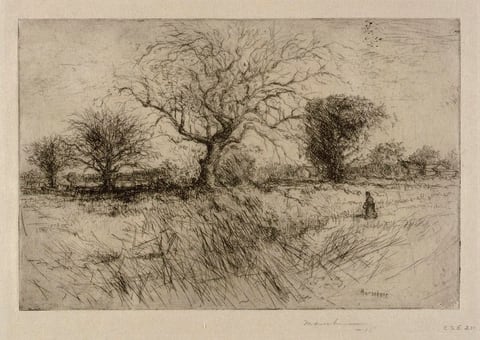
  2. The Old Orchard, by Arthur A. Marschner, 1915
    The Old OrchardArthur A. Marschner, 1915Courtesy of the Smithsonian American Art Museum
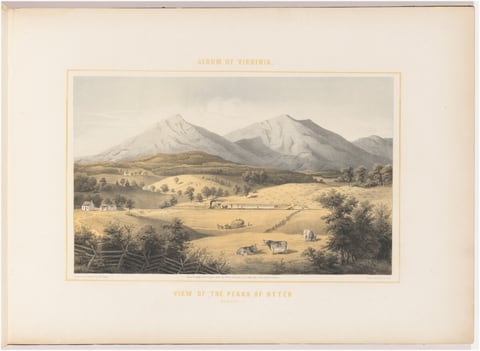
  3. The image shows a landscape with a valley leading towards two mountain peaks known as the Peaks of Otter. The horizon is low, with the mountains dominating the scene. The brushwork is smooth and delicate, and the color palette consists of muted earth tones, greens, and soft blues. In the foreground, there are cattle grazing in a field with a wooden fence, and a couple of houses among trees to the left. Further back, there are open fields with horses and agricultural activities, leading to a dense tree line at the base of the mountains.
    View of the Peaks of OtterWoldemar Rau, 1858Courtesy National Gallery of Art, Washington

Section 3, south wall
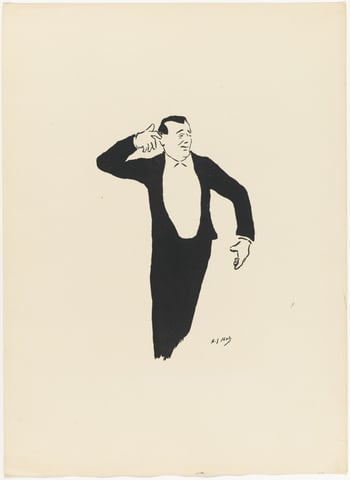
  1. A work made of lithograph on ivory wove paper.
    Paulus, from Le Café-ConcertHenri-Gabriel Ibels, 1893Courtesy of the Art Institute of Chicago
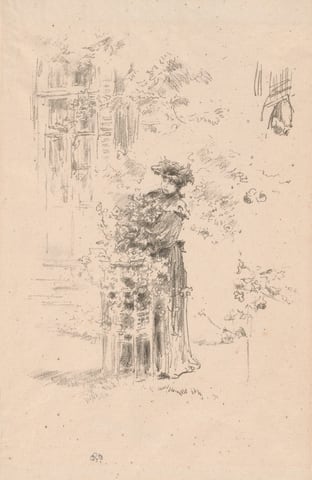
  2. A work made of transfer lithograph in black, with stumping and scraping, on cream laid paper, laid down on a heavy backing sheet.
    La Belle JardinièreJames McNeill Whistler, 1894Courtesy of the Art Institute of Chicago
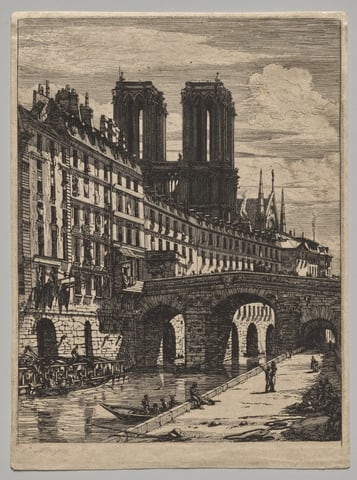
  3. The Petit Pont, by Charles Meryon, 1850
    The Petit PontCharles Meryon, 1850Courtesy of the Cleveland Museum of Art