Floor plan

Style galleriesAmerican colonial and Federal art
American colonial and Federal art
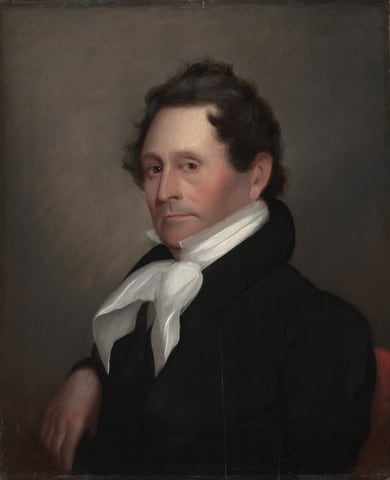
Senator Thomas Hart Benton, by Matthew Harris Jouett, 1820s
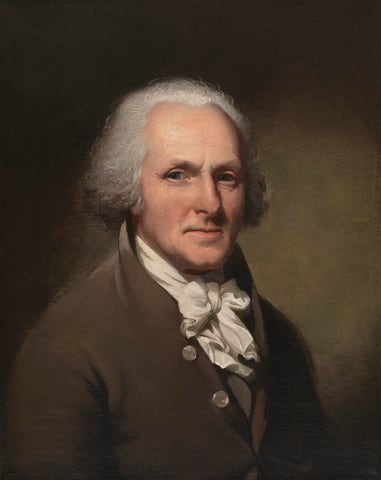
Artist: Charles Willson Peale, Sitter: Charles Willson Peale, Current owner: National Portrait Gallery, Smithsonian Institution
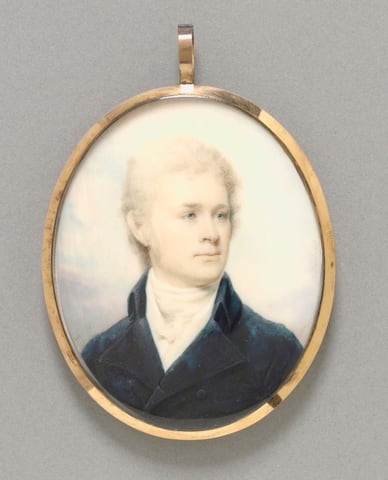
James Alexander Ross Cuthbert, by Edward Greene Malbone, 1799
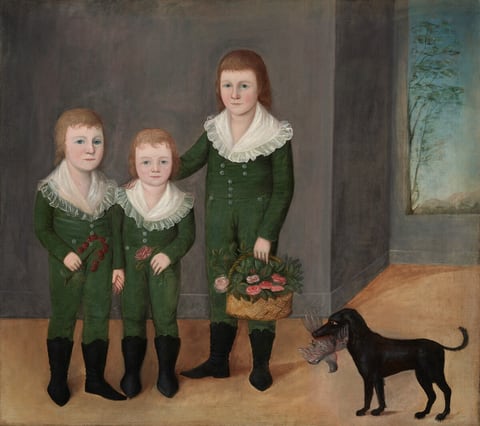
Three pale-skinned, blue-eyed children wearing green suits stand in a row facing us in this horizontal portrait painting. They all have round faces and full, pink cheeks. The tallest child is to the right, and he has shoulder-length cinnamon-brown hair. The other two come up to his shoulder and have blond hair. The tallest puts one arm on the far shoulder of the middle child, and the two smaller children hold hands. Each wears a pine-green, one-piece outfit with pewter-gray buttons, a wide, ivory-white collar lined with ruffles, and black, shin-high boots. The boy on our left holds a branch of dark red cherries. The middle child holds a pink rose, and the tallest a basket filled with pink roses. A black dog holding a gray and mauve-pink bird in its mouth stands in profile facing our left in the lower right corner of the canvas. The room around them has a tan-colored floor and gray walls. The room opens onto an alcove to our right with a rectangular window. A slender tree is along the left edge of the opening and a few pale, pink-tinged gray mountains line the bottom edge. Clear blue sky fills the rest of the window.
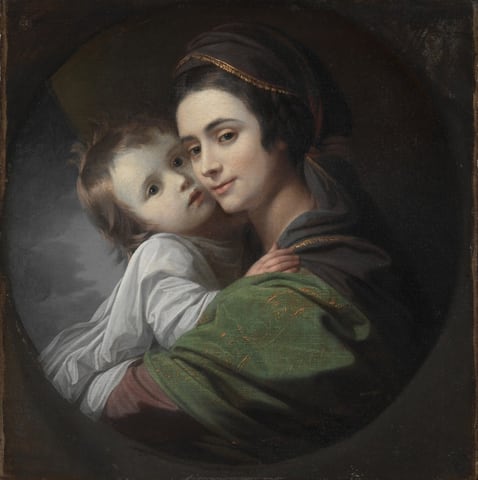
Elizabeth Shewell West and Her Son, Raphael, by Benjamin West, c. 1770
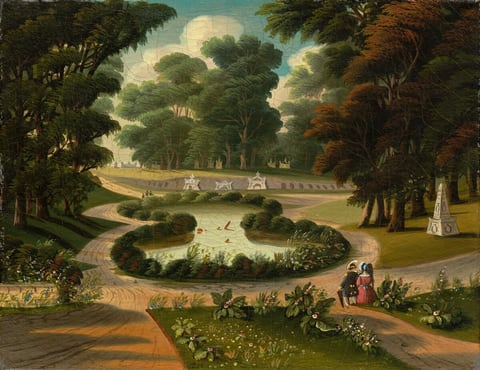
This painting shows a park-like landscape with trees, flowers, bushes, and a pond, all surrounded by light brown paths. The pond is in the center of the park, with light green-blue water framed by bushes, ferns, and tall flowers. Across from the pond are three large, white structures that could be mausoleums. Behind them is a hill with trees and more white graves or mausoleums on top of it. On either side of the pond, past the paths that encircle it, are tall trees with leaves in shades of dark green and brown. On the right side is a tall white structure that could be a grave or a monument. At the bottom of the painting, the paths curve up over a small hill in front of the pond. In between the paths are sections of grass dotted with small pink and white flowers. On the right side of the painting, a couple walks down the hill towards the pond. The person on the left wears a long blue coat decorated with gold buttons and a large, plumed hat, while the person on the right wears a pink gown and blue bonnet. Above the scene, the sky is blue, with puffy white clouds.

The works in this room are listed below.

Works in this room

Portraits and pictures from early America, before and after independence.

First room, north wall

  1. Senator Thomas Hart Benton, by Matthew Harris Jouett, 1820s
    Senator Thomas Hart BentonMatthew Harris Jouett, 1820sCourtesy of the Cleveland Museum of Art
  2. Artist: Charles Willson Peale, Sitter: Charles Willson Peale, Current owner: National Portrait Gallery, Smithsonian Institution
    Charles Willson Peale Self-PortraitCharles Willson Peale, c. 1791Courtesy of the National Portrait Gallery, Smithsonian Institution
  3. James Alexander Ross Cuthbert, by Edward Greene Malbone, 1799
    James Alexander Ross CuthbertEdward Greene Malbone, 1799Courtesy of the Cleveland Museum of Art

First room, south wall

  1. Three pale-skinned, blue-eyed children wearing green suits stand in a row facing us in this horizontal portrait painting. They all have round faces and full, pink cheeks. The tallest child is to the right, and he has shoulder-length cinnamon-brown hair. The other two come up to his shoulder and have blond hair. The tallest puts one arm on the far shoulder of the middle child, and the two smaller children hold hands. Each wears a pine-green, one-piece outfit with pewter-gray buttons, a wide, ivory-white collar lined with ruffles, and black, shin-high boots. The boy on our left holds a branch of dark red cherries. The middle child holds a pink rose, and the tallest a basket filled with pink roses. A black dog holding a gray and mauve-pink bird in its mouth stands in profile facing our left in the lower right corner of the canvas. The room around them has a tan-colored floor and gray walls. The room opens onto an alcove to our right with a rectangular window. A slender tree is along the left edge of the opening and a few pale, pink-tinged gray mountains line the bottom edge. Clear blue sky fills the rest of the window.
    The Westwood ChildrenJoshua Johnson, c. 1807Courtesy National Gallery of Art, Washington
  2. Elizabeth Shewell West and Her Son, Raphael, by Benjamin West, c. 1770
    Elizabeth Shewell West and Her Son, RaphaelBenjamin West, c. 1770Courtesy of the Cleveland Museum of Art
  3. This painting shows a park-like landscape with trees, flowers, bushes, and a pond, all surrounded by light brown paths. The pond is in the center of the park, with light green-blue water framed by bushes, ferns, and tall flowers. Across from the pond are three large, white structures that could be mausoleums. Behind them is a hill with trees and more white graves or mausoleums on top of it. On either side of the pond, past the paths that encircle it, are tall trees with leaves in shades of dark green and brown. On the right side is a tall white structure that could be a grave or a monument. At the bottom of the painting, the paths curve up over a small hill in front of the pond. In between the paths are sections of grass dotted with small pink and white flowers. On the right side of the painting, a couple walks down the hill towards the pond. The person on the left wears a long blue coat decorated with gold buttons and a large, plumed hat, while the person on the right wears a pink gown and blue bonnet. Above the scene, the sky is blue, with puffy white clouds.
    Mount Auburn CemeteryThomas Chambers, mid 19th centuryCourtesy National Gallery of Art, Washington

Second room, south wall
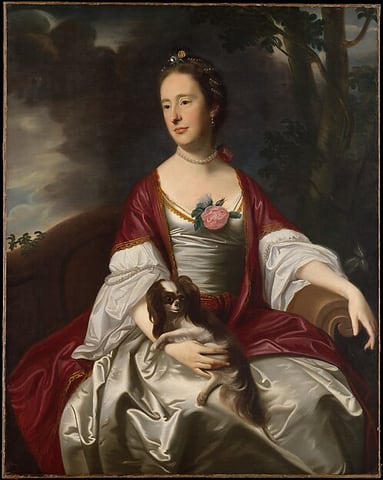
  1. Mrs. Jerathmael Bowers, by John Singleton Copley, ca. 1763
    Mrs. Jerathmael BowersJohn Singleton Copley, ca. 1763Courtesy of The Metropolitan Museum of Art
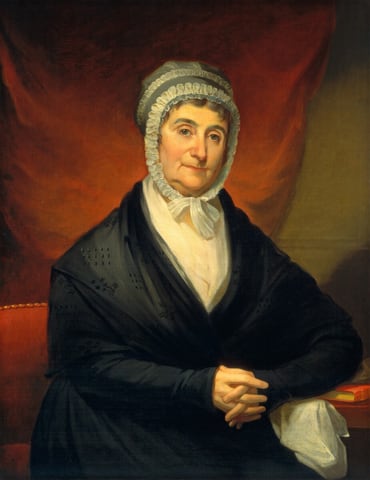
  2. The image shows the upper half of a seated woman facing forward. She has her hands clasped together in front of her. The woman appears calm with visible signs of age, including a few wrinkles on her face. She wears a white bonnet with a frilled edge tied under her chin, a dark shawl over a white high-collared blouse, and sits on a red chair with a gold trim. A red book and a handkerchief are on the surface next to her. The background transitions from deep red to brown tones.
    Ann Old Coleman (Mrs. Robert Coleman)Jacob Eichholtz, c. 1820Courtesy National Gallery of Art, Washington
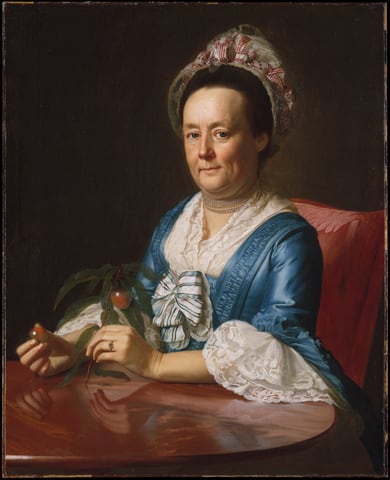
  3. Mrs. John Winthrop, by John Singleton Copley, 1773
    Mrs. John WinthropJohn Singleton Copley, 1773Courtesy of The Metropolitan Museum of Art

Second room, north wall
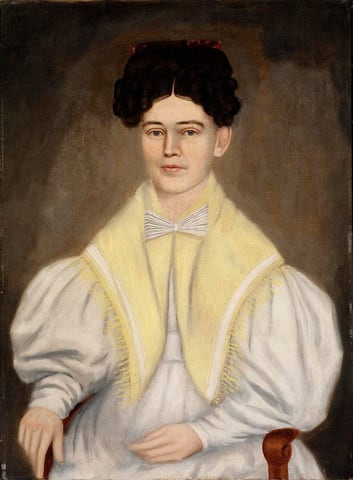
  1. Portrait of a Woman with a Shawl, by Erastus Salisbury Field, ca. 1825-1850
    Portrait of a Woman with a ShawlErastus Salisbury Field, ca. 1825-1850Courtesy of the Smithsonian American Art Museum
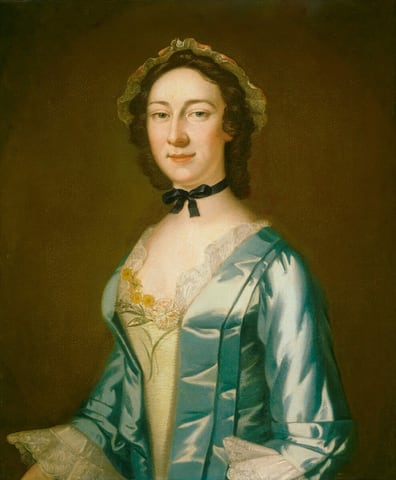
  2. Mary Walton Morris, by John Wollaston, 1749/1752
    Mary Walton MorrisJohn Wollaston, 1749/1752Courtesy National Gallery of Art, Washington
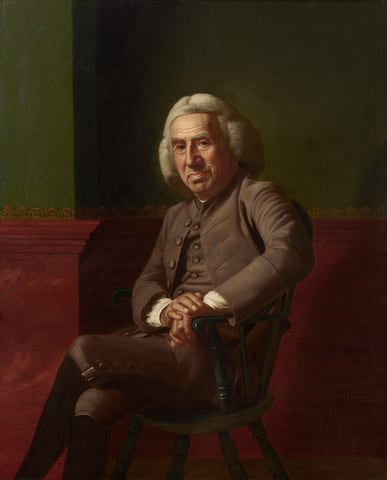
  3. A pale-skinned, clean-shaven man with a heavily lined, paunchy face sits against a green and red wall in this vertical portrait painting. The man sits in a wooden chair painted forest green and rests both hands on the closer arm. His body and knees are angled to our left, and he turns his wide, square face to look at with heavy-lidded eyes. One brow seems slightly cocked, and he has a large nose. His lips are pulled up on one side over a round double chin. He wears a white, shoulder-length wig and a sable-brown suit. The cuffs of a white shirt are visible at his wrists where his hands are stacked on the arm of the chair. The knee-length breeches are buckled at the knee over black stockings. His legs are crossed away from us, and his feet extend off the bottom edge of the composition. The bottom half of the wall behind him is painted burgundy red up to and including a chair rail, and the wall above is moss green. The wall is lined with a gold scallop pattern along the top of the chair rail and a sliver of brown on across the bottom of the composition suggests a wood floor. The artist signed and dated the painting as if he had inscribed the red wall near the man’s knees, “John Singleton Copley pinx 1772. Boston.”
    Eleazer TyngJohn Singleton Copley, 1772Courtesy National Gallery of Art, Washington

Third room, north wall
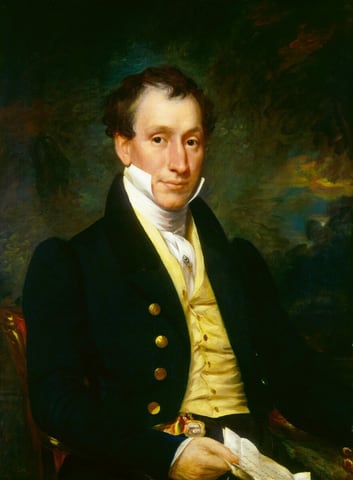
  1. This image depicts a man from the waist up. He is seated, slightly turned to his right, while facing the viewer. The man has a composed expression, prominent cheekbones, and a slightly pointed nose. His dark brown hair is styled in a classic early 19th-century manner, with curls around the sides and forehead. He is dressed in a dark blue coat with gold buttons, a yellow waistcoat, a high-collared white shirt, and a decorative pin. In his right hand, he holds a piece of folded paper with writing on it. The background is an indistinct swirl of darker colors.
    Robert G. L. De PeysterSamuel Lovett Waldo, 1828Courtesy National Gallery of Art, Washington
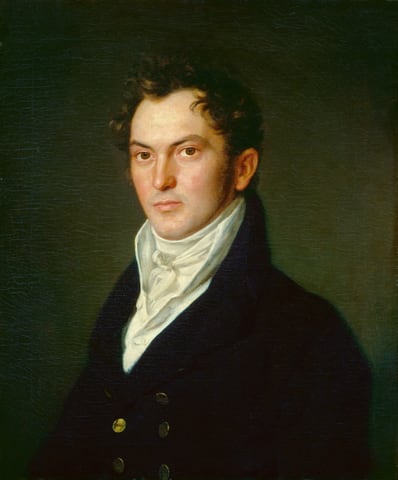
  2. The image shows a man depicted from the waist up, positioned slightly turned to the side yet facing the viewer directly. He has a composed expression with defined facial features, including a high forehead, strong eyebrows, prominent cheekbones, and a clean-shaven face. His hair is dark and curly, styled away from his forehead. He is dressed in a dark coat featuring a double-breasted design with gold buttons, complemented by a high-collared, white cravat intricately tied at his neck. In the background, there is a subtle, dark, greenish hue.
    Zachariah SchoonmakerJohn Vanderlyn, 1815/1818Courtesy National Gallery of Art, Washington

Third room, south wall
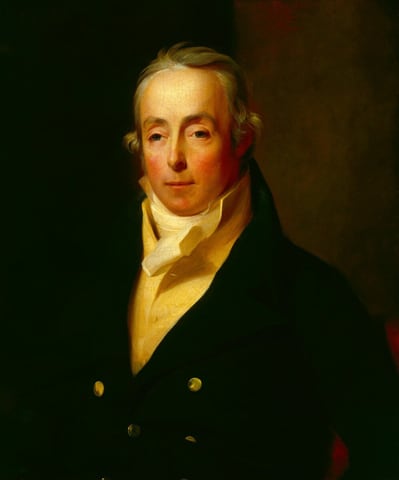
  1. This painting is a portrait of a man from the waist up. He is facing us, with pale skin, thin lips, rosy cheeks, light green eyes, and gray hair styled into curls around his ears. He has a neutral expression. The man is wearing a dark coat with gold buttons on the front, with a pale-yellow shirt underneath and a white cravat around his neck. The background is a dark and indistinct brown color.
    Abraham KintzingThomas Sully, 1815Courtesy National Gallery of Art, Washington
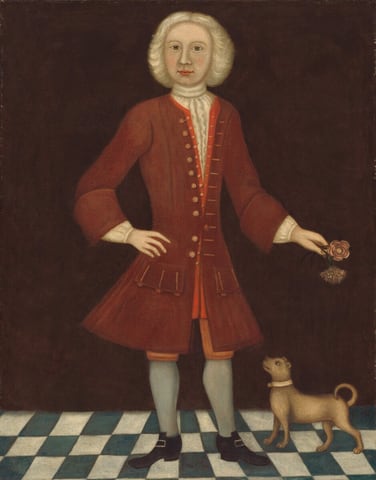
  2. Jonathan Bentham, c. 1725
    Jonathan BenthamUnrecorded American maker, c. 1725Courtesy National Gallery of Art, Washington