Floor plan

East wing: The Nineteenth CenturyImpressionism

Impressionism

A work made of oil on canvas.
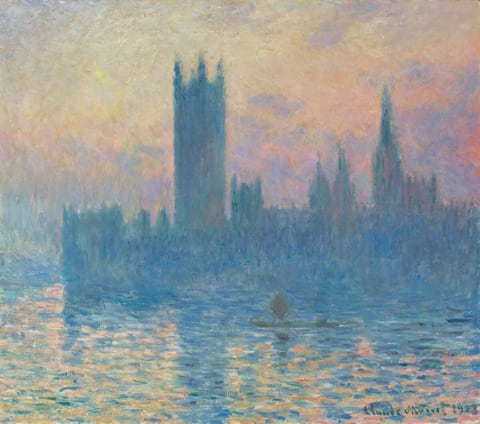
A row of spire-like structures of different heights is silhouetted in azure blue against a soft pink, yellow, peach, and lavender-purple sunset and reflected in a rippling river in this nearly square landscape painting. Along the horizon, the buildings stretch from our right, almost fully across the canvas, and are painted with vertical brushstrokes in cool shades of blue. The sky behind the towers seems hazy with intermingling, pastel-colored clouds. The buildings are reflected in the river, which fills the bottom third of the painting. The surface of the water is painted with short, horizontal brushstrokes in azure blue for the buildings, and apricot, rose, and marigold orange for the sky’s reflection. A streak and smudge of olive-green paint on the water represents a person in a boat near the center of the painting. The artist signed and dated the work in the same olive color at the lower right: “Claude Monet 1903.”
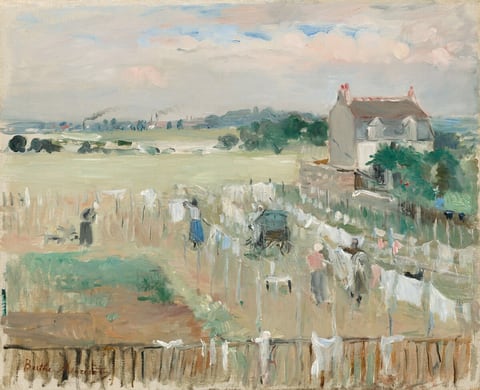
We look down onto a landscape where several laundry lines have been draped mostly with white sheets or cloth to dry in a flat, grassy yard in front of a rustic house and a distant town in this horizontal painting. The scene is created entirely with thick, visible brushstrokes that creates a sense of texture on the canvas’s surface and makes many details difficult to make out. The forms of at least three women wearing skirts hang laundry out along the lines, and a person wearing trousers tends to a flat piece of green ground near the lower left corner. A few pieces of white cloth have been draped over the wooden fence that runs along the bottom edge of the canvas. A dove-gray cart with wooden carriage wheels rests, tipped forward, at the center of the laundry lines. To our right and just beyond the laundry lines, a two-story ivory and slate-blue house with a gray peaked roof sits behind a grove of emerald-green trees. The laundry field and the grassy plane beyond is painted with a pale celery green with long, horizontal strokes. Dabs of moss green and a white streak interrupt the field in the distance. Beyond that, touches of steel and silvery-gray paint suggest smokestacks and smoke in a town along the horizon, which comes about three-quarters of the way up this composition. A few patches of vivid blue sky peek through a screen of shell-pink and cream-white clouds above. The artist signed the work in brick-red paint in the lower left corner, “Berthe Morisot.”
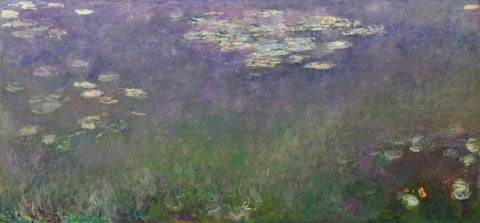
Water Lilies (Agapanthus), by Claude Monet, c. 1915–26
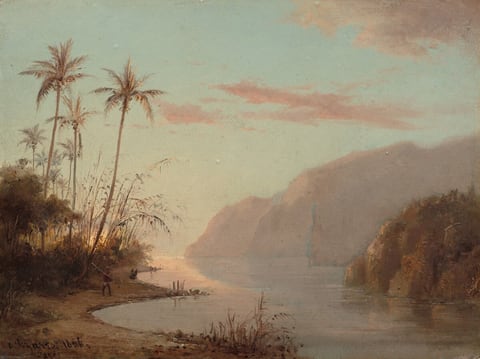
A wide creek winds between a tree-lined bank to our left and hazy mountains to our right in this horizontal landscape painting. The riverbank curves deeply like a backward capital letter B. Marshy grasses grow in tufts, and palm and other trees grow in a grove to our left. One brown-skinned person wearing only a white cloth around the hips carries a long stick near the shoreline. Dabs of brown and muted dark pink suggest other people farther along the riverside. Tree-covered boulders jut into the creek from our right. A band of rocky, mountains are smoky mauve-pink across the rightmost two-thirds of the horizon, which comes a third of the way up the composition. The butter-yellow sun is low on the horizon to our right, peeking through the grove of palm trees. The light pours across the placid surface of the creek, creating a soft yellow streak next to the reflection of the mountain ridge. A few heather-pink clouds drift across the pale turquoise sky. The artist signed and dated the painting in the lower left corner, “C. Pizarro. 1856. Paris.”

The works in this room are listed below.

Works in this room

Painters in 1870s Paris who worked quickly, often outdoors, to catch light as it changed.

First room, north wall

  1. A work made of oil on canvas.
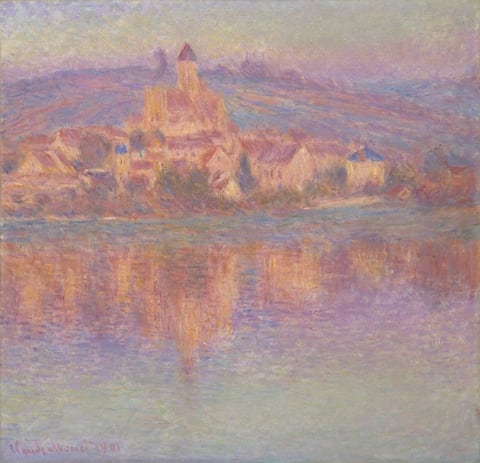
    VétheuilClaude Monet, 1901Courtesy of the Art Institute of Chicago
  2. A work made of oil on canvas.
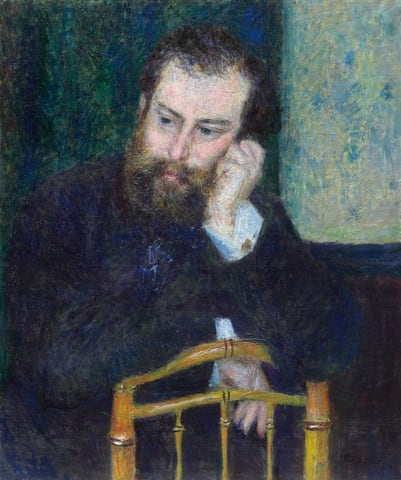
    Alfred SisleyPierre-Auguste Renoir, 1876Courtesy of the Art Institute of Chicago
  3. A row of spire-like structures of different heights is silhouetted in azure blue against a soft pink, yellow, peach, and lavender-purple sunset and reflected in a rippling river in this nearly square landscape painting. Along the horizon, the buildings stretch from our right, almost fully across the canvas, and are painted with vertical brushstrokes in cool shades of blue. The sky behind the towers seems hazy with intermingling, pastel-colored clouds. The buildings are reflected in the river, which fills the bottom third of the painting. The surface of the water is painted with short, horizontal brushstrokes in azure blue for the buildings, and apricot, rose, and marigold orange for the sky’s reflection. A streak and smudge of olive-green paint on the water represents a person in a boat near the center of the painting. The artist signed and dated the work in the same olive color at the lower right: “Claude Monet 1903.”
    The Houses of Parliament, SunsetClaude Monet, 1903Courtesy National Gallery of Art, Washington

First room, south wall

  1. We look down onto a landscape where several laundry lines have been draped mostly with white sheets or cloth to dry in a flat, grassy yard in front of a rustic house and a distant town in this horizontal painting. The scene is created entirely with thick, visible brushstrokes that creates a sense of texture on the canvas’s surface and makes many details difficult to make out. The forms of at least three women wearing skirts hang laundry out along the lines, and a person wearing trousers tends to a flat piece of green ground near the lower left corner. A few pieces of white cloth have been draped over the wooden fence that runs along the bottom edge of the canvas. A dove-gray cart with wooden carriage wheels rests, tipped forward, at the center of the laundry lines. To our right and just beyond the laundry lines, a two-story ivory and slate-blue house with a gray peaked roof sits behind a grove of emerald-green trees. The laundry field and the grassy plane beyond is painted with a pale celery green with long, horizontal strokes. Dabs of moss green and a white streak interrupt the field in the distance. Beyond that, touches of steel and silvery-gray paint suggest smokestacks and smoke in a town along the horizon, which comes about three-quarters of the way up this composition. A few patches of vivid blue sky peek through a screen of shell-pink and cream-white clouds above. The artist signed the work in brick-red paint in the lower left corner, “Berthe Morisot.”
    Hanging the Laundry out to DryBerthe Morisot, 1875Courtesy National Gallery of Art, Washington
  2. Water Lilies (Agapanthus), by Claude Monet, c. 1915–26
    Water Lilies (Agapanthus)Claude Monet, c. 1915–26Courtesy of the Cleveland Museum of Art
  3. A wide creek winds between a tree-lined bank to our left and hazy mountains to our right in this horizontal landscape painting. The riverbank curves deeply like a backward capital letter B. Marshy grasses grow in tufts, and palm and other trees grow in a grove to our left. One brown-skinned person wearing only a white cloth around the hips carries a long stick near the shoreline. Dabs of brown and muted dark pink suggest other people farther along the riverside. Tree-covered boulders jut into the creek from our right. A band of rocky, mountains are smoky mauve-pink across the rightmost two-thirds of the horizon, which comes a third of the way up the composition. The butter-yellow sun is low on the horizon to our right, peeking through the grove of palm trees. The light pours across the placid surface of the creek, creating a soft yellow streak next to the reflection of the mountain ridge. A few heather-pink clouds drift across the pale turquoise sky. The artist signed and dated the painting in the lower left corner, “C. Pizarro. 1856. Paris.”
    A Creek in St. Thomas (Virgin Islands)Camille Pissarro, 1856Courtesy National Gallery of Art, Washington

Second room, south wall
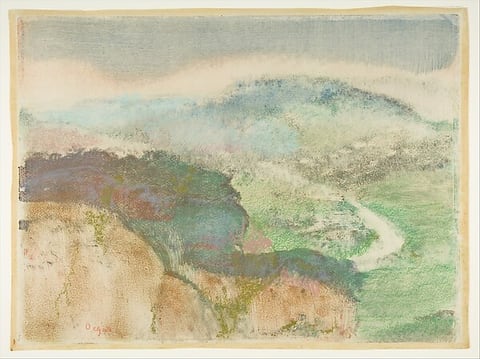
  1. Landscape, by Edgar Degas, 1892
    LandscapeEdgar Degas, 1892Courtesy of The Metropolitan Museum of Art
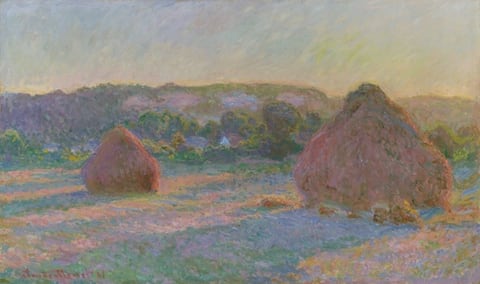
  2. Painting composed of short, dense brushstrokes depicts two domed stacks of wheat that cast long shadows on a field. The angled light indicates either a rising or setting sun.
    Stacks of Wheat (End of Summer)Claude Monet, 1890–91Courtesy of the Art Institute of Chicago
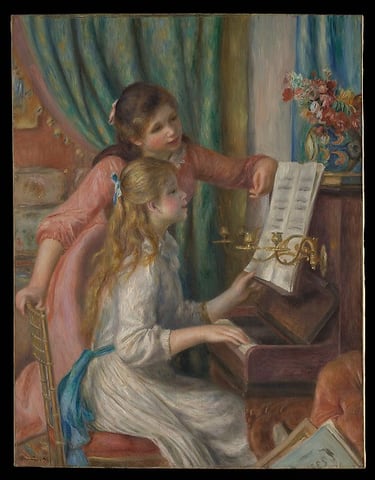
  3. Two Young Girls at the Piano, by Pierre-Auguste Renoir, 1892
    Two Young Girls at the PianoPierre-Auguste Renoir, 1892Courtesy of The Metropolitan Museum of Art

Second room, north wall
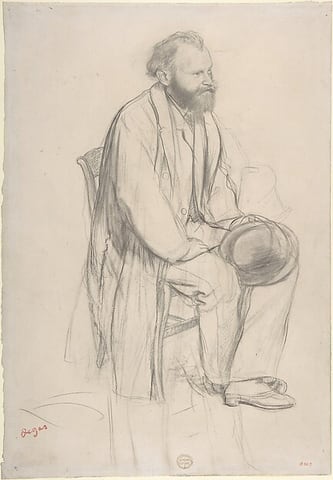
  1. Édouard Manet, Seated, Holding His Hat, by Edgar Degas, ca. 1868
    Édouard Manet, Seated, Holding His HatEdgar Degas, ca. 1868Courtesy of The Metropolitan Museum of Art
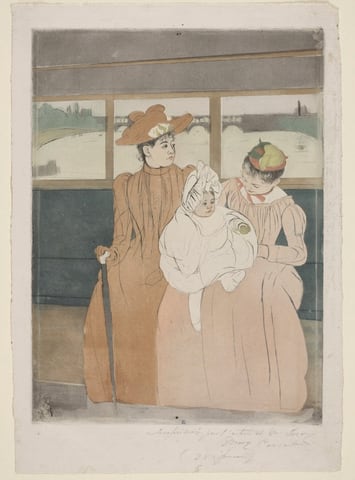
  2. In the Omnibus, by Mary Cassatt, 1890–91
    In the OmnibusMary Cassatt, 1890–91Courtesy of the Cleveland Museum of Art
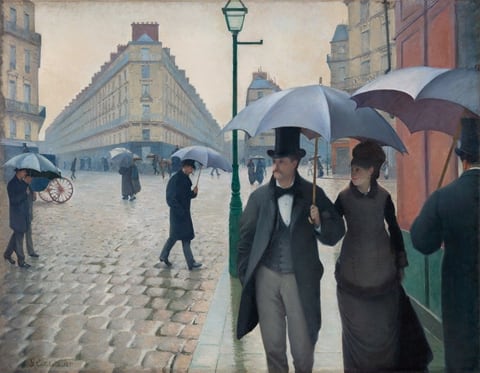
  3. Life-size painting of an urban scene in Paris. A man in a top hat holding an umbrella and a woman in a long fashionable dark dress walk arm in arm toward the viewer as other city dwellers with umbrellas walk in various directions across cobblestone roads and sidewalks.
    Paris Street; Rainy DayGustave Caillebotte, 1877Courtesy of the Art Institute of Chicago

Third room, north wall
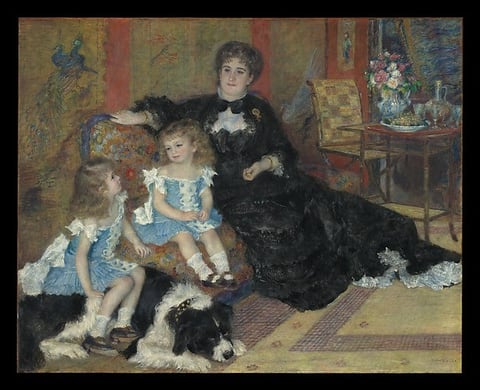
  1. Madame Georges Charpentier (Marguerite-Louise Lemonnier, 1848–1904) and Her Children, Georgette-Berthe (1872–1945) and Paul-Emile-Charles (1875–1895), by Pierre-Auguste Renoir, 1878
    Madame Georges Charpentier (Marguerite-Louise Lemonnier, 1848–1904) and Her Children, Georgette-Berthe (1872–1945) and Paul-Emile-Charles (1875–1895)Pierre-Auguste Renoir, 1878Courtesy of The Metropolitan Museum of Art
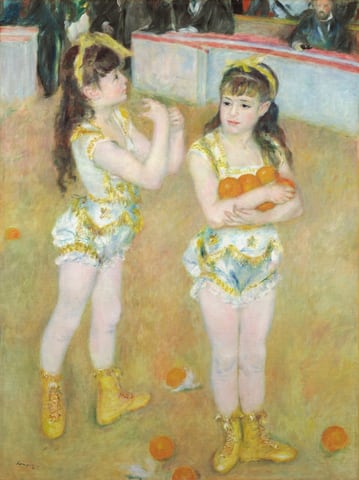
  2. Two girls in acrobatic uniforms stand in an arena, one holds oranges.
    Acrobats at the Cirque Fernando (Francisca and Angelina Wartenberg)Pierre-Auguste Renoir, 1879Courtesy of the Art Institute of Chicago

Third room, south wall
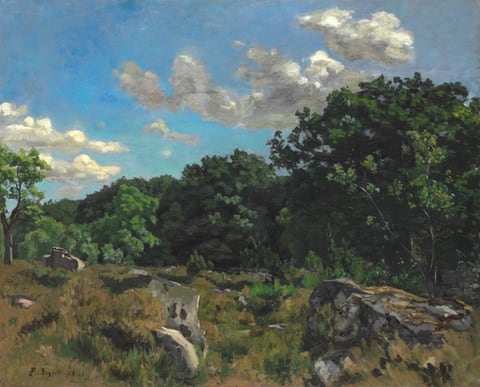
  1. A work made of oil on canvas.
    Landscape at ChaillyFrédéric Bazille, 1865Courtesy of the Art Institute of Chicago
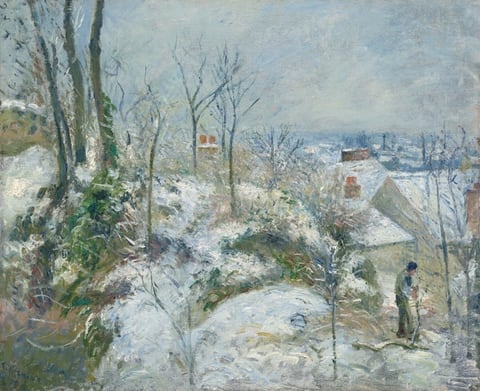
  2. A work made of oil on canvas.
    Rabbit Warren at Pontoise, SnowCamille Pissarro, 1879Courtesy of the Art Institute of Chicago