Floor plan

Time and placeNow at National Gallery of Art, Washington
Now at National Gallery of Art, Washington
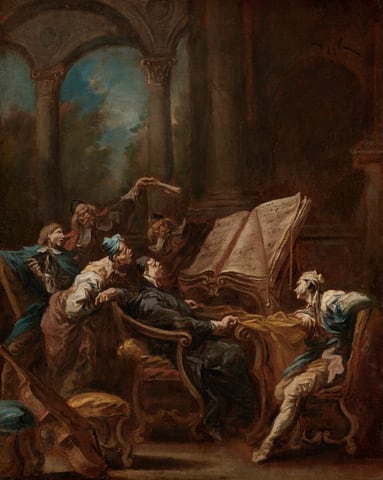
This is a painting of a group engaged in a music session, all looking towards a large open music book in a grand, architectural setting. Behind the group are tall, ornate columns and an arched background that opens up to show a cloudy blue sky. Most of the people have open mouths as if they are singing, while one man in the back seems to be conducting, holding a up roll of paper. Some of the people in the group are seated in cushioned wooden chairs, and a yellowish cloth is draped over the surface that the large book rests on. There is a string instrument similar to a cello near the bottom left corner. The colors used are rich, earthy browns, yellows, and reds, with elements of blue and white clothing. All of the people have pale skin, and two have long white mustaches.
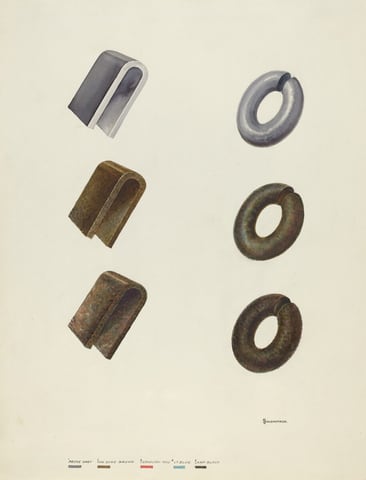
The image shows five metallic objects arranged in a vertical column. These include three L-shaped brackets and two circular rings, in muted gray and rust-brown shades with a metallic sheen. The objects are positioned against a light, neutral background.
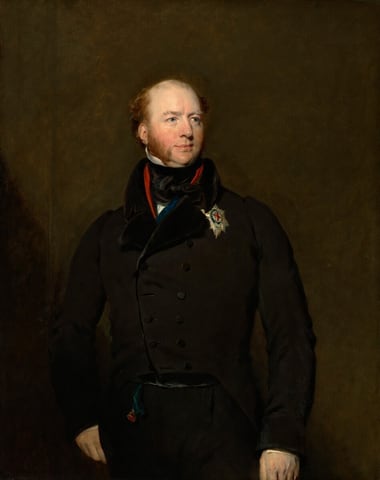
The image displays a man in a portrait from the waist up, in a three-quarter view. He is facing slightly to the right and looking into the distance with a calm expression. The man has fair skin, light reddish-brown hair, sideburns, a defined nose, and a slightly upturned chin. He is wearing a black double-breasted coat with a high collar, a dark waistcoat, a white shirt, and a medal on his chest with an insignia and ribbon. The background is plain and deep brown.
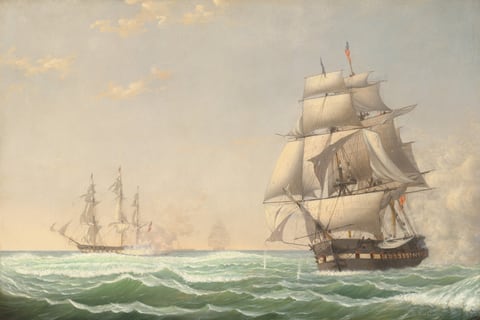
This painting shows a maritime landscape with an expansive view of the ocean and sky. The horizon is positioned in the lower third of the composition, meeting a clear sky with soft, diffused clouds. Two ships appear to be engaged in a conflict on the green, wave-filled water. One large sailing ship with fully extended sails is near the bottom right corner of the painting. It has two tall masts and multiple white sails, and it flies the flag of the U.S.A in several places. The body of this ship is gray with a wide white stripe, and cannons stick out of small holes across the ship. Small people climb on ropes up into the sails, which are covered in small white and gray dots, perhaps indicating holes. Another ship is visible in the distance on the left side of the painting, and its cannons appear to be firing, with bursts of yellow flame and smoke drifting across the water. This ship flies several flags in shades of red, blue, and white. In the background, the faint gray silhouettes of other ships can be seen across the water. The ocean is depicted with smooth brushstrokes in shades of green and white, and the wide sky is a gradient, with light blue at the top and pale yellow towards the horizon. Faint white clouds drift in the top left corner of the painting.
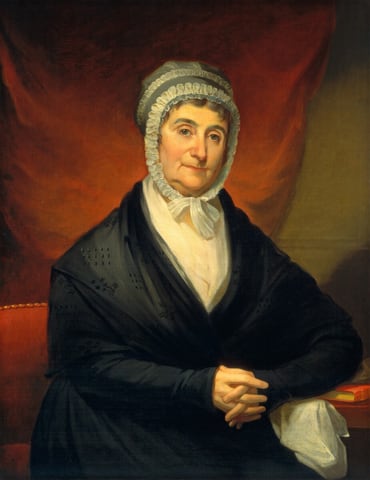
The image shows the upper half of a seated woman facing forward. She has her hands clasped together in front of her. The woman appears calm with visible signs of age, including a few wrinkles on her face. She wears a white bonnet with a frilled edge tied under her chin, a dark shawl over a white high-collared blouse, and sits on a red chair with a gold trim. A red book and a handkerchief are on the surface next to her. The background transitions from deep red to brown tones.
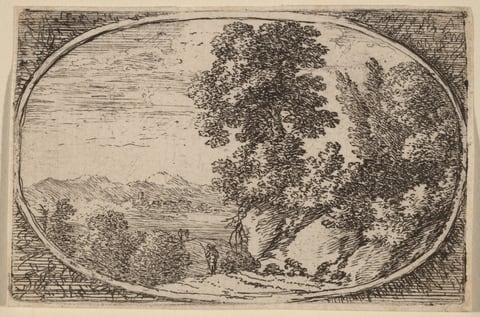
The image shows a landscape viewed from above. The scene is oval, framed by tree branches on each side. Distant mountains form a boundary near the top. Delicate, finely executed lines create detailed foliage and landscape features. A winding path with a small figure adds scale. Lush trees climb upwards, with a muted color palette of the paper and dark brown and black lines providing contrast.
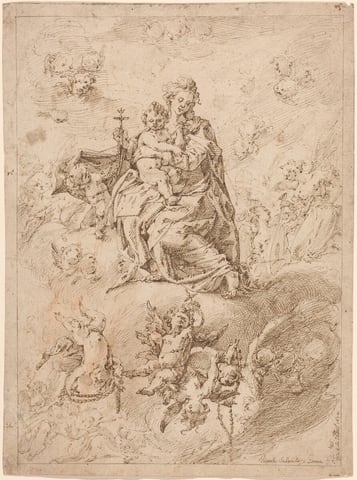
The image depicts a woman seated with a child in her lap. The woman looks down at the child, who has curly hair. Both figures are intricately drawn in a detailed line drawing style. The woman wears a headdress and flowing garment, holding a cross-topped staff. The child clutches her arm. Surrounding them are cloud-like forms and cherubic figures with wings, some holding rosary beads. In the background, more clouds and angelic faces are sketched.
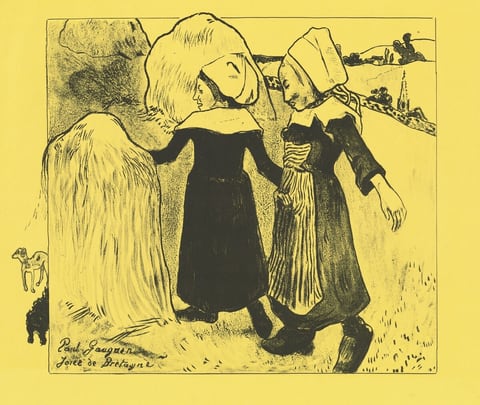
The image shows two women walking arm in arm, both in traditional attire. One woman is facing away with a slight profile, while the other is seen from the side. Their faces are stylized and simplistic with covered hair. They wear long dresses with aprons and collars, and one has a striped apron. Haystacks and greenery surround them. Faint figures are in the background, as well as a spire-like structure. A dog is seen near the haystack, with simple lines suggesting a landscape.

The works in this room are listed below.

Works in this room

Works that hang today at National Gallery of Art, Washington, in Washington, DC. Where a work is now, not where it was made.

Section 1, north wall

  1. This is a painting of a group engaged in a music session, all looking towards a large open music book in a grand, architectural setting. Behind the group are tall, ornate columns and an arched background that opens up to show a cloudy blue sky. Most of the people have open mouths as if they are singing, while one man in the back seems to be conducting, holding a up roll of paper. Some of the people in the group are seated in cushioned wooden chairs, and a yellowish cloth is draped over the surface that the large book rests on. There is a string instrument similar to a cello near the bottom left corner. The colors used are rich, earthy browns, yellows, and reds, with elements of blue and white clothing. All of the people have pale skin, and two have long white mustaches.
    The ChoristersAlessandro Magnasco, c. 1740/1745Courtesy National Gallery of Art, Washington
  2. The image shows five metallic objects arranged in a vertical column. These include three L-shaped brackets and two circular rings, in muted gray and rust-brown shades with a metallic sheen. The objects are positioned against a light, neutral background.
    Color Notes on IronGerald Transpota, 1935/1942Courtesy National Gallery of Art, Washington
  3. The image displays a man in a portrait from the waist up, in a three-quarter view. He is facing slightly to the right and looking into the distance with a calm expression. The man has fair skin, light reddish-brown hair, sideburns, a defined nose, and a slightly upturned chin. He is wearing a black double-breasted coat with a high collar, a dark waistcoat, a white shirt, and a medal on his chest with an insignia and ribbon. The background is plain and deep brown.
    Francis Charles Seymour-Conway, 3rd Marquess of HertfordThomas Lawrence, c. 1822/1823Courtesy National Gallery of Art, Washington
  4. This painting shows a maritime landscape with an expansive view of the ocean and sky. The horizon is positioned in the lower third of the composition, meeting a clear sky with soft, diffused clouds. Two ships appear to be engaged in a conflict on the green, wave-filled water. One large sailing ship with fully extended sails is near the bottom right corner of the painting. It has two tall masts and multiple white sails, and it flies the flag of the U.S.A in several places. The body of this ship is gray with a wide white stripe, and cannons stick out of small holes across the ship. Small people climb on ropes up into the sails, which are covered in small white and gray dots, perhaps indicating holes. Another ship is visible in the distance on the left side of the painting, and its cannons appear to be firing, with bursts of yellow flame and smoke drifting across the water. This ship flies several flags in shades of red, blue, and white. In the background, the faint gray silhouettes of other ships can be seen across the water. The ocean is depicted with smooth brushstrokes in shades of green and white, and the wide sky is a gradient, with light blue at the top and pale yellow towards the horizon. Faint white clouds drift in the top left corner of the painting.
    The United States Frigate "President" Engaging the British Squadron, 1815Fitz Henry Lane, 1850Courtesy National Gallery of Art, Washington
Section 1, south wall

  1. The image shows the upper half of a seated woman facing forward. She has her hands clasped together in front of her. The woman appears calm with visible signs of age, including a few wrinkles on her face. She wears a white bonnet with a frilled edge tied under her chin, a dark shawl over a white high-collared blouse, and sits on a red chair with a gold trim. A red book and a handkerchief are on the surface next to her. The background transitions from deep red to brown tones.
    Ann Old Coleman (Mrs. Robert Coleman)Jacob Eichholtz, c. 1820Courtesy National Gallery of Art, Washington
  2. The image shows a landscape viewed from above. The scene is oval, framed by tree branches on each side. Distant mountains form a boundary near the top. Delicate, finely executed lines create detailed foliage and landscape features. A winding path with a small figure adds scale. Lush trees climb upwards, with a muted color palette of the paper and dark brown and black lines providing contrast.
    The Boulder Crowned with TreesHerman van SwaneveltCourtesy National Gallery of Art, Washington
  3. The image depicts a woman seated with a child in her lap. The woman looks down at the child, who has curly hair. Both figures are intricately drawn in a detailed line drawing style. The woman wears a headdress and flowing garment, holding a cross-topped staff. The child clutches her arm. Surrounding them are cloud-like forms and cherubic figures with wings, some holding rosary beads. In the background, more clouds and angelic faces are sketched.
    The Madonna of the RosaryVicente Salvador Gómez, 1674Courtesy National Gallery of Art, Washington
  4. The image shows two women walking arm in arm, both in traditional attire. One woman is facing away with a slight profile, while the other is seen from the side. Their faces are stylized and simplistic with covered hair. They wear long dresses with aprons and collars, and one has a striped apron. Haystacks and greenery surround them. Faint figures are in the background, as well as a spire-like structure. A dog is seen near the haystack, with simple lines suggesting a landscape.
    Pleasures of Brittany (Joies de Bretagne)Paul Gauguin, 1889Courtesy National Gallery of Art, Washington

Section 2, south wall
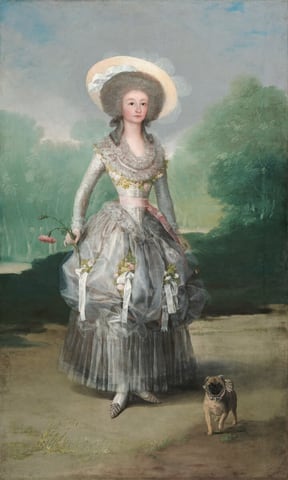
  1. A woman with pale skin, wearing a silvery-gray dress adorned with white ribbons and light pink roses, stands looking out at us with a small, pug dog by her feet in this vertical portrait painting. The woman’s body is angled slightly to our right but she looks at us with dark eyes under faint, arched brows. Her nose is rounded, her cheeks smooth and flushed, and her pale pink lips are closed. Her face is framed in a cloud of nickel-gray hair, and tendrils curl down over her shoulders. She wears a wide-brimmed straw hat with a white ribbon set on the back of her head and slightly off to one side. The bodice of her dress has a low, curving neck. This area is loosely painted to create the impression of layers of lace. A band of intertwined pale pink roses and delicate green leaves borders the outer edge of the lace. The dress has long, tight sleeves with lace at the cuffs and the notably narrow waist is tied with a blush-pink ribbon. The full, silver skirt is picked up to create a row of puffs, like the top of a muffin, around her knees. Bunches of pink roses and white ribbons are nestled into the puffs, and below, the skirt falls in long, vertical pleats to her ankles. She wears white stockings and pointed, petal-pink shoes. In her left arm, on our right, she holds a closed fan loosely at her side, almost lost behind the skirt. She holds a pink carnation with a full bloom and a bud on a long, curving stem in her other hand, by her hip. A caramel-brown pug with a black face, wearing a pink collar lined with three bells, stands facing us with one front paw lifted, to our right of the woman's feet. The landscape is painted in tones of mint and sage green for grass beneath trees enclosing the space the woman stands in, sand brown for the ground, and icy blue for the sky above.
    The Marquesa de PontejosFrancisco Goya, c. 1786Courtesy National Gallery of Art, Washington
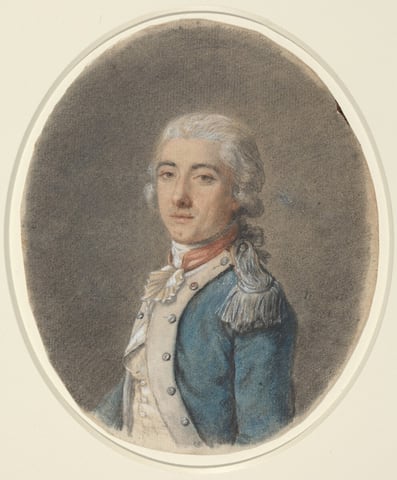
  2. The image displays an oval portrait of a man's upper torso. He is turned slightly to the right, looking directly at the viewer with a composed expression. The man has pale skin, defined facial features, softly arched eyebrows, a subtle mustache, and styled hair in an 18th-century fashion. He wears a blue coat with white lapels, silver buttons, and a silver-fringed epaulet on the shoulder, along with a cravat and waistcoat. The background is a smooth, neutral gray.
    Portrait of a Man in a Military UniformUnrecorded French maker, 18th centuryCourtesy National Gallery of Art, Washington
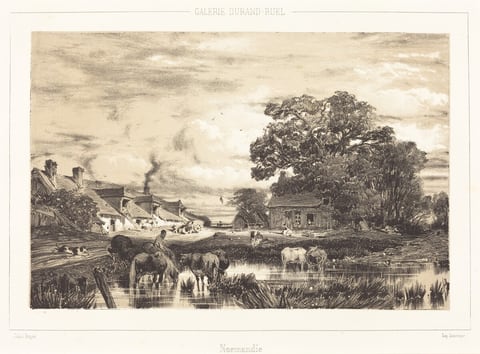
  3. This image shows a rural landscape with a pond in the foreground where cattle are being herded by a person on horseback. There are low buildings with smoking chimneys in the middle ground. Trees on the horizon separate the land from the sky, which is filled with clouds. The painting is detailed with a consistent brushwork, capturing foliage and buildings. The color palette is primarily sepia, giving a vintage and serene feel to the scene.
    View in Normandy (Vue prise en Normandie)Jules Dupré, 1835Courtesy National Gallery of Art, Washington
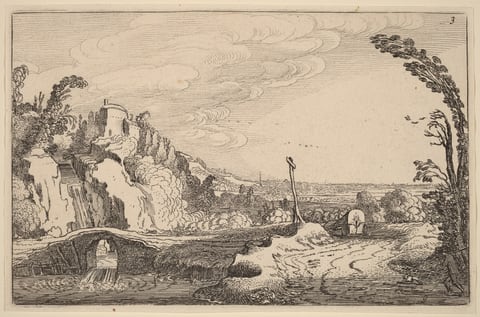
  4. The image shows a pastoral scene in black and white with fine line work. A small bridge with a circular archway crosses a stream. A dirt path winds through the landscape flanked by grass and bushes. A rocky cliff ascends on the left with a tower-like structure partially obscured by vegetation. The horizon features a cloudy sky, with swirling lines indicating motion. In the distance, a tall, thin structure, possibly a spire or chimney, stands amid faint hills and trees. The scene conveys a serene atmosphere through hatching and cross-hatching techniques.
    Cascade under a Stone BridgeJan van de Velde II, c. 1616Courtesy National Gallery of Art, Washington

Section 2, north wall
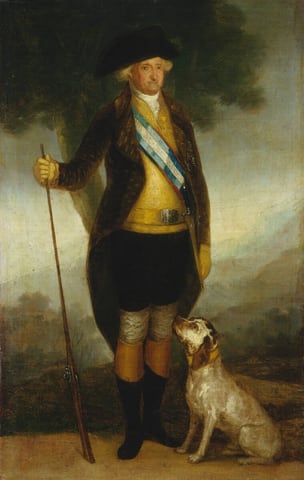
  1. This painting shows a man standing upright, his body slightly turned to the right. He has pale skin and curled white hair under a large black hat, and he wears a long brown jacket over a yellow vest with a white ruffled neck and a wide blue-and-white striped sash over his torso. His pants are black, and he wears tall black boots with brown tops. His hands are covered by yellow gloves, and he is holding a tall, thin rifle on the left, its bottom on the ground. Next to him on the right is a white dog with brown spots and large brown ears. The dog is sitting, looking up at the man. The background features an outdoor setting, with a landscape of hazy hills in shades of pale green and blue below a white and gray sky. There is a tall, dark green tree behind the man, and the ground he stands on is brown.
    Charles IV of Spain as HuntsmanUnrecorded Spanish maker, c. 1799/1800Courtesy National Gallery of Art, Washington
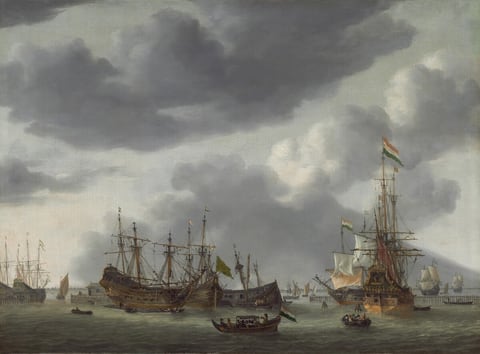
  2. A sage-green harbor teems with more than a dozen sailing ships and rowboats under a pale gray sky in this horizontal painting. The horizon comes about one-fifth of the way up the composition, and dark gray and white clouds tower above. Light filters onto the scene through the clouds from our left to fall across the ships while casting shadows on the water nearest us. Painted in tones of slate gray and warm brown, most of the ships closest to us have their sails furled so the masts and horizontal yard arms bristle against the sky. The larger ships have cannons poking out of square portholes. On our right, a war ship floats with its ornately carved and gilded stern facing us. A flag flying from the tallest of the three masts has red, white, and green stripes. The artist painted his name on that flag, “R. Zeeman.” The ship is tied to a buoy with a length of rope, and an empty rowboat is tethered to the right side of the ship. A similar ship but with the sails hanging loosely is tied to a buoy just beyond this one. A row of pickets, like a fence, extends into the water behind these two ships. To our left, a rowboat full of men has pulled up alongside a partially sunken ship, its masts tilting toward us. A few people stand on two more ships nearby. A black temporary dock floats next to the leftmost ship here. A person mixes something that smokes on the platform, and another person stands on a board lifted halfway up the ship’s side, presumably working on a repair. Two women in another rowboat next to the floating dock lean over the side, washing clothes. Another fence encloses the harbor to our left, and a hut in the middle of the harbor is surrounded by a similar structure. Two rowboats closer to us are filled with men wearing tall hats and black or brown coats, and women wearing black bonnets and white shawls. More sailing ships and rowboats move back or around beyond the harbor, out to sea. Visible cracks cover the surface of the painting.
    Amsterdam Harbor SceneReinier Nooms, called Zeeman, c. 1654/1655Courtesy National Gallery of Art, Washington

Section 3, north wall
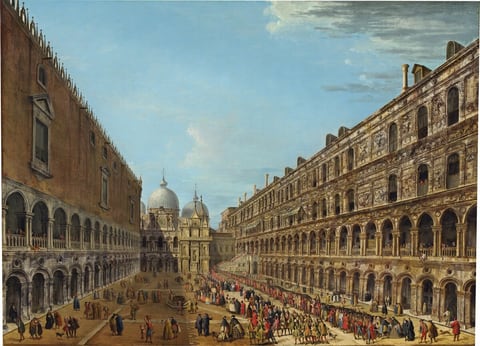
  1. This painting depicts a square seen from above, surrounded by elegant architectural structures. On the left side, there is a large building with a red-brown facade and arched white windows with columns. On the right, there is an ornate off-white structure with arches and detailed stonework. Both of these long buildings stretch from the sides of the painting towards the center, where they converge at a gray building with tall spires and large blue domes behind it. In the square there are countless people in colorful attire, wearing shades of pink, red, blue, green, yellow, black, and blue. There are men, women, and children, and those with visible faces all appear to have light skin. Some wear white masks with bird-like noses. On the right, there is a long line of people engaging in a procession or gathering. People also line the windows of the two buildings on either side of the square. The painting is incredibly detailed, capturing architectural elements and the bustling crowd. The color palette features earthy tones for the architecture and vibrant colors for the people, all set below a pale blue sky with a few white-and-gray clouds.
    Procession in the Courtyard of the Ducal Palace, VeniceAntonio Joli, 1742 or afterCourtesy National Gallery of Art, Washington
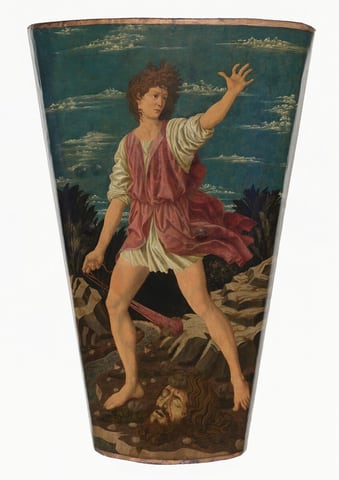
  2. This shield-shaped painting shows a young man with pale, peachy skin and curling brown hair standing astride the severed head of a man with dark hair and tanned skin. The painting is wider at the top and tapers like a pint glass to a narrower base. The young man, David, holds the end of long red slingshot with his right hand. The slingshot is weighted by a rock and swings behind his body. His sleeveless rust-red garment is cinched at his waist over a long white shirt. Both garments skim David’s thighs and his legs and feet are bare. Long, curling brown hair frames the ashen and bloodied upturned face of the head at David’s feet. A palm-sized stone is embedded in that forehead. The landscape background is made up of gray boulders, a meandering river, and low palm-like trees. Frothy white clouds sweep across an azure-blue sky.
    David with the Head of GoliathAndrea del Castagno, c. 1450/1455Courtesy National Gallery of Art, Washington