Floor plan

Time and placeGermany

Germany

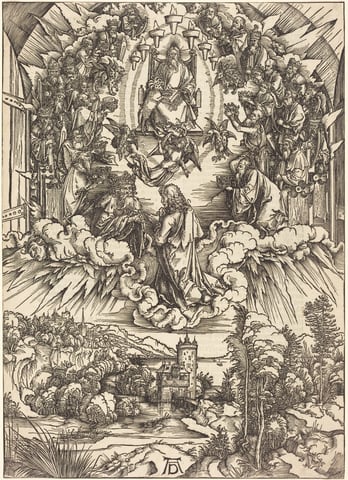
The image features a celestial scene with multiple figures depicted from head to waist. Two central figures are engaged in a conversation amidst clouds. One figure appears seated, possibly on a throne, holding a book. Both figures have long hair and beards. The robes worn by the figures are detailed. Other figures surround them in a semi-circle, some wearing crowns, holding items like bowls. Heavenly hosts with wings are seen above. The background shows a detailed landscape with trees, a river, and castles nestled in hills.
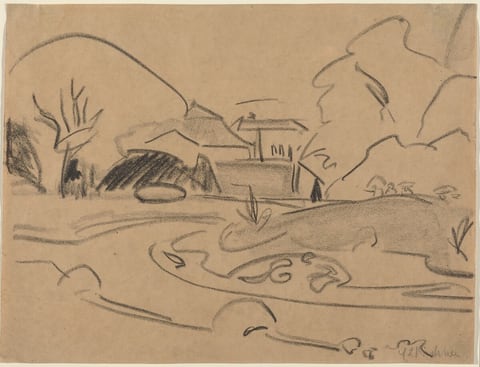
The image shows a landscape drawing with buildings, trees, and a winding path or water feature. The drawing is done in black charcoal on brownish background paper, creating a monochromatic color palette.
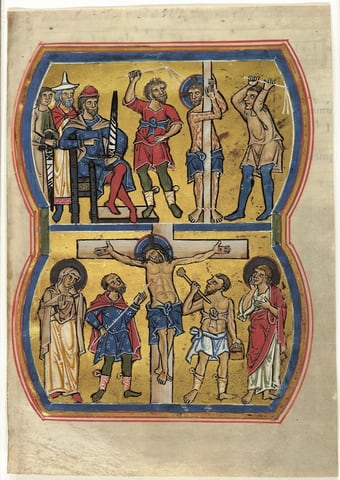
A work made of opaque watercolor, gold leaf, and shell gold, with pen and red and white ink (recto), and pen and red and black ink (verso), on parchment.
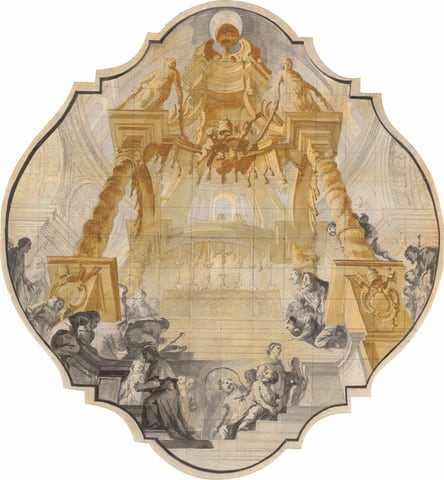
This is a painting of an architectural scene with decorative and religious elements. The painting features a grand interior setting, possibly a church or cathedral, dominated by ornate columns and a ceiling structure. Figures appear on pedestals atop the columns. In the background, there is a depiction of a religious or ceremonial space with detailed balustrades and steps, where figures are shown in dynamic poses. The color palette consists of warm golden hues contrasted with cooler grey tones, highlighting the intricate details of the architecture and figures. This is in the style of Giovanni Battista Tiepolo.
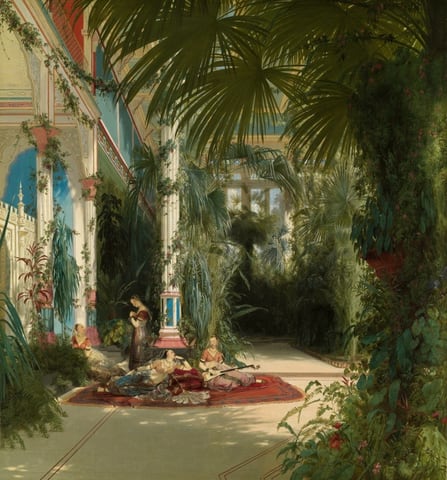
Four women with musical instruments lounge in a massive garden courtyard.
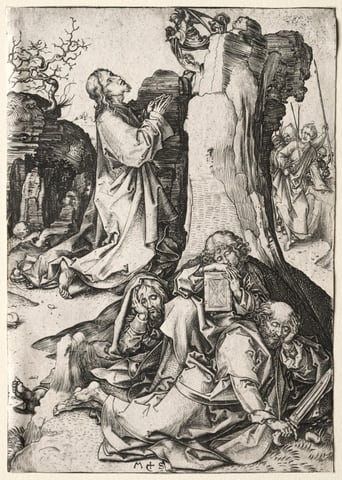
The Passion: The Agony in the Garden, by Martin Schongauer, c. 1480
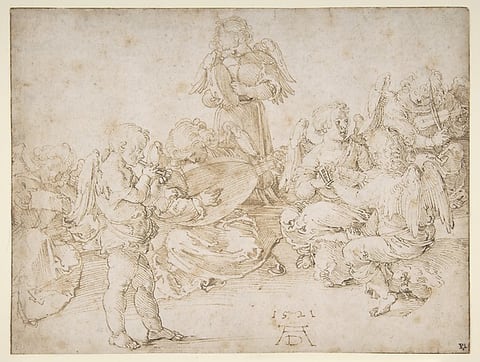
Music-Making Angels, by Albrecht Dürer, 1521
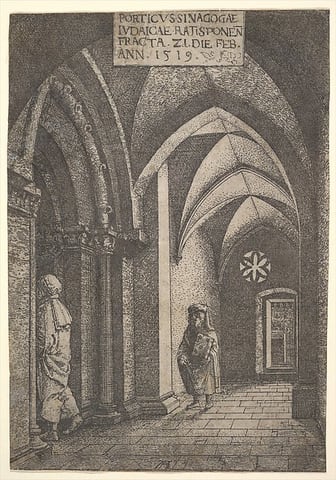
The Entrance Hall of the Regensburg Synagogue, by Albrecht Altdorfer, 1519

The works in this room are listed below.

Works in this room

Works made in Germany, from every century in the collection.

First room, north wall

  1. The image features a celestial scene with multiple figures depicted from head to waist. Two central figures are engaged in a conversation amidst clouds. One figure appears seated, possibly on a throne, holding a book. Both figures have long hair and beards. The robes worn by the figures are detailed. Other figures surround them in a semi-circle, some wearing crowns, holding items like bowls. Heavenly hosts with wings are seen above. The background shows a detailed landscape with trees, a river, and castles nestled in hills.
    Saint John before God and the EldersAlbrecht Dürer, probably c. 1496/1498Courtesy National Gallery of Art, Washington
  2. The image shows a landscape drawing with buildings, trees, and a winding path or water feature. The drawing is done in black charcoal on brownish background paper, creating a monochromatic color palette.
    Footpaths and Pavilion in the Dresden Grosser GartenErnst Ludwig Kirchner, c. 1909Courtesy National Gallery of Art, Washington
  3. A work made of opaque watercolor, gold leaf, and shell gold, with pen and red and white ink (recto), and pen and red and black ink (verso), on parchment.
    The Flagellation and The Crucifixion, from a PsalterGerman, about 1239Courtesy of the Art Institute of Chicago
  4. This is a painting of an architectural scene with decorative and religious elements. The painting features a grand interior setting, possibly a church or cathedral, dominated by ornate columns and a ceiling structure. Figures appear on pedestals atop the columns. In the background, there is a depiction of a religious or ceremonial space with detailed balustrades and steps, where figures are shown in dynamic poses. The color palette consists of warm golden hues contrasted with cooler grey tones, highlighting the intricate details of the architecture and figures. This is in the style of Giovanni Battista Tiepolo.
    Worshippers at the Tomb of Saint PeterMatthäus Günther, 1740/1741Courtesy National Gallery of Art, Washington

First room, south wall

  1. Four women with musical instruments lounge in a massive garden courtyard.
    The Interior of the Palm House on the Pfaueninsel Near PotsdamCarl Blechen, 1834Courtesy of the Art Institute of Chicago
  2. The Passion: The Agony in the Garden, by Martin Schongauer, c. 1480
    The Passion: The Agony in the GardenMartin Schongauer, c. 1480Courtesy of the Cleveland Museum of Art
  3. Music-Making Angels, by Albrecht Dürer, 1521
    Music-Making AngelsAlbrecht Dürer, 1521Courtesy of The Metropolitan Museum of Art
  4. The Entrance Hall of the Regensburg Synagogue, by Albrecht Altdorfer, 1519
    The Entrance Hall of the Regensburg SynagogueAlbrecht Altdorfer, 1519Courtesy of The Metropolitan Museum of Art

Second room, south wall
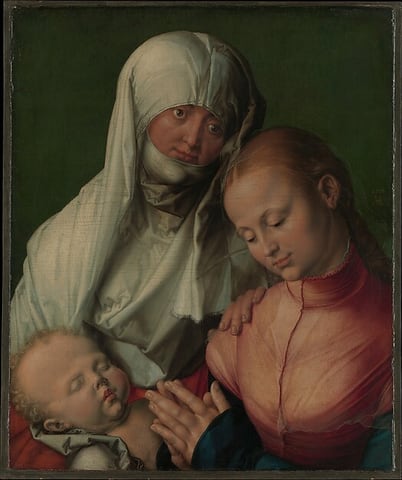
  1. Virgin and Child with Saint Anne, by Albrecht Dürer, probably 1519
    Virgin and Child with Saint AnneAlbrecht Dürer, probably 1519Courtesy of The Metropolitan Museum of Art
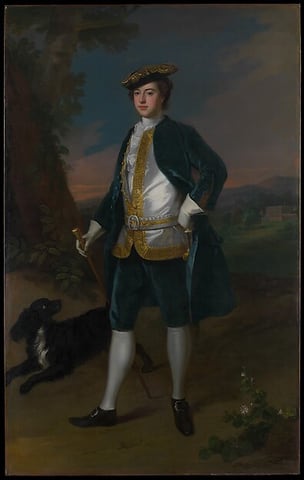
  2. Sir James Dashwood (1715–1779), by Enoch Seeman the Younger, 1737
    Sir James Dashwood (1715–1779)Enoch Seeman the Younger, 1737Courtesy of The Metropolitan Museum of Art
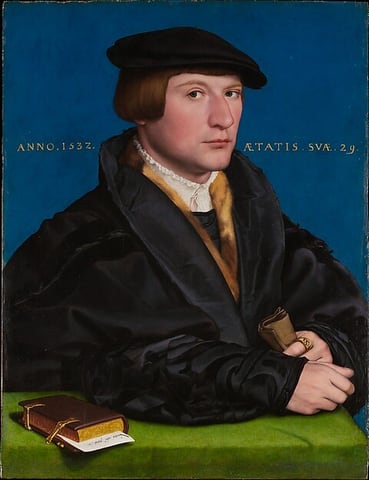
  3. Hermann von Wedigh III (died 1560), by Hans Holbein the Younger, 1532
    Hermann von Wedigh III (died 1560)Hans Holbein the Younger, 1532Courtesy of The Metropolitan Museum of Art

Second room, north wall
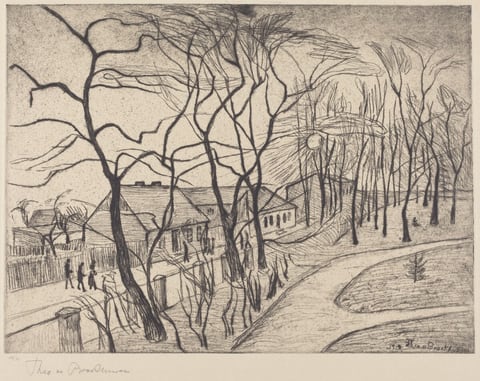
  1. The image shows a residential area with barren trees, rooftops of houses, and people walking along fences. The trees sway in the wind, their branches extending in various directions. The scene is depicted in a monochromatic black and white style, with expressive lines creating a sense of movement and a sketch-like quality. The horizon is high, showing rooftops and the sun above it.
    LandscapeTheo von BrockhusenCourtesy National Gallery of Art, Washington
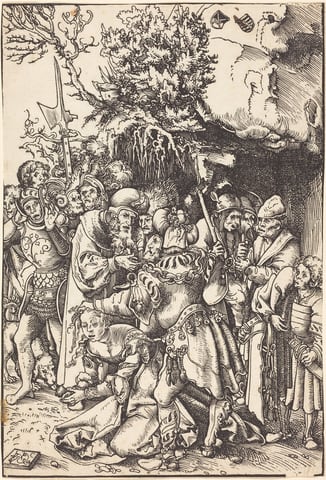
  2. This is a drawing of a group of medieval figures and a tree. The image depicts a dense gathering of figures, all wearing elaborate period costumes, including helmets, robes, and armor. Their expressions vary. At the top, a leafy tree dominates the background alongside swirling clouds. The foreground hints at an interaction among the individuals, possibly a scene of discourse or judgment. Several personal items and tools are on the ground. The attention to detail and the use of line to create intricate patterns and textures are notable features of this work. This is in the style of Albrecht Dürer.
    The Martyrdom of Saint BarbaraLucas Cranach the ElderCourtesy National Gallery of Art, Washington
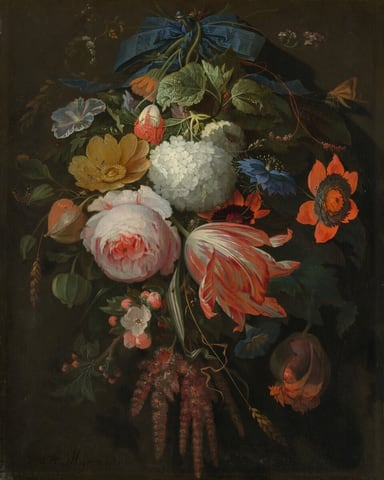
  3. A bouquet of flowers against a dark brown background hangs from a sapphire-blue bow to fill this vertical still life painting. The three largest blooms make a pyramid at the center. A pale pink, flat-leaved carnation is to the lower right of this trio. A red and white striped tulip with flame-shaped petals is next to it, to our right, and a white viburnum bloom, which is made of dozens of smaller clusters, is above. A tan-colored spider builds a web at the center of these three blossoms. Using the face of a clock to work around this trio, we find a spotted bug on a smaller viburnum and some frosty green leaves at noon. A muted orange moth rests on a stalk nearby. Down the right side, the layered vivid blue petals of a love-in-the-mist explode like a starburst. Two coral-red peonies, a mostly closed peony, a topaz-blue morning glory, and the fuzzy fingers of amaranth bring us to six o’clock. Up the left side are delicate pink crab apple blossoms, a spray of Chinese lanterns, a yellow rose with ants crawling across its splayed petals, a striped morning glory, and a few blue, orange, and red buds. A caterpillar rears up on a Chinese lantern bud and a ladybug sits on a leaf nearby. A few stalks of wheat are scattered throughout. Stems weave through the blue ribbon at the top, which is tied around a protruding nail. The artist signed the lower left corner, “AB Mignon f,” with the AB conjoined in a monogram.
    A Hanging Bouquet of FlowersAbraham Mignon, probably 1665/1670Courtesy National Gallery of Art, Washington

Third room, north wall
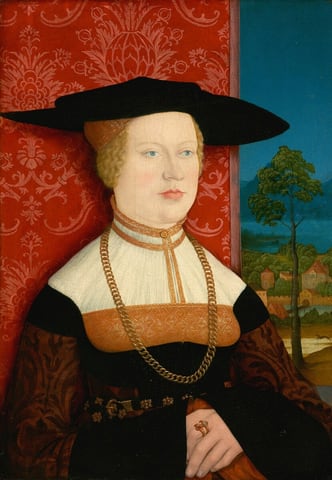
  1. Shown from the waist up, a light-skinned woman sits angled slightly to our right in this vertical portrait painting. The woman has blue eyes, faint brows, and a sloping nose ending in a small bulb. Her upper lip is thin and her lower lip full over a slight double chin. Her blond hair is pulled back under a gold, cap-like headdress and a black, wide-brimmed hat with a shallow crown. She wears a high-necked white, black, and gold dress with intricate detailing, a gold chain necklace that falls to her waist, and a black belt with a gold clasp and medallions. She wears two gold rings set with gems on the pointer finger of her left hand, which is folded across her belly over the other hand. A scarlet-red wallcovering with pink floral designs fills two-thirds of the space behind her. The rightmost third of the background opens onto a landscape with a tall, spindly tree, a leaping animal, presumably a dog, and a bridge across a body of water leading to a town. Across another body of water, perhaps a lake, mountains are marine blue in the distance under a clear, celestial-blue sky.
    Margarethe Vöhlin [obverse]Bernhard Strigel, 1527Courtesy National Gallery of Art, Washington
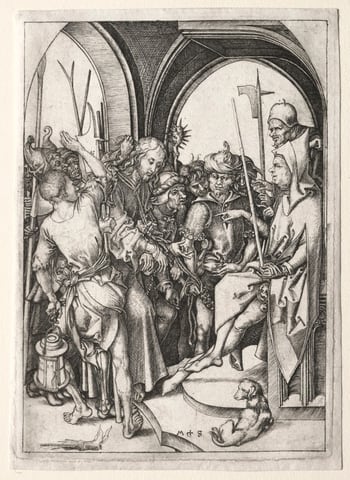
  2. The Passion: Christ Before Annas, by Martin Schongauer, c. 1480
    The Passion: Christ Before AnnasMartin Schongauer, c. 1480Courtesy of the Cleveland Museum of Art