Floor plan

Time and placeFrance

France

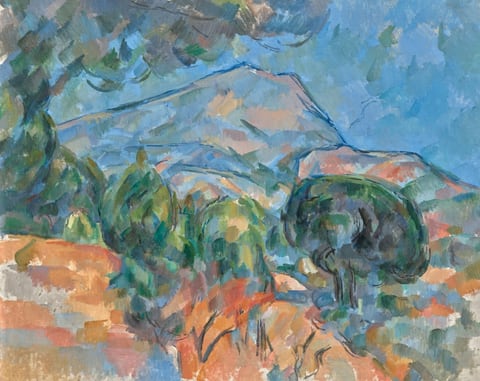
Mount Sainte-Victoire, by Paul Cézanne, c. 1904
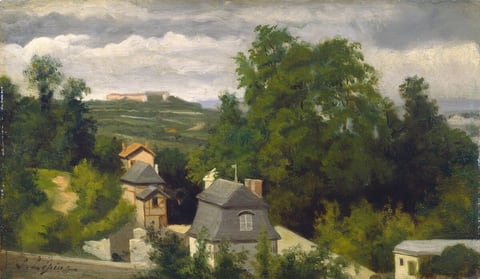
The painting shows an elevated perspective overlooking a landscape with green hills and leafy trees. Closest to us, there are cream-colored buildings among dense foliage. These buildings have roofs in shades of pale blue-gray and reddish-brown, and the one in the center has wispy white smoke coming out of a chimney. In the distance on the left, a large, low structure sits atop a hill, with faint paths winding towards it through the green landscape. Beyond the trees, the distant landscape on the right is painted in shades of pale blue and green. The sky above is filled with puffy clouds in shades of gray.
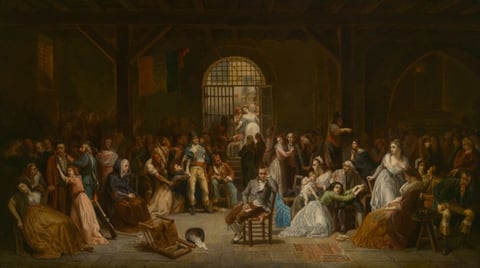
A work made of oil on canvas.
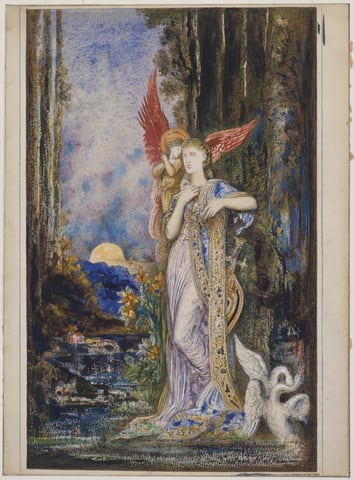
A work made of watercolor and gouache, with pen and blue ink, over traces of graphite, on ivory wove paper, wrapped and adhered on verso to wood pulp board.
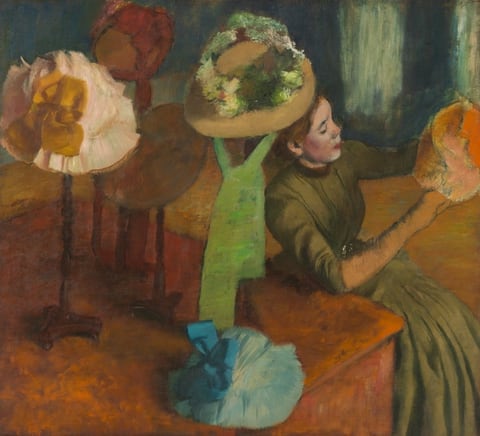
Impressionist painting of woman wearing green dress trying on hats.
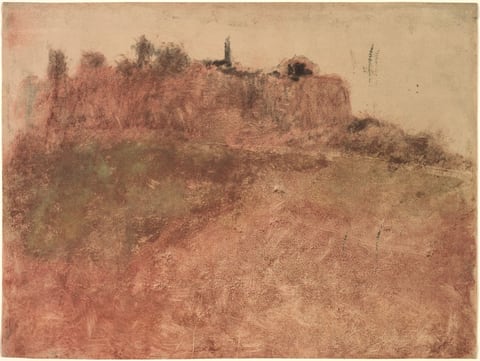
Estérel Village, by Edgar Degas, c. 1890

The works in this room are listed below.

Works in this room

Works made in France, from every century in the collection.

First room, north wall

  1. Mount Sainte-Victoire, by Paul Cézanne, c. 1904
    Mount Sainte-VictoirePaul Cézanne, c. 1904Courtesy of the Cleveland Museum of Art
  2. The painting shows an elevated perspective overlooking a landscape with green hills and leafy trees. Closest to us, there are cream-colored buildings among dense foliage. These buildings have roofs in shades of pale blue-gray and reddish-brown, and the one in the center has wispy white smoke coming out of a chimney. In the distance on the left, a large, low structure sits atop a hill, with faint paths winding towards it through the green landscape. Beyond the trees, the distant landscape on the right is painted in shades of pale blue and green. The sky above is filled with puffy clouds in shades of gray.
    View on the Outskirts of CaenStanislas Lépine, 1872/1875Courtesy National Gallery of Art, Washington
  3. A work made of oil on canvas.
    The Roll Call of the Last Victims of the TerrorCharles Louis-Lucien Muller, c. 1850Courtesy of the Art Institute of Chicago

First room, south wall

  1. A work made of watercolor and gouache, with pen and blue ink, over traces of graphite, on ivory wove paper, wrapped and adhered on verso to wood pulp board.
    InspirationGustave Moreau, c. 1893Courtesy of the Art Institute of Chicago
  2. Impressionist painting of woman wearing green dress trying on hats.
    The Millinery ShopEdgar Degas, 1879-86Courtesy of the Art Institute of Chicago
  3. Estérel Village, by Edgar Degas, c. 1890
    Estérel VillageEdgar Degas, c. 1890Courtesy of the Cleveland Museum of Art

Second room, south wall
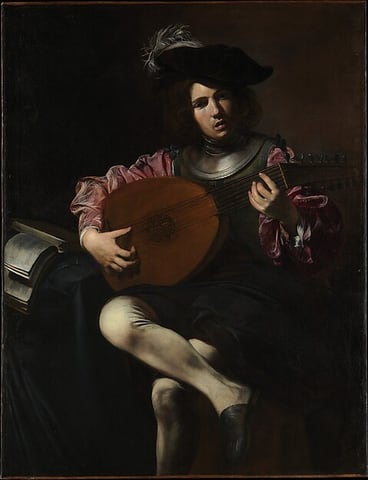
  1. Lute Player, by Valentin de Boulogne, ca. 1625–26
    Lute PlayerValentin de Boulogne, ca. 1625–26Courtesy of The Metropolitan Museum of Art
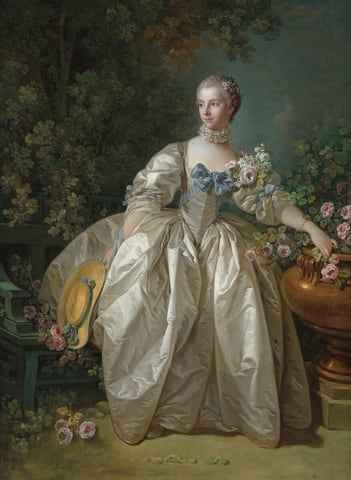
  2. A young woman with light skin stands in a garden, wearing a voluminous, full-length, silvery, shimmering gown in this vertical portrait painting. Her body faces us, as she looks into the distance to our left. She has rosy cheeks, gray-green eyes under gently arched, light brown brows, and her coral-pink, thin, closed lips curve in a slight smile. Her ash-brown hair is pulled back and adorned with tiny shell-pink and azure-blue flowers along the left side top of head, to our right. A pleated lace ruffle encircles her smooth neck. Her gown is parchment white where the light glints off the stiff fabric and is silvery gray in the shadows, creating a silk-like sheen. The dress is cut low across the chest, fits tightly around her narrow waist, and has puffy sleeves tied at the elbows with topaz-blue bows. Another blue bow is tied at her chest, and the ends wrap around her back along her waist. A corsage at her left shoulder, to our right, is a profusion of white flowers around a pale pink rose. In her other hand, to our left, she holds a straw hat with a shallow crown and a wide brim, trimmed with sky-blue ribbon. The arm holding the hat is nearly engulfed in the deep folds of her full skirt. She holds a pink rose in her other hand, which rests on the lip of a shiny, copper-colored urn filled with pink flowers and delicate green leaves. On that wrist she wears a bracelet with four strands of white pearls holding a cameo. She stands on a pale, dirt ground. A teal-blue bench in the lower left corner of the painting is tucked into sage-green shrubbery. Sprigs of pink roses are strewn across the seat and on the ground. The woman is framed to either side with olive and celery-green trees and vegetation, which blend into the hazy distance beyond her head.
    Madame BergeretFrançois Boucher, possibly 1766Courtesy National Gallery of Art, Washington
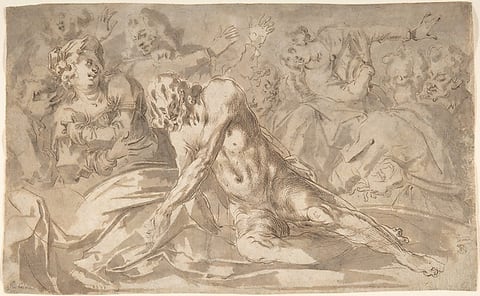
  3. The Raising of Lazarus, by Jacques Bellange, ca. 1606–8
    The Raising of LazarusJacques Bellange, ca. 1606–8Courtesy of The Metropolitan Museum of Art

Second room, north wall
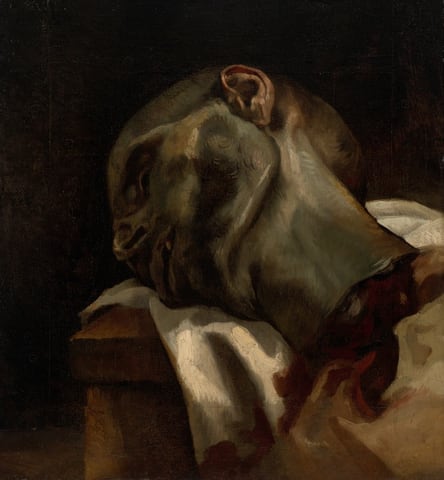
  1. A work made of oil on panel.
    Head of a Guillotined ManJean Louis André Théodore Géricault, 1818–19Courtesy of the Art Institute of Chicago
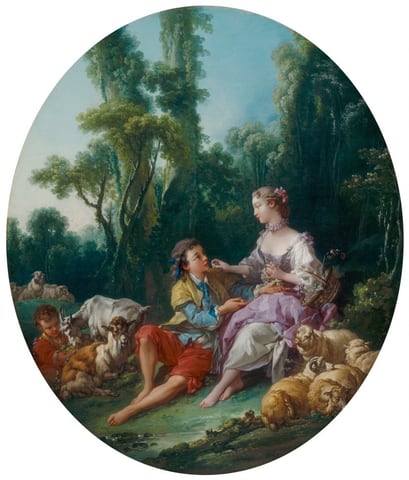
  2. A work made of oil on canvas.
    Are They Thinking about the Grape? (Pensent-ils au raisin?)François Boucher, 1747Courtesy of the Art Institute of Chicago
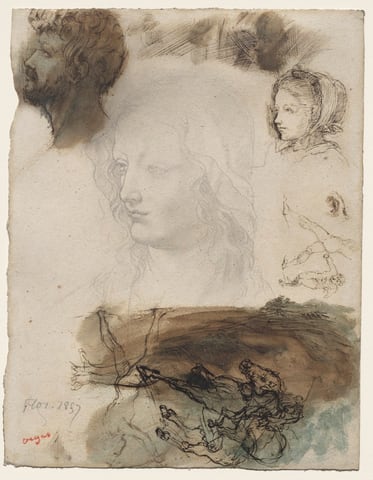
  3. Sheet of Studies and Sketches, by Edgar Degas, 1858
    Sheet of Studies and SketchesEdgar Degas, 1858Courtesy of the Cleveland Museum of Art
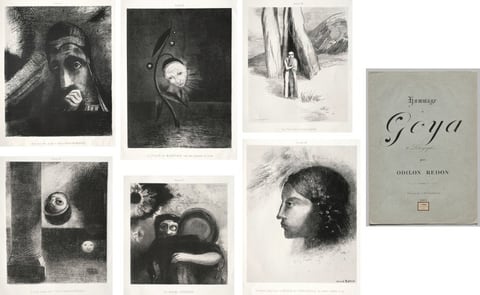
  4. Homage to Goya, by Odilon Redon, 1885
    Homage to GoyaOdilon Redon, 1885Courtesy of the Cleveland Museum of Art

Third room, north wall
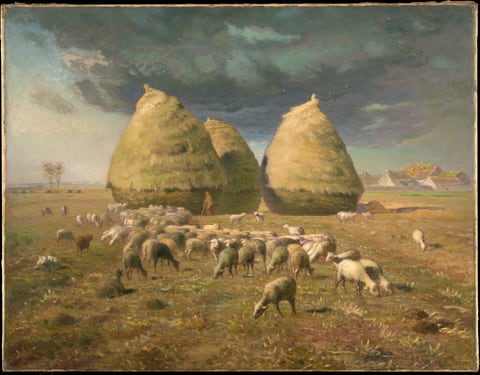
  1. Haystacks: Autumn, by Jean-François Millet, ca. 1874
    Haystacks: AutumnJean-François Millet, ca. 1874Courtesy of The Metropolitan Museum of Art
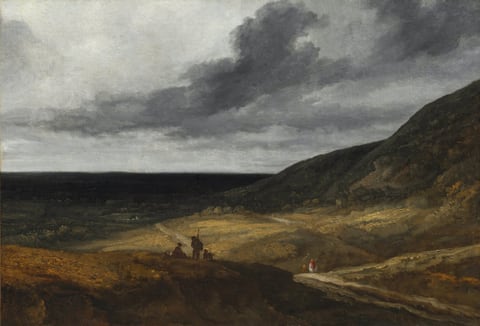
  2. Landscape Near Paris, by Georges Michel, c. 1840
    Landscape Near ParisGeorges Michel, c. 1840Courtesy of the Cleveland Museum of Art
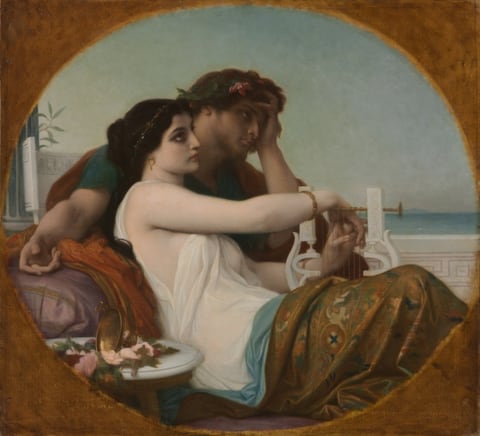
  3. Aglaida and Boniface, by Alexandre Cabanel, c. 1857
    Aglaida and BonifaceAlexandre Cabanel, c. 1857Courtesy of the Cleveland Museum of Art