Floor plan

Time and placeFlanders

Flanders

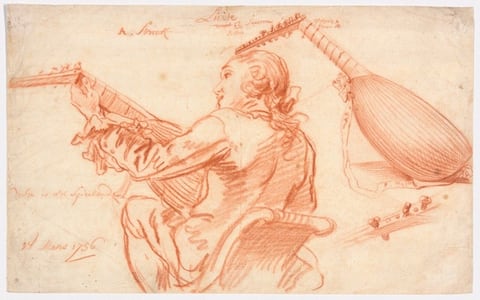
A work made of red chalk on ivory laid paper.
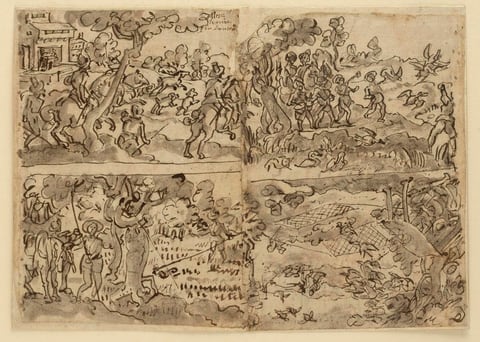
1901-39-151-a: DEER HUNT WITH HOUNDS [ABOVE]; SKYLARK HUNT WITH FALCONS [BELOW]; 1901-39-151-b: GOOSE AND DUCK HUNT WITH FALCONS [ABOVE RIGHT]; GOOSE HUNT [BELOW RIGHT]
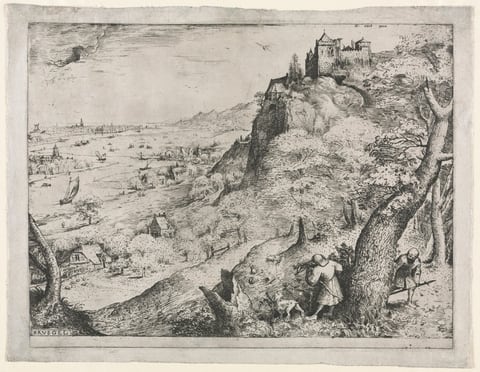
The Rabbit Hunt, by Pieter Bruegel, 1560
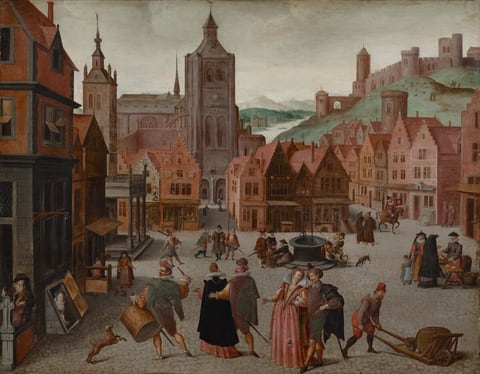
We look slightly down onto a scene with people gathering in small groups in a cobblestone town square lined with rows of brick, wood, and stone buildings, many with stepped rooflines, in this horizontal painting. Singly or in pairs or trios, men, women, and children walk across the square, move goods around, or talk to merchants. All the people have light skin. Many of the men have mustaches and wear hats, and some carry swords. In tones of black, olive green, brick red, and plum purple, they wear hip-length cloaks over jackets, with white collars or ruffs and brass buttons, and knee-length breeches over yellow or black stockings. The women all wear long dresses in salmon pink, coral red, or golden yellow, with white collars or ruffs, and many wear black, ankle-length cloaks, some with hoods. Closest to us, a sumptuously dressed man and woman walk toward us while another similarly elegant couple walks away. Also facing away from us, to our left, a man wearing a large drum strapped around his waist raises one drumstick as he looks over his left shoulder. Nearby, a woman peers up out of a cellar door that opens on an angle to the street. More couples gather around a well across the square, and two women and a child talk to a third woman selling wares at a wooden table to our right. A pair of hooded priests or monks walk near a man blowing on a trumpet on horseback. The buildings are mostly shades of brick red and brown, and most have three or four stories with steeply pitched roofs. More people walk along side streets leading off the main square. One gap in the buildings across from us leads to a nickel-gray stone church with a pointed spire and square tower. A grassy, green hill rises steeply beyond the buildings to our right, leading down to a waterway that extends up and away into the distance. A few boats float in the water, which reflects the leaden-gray sky. Beyond the town square, a brown stone structure like a fortress with turret towers and crenellated walls looms along the ridge of the hill to our right. Tiny in scale, people on horseback and tending sheep dot the hillside below. The date “1590” is painted on the front of one of the buildings across from us while another date, “1597,” is painted on the end of a short wall near the lower left corner.
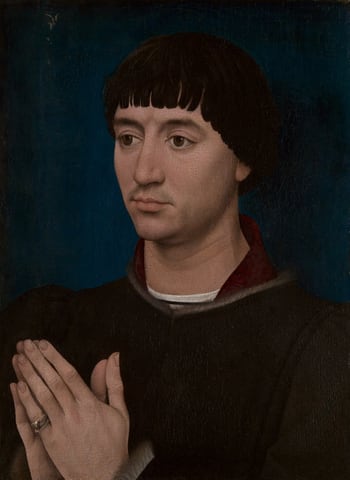
Painted dark colored portrait of man, hands in prayer.
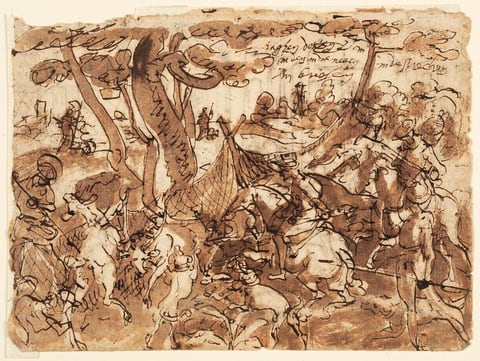
DEER HUNT WITH NETS
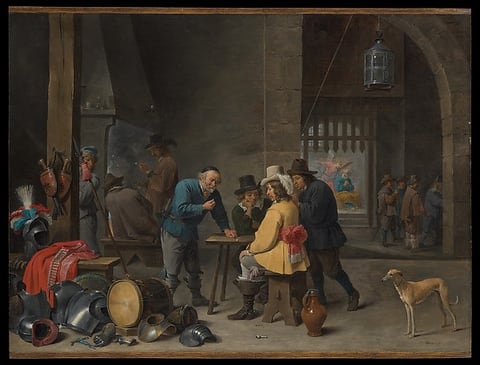
Guardroom with the Deliverance of Saint Peter, by David Teniers the Younger, ca. 1645–47
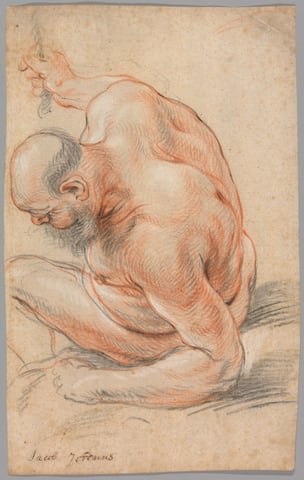
A work made of red and black chalk, with touches of white chalk, on cream laid paper.

The works in this room are listed below.

Works in this room

Works made in Flanders, from every century in the collection.

First room, north wall

  1. A work made of red chalk on ivory laid paper.
    Sketches of a Lute Player and LuteJan Anton Garemyn, 1756Courtesy of the Art Institute of Chicago
  2. 1901-39-151-a: DEER HUNT WITH HOUNDS [ABOVE]; SKYLARK HUNT WITH FALCONS [BELOW]; 1901-39-151-b: GOOSE AND DUCK HUNT WITH FALCONS [ABOVE RIGHT]; GOOSE HUNT [BELOW RIGHT]
    Goose and Duck Hunt with Falcons [above right]; Goose Hunt [below right]Jan van der Straet, called Stradanus, ca. 1596-99Courtesy of Cooper Hewitt, Smithsonian Design Museum
  3. The Rabbit Hunt, by Pieter Bruegel, 1560
    The Rabbit HuntPieter Bruegel, 1560Courtesy of the Cleveland Museum of Art
  4. We look slightly down onto a scene with people gathering in small groups in a cobblestone town square lined with rows of brick, wood, and stone buildings, many with stepped rooflines, in this horizontal painting. Singly or in pairs or trios, men, women, and children walk across the square, move goods around, or talk to merchants. All the people have light skin. Many of the men have mustaches and wear hats, and some carry swords. In tones of black, olive green, brick red, and plum purple, they wear hip-length cloaks over jackets, with white collars or ruffs and brass buttons, and knee-length breeches over yellow or black stockings. The women all wear long dresses in salmon pink, coral red, or golden yellow, with white collars or ruffs, and many wear black, ankle-length cloaks, some with hoods. Closest to us, a sumptuously dressed man and woman walk toward us while another similarly elegant couple walks away. Also facing away from us, to our left, a man wearing a large drum strapped around his waist raises one drumstick as he looks over his left shoulder. Nearby, a woman peers up out of a cellar door that opens on an angle to the street. More couples gather around a well across the square, and two women and a child talk to a third woman selling wares at a wooden table to our right. A pair of hooded priests or monks walk near a man blowing on a trumpet on horseback. The buildings are mostly shades of brick red and brown, and most have three or four stories with steeply pitched roofs. More people walk along side streets leading off the main square. One gap in the buildings across from us leads to a nickel-gray stone church with a pointed spire and square tower. A grassy, green hill rises steeply beyond the buildings to our right, leading down to a waterway that extends up and away into the distance. A few boats float in the water, which reflects the leaden-gray sky. Beyond the town square, a brown stone structure like a fortress with turret towers and crenellated walls looms along the ridge of the hill to our right. Tiny in scale, people on horseback and tending sheep dot the hillside below. The date “1590” is painted on the front of one of the buildings across from us while another date, “1597,” is painted on the end of a short wall near the lower left corner.
    The Marketplace in Bergen op ZoomAbel Grimmer, probably 1590 and 1597Courtesy National Gallery of Art, Washington

First room, south wall

  1. Painted dark colored portrait of man, hands in prayer.
    Portrait of Jean Gros (recto); Coat of Arms of Jean Gros (verso)Rogier van der Weyden, 1460–64Courtesy of the Art Institute of Chicago
  2. DEER HUNT WITH NETS
    Deer Hunt with NetsJan van der Straet, called Stradanus, ca. 1590 – 1599Courtesy of Cooper Hewitt, Smithsonian Design Museum
  3. Guardroom with the Deliverance of Saint Peter, by David Teniers the Younger, ca. 1645–47
    Guardroom with the Deliverance of Saint PeterDavid Teniers the Younger, ca. 1645–47Courtesy of The Metropolitan Museum of Art
  4. A work made of red and black chalk, with touches of white chalk, on cream laid paper.
    Nude Old Man Seated, Leaning on His Forearm, Facing LeftJacob Jordaens, c. 1640Courtesy of the Art Institute of Chicago

Second room, south wall
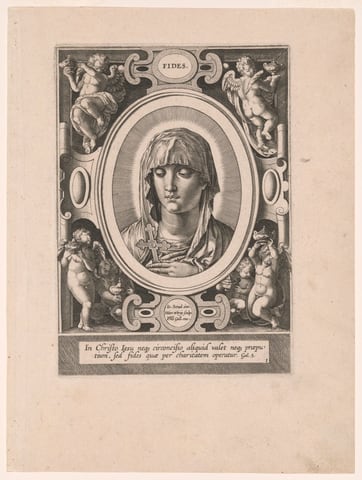
  1. A work made of engraving on ivory laid paper.
    Fides, plate 1 from The Seven VirtuesHieronymous Wierix, c. 1598Courtesy of the Art Institute of Chicago
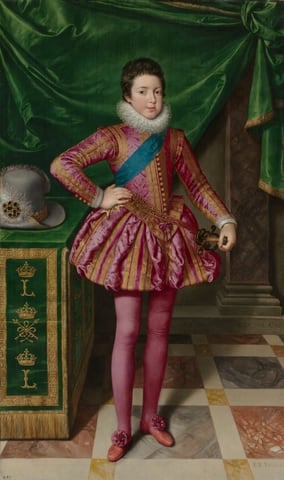
  2. Portrait of King Louis XIII of France, by Frans Pourbus, 1611
    Portrait of King Louis XIII of FranceFrans Pourbus, 1611Courtesy of the Cleveland Museum of Art
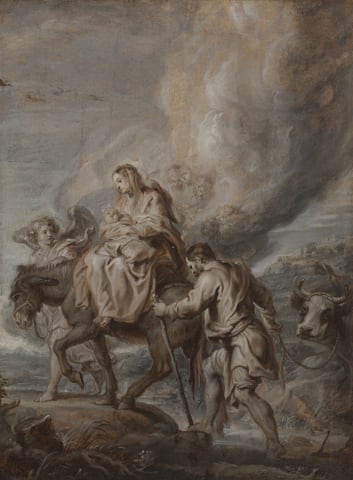
  3. A work made of oil on panel.
    The Flight into EgyptAbraham Jansz. van Diepenbeeck, c. 1650Courtesy of the Art Institute of Chicago
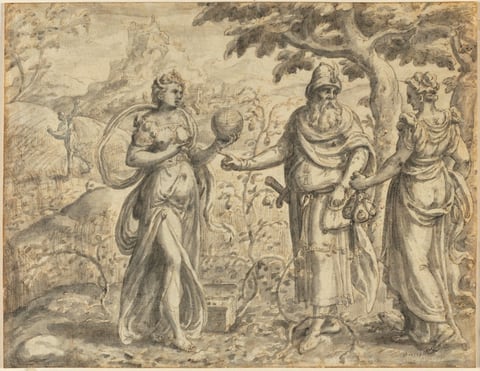
  4. The Seed Received among the Thorns, from the Parable of the Sower, by Gerard P. van Groningen, c. 1573
    The Seed Received among the Thorns, from the Parable of the SowerGerard P. van Groningen, c. 1573Courtesy of the Cleveland Museum of Art

Second room, north wall
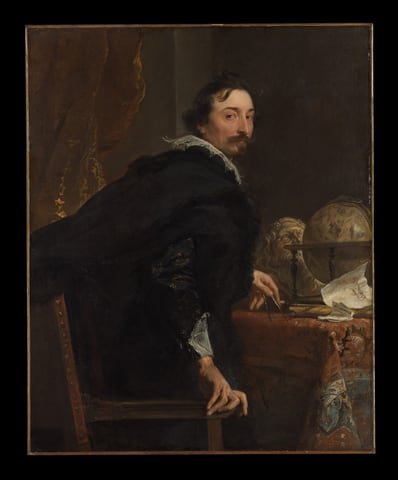
  1. Lucas van Uffel (died 1637), by Anthony van Dyck, ca. 1622
    Lucas van Uffel (died 1637)Anthony van Dyck, ca. 1622Courtesy of The Metropolitan Museum of Art
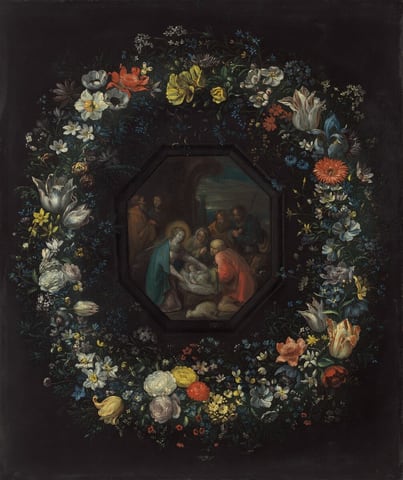
  2. A scene with seven men and women gathered around an infant is enclosed in an eight-sided, octagonal painted frame, which is surrounded by a wreath of flowers in this vertical painting. The painted black frame-within-a-frame resembles molding. The people in the scene have pale skin and wear robes in shades of teal blue, burnt orange, red, muted purple, or red. A woman reaching for the bed on which the child lies and the child have gold halos. Others crouch or bend toward the child, and one pair, to our left, turn toward each other, presumably talking. The nighttime-blue sky is streaked with nickel-gray clouds beyond a partially ruined stone arch. A lamb with all four feet tired together lies at the foot of the child’s bed. The wreath surrounding the painting-within-a-painting is dense with tulips, roses, daffodils, poppies, violets, and other flowers and greenery painted in shades of lemon and butter yellow, opal and pearl white, brick and coral red, and sky and slate blue against an inky-black background. One artist signed the painting-within-a-painting near the bottom left corner, “FF F.” The second artist who painted this signed his initials, “HDB”, on the bottom edge of the painted frame.
    Garland of Flowers with Adoration of the ShepherdsFrans Francken the Younger, c. 1625/1630Courtesy National Gallery of Art, Washington
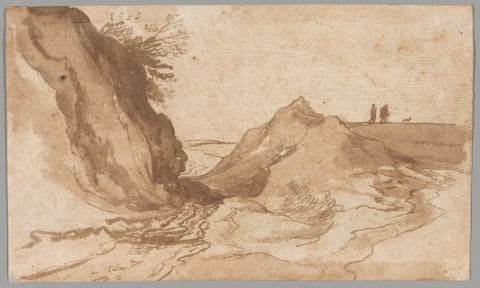
  3. A work made of pen and brush and brown ink and brush and brown wash on ivory laid paper.
    A Hilly Landscape with Figures Near a RavineJan Brueghel the Elder, 1595Courtesy of the Art Institute of Chicago
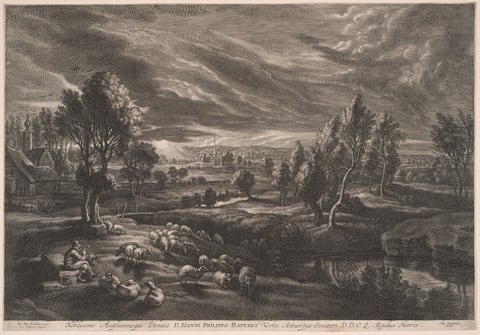
  4. A work made of engraving on ivory laid paper.
    Landscape with Sheep, from The Small LandscapesSchelte Adamsz. Bolswert, c. 1638Courtesy of the Art Institute of Chicago