Floor plan

Time and placeThe 19th century

The 19th century

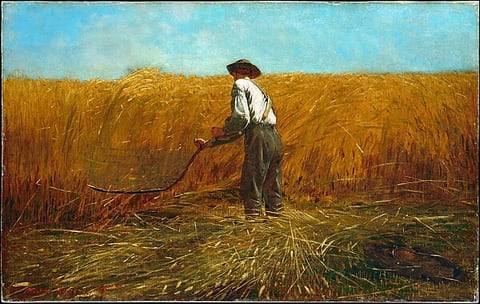
The Veteran in a New Field, by Winslow Homer, 1865
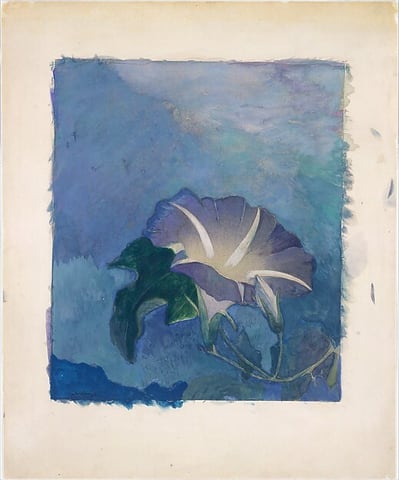
Nocturne, by John La Farge, ca. 1885
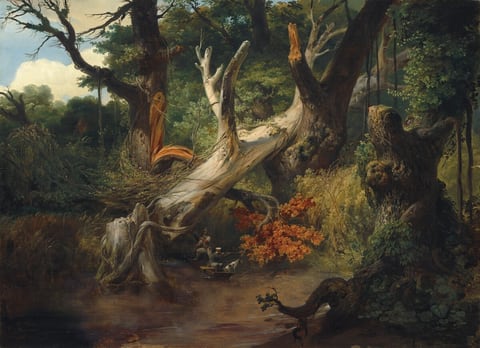
A leafless, ash-white tree trunk has fallen from a broken stump into the wide V of a neighboring tree at the edge of a body of water near a verdant forest in this horizontal landscape painting. The fallen trunk creates a diagonal from near the lower left corner to the upper right. As it fell, it sheared off a substantial branch from a neighboring tree with a dark trunk. The bark where the damaged branch has pulled away is honey-orange, the same color as the leaves at the canopy, which has been pinned under the fallen trunk. Trees, vines, and other vegetation fill the space around and beyond this pair. In the lower right corner of the painting, vines grow over a broken stump, which deep in shadow. Between the stump and fallen tree, the peanut-brown surface of the water is smooth. Tiny in scale beneath the fallen tree and easily overlooked, there are two men and a dog in a boat. One man stands at the back of the boat and pushes it along with a long pole. He wears a tall, brown, cloth hat, a white shirt rolled up to the elbows under a blue vest, and loose-fitting pants. A second man wears a flat-topped, white hat with a black brim, a long, forest-green jacket, and tight-fitting slate-blue pants. He braces a rifle against one shoulder and shoots into the forest. The dog is white with brown spots, and it stands with its front paws on the edge of the boat, presumably ready to spring after the target. A patch of blue sky with puffy white clouds is seen above the trees in the upper left corner. The artist signed and dated the work in the lower right corner: “H. Vernet Rome 1833.”
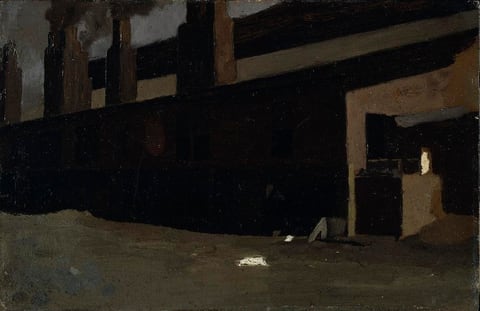
Thomas Anshutz
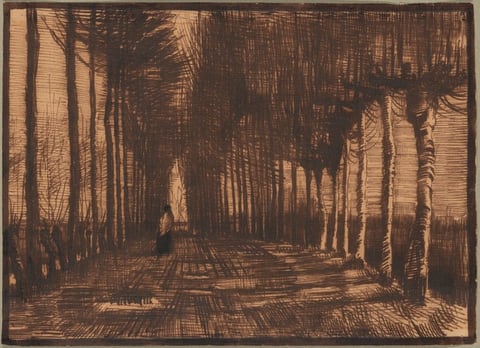
A work made of reed pen and iron-gall ink on tan laid paper.
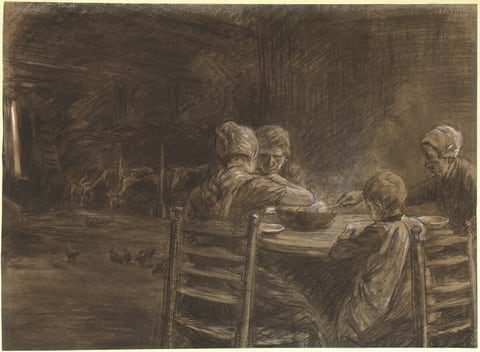
This is a drawing of a rustic interior scene. The artwork depicts an interior where a table is surrounded by chairs. On the table, there is a bowl, as the individuals appear to be interacting or reaching towards it. In the background, livestock and chickens are visible, suggesting the environment is possibly a farm or a barn with a dining space. The use of soft lines and shading creates a warm, intimate, and slightly somber atmosphere within the image, with light and shadow playing an important role in highlighting the subjects and their surroundings.
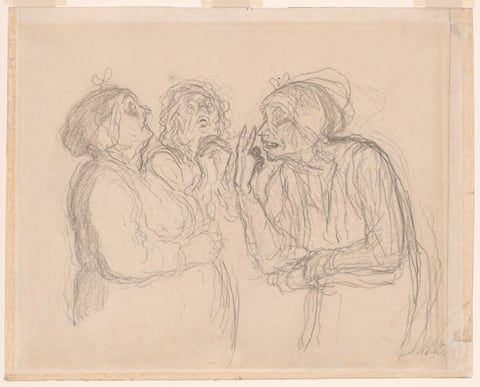
A work made of black crayon and charcoal, on ivory laid paper.
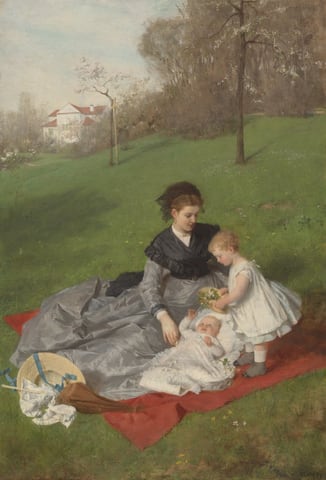
A work made of oil on canvas.

The works in this room are listed below.

Works in this room

Works made in the 19th century, anywhere in the world.

Section 1, north wall

  1. The Veteran in a New Field, by Winslow Homer, 1865
    The Veteran in a New FieldWinslow Homer, 1865Courtesy of The Metropolitan Museum of Art
  2. Nocturne, by John La Farge, ca. 1885
    NocturneJohn La Farge, ca. 1885Courtesy of The Metropolitan Museum of Art
  3. A leafless, ash-white tree trunk has fallen from a broken stump into the wide V of a neighboring tree at the edge of a body of water near a verdant forest in this horizontal landscape painting. The fallen trunk creates a diagonal from near the lower left corner to the upper right. As it fell, it sheared off a substantial branch from a neighboring tree with a dark trunk. The bark where the damaged branch has pulled away is honey-orange, the same color as the leaves at the canopy, which has been pinned under the fallen trunk. Trees, vines, and other vegetation fill the space around and beyond this pair. In the lower right corner of the painting, vines grow over a broken stump, which deep in shadow. Between the stump and fallen tree, the peanut-brown surface of the water is smooth. Tiny in scale beneath the fallen tree and easily overlooked, there are two men and a dog in a boat. One man stands at the back of the boat and pushes it along with a long pole. He wears a tall, brown, cloth hat, a white shirt rolled up to the elbows under a blue vest, and loose-fitting pants. A second man wears a flat-topped, white hat with a black brim, a long, forest-green jacket, and tight-fitting slate-blue pants. He braces a rifle against one shoulder and shoots into the forest. The dog is white with brown spots, and it stands with its front paws on the edge of the boat, presumably ready to spring after the target. A patch of blue sky with puffy white clouds is seen above the trees in the upper left corner. The artist signed and dated the work in the lower right corner: “H. Vernet Rome 1833.”
    Hunting in the Pontine MarshesHorace Vernet, 1833Courtesy National Gallery of Art, Washington
  4. Thomas Anshutz
    Factory--Study for "Ironworkers, Noontime"/Verso: Still Life with OrangeThomas Anshutz, (1880)Courtesy of the Hirshhorn Museum and Sculpture Garden, Smithsonian Institution

Section 1, south wall

  1. A work made of reed pen and iron-gall ink on tan laid paper.
    Avenue of Pollard Birches and PoplarsVincent van Gogh, March 1884Courtesy of the Art Institute of Chicago
  2. This is a drawing of a rustic interior scene. The artwork depicts an interior where a table is surrounded by chairs. On the table, there is a bowl, as the individuals appear to be interacting or reaching towards it. In the background, livestock and chickens are visible, suggesting the environment is possibly a farm or a barn with a dining space. The use of soft lines and shading creates a warm, intimate, and slightly somber atmosphere within the image, with light and shadow playing an important role in highlighting the subjects and their surroundings.
    East Frisian Peasants Eating SupperMax Liebermann, 1893Courtesy National Gallery of Art, Washington
  3. A work made of black crayon and charcoal, on ivory laid paper.
    Three GossipsHonoré Daumier, 1865/1867Courtesy of the Art Institute of Chicago
  4. A work made of oil on canvas.
    Mother and ChildrenPál Szinyei Merse, 1869Courtesy of the Art Institute of Chicago

Section 2, south wall
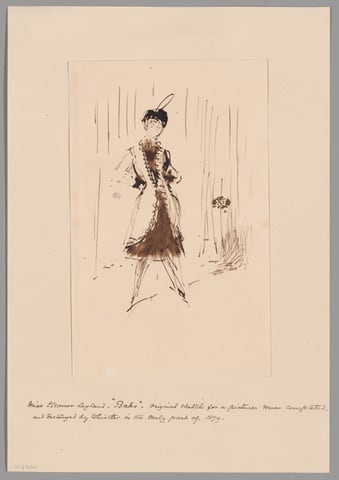
  1. A work made of pen and brown ink, with brush and brown ink, on cream pseudo-laid paper tipped onto cream wove paper.
    Study for "The Blue Girl: Portrait of Miss Elinor Leyland"James McNeill Whistler, c. 1879Courtesy of the Art Institute of Chicago
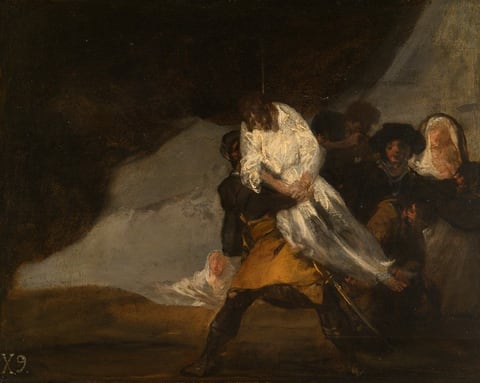
  2. A work made of oil on panel.
    The Hanged MonkFrancisco Goya, c. 1810Courtesy of the Art Institute of Chicago
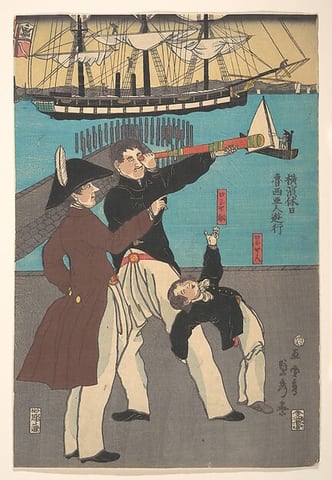
  3. Russians Enjoying a Holiday in Yokohama (Yokohama kyūjitsu Roshiajin yūkō), by Utagawa (Gountei) Sadahide, 1861
    Russians Enjoying a Holiday in Yokohama (Yokohama kyūjitsu Roshiajin yūkō)Utagawa (Gountei) Sadahide, 1861Courtesy of The Metropolitan Museum of Art
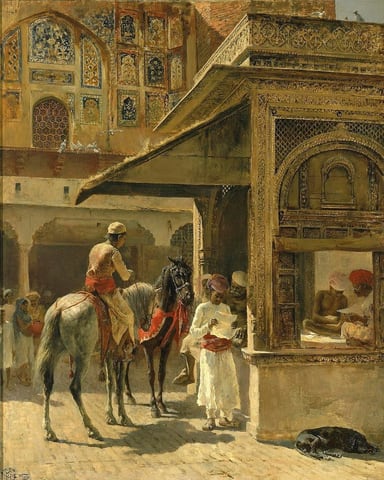
  4. Hindu Merchants, by Edwin Lord Weeks, ca. 1885
    Hindu MerchantsEdwin Lord Weeks, ca. 1885Courtesy of the Smithsonian American Art Museum

Section 2, north wall
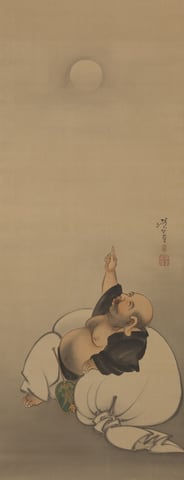
  1. A work made of hanging scroll; ink and color on silk.
    Moon of Enlightenment, from the series Twelve Aspects of the MoonTsukioka Yoshitoshi, About 1885-92Courtesy of the Art Institute of Chicago
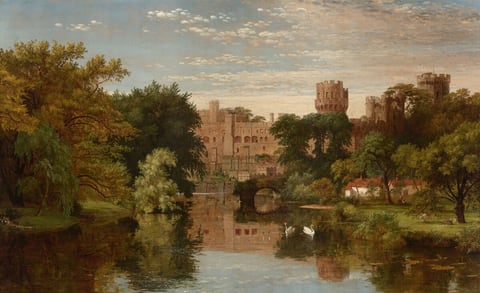
  2. This painting features a landscape with a calm body of water dominating the lower portion. The view is slightly elevated, overlooking the water that reflects the surrounding greenery and sky. Two white swans glide on the river, which is surrounded by green trees and shrubs. In the distance, a large tan castle with multiple towers and crenellations stands above the trees. In front of the castle, on the right side of the painting, a smaller structure with white walls and red roofs sits, surrounded by greenery. One or two people appear to sit out in front of it, and on the right sheep lay in the soft green grass. The color palette includes deep greens, soft browns, and varying shades of blue.
    Warwick Castle, EnglandJasper Francis Cropsey, 1857Courtesy National Gallery of Art, Washington

Section 3, north wall
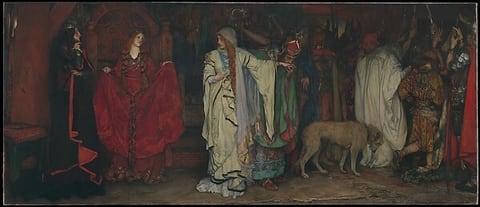
  1. "King Lear," Act I, Scene I, by Edwin Austin Abbey, 1898
    "King Lear," Act I, Scene IEdwin Austin Abbey, 1898Courtesy of The Metropolitan Museum of Art
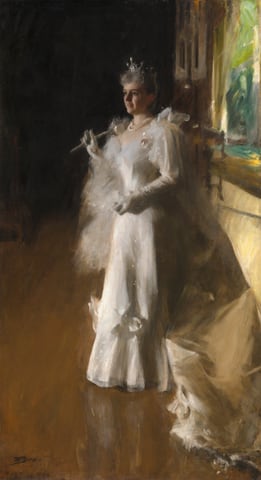
  2. A work made of oil on canvas.
    Mrs. Potter PalmerAnders Zorn, 1893Courtesy of the Art Institute of Chicago