Floor plan

Time and placeThe 19th century

The 19th century

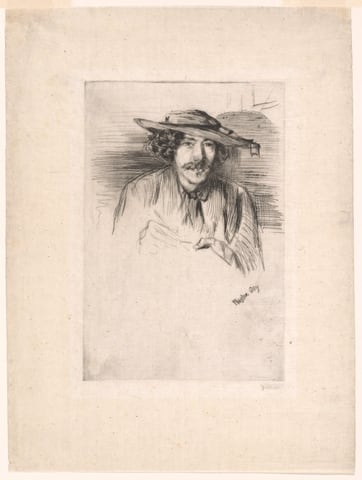
A work made of drypoint with light plate tone on thin ivory japanese paper.
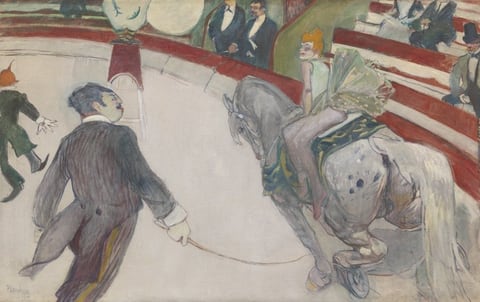
Painting of a performance inside a circus ring. A man wearing a suit holds a whip in his hand and looks towards a woman with red hair riding a gray horse and wearing a green dress. Audience members wearing suits and top hats watch from red and white benches on the side.
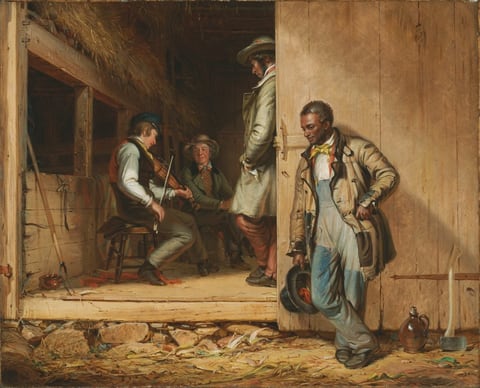
The Power of Music, by William Sidney Mount, 1847
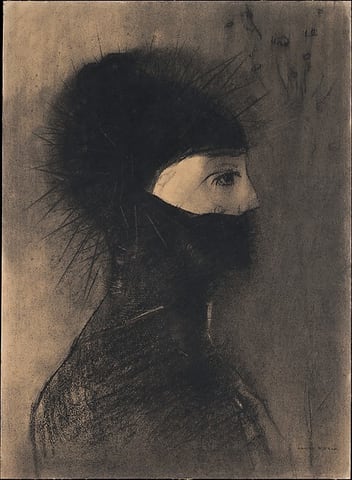
Armor, by Odilon Redon, 1891
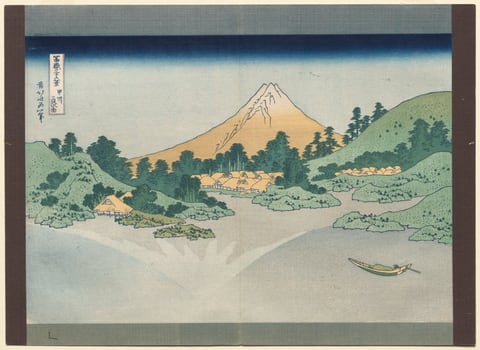
Thirty-Six Views of Mt. Fuji: The Surface of Lake Misaka in Kai Province, by Katsushika Hokusai, early 1830s
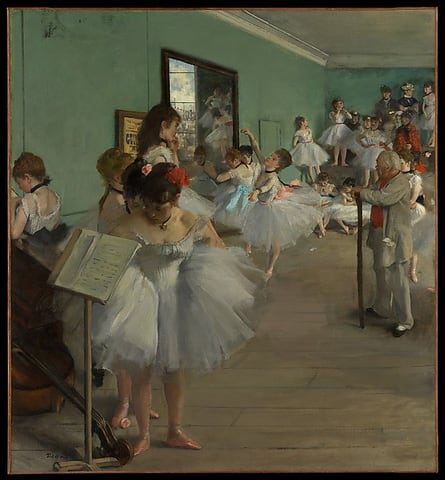
The Dance Class, by Edgar Degas, 1874
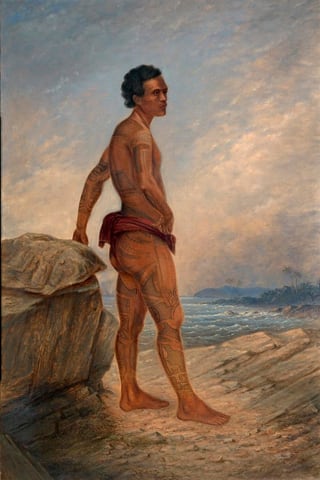
Melanesian Man, by Antonion Zeno Shindler, ca. 1890-1899
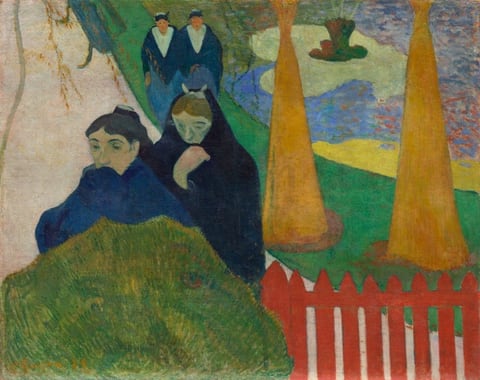
Painting of four women with blue shawls walking near red fence.

The works in this room are listed below.

Works in this room

Works made in the 19th century, anywhere in the world.

Section 1, north wall

  1. A work made of drypoint with light plate tone on thin ivory japanese paper.
    Whistler with a HatJames McNeill Whistler, 1859Courtesy of the Art Institute of Chicago
  2. Painting of a performance inside a circus ring. A man wearing a suit holds a whip in his hand and looks towards a woman with red hair riding a gray horse and wearing a green dress. Audience members wearing suits and top hats watch from red and white benches on the side.
    Equestrienne (At the Cirque Fernando)Henri de Toulouse-Lautrec, 1887–88Courtesy of the Art Institute of Chicago
  3. The Power of Music, by William Sidney Mount, 1847
    The Power of MusicWilliam Sidney Mount, 1847Courtesy of the Cleveland Museum of Art
  4. Armor, by Odilon Redon, 1891
    ArmorOdilon Redon, 1891Courtesy of The Metropolitan Museum of Art

Section 1, south wall

  1. Thirty-Six Views of Mt. Fuji: The Surface of Lake Misaka in Kai Province, by Katsushika Hokusai, early 1830s
    Thirty-Six Views of Mt. Fuji: The Surface of Lake Misaka in Kai ProvinceKatsushika Hokusai, early 1830sCourtesy of the Cleveland Museum of Art
  2. The Dance Class, by Edgar Degas, 1874
    The Dance ClassEdgar Degas, 1874Courtesy of The Metropolitan Museum of Art
  3. Melanesian Man, by Antonion Zeno Shindler, ca. 1890-1899
    Melanesian ManAntonion Zeno Shindler, ca. 1890-1899Courtesy of the Smithsonian American Art Museum
  4. Painting of four women with blue shawls walking near red fence.
    Arlésiennes (Mistral)Paul Gauguin, 1888Courtesy of the Art Institute of Chicago

Section 2, south wall
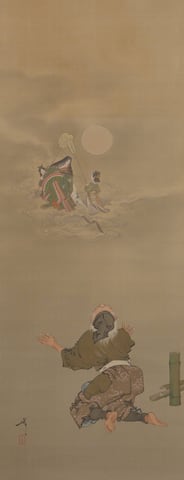
  1. A work made of hanging scroll; ink and colors on silk.
    Received Back into the Moon Palace-Taketori (Bamboo Cutter) from the series Twelve Aspects of the MoonTsukioka Yoshitoshi, c. 1885/92Courtesy of the Art Institute of Chicago
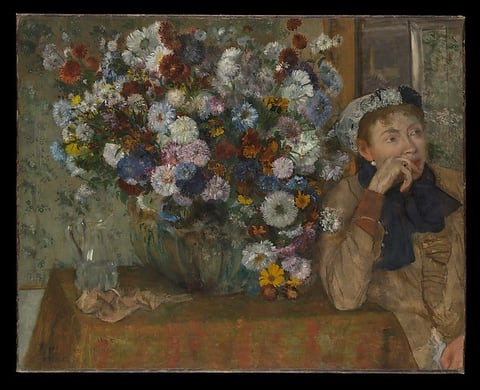
  2. A Woman Seated beside a Vase of Flowers (Madame Paul Valpinçon?), by Edgar Degas, 1865
    A Woman Seated beside a Vase of Flowers (Madame Paul Valpinçon?)Edgar Degas, 1865Courtesy of The Metropolitan Museum of Art
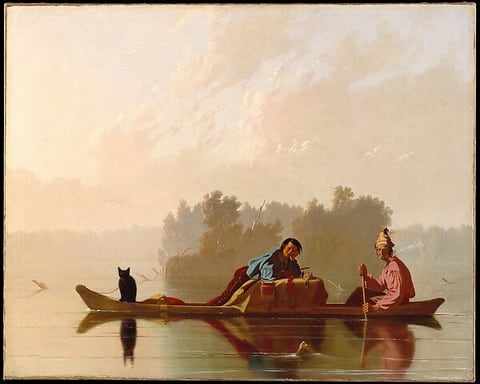
  3. Fur Traders Descending the Missouri, by George Caleb Bingham, 1845
    Fur Traders Descending the MissouriGeorge Caleb Bingham, 1845Courtesy of The Metropolitan Museum of Art

Section 2, north wall
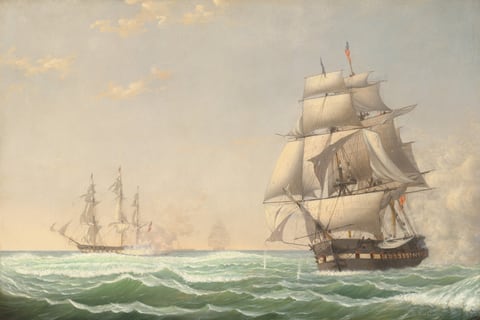
  1. This painting shows a maritime landscape with an expansive view of the ocean and sky. The horizon is positioned in the lower third of the composition, meeting a clear sky with soft, diffused clouds. Two ships appear to be engaged in a conflict on the green, wave-filled water. One large sailing ship with fully extended sails is near the bottom right corner of the painting. It has two tall masts and multiple white sails, and it flies the flag of the U.S.A in several places. The body of this ship is gray with a wide white stripe, and cannons stick out of small holes across the ship. Small people climb on ropes up into the sails, which are covered in small white and gray dots, perhaps indicating holes. Another ship is visible in the distance on the left side of the painting, and its cannons appear to be firing, with bursts of yellow flame and smoke drifting across the water. This ship flies several flags in shades of red, blue, and white. In the background, the faint gray silhouettes of other ships can be seen across the water. The ocean is depicted with smooth brushstrokes in shades of green and white, and the wide sky is a gradient, with light blue at the top and pale yellow towards the horizon. Faint white clouds drift in the top left corner of the painting.
    The United States Frigate "President" Engaging the British Squadron, 1815Fitz Henry Lane, 1850Courtesy National Gallery of Art, Washington
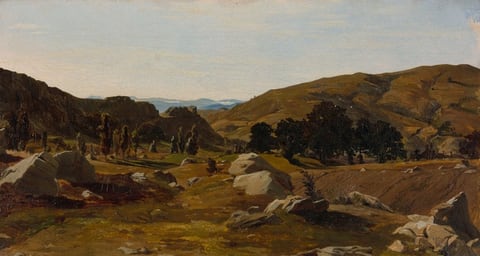
  2. A work made of oil on canvas.
    Landscape near Chiusi, TuscanyAlexandre Desgoffe, 1841Courtesy of the Art Institute of Chicago
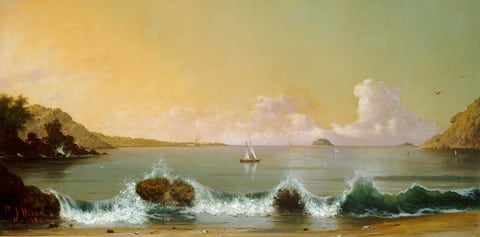
  3. Across a short stretch of sand in front of us, waves of bottle-green water break over two boulders on the shoreline, with sailboats in the water beyond, in this wide, horizontal painting. One boulder is at the left edge of the painting; the other is a short distance away, about a quarter of the way across. The water cascades down between those large rocks. Across the rest of the beach, the waves flare up to break toward us in white, foamy surf. The land curves back into view on both sides of the canvas with muted, sage-green hills and, to our left, dark green trees on more craggy boulders. A more distant finger of land to our left stretches nearly halfway across the horizon, which comes about halfway up the composition. Minuscule in scale there, smoke pours out of a chimney, which is surrounded by pale yellow buildings. A mound emerges from the horizon to our right of center. About ten sailboats float on the water. The closest one to us is near the center of the painting, and the tiny forms of people aboard can just barely be made out. The other boats become smaller as they move back to the horizon, and some are only a touch of white or gray on the canvas. White and pale lavender-purple clouds sweep up from the horizon into the sky, which glows butter yellow along the left edge. The sky cools to mint green in the upper right corner. Several white or brown birds fly across the sky or low over the water. The artist signed and dated the lower left, “M. J. Heade 1864.”
    Rio de Janeiro BayMartin Johnson Heade, 1864Courtesy National Gallery of Art, Washington

Section 3, north wall
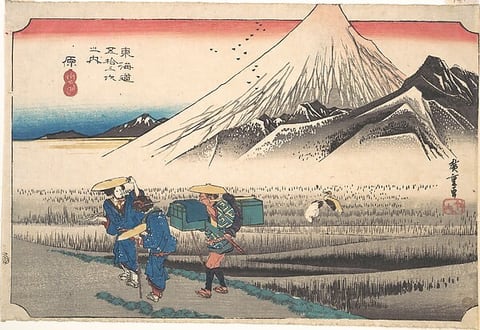
  1. Hara: Mount Fuji in the Morning (Hara, Asa no Fuji), from the series Fifty-Three Stations of the Tōkaidō Road (Tōkaidō gojūsan tsugi), also known as the First Tōkaidō or Great Tōkaidō, by Utagawa Hiroshige, ca. 1833–34
    Hara: Mount Fuji in the Morning (Hara, Asa no Fuji), from the series Fifty-Three Stations of the Tōkaidō Road (Tōkaidō gojūsan tsugi), also known as the First Tōkaidō or Great TōkaidōUtagawa Hiroshige, ca. 1833–34Courtesy of The Metropolitan Museum of Art
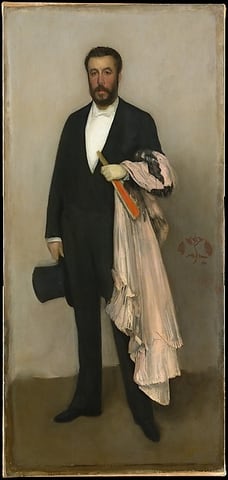
  2. Arrangement in Flesh Colour and Black: Portrait of Theodore Duret, by James McNeill Whistler, 1883
    Arrangement in Flesh Colour and Black: Portrait of Theodore DuretJames McNeill Whistler, 1883Courtesy of The Metropolitan Museum of Art