Floor plan

Time and placeThe 19th century

The 19th century

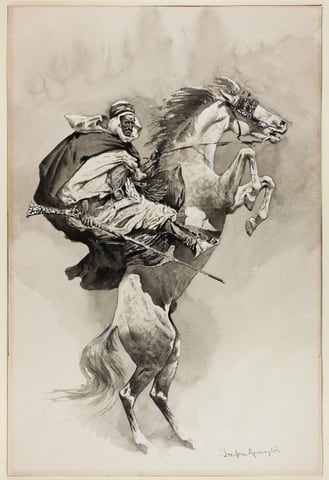
A work made of brush and black gray wash heightened with white gouache over graphite, on cream laminate board.
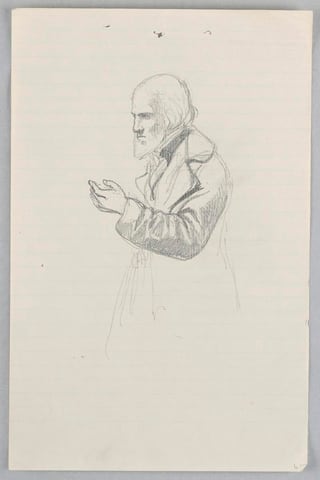
STUDY FOR "SCIENTIFIC GROUP"
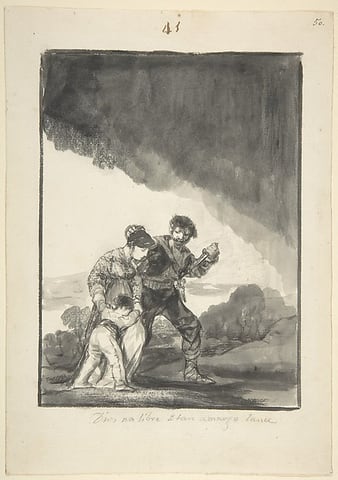
God save us from such a bitter fate; a bandit threatening a woman and a child with a knife, page 41 from the "Black Border Album" (E), by Francisco Goya, ca. 1816–20
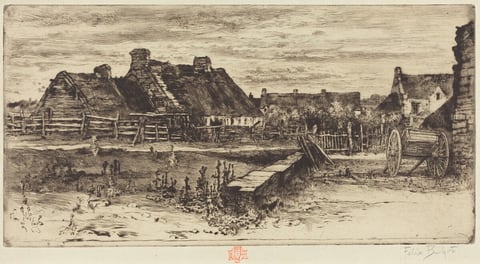
The image depicts a rustic village scene featuring thatched-roof cottages, wooden fences, and a low horizon with rooftops and chimneys. The etching showcases detailed brushstrokes capturing various textures, with a monochromatic sepia color palette. A stone or wooden wall leads into the scene, alongside grassy vegetation. The cottages create a sense of enclosure, with trees and other structures in the background. A cart is placed near the wall.
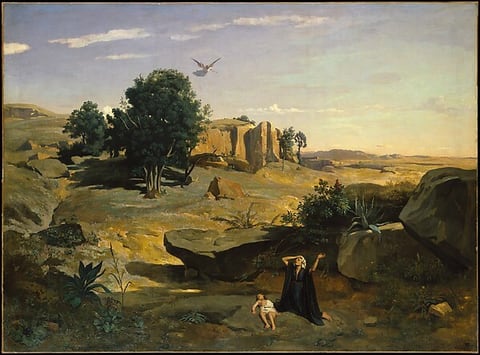
Hagar in the Wilderness, by Jean Baptiste Camille Corot, 1835
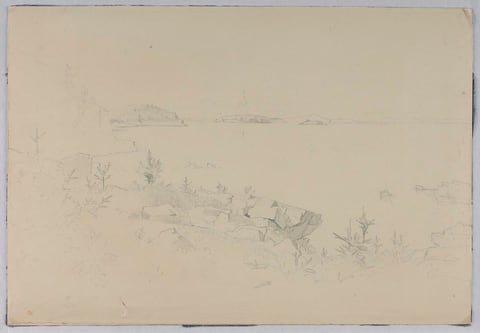
STUDY OF SEASCAPE. PORCUPINE ISLANDS, BAR HARBOR, ME

The works in this room are listed below.

Works in this room

Works made in the 19th century, anywhere in the world.

Section 1, north wall

  1. A work made of brush and black gray wash heightened with white gouache over graphite, on cream laminate board.
    "As They Threw their Animals Back upon their Haunches," illustration for An Arabian Day and Night, in Harper's New Monthly MagazineFrederic Remington, n.d.Courtesy of the Art Institute of Chicago
  2. STUDY FOR "SCIENTIFIC GROUP"
    Study for "Scientific Group"Daniel Huntington, 1858Courtesy of Cooper Hewitt, Smithsonian Design Museum
  3. God save us from such a bitter fate; a bandit threatening a woman and a child with a knife, page 41 from the "Black Border Album" (E), by Francisco Goya, ca. 1816–20
    God save us from such a bitter fate; a bandit threatening a woman and a child with a knife, page 41 from the "Black Border Album" (E)Francisco Goya, ca. 1816–20Courtesy of The Metropolitan Museum of Art
  4. The image depicts a rustic village scene featuring thatched-roof cottages, wooden fences, and a low horizon with rooftops and chimneys. The etching showcases detailed brushstrokes capturing various textures, with a monochromatic sepia color palette. A stone or wooden wall leads into the scene, alongside grassy vegetation. The cottages create a sense of enclosure, with trees and other structures in the background. A cart is placed near the wall.
    Les Grandes ChaumièresFélix-Hilaire Buhot, 1881Courtesy National Gallery of Art, Washington

Section 1, south wall

  1. Hagar in the Wilderness, by Jean Baptiste Camille Corot, 1835
    Hagar in the WildernessJean Baptiste Camille Corot, 1835Courtesy of The Metropolitan Museum of Art
  2. STUDY OF SEASCAPE. PORCUPINE ISLANDS, BAR HARBOR, ME
    Study of seascape. Porcupine Islands, Bar Harbor, MEWilliam Stanley Haseltine, 1859Courtesy of Cooper Hewitt, Smithsonian Design Museum

Section 2, south wall
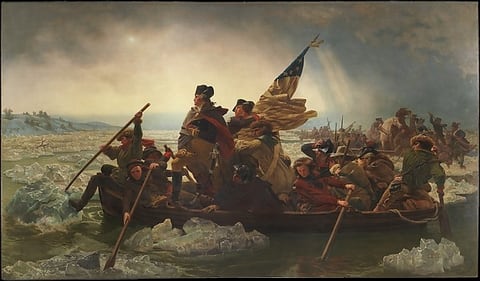
  1. Washington Crossing the Delaware, by Emanuel Leutze, 1851
    Washington Crossing the DelawareEmanuel Leutze, 1851Courtesy of The Metropolitan Museum of Art
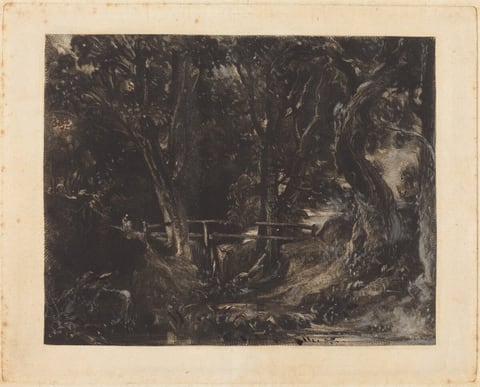
  2. The image shows a landscape scene with a frontal view of a dense forest. A wooden bridge spans across a narrow ravine or creek. The painting features vigorous and textural brushstrokes with dark tones creating a shadowy effect. The color palette includes deep blacks, dark browns, and occasional highlights of light filtering through the canopy. In the distance, lighter areas suggest a path leading further into the woods, surrounded by trees and undergrowth.
    A Dell at Helmingham Park, SuffolkDavid Lucas, 1830Courtesy National Gallery of Art, Washington
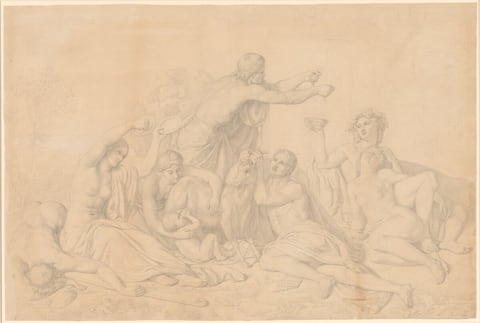
  3. This is a drawing of a group of mythological figures in a ceremonial scene. The composition features multiple figures in various poses, centered around a symbolic gathering. The drawing is detailed, providing a classical representation of human forms, draped fabrics, and an animal. A plateau with trees is subtly depicted in the background. The figures display expressions ranging from serene to contemplative.
    The Nursing of JupiterThéodore ChassériauCourtesy National Gallery of Art, Washington

Section 2, north wall
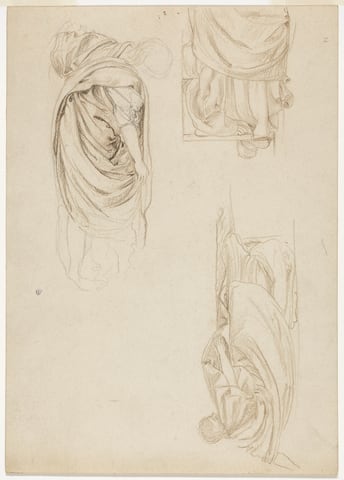
  1. A work made of brown and black chalks on cream wove paper.
    Study for FestivalSir John Edward Poynter, c. 1875Courtesy of the Art Institute of Chicago
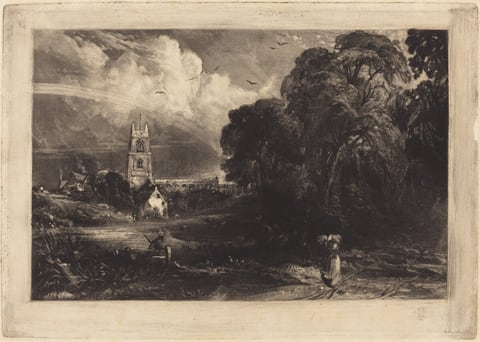
  2. The image displays a landscape with a high vantage point. The horizon is low, with a row of trees. A church tower is off-center to the left. The church is surrounded by trees and buildings. A line of trees is on the right side. The sky has large, expressive clouds. A monochromatic palette of gray is used. A path winds through the scene, with two figures: one person working and another walking.
    Stoke-by-NeylandDavid Lucas, 1830Courtesy National Gallery of Art, Washington
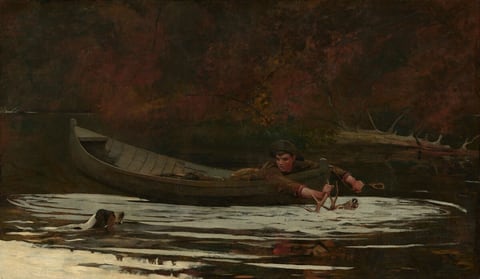
  3. A young man with a peachy, ruddy complexion lies on his stomach in a wooden rowboat on a river, reaching forward to grasp the horn of a stag almost completely submerged in the rippling water with one hand. On the opposite riverbank, gold, rust, and scarlet-red trees span the width of this horizontal painting. The boy’s arms straddle the stern of the boat so one holds the antler with his right hand, closer to us, while the other clutches a rope with a loop at the end. He turns his face, mouth agape and cheeks flushed, over his right shoulder to look to our left, at a dog swimming toward the boat. The dog has white and caramel-brown markings, with dark brown ears. The boy wears earth-brown clothing and the front of his wide-brimmed hat is pushed up to reveal dark eyes and sable-brown bangs and brows. The stag and dog are between us and the boat, and are surrounded by thick brushstrokes of parchment white to create ripples in the forest-green water. Only the open muzzle, part of the eye, and the tips of the stag’s antlers are above the water’s surface. To our right, a bare, fallen tree lies along the far riverbank parallel to the boat. The boat and water fill the lower half of the scene and the autumn trees fill the upper half. The artist has signed and dated the painting in the lower right, “Winslow Homer 1892.”
    Hound and HunterWinslow Homer, 1892Courtesy National Gallery of Art, Washington
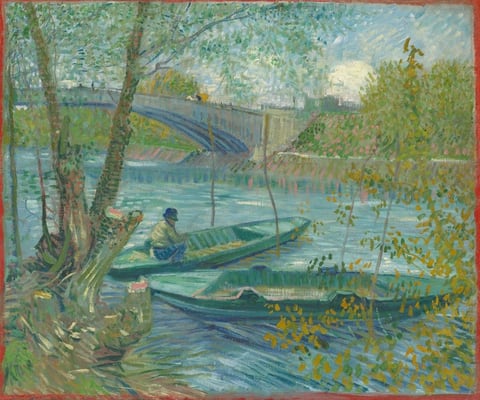
  4. Painting in short strokes of pale blue, green, white, yellow, and pink, of a fisherman in one of two small boats on a river, a tree-lined bank and a bridge in the background.
    Fishing in Spring, the Pont de Clichy (Asnières)Vincent van Gogh, 1887Courtesy of the Art Institute of Chicago

Section 3, north wall
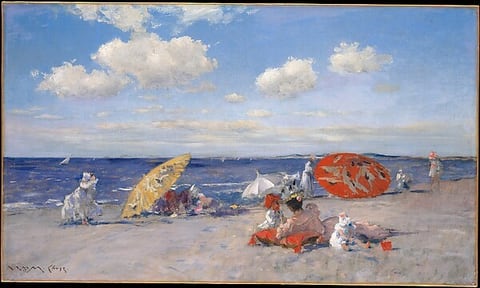
  1. At the Seaside, by William Merritt Chase, ca. 1892
    At the SeasideWilliam Merritt Chase, ca. 1892Courtesy of The Metropolitan Museum of Art
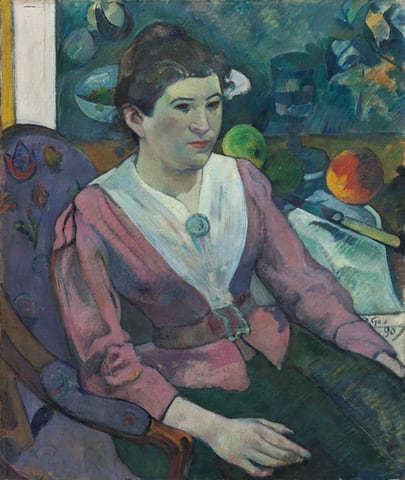
  2. A work made of oil on linen canvas.
    Woman in Front of a Still Life by CezannePaul Gauguin, 1890Courtesy of the Art Institute of Chicago
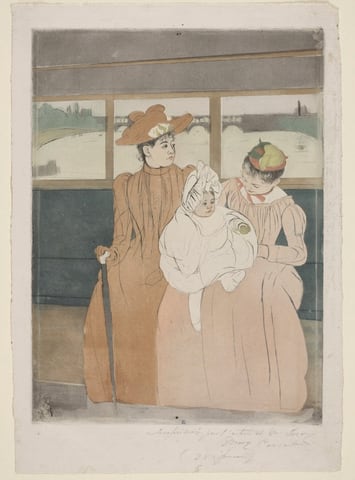
  3. In the Omnibus, by Mary Cassatt, 1890–91
    In the OmnibusMary Cassatt, 1890–91Courtesy of the Cleveland Museum of Art