Floor plan

Time and placeThe 19th century

The 19th century

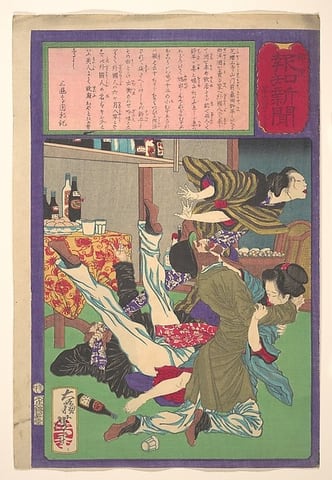
Postal Hōchi Newspaper no. 645, Englishman raping a wine shopkeeper's daughter (Yūbin Hōchi shinbun, roppyaku yonjū gogō), by Tsukioka Yoshitoshi, August, 1875
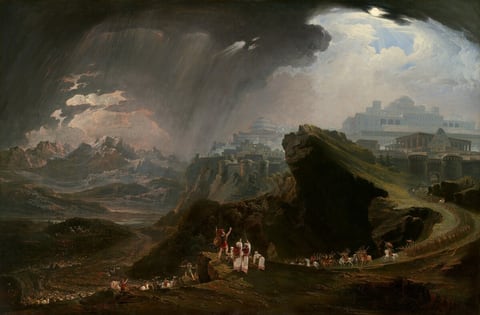
Armies of men march and battle along a rocky outcropping set among huge rock formations and massive buildings under a stormy sky in this horizontal landscape painting. The people we can see all have pale skin. Sheets of rain fall from flint-gray clouds on our left into a valley, though hints of peach brighten the clouds along the mountainous horizon there. In the right half of the sky, light pours down from a brilliant white sun that breaks through white clouds to reveal topaz-blue patches of sky. The horizon comes about halfway up the composition and is lined with rugged white, pale pink, and olive-green mountains on our left and silvery-white buildings along the right half. These structures include two domed buildings and a colosseum among many others. The buildings are all enclosed within city walls buttressed with towers. The land dips precipitously from the rocky cliffs supporting the buildings, to sweep down toward us. A huge outcropping angles up like a ramp between us and the buildings in the distance. A road runs from the walled town toward us, down along the ridge and in front of the outcropping. Countless warriors march in rows of four or five across on the road past a man wearing a feathered helmet and armored breastplate. This man, Joshua, stands on a rocky precipice facing away from us with his right hand raised. He wears a scarlet-red toga under his breastplate, and a royal-blue cape flutters at his left side. He holds a round, copper-colored shield and a spear in his other hand. Two men with gray beards stand near Joshua with their backs to us. Both gesture up to the sky. One holds a slender staff and the other a curling horn. They and another pair of men, who stoop to hold poles used to carry a chest, all wear long, ivory-white robes, cherry-red drapery, and white turbans. The column of soldiers on foot and horseback pass in front of Joshua to a massive battlefield to our left. The fight takes place in a valley that leads back to a river. A bolt of lightning zigzags from the storm clouds and strikes a city in the deep distance. The artist signed the painting in the lower right, “J. Martin.”
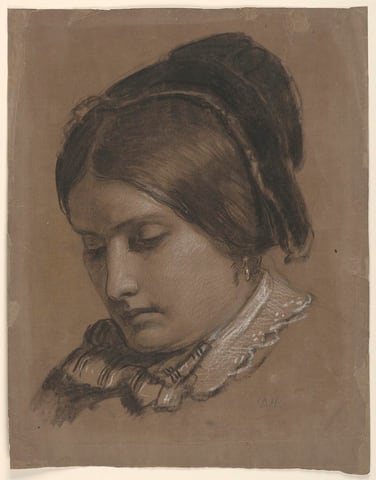
THE ARTIST'S WIFE SOPHIE
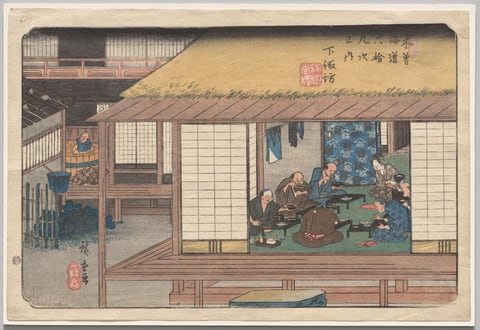
Shimosuwa, from Sixty-Nine Stations of the Kisokaidō, by Utagawa Hiroshige, 1835–38
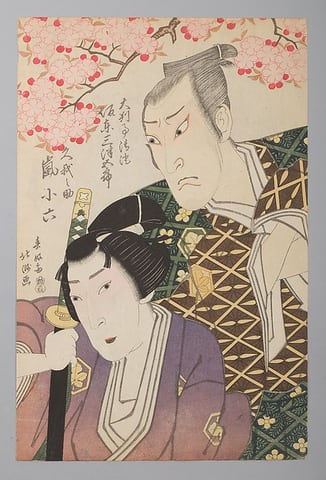
Bandō Mitsugorō III as Daihanji Kiyozumi and Arashi Koroku IV as Koganosuke, by Shunkōsai Hokushū, 1821
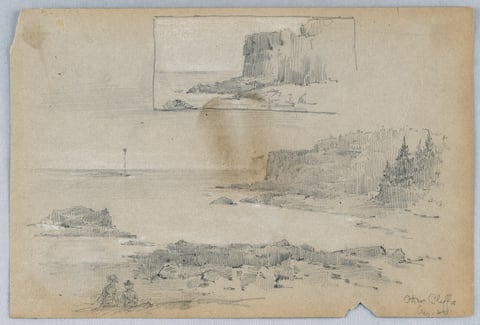
OTTER CLIFFS
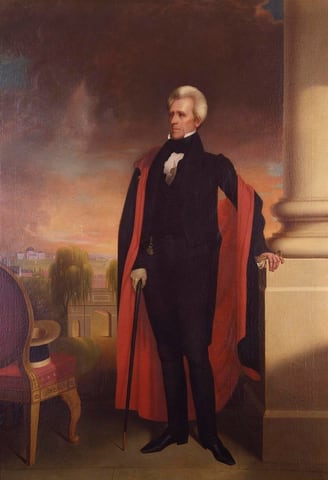
Andrew Jackson, by Ralph Eleaser Whiteside Earl, 1836-1837

The works in this room are listed below.

Works in this room

Works made in the 19th century, anywhere in the world.

Section 1, north wall

  1. Postal Hōchi Newspaper no. 645, Englishman raping a wine shopkeeper's daughter (Yūbin Hōchi shinbun, roppyaku yonjū gogō), by Tsukioka Yoshitoshi, August, 1875
    Postal Hōchi Newspaper no. 645, Englishman raping a wine shopkeeper's daughter (Yūbin Hōchi shinbun, roppyaku yonjū gogō)Tsukioka Yoshitoshi, August, 1875Courtesy of The Metropolitan Museum of Art
  2. Armies of men march and battle along a rocky outcropping set among huge rock formations and massive buildings under a stormy sky in this horizontal landscape painting. The people we can see all have pale skin. Sheets of rain fall from flint-gray clouds on our left into a valley, though hints of peach brighten the clouds along the mountainous horizon there. In the right half of the sky, light pours down from a brilliant white sun that breaks through white clouds to reveal topaz-blue patches of sky. The horizon comes about halfway up the composition and is lined with rugged white, pale pink, and olive-green mountains on our left and silvery-white buildings along the right half. These structures include two domed buildings and a colosseum among many others. The buildings are all enclosed within city walls buttressed with towers. The land dips precipitously from the rocky cliffs supporting the buildings, to sweep down toward us. A huge outcropping angles up like a ramp between us and the buildings in the distance. A road runs from the walled town toward us, down along the ridge and in front of the outcropping. Countless warriors march in rows of four or five across on the road past a man wearing a feathered helmet and armored breastplate. This man, Joshua, stands on a rocky precipice facing away from us with his right hand raised. He wears a scarlet-red toga under his breastplate, and a royal-blue cape flutters at his left side. He holds a round, copper-colored shield and a spear in his other hand. Two men with gray beards stand near Joshua with their backs to us. Both gesture up to the sky. One holds a slender staff and the other a curling horn. They and another pair of men, who stoop to hold poles used to carry a chest, all wear long, ivory-white robes, cherry-red drapery, and white turbans. The column of soldiers on foot and horseback pass in front of Joshua to a massive battlefield to our left. The fight takes place in a valley that leads back to a river. A bolt of lightning zigzags from the storm clouds and strikes a city in the deep distance. The artist signed the painting in the lower right, “J. Martin.”
    Joshua Commanding the Sun to Stand Still upon GibeonJohn Martin, 1816Courtesy National Gallery of Art, Washington
  3. THE ARTIST'S WIFE SOPHIE
    The Artist's Wife SophieDaniel Huntington, 1853Courtesy of Cooper Hewitt, Smithsonian Design Museum

Section 1, south wall

  1. Shimosuwa, from Sixty-Nine Stations of the Kisokaidō, by Utagawa Hiroshige, 1835–38
    Shimosuwa, from Sixty-Nine Stations of the KisokaidōUtagawa Hiroshige, 1835–38Courtesy of the Cleveland Museum of Art
  2. Bandō Mitsugorō III as Daihanji Kiyozumi and Arashi Koroku IV as Koganosuke, by Shunkōsai Hokushū, 1821
    Bandō Mitsugorō III as Daihanji Kiyozumi and Arashi Koroku IV as KoganosukeShunkōsai Hokushū, 1821Courtesy of The Metropolitan Museum of Art
  3. OTTER CLIFFS
    Otter CliffsArnold William Brunner, 1879–80Courtesy of Cooper Hewitt, Smithsonian Design Museum
  4. Andrew Jackson, by Ralph Eleaser Whiteside Earl, 1836-1837
    Andrew JacksonRalph Eleaser Whiteside Earl, 1836-1837Courtesy of the Smithsonian American Art Museum

Section 2, south wall
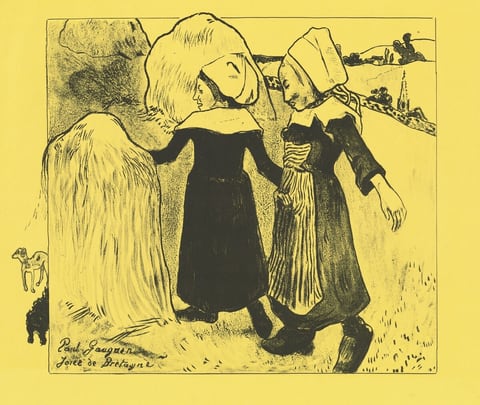
  1. The image shows two women walking arm in arm, both in traditional attire. One woman is facing away with a slight profile, while the other is seen from the side. Their faces are stylized and simplistic with covered hair. They wear long dresses with aprons and collars, and one has a striped apron. Haystacks and greenery surround them. Faint figures are in the background, as well as a spire-like structure. A dog is seen near the haystack, with simple lines suggesting a landscape.
    Pleasures of Brittany (Joies de Bretagne)Paul Gauguin, 1889Courtesy National Gallery of Art, Washington
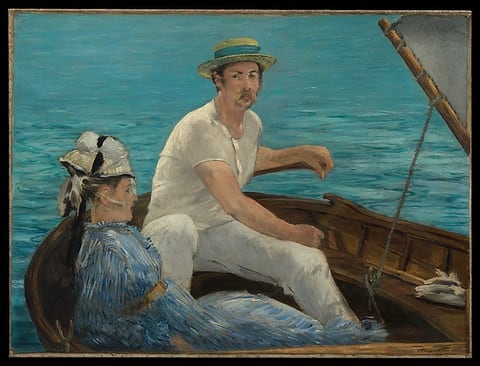
  2. Boating, by Édouard Manet, 1874
    BoatingÉdouard Manet, 1874Courtesy of The Metropolitan Museum of Art
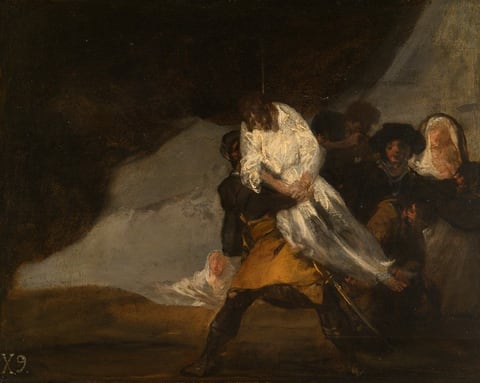
  3. A work made of oil on panel.
    The Hanged MonkFrancisco Goya, c. 1810Courtesy of the Art Institute of Chicago
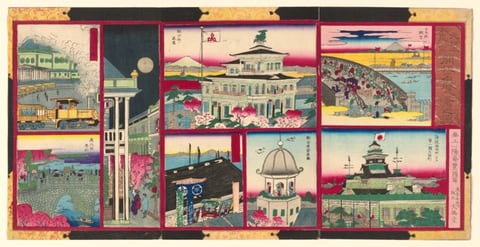
  4. A work made of color woodblock print; oban triptych.
    Eight Modern Views of Famous Places in Tokyo of Great Japan (Dai Nippon Tokyo kaika meisho hakkei no zu)Utagawa Kunisada II (Kunimasa III, Toyokuni IV), 1875Courtesy of the Art Institute of Chicago

Section 2, north wall
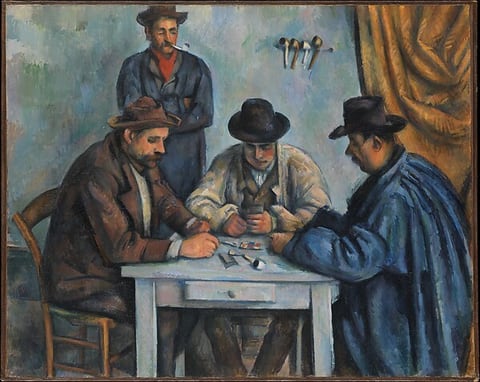
  1. The Card Players, by Paul Cézanne, 1890–92
    The Card PlayersPaul Cézanne, 1890–92Courtesy of The Metropolitan Museum of Art
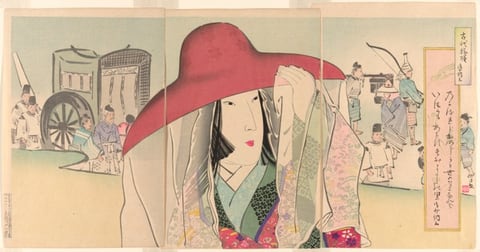
  2. A work made of color woodblock print, oban triptych.
    Sei Shonagon, from the series Ancient Patterns (Kodai moyo)Kobayashi Kiyochika, Meiji period (1896–1912), 1896Courtesy of the Art Institute of Chicago
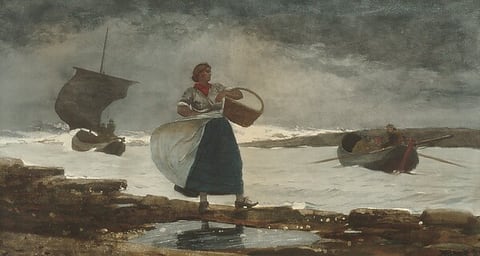
  3. Inside the Bar, by Winslow Homer, 1883
    Inside the BarWinslow Homer, 1883Courtesy of The Metropolitan Museum of Art

Section 3, north wall
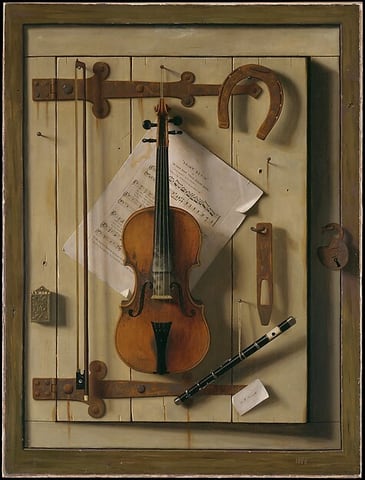
  1. Still Life—Violin and Music, by William Michael Harnett, 1888
    Still Life—Violin and MusicWilliam Michael Harnett, 1888Courtesy of The Metropolitan Museum of Art
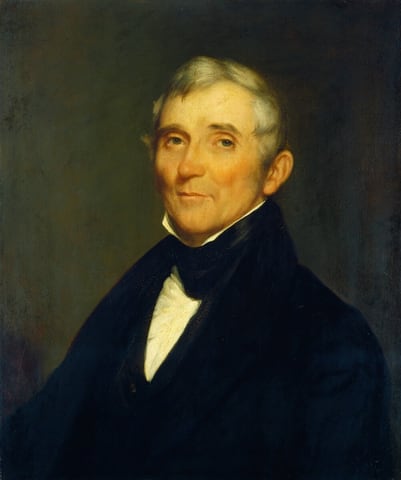
  2. The image is a portrait painting showing a man's upper body. He is positioned slightly turned to his right, with his head facing the viewer. The man has fair skin, defined cheekbones, and small, bright eyes. His hair is short, neatly combed, and grey or white. He is wearing a dark coat over a white shirt with a high collar, partially visible. The background is a muted, dark color, providing a simple setting that emphasizes the subject. There are no visible jewelry or objects in the image.
    Aaron BaldwinFrancis Alexander, c. 1835Courtesy National Gallery of Art, Washington