Floor plan

Time and placeThe 19th century

The 19th century

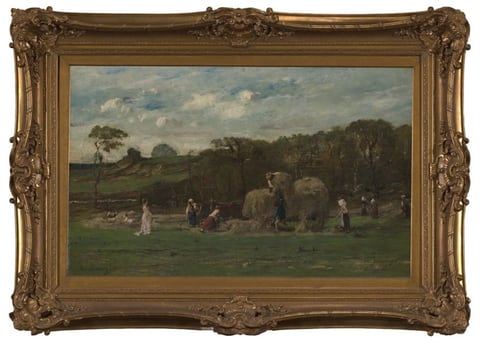
A work made of oil on canvas.
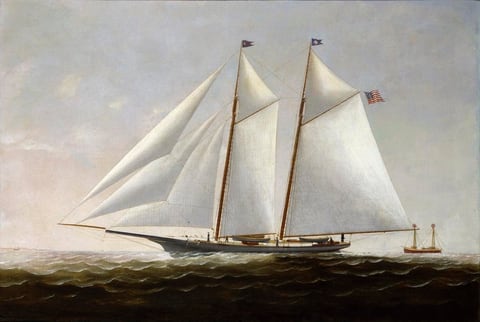
The Yacht America, by Charles S. Raleigh, 1877
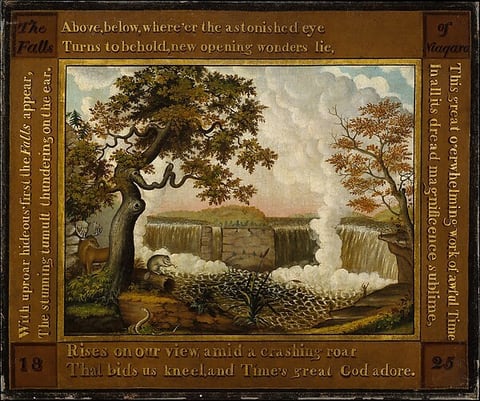
The Falls of Niagara, by Edward Hicks, ca. 1825
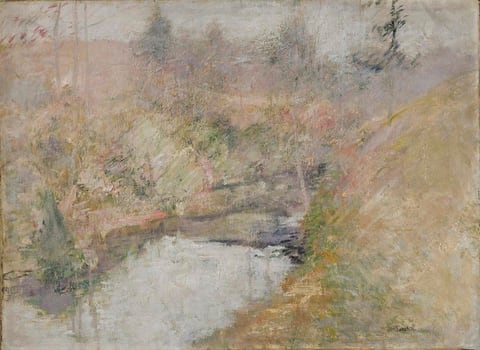
Hemlock Pool, by John Henry Twachtman, ca. 1890-1900
A work made of oil on canvas.
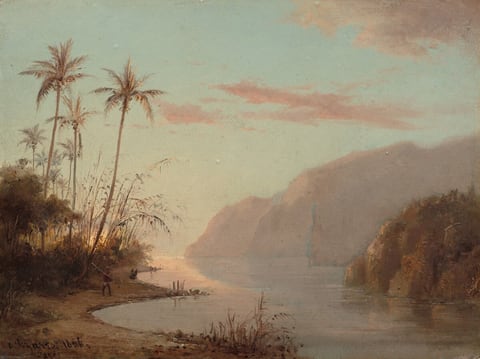
A wide creek winds between a tree-lined bank to our left and hazy mountains to our right in this horizontal landscape painting. The riverbank curves deeply like a backward capital letter B. Marshy grasses grow in tufts, and palm and other trees grow in a grove to our left. One brown-skinned person wearing only a white cloth around the hips carries a long stick near the shoreline. Dabs of brown and muted dark pink suggest other people farther along the riverside. Tree-covered boulders jut into the creek from our right. A band of rocky, mountains are smoky mauve-pink across the rightmost two-thirds of the horizon, which comes a third of the way up the composition. The butter-yellow sun is low on the horizon to our right, peeking through the grove of palm trees. The light pours across the placid surface of the creek, creating a soft yellow streak next to the reflection of the mountain ridge. A few heather-pink clouds drift across the pale turquoise sky. The artist signed and dated the painting in the lower left corner, “C. Pizarro. 1856. Paris.”
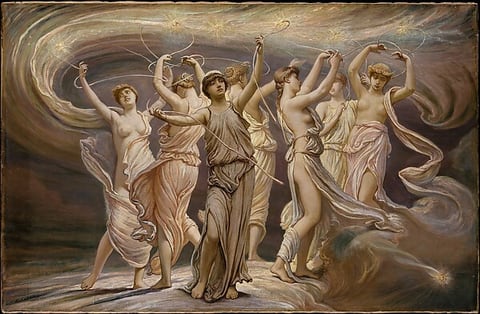
The Pleiades, by Elihu Vedder, 1885

The works in this room are listed below.

Works in this room

Works made in the 19th century, anywhere in the world.

Section 1, north wall

  1. A work made of oil on canvas.
    Loading HayMihály Munkácsy, c. 1886-87Courtesy of the Art Institute of Chicago
  2. The Yacht America, by Charles S. Raleigh, 1877
    The Yacht AmericaCharles S. Raleigh, 1877Courtesy of the Smithsonian American Art Museum
  3. The Falls of Niagara, by Edward Hicks, ca. 1825
    The Falls of NiagaraEdward Hicks, ca. 1825Courtesy of The Metropolitan Museum of Art

Section 1, south wall

  1. Hemlock Pool, by John Henry Twachtman, ca. 1890-1900
    Hemlock PoolJohn Henry Twachtman, ca. 1890-1900Courtesy of the Smithsonian American Art Museum
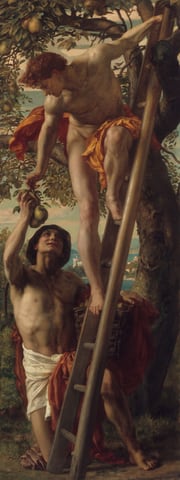
  2. A work made of oil on canvas.
    The Golden AgeSir John Edward Poynter, 1875Courtesy of the Art Institute of Chicago
  3. A wide creek winds between a tree-lined bank to our left and hazy mountains to our right in this horizontal landscape painting. The riverbank curves deeply like a backward capital letter B. Marshy grasses grow in tufts, and palm and other trees grow in a grove to our left. One brown-skinned person wearing only a white cloth around the hips carries a long stick near the shoreline. Dabs of brown and muted dark pink suggest other people farther along the riverside. Tree-covered boulders jut into the creek from our right. A band of rocky, mountains are smoky mauve-pink across the rightmost two-thirds of the horizon, which comes a third of the way up the composition. The butter-yellow sun is low on the horizon to our right, peeking through the grove of palm trees. The light pours across the placid surface of the creek, creating a soft yellow streak next to the reflection of the mountain ridge. A few heather-pink clouds drift across the pale turquoise sky. The artist signed and dated the painting in the lower left corner, “C. Pizarro. 1856. Paris.”
    A Creek in St. Thomas (Virgin Islands)Camille Pissarro, 1856Courtesy National Gallery of Art, Washington
  4. The Pleiades, by Elihu Vedder, 1885
    The PleiadesElihu Vedder, 1885Courtesy of The Metropolitan Museum of Art

Section 2, south wall
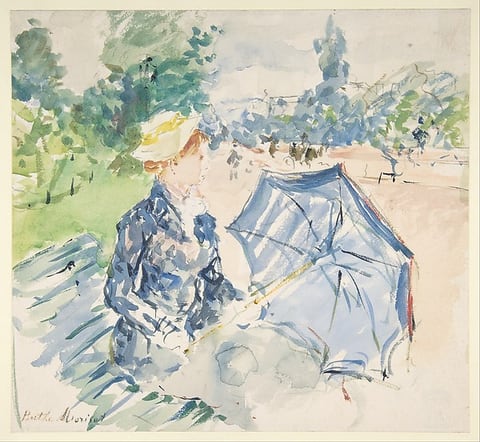
  1. A Woman Seated at a Bench on the Avenue du Bois, by Berthe Morisot, 1885
    A Woman Seated at a Bench on the Avenue du BoisBerthe Morisot, 1885Courtesy of The Metropolitan Museum of Art
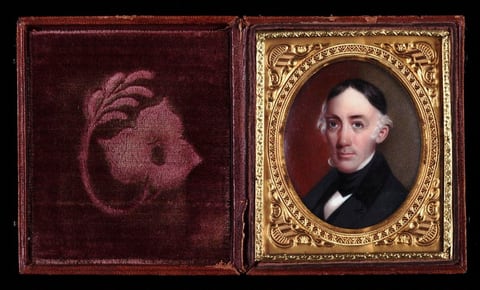
  2. Robert Edwards Carter, by Sarah C. Frothingham, ca. 1840
    Robert Edwards CarterSarah C. Frothingham, ca. 1840Courtesy of the Smithsonian American Art Museum
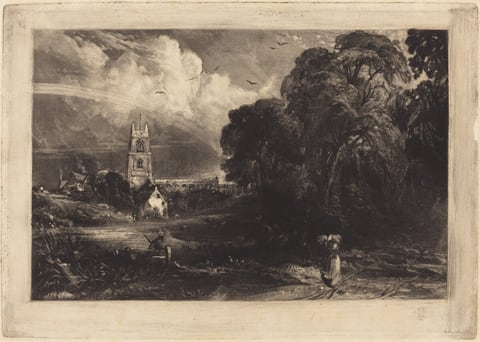
  3. The image displays a landscape with a high vantage point. The horizon is low, with a row of trees. A church tower is off-center to the left. The church is surrounded by trees and buildings. A line of trees is on the right side. The sky has large, expressive clouds. A monochromatic palette of gray is used. A path winds through the scene, with two figures: one person working and another walking.
    Stoke-by-NeylandDavid Lucas, 1830Courtesy National Gallery of Art, Washington
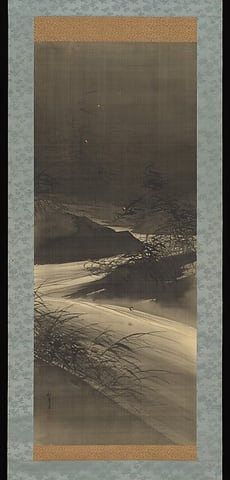
  4. Fireflies Over the Uji River by Moonlight, by Suzuki Shōnen
    Fireflies Over the Uji River by MoonlightSuzuki ShōnenCourtesy of The Metropolitan Museum of Art

Section 2, north wall
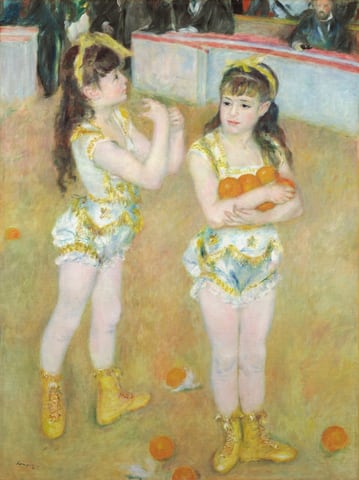
  1. Two girls in acrobatic uniforms stand in an arena, one holds oranges.
    Acrobats at the Cirque Fernando (Francisca and Angelina Wartenberg)Pierre-Auguste Renoir, 1879Courtesy of the Art Institute of Chicago
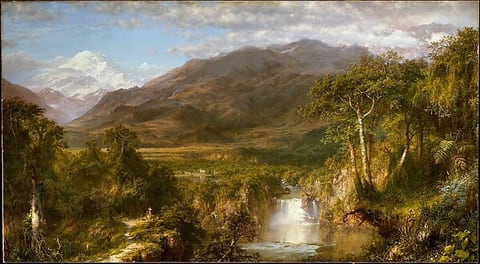
  2. Heart of the Andes, by Frederic Edwin Church, 1859
    Heart of the AndesFrederic Edwin Church, 1859Courtesy of The Metropolitan Museum of Art

Section 3, north wall
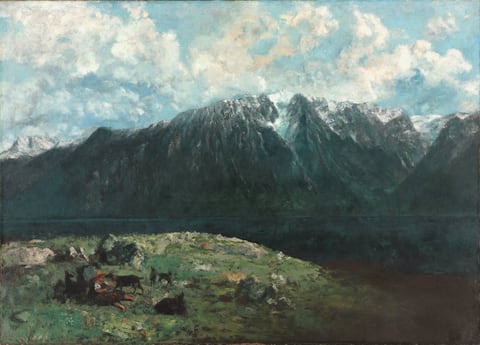
  1. Panoramic View of the Alps, Les Dents du Midi, by Gustave Courbet, 1877
    Panoramic View of the Alps, Les Dents du MidiGustave Courbet, 1877Courtesy of the Cleveland Museum of Art
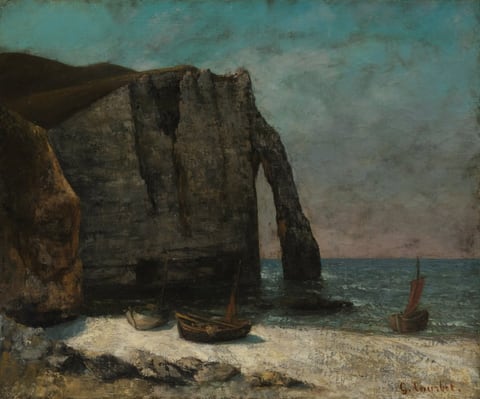
  2. The Cliff at Étretat, by Gustave Courbet, after 1872
    The Cliff at ÉtretatGustave Courbet, after 1872Courtesy of the Cleveland Museum of Art
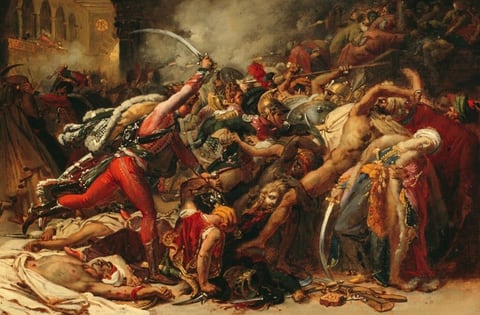
  3. A work made of oil and ink on paper, laid down on canvas.
    Sketch for The Revolt of CairoAnne-Louis Girodet de Roussy-Trioson, c. 1810Courtesy of the Art Institute of Chicago