Floor plan

Time and placeThe 19th century

The 19th century

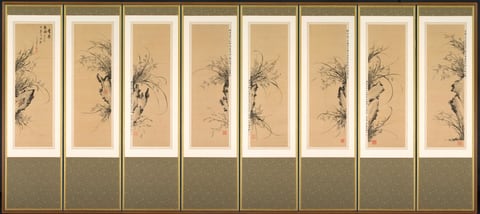
Orchids and Rocks, by Yi Ha-eung, 1897–98
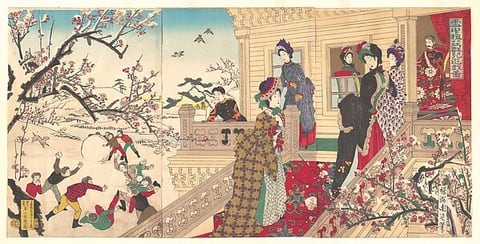
Children Playing in the Snow under Plum Trees in Bloom (Secchū baisō gunji yūgi zu), by Yōshū (Hashimoto) Chikanobu, November 1887
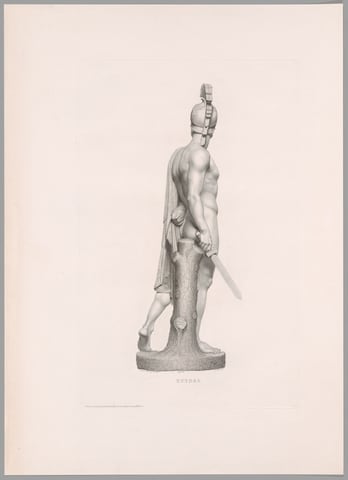
A work made of engraving and etching in black on ivory wove paper.
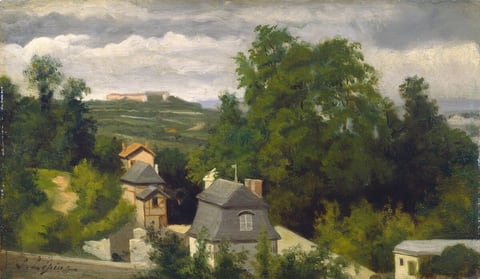
The painting shows an elevated perspective overlooking a landscape with green hills and leafy trees. Closest to us, there are cream-colored buildings among dense foliage. These buildings have roofs in shades of pale blue-gray and reddish-brown, and the one in the center has wispy white smoke coming out of a chimney. In the distance on the left, a large, low structure sits atop a hill, with faint paths winding towards it through the green landscape. Beyond the trees, the distant landscape on the right is painted in shades of pale blue and green. The sky above is filled with puffy clouds in shades of gray.
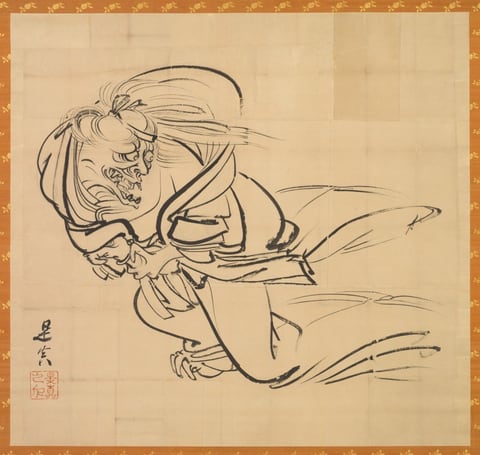
Sketch of Ibaraki-dōji, by Shibata Zeshin, c. 1840
A work made of oil on canvas.

The works in this room are listed below.

Works in this room

Works made in the 19th century, anywhere in the world.

Section 1, north wall

  1. Orchids and Rocks, by Yi Ha-eung, 1897–98
    Orchids and RocksYi Ha-eung, 1897–98Courtesy of the Cleveland Museum of Art
  2. Children Playing in the Snow under Plum Trees in Bloom (Secchū baisō gunji yūgi zu), by Yōshū (Hashimoto) Chikanobu, November 1887
    Children Playing in the Snow under Plum Trees in Bloom (Secchū baisō gunji yūgi zu)Yōshū (Hashimoto) Chikanobu, November 1887Courtesy of The Metropolitan Museum of Art
  3. A work made of engraving and etching in black on ivory wove paper.
    Ettore, Side View, from Oeuvre de CanovaAntonio Canova, 1817Courtesy of the Art Institute of Chicago

Section 1, south wall

  1. The painting shows an elevated perspective overlooking a landscape with green hills and leafy trees. Closest to us, there are cream-colored buildings among dense foliage. These buildings have roofs in shades of pale blue-gray and reddish-brown, and the one in the center has wispy white smoke coming out of a chimney. In the distance on the left, a large, low structure sits atop a hill, with faint paths winding towards it through the green landscape. Beyond the trees, the distant landscape on the right is painted in shades of pale blue and green. The sky above is filled with puffy clouds in shades of gray.
    View on the Outskirts of CaenStanislas Lépine, 1872/1875Courtesy National Gallery of Art, Washington
  2. Sketch of Ibaraki-dōji, by Shibata Zeshin, c. 1840
    Sketch of Ibaraki-dōjiShibata Zeshin, c. 1840Courtesy of the Cleveland Museum of Art
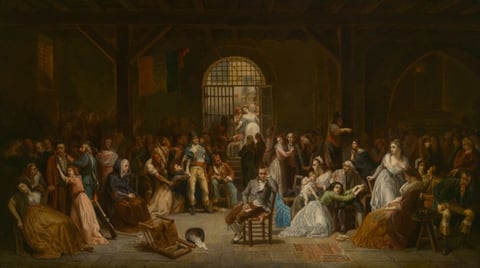
  3. A work made of oil on canvas.
    The Roll Call of the Last Victims of the TerrorCharles Louis-Lucien Muller, c. 1850Courtesy of the Art Institute of Chicago

Section 2, south wall
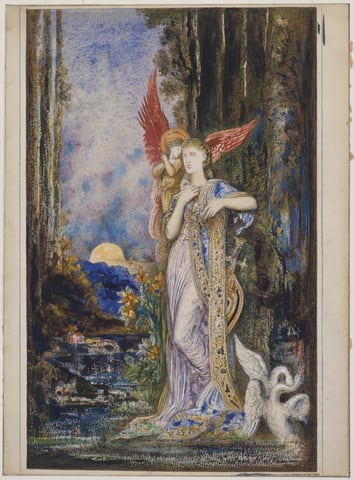
  1. A work made of watercolor and gouache, with pen and blue ink, over traces of graphite, on ivory wove paper, wrapped and adhered on verso to wood pulp board.
    InspirationGustave Moreau, c. 1893Courtesy of the Art Institute of Chicago
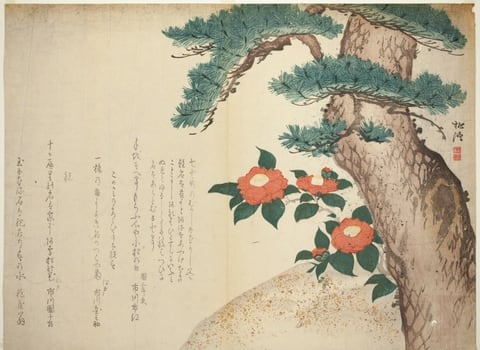
  2. A work made of color woodblock print; surimono.
    A Pine Tree and CamelliasNiwa Tokei, 1840Courtesy of the Art Institute of Chicago
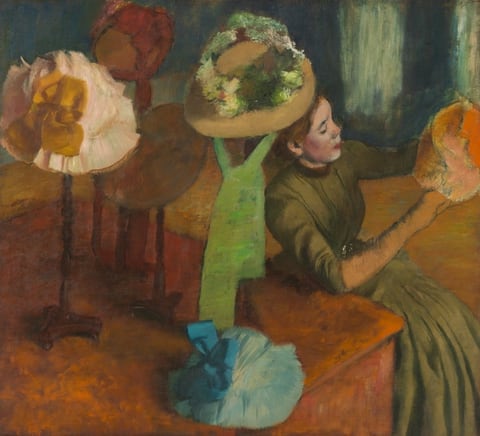
  3. Impressionist painting of woman wearing green dress trying on hats.
    The Millinery ShopEdgar Degas, 1879-86Courtesy of the Art Institute of Chicago
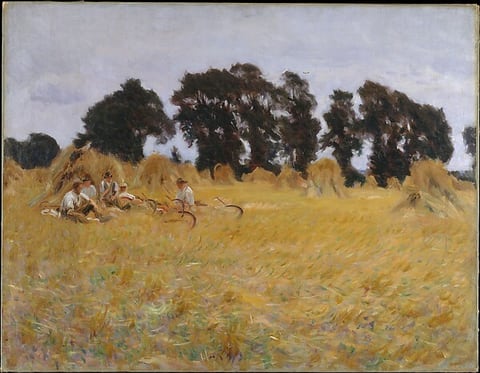
  4. Reapers Resting in a Wheat Field, by John Singer Sargent, 1885
    Reapers Resting in a Wheat FieldJohn Singer Sargent, 1885Courtesy of The Metropolitan Museum of Art

Section 2, north wall
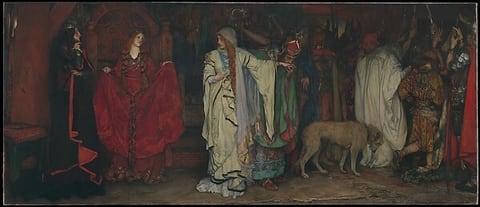
  1. "King Lear," Act I, Scene I, by Edwin Austin Abbey, 1898
    "King Lear," Act I, Scene IEdwin Austin Abbey, 1898Courtesy of The Metropolitan Museum of Art
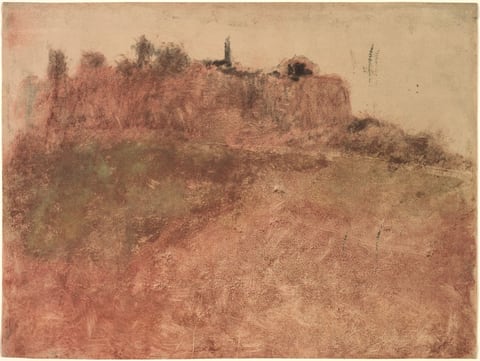
  2. Estérel Village, by Edgar Degas, c. 1890
    Estérel VillageEdgar Degas, c. 1890Courtesy of the Cleveland Museum of Art

Section 3, north wall
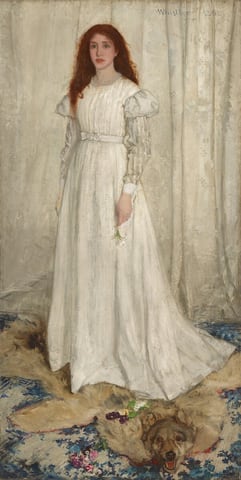
  1. A young woman with pale, peachy skin, wearing a long, flowing white dress, stands in front of a white curtain in this vertical portrait painting. Her auburn-red hair cascades down over and behind her shoulders. She looks to our left with green eyes, and her pink, full lips are closed. Her dress has puffed shoulders above a white-on-white striped pattern on the long sleeves. She stands on an animal pelt; it is not clear whether it is a wolf or a bear. The pelt spans the width of the painting and overlaps a blue patterned carpet. The animal’s mouth gapes to show sharp teeth. Its glassy eyes are wide open, and it seems to look at us. The edges of the animal skin are red. The woman holds a white lily by her side in her left hand, while yellow and purple flowers lie scattered on the pelt.
    Symphony in White, No. 1: The White GirlJames McNeill Whistler, 1861-1863, 1872Courtesy National Gallery of Art, Washington
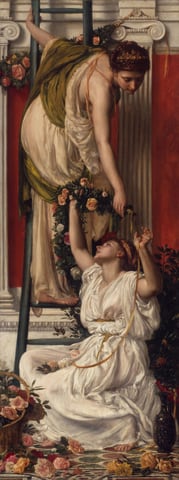
  2. A work made of oil on canvas.
    The FestivalSir John Edward Poynter, 1875Courtesy of the Art Institute of Chicago
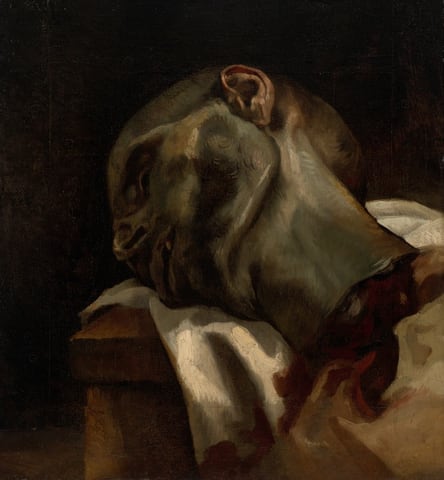
  3. A work made of oil on panel.
    Head of a Guillotined ManJean Louis André Théodore Géricault, 1818–19Courtesy of the Art Institute of Chicago
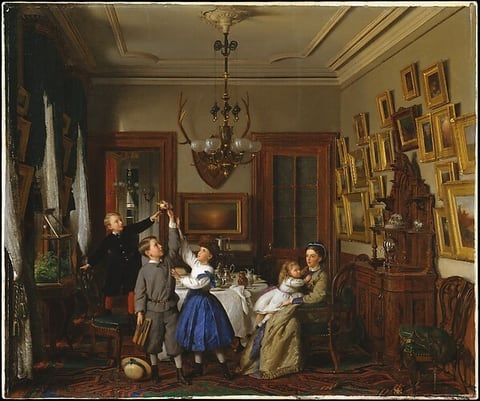
  4. The Contest for the Bouquet: The Family of Robert Gordon in Their New York Dining-Room, by Seymour Joseph Guy, 1866
    The Contest for the Bouquet: The Family of Robert Gordon in Their New York Dining-RoomSeymour Joseph Guy, 1866Courtesy of The Metropolitan Museum of Art