Floor plan

Time and place19th-century France

19th-century France

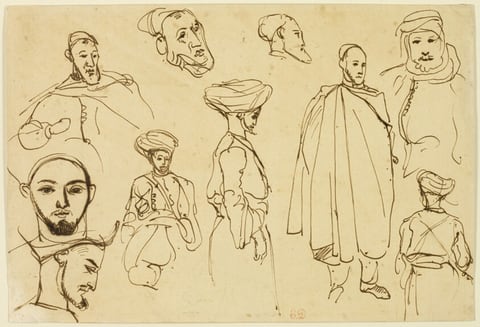
A work made of pen and brown ink, with traces of graphite, on tan wove paper, laid down on cream wove paper.
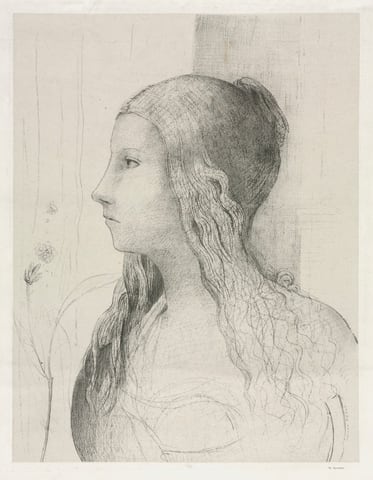
Brünnhilde in Twilight of the Gods, by Odilon Redon, 1894
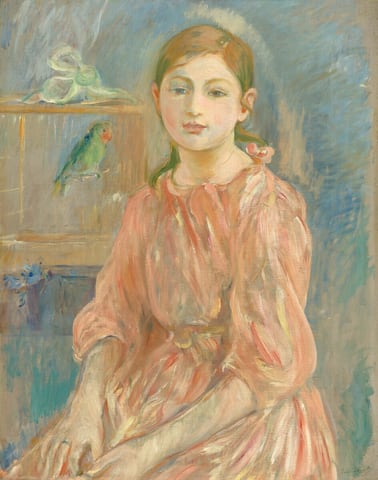
Shown from the knees up, a young girl with pale skin, wearing a coral-peach dress, sits facing and looking at us in this loosely painted, vertical portrait. Her knees are angled slightly to our left, and her hands rest in her lap. She has a round face and smooth, lightly flushed cheeks. She has brown eyes under arched brows, a delicate, snub nose, and her rose-pink lips are closed. Her hair, which is painted with broad strokes of caramel brown and moss green, is parted on one side and pulled smoothly back, presumably tied behind her head. Tendrils fall over her shoulders. Her dress is gathered around her neck and tied with a bow at the back. The loose sleeves fall to just below her elbows, and the dress is belted around the waist. A curving swipe of canary-yellow paint could be a buckle at the front. The fabric of the dress is painted with long, visible strokes of shell and rose pink, butter yellow, and ivory white, and a few touches of sage green and periwinkle blue for shadows. She wears a ring on the middle finger of her right hand. The space around her is loosely painted with strokes of electric and cobalt blue, with unpainted canvas visible at some of the edges. To our left, over the girl's shoulder, a wooden bird cage holds an emerald-green parakeet. The bird is streaked with royal blue along its back, and the area around its hooked beak is apple red. The cage has a mint-green bow and ribbon along the top. The artist signed the painting in green on the lower right corner: “Berthe Morisot.”
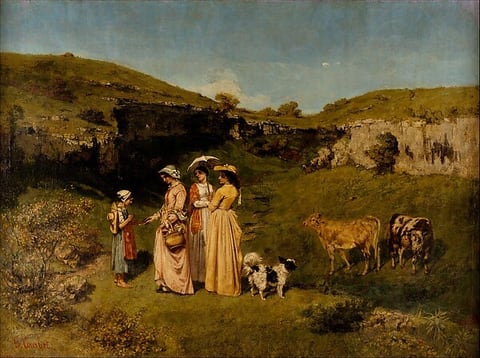
Young Ladies of the Village, by Gustave Courbet, 1851–52
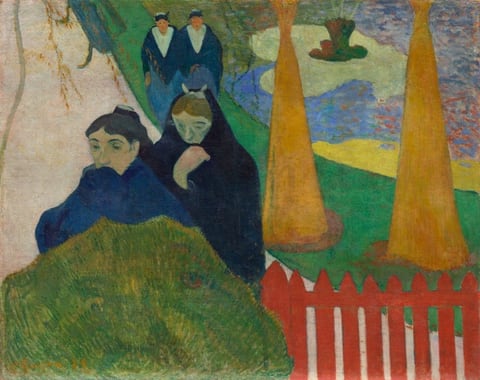
Painting of four women with blue shawls walking near red fence.

The works in this room are listed below.

Works in this room

Works made in France in the 19th century.

First room, north wall

  1. A work made of pen and brown ink, with traces of graphite, on tan wove paper, laid down on cream wove paper.
    Sketches of Algerian MenEugène Delacroix, c. 1832Courtesy of the Art Institute of Chicago
  2. Brünnhilde in Twilight of the Gods, by Odilon Redon, 1894
    Brünnhilde in Twilight of the GodsOdilon Redon, 1894Courtesy of the Cleveland Museum of Art
  3. Shown from the knees up, a young girl with pale skin, wearing a coral-peach dress, sits facing and looking at us in this loosely painted, vertical portrait. Her knees are angled slightly to our left, and her hands rest in her lap. She has a round face and smooth, lightly flushed cheeks. She has brown eyes under arched brows, a delicate, snub nose, and her rose-pink lips are closed. Her hair, which is painted with broad strokes of caramel brown and moss green, is parted on one side and pulled smoothly back, presumably tied behind her head. Tendrils fall over her shoulders. Her dress is gathered around her neck and tied with a bow at the back. The loose sleeves fall to just below her elbows, and the dress is belted around the waist. A curving swipe of canary-yellow paint could be a buckle at the front. The fabric of the dress is painted with long, visible strokes of shell and rose pink, butter yellow, and ivory white, and a few touches of sage green and periwinkle blue for shadows. She wears a ring on the middle finger of her right hand. The space around her is loosely painted with strokes of electric and cobalt blue, with unpainted canvas visible at some of the edges. To our left, over the girl's shoulder, a wooden bird cage holds an emerald-green parakeet. The bird is streaked with royal blue along its back, and the area around its hooked beak is apple red. The cage has a mint-green bow and ribbon along the top. The artist signed the painting in green on the lower right corner: “Berthe Morisot.”
    The Artist's Daughter with a ParakeetBerthe Morisot, 1890Courtesy National Gallery of Art, Washington

First room, south wall

  1. Young Ladies of the Village, by Gustave Courbet, 1851–52
    Young Ladies of the VillageGustave Courbet, 1851–52Courtesy of The Metropolitan Museum of Art
  2. Painting of four women with blue shawls walking near red fence.
    Arlésiennes (Mistral)Paul Gauguin, 1888Courtesy of the Art Institute of Chicago

Second room, south wall
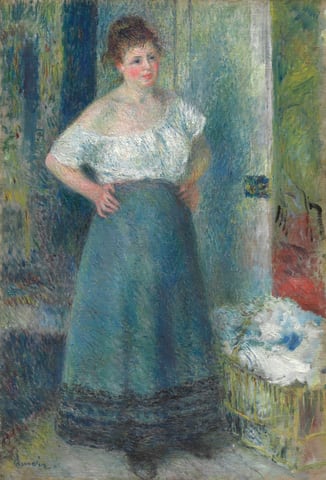
  1. A work made of oil on canvas.
    The LaundressPierre-Auguste Renoir, 1877–79Courtesy of the Art Institute of Chicago
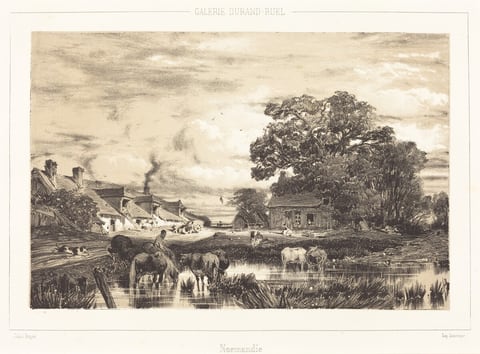
  2. This image shows a rural landscape with a pond in the foreground where cattle are being herded by a person on horseback. There are low buildings with smoking chimneys in the middle ground. Trees on the horizon separate the land from the sky, which is filled with clouds. The painting is detailed with a consistent brushwork, capturing foliage and buildings. The color palette is primarily sepia, giving a vintage and serene feel to the scene.
    View in Normandy (Vue prise en Normandie)Jules Dupré, 1835Courtesy National Gallery of Art, Washington
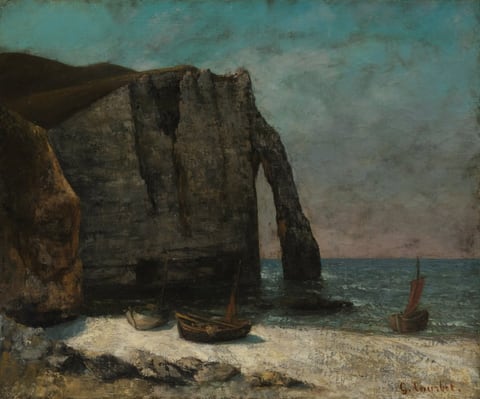
  3. The Cliff at Étretat, by Gustave Courbet, after 1872
    The Cliff at ÉtretatGustave Courbet, after 1872Courtesy of the Cleveland Museum of Art
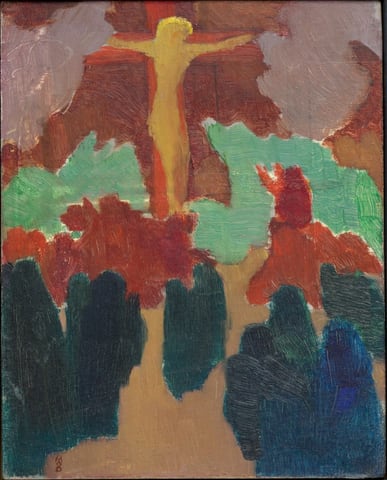
  4. The Orange Christ, by Maurice Denis, 1889
    The Orange ChristMaurice Denis, 1889Courtesy of the Cleveland Museum of Art

Second room, north wall
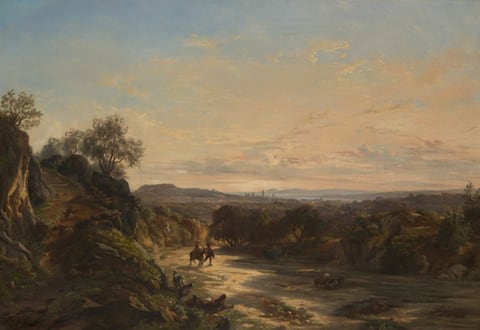
  1. A work made of oil on canvas.
    Sur la route de NicePaul Huet, c. 1844Courtesy of the Art Institute of Chicago
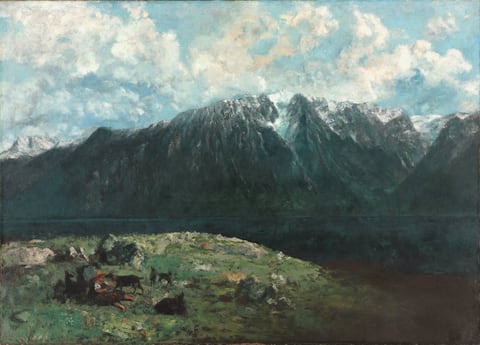
  2. Panoramic View of the Alps, Les Dents du Midi, by Gustave Courbet, 1877
    Panoramic View of the Alps, Les Dents du MidiGustave Courbet, 1877Courtesy of the Cleveland Museum of Art

Third room, north wall
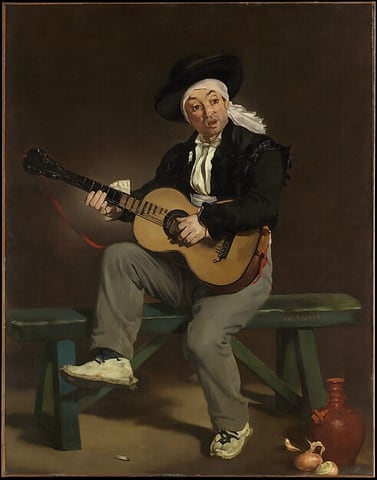
  1. The Spanish Singer, by Édouard Manet, 1860
    The Spanish SingerÉdouard Manet, 1860Courtesy of The Metropolitan Museum of Art
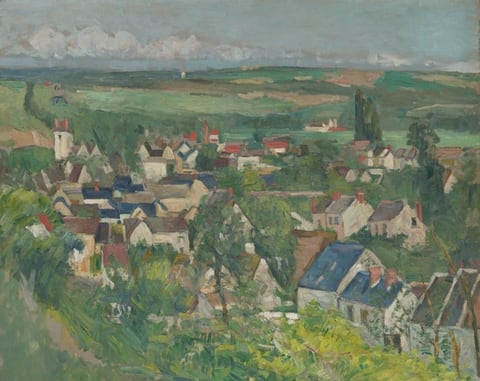
  2. View of a village surrounded by hills, fields, and trees, shown from a vantage point above the scene. Subtly rolling hills recede into a bluish gray-ish sky punctuated by white clouds. Thick brushstrokes built up atop each other are visible throughout.
    Auvers, Panoramic ViewPaul Cézanne, 1873–75Courtesy of the Art Institute of Chicago
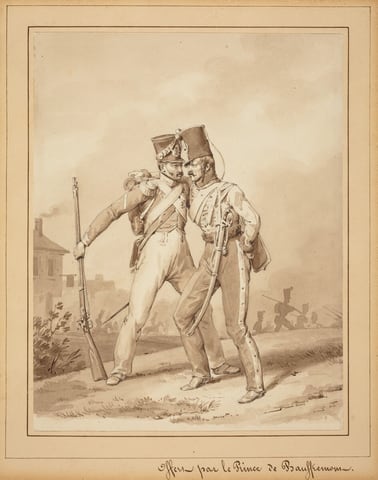
  3. The image features two men in military uniform engaging closely with each other. Both are shown from head to toe. The man on the left stands with his left leg forward, holding a rifle, and has his right arm around the shoulder of the other man. The man on the right has his right leg slightly bent, supporting his weight, and is holding a sword in his left hand. Each man has distinctive facial features. Both wear tall, elaborate military hats and detailed uniforms. The man on the left displays a strap over his shoulder, while the man on the right has intricate decorations on his jacket and trousers. In the background, there are a few more soldiers and part of a building to the left. The setting is monochromatic.
    Two GrenadiersVictor AdamCourtesy National Gallery of Art, Washington

Third room, south wall
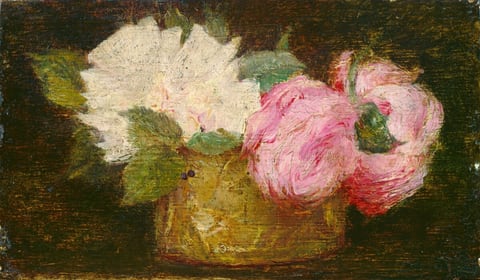
  1. Roses in a Vase, 1880/1900
    Roses in a VaseUnrecorded French maker, 1880/1900Courtesy National Gallery of Art, Washington
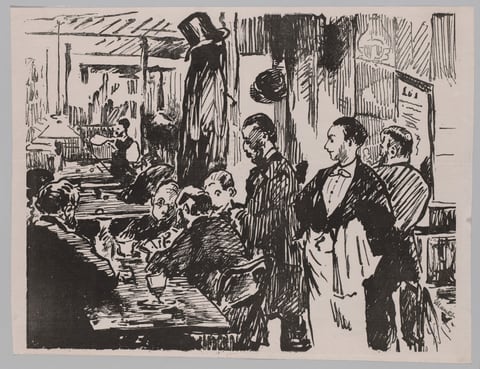
  2. At the Café, by Édouard Manet, 1874
    At the CaféÉdouard Manet, 1874Courtesy of the Cleveland Museum of Art