Floor plan

Time and place19th-century France

19th-century France

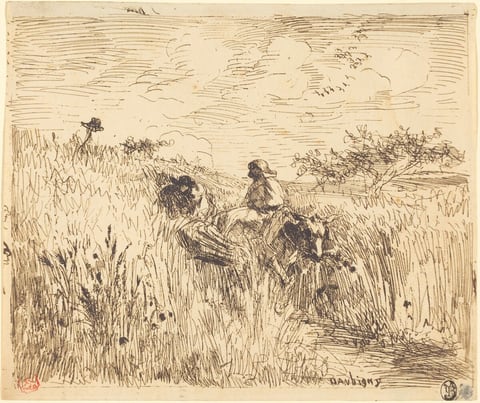
This image shows an elevated view of a grassy landscape with sparse trees and vegetation at the horizon. The linear brushstrokes create texture and movement in the grass and sky. The color palette is monochromatic with sepia tones. In the foreground, a figure is on a horse amidst tall grasses, while in the distance, another figure stands on the left and a cluster of trees is on the right. The sky has wisps of clouds.
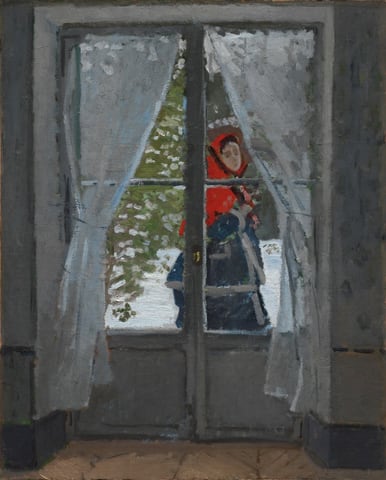
The Red Kerchief, by Claude Monet, c. 1868–73
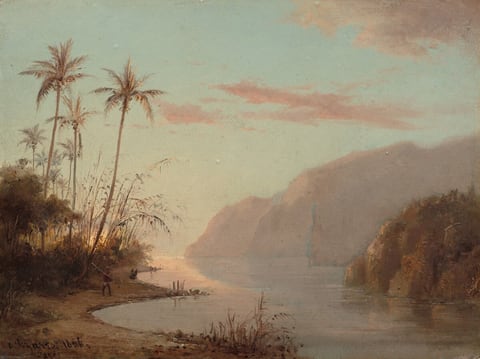
A wide creek winds between a tree-lined bank to our left and hazy mountains to our right in this horizontal landscape painting. The riverbank curves deeply like a backward capital letter B. Marshy grasses grow in tufts, and palm and other trees grow in a grove to our left. One brown-skinned person wearing only a white cloth around the hips carries a long stick near the shoreline. Dabs of brown and muted dark pink suggest other people farther along the riverside. Tree-covered boulders jut into the creek from our right. A band of rocky, mountains are smoky mauve-pink across the rightmost two-thirds of the horizon, which comes a third of the way up the composition. The butter-yellow sun is low on the horizon to our right, peeking through the grove of palm trees. The light pours across the placid surface of the creek, creating a soft yellow streak next to the reflection of the mountain ridge. A few heather-pink clouds drift across the pale turquoise sky. The artist signed and dated the painting in the lower left corner, “C. Pizarro. 1856. Paris.”
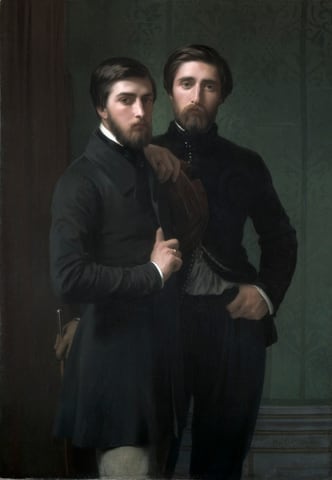
René-Charles Dassy and His Brother Jean-Baptiste-Claude-Amédé Dassy, by Hippolyte Jean Flandrin, 1850
A work made of oil on canvas.
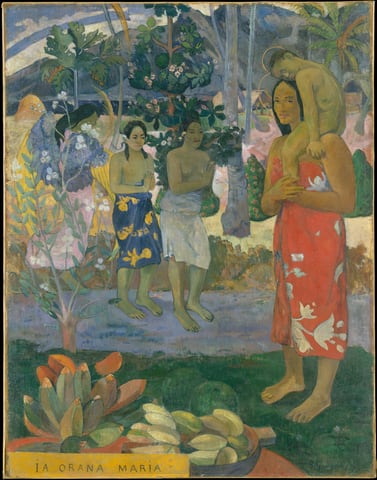
Ia Orana Maria (Hail Mary), by Paul Gauguin, 1891
A work made of oil on canvas.

The works in this room are listed below.

Works in this room

Works made in France in the 19th century.

Section 1, north wall

  1. This image shows an elevated view of a grassy landscape with sparse trees and vegetation at the horizon. The linear brushstrokes create texture and movement in the grass and sky. The color palette is monochromatic with sepia tones. In the foreground, a figure is on a horse amidst tall grasses, while in the distance, another figure stands on the left and a cluster of trees is on the right. The sky has wisps of clouds.
    Path through a Wheat Field (Sentier dans les bles)Charles-François Daubigny, 1862Courtesy National Gallery of Art, Washington
  2. The Red Kerchief, by Claude Monet, c. 1868–73
    The Red KerchiefClaude Monet, c. 1868–73Courtesy of the Cleveland Museum of Art
  3. A wide creek winds between a tree-lined bank to our left and hazy mountains to our right in this horizontal landscape painting. The riverbank curves deeply like a backward capital letter B. Marshy grasses grow in tufts, and palm and other trees grow in a grove to our left. One brown-skinned person wearing only a white cloth around the hips carries a long stick near the shoreline. Dabs of brown and muted dark pink suggest other people farther along the riverside. Tree-covered boulders jut into the creek from our right. A band of rocky, mountains are smoky mauve-pink across the rightmost two-thirds of the horizon, which comes a third of the way up the composition. The butter-yellow sun is low on the horizon to our right, peeking through the grove of palm trees. The light pours across the placid surface of the creek, creating a soft yellow streak next to the reflection of the mountain ridge. A few heather-pink clouds drift across the pale turquoise sky. The artist signed and dated the painting in the lower left corner, “C. Pizarro. 1856. Paris.”
    A Creek in St. Thomas (Virgin Islands)Camille Pissarro, 1856Courtesy National Gallery of Art, Washington
  4. René-Charles Dassy and His Brother Jean-Baptiste-Claude-Amédé Dassy, by Hippolyte Jean Flandrin, 1850
    René-Charles Dassy and His Brother Jean-Baptiste-Claude-Amédé DassyHippolyte Jean Flandrin, 1850Courtesy of the Cleveland Museum of Art

Section 1, south wall

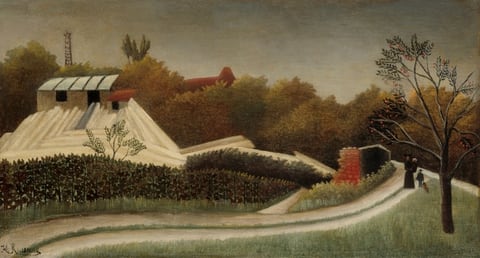
  1. A work made of oil on canvas.
    Sawmill, Outskirts of ParisHenri Rousseau, c. 1893/95Courtesy of the Art Institute of Chicago
  2. Ia Orana Maria (Hail Mary), by Paul Gauguin, 1891
    Ia Orana Maria (Hail Mary)Paul Gauguin, 1891Courtesy of The Metropolitan Museum of Art
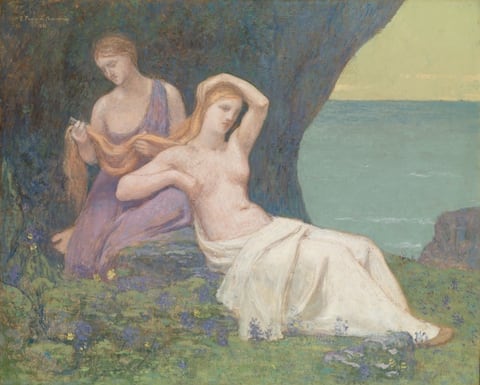
  3. A work made of oil on canvas.
    In the HeatherPierre Puvis de Chavannes, 1896Courtesy of the Art Institute of Chicago

Section 2, south wall
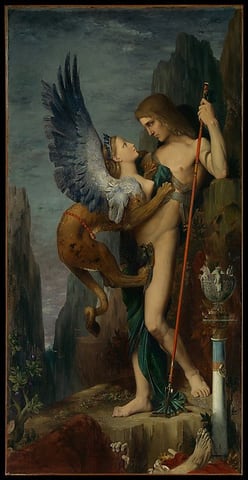
  1. Oedipus and the Sphinx, by Gustave Moreau, 1864
    Oedipus and the SphinxGustave Moreau, 1864Courtesy of The Metropolitan Museum of Art
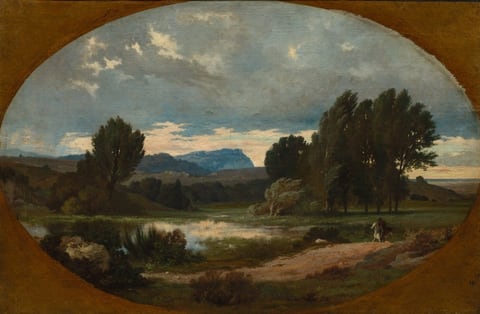
  2. Landscape with Rider on White Horse, by Jean Achille Benouville, 1846
    Landscape with Rider on White HorseJean Achille Benouville, 1846Courtesy of the Cleveland Museum of Art
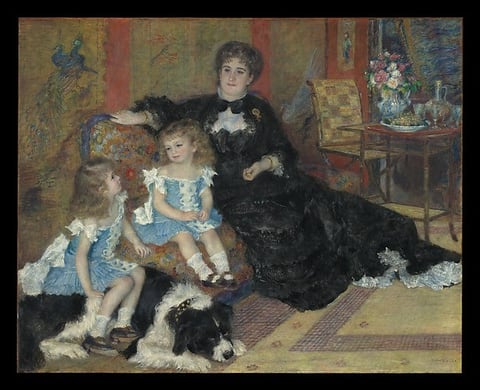
  3. Madame Georges Charpentier (Marguerite-Louise Lemonnier, 1848–1904) and Her Children, Georgette-Berthe (1872–1945) and Paul-Emile-Charles (1875–1895), by Pierre-Auguste Renoir, 1878
    Madame Georges Charpentier (Marguerite-Louise Lemonnier, 1848–1904) and Her Children, Georgette-Berthe (1872–1945) and Paul-Emile-Charles (1875–1895)Pierre-Auguste Renoir, 1878Courtesy of The Metropolitan Museum of Art

Section 2, north wall
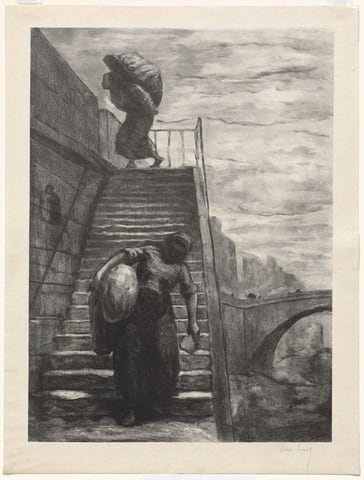
  1. Washerwomen Descending a Quai Staircase, by Alexandre Lunois, 1888
    Washerwomen Descending a Quai StaircaseAlexandre Lunois, 1888Courtesy of the Cleveland Museum of Art
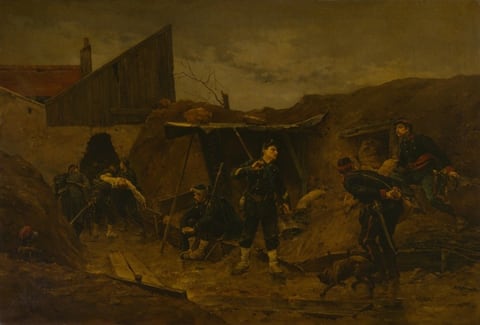
  2. A work made of oil on canvas.
    Dans la TranchéeEtienne Prosper Berne-Bellecour, c. 1875Courtesy of the Art Institute of Chicago
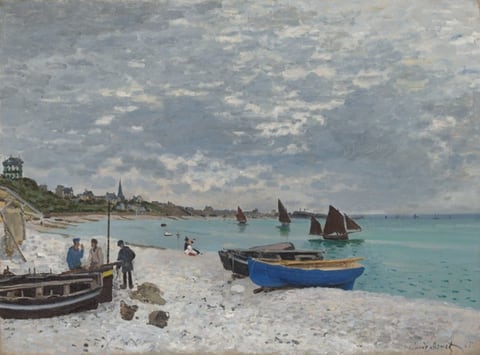
  3. Painting of a beach on a cloudy day with several sailboats on the water, a few rowboats on the shore, and two groupings of people on the sand.
    The Beach at Sainte-AdresseClaude Monet, 1867Courtesy of the Art Institute of Chicago

Section 3, north wall
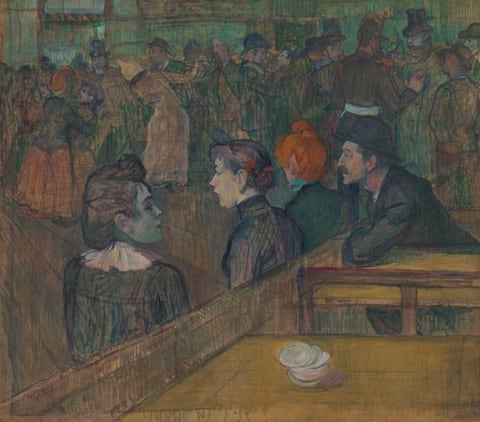
  1. A scene in brown and green tones of people dancing indoors. In the foreground, three women stand near boothed tables while a man sits.
    Moulin de la GaletteHenri de Toulouse-Lautrec, 1889Courtesy of the Art Institute of Chicago
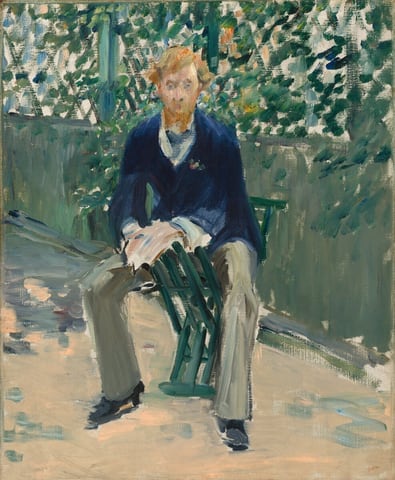
  2. A pale-skinned young man with a carrot-red beard and hair faces us, straddling a green chair in a sunny outdoor setting in this vertical painting. The scene is loosely painted so his features are indistinct. His eyes are painted as pale blue dots, and he looks out at us. His chair unfolds into an X shape, with interlacing slats to make the seat. He leans forward to rest his hands on one side of the chair, and his legs are spread wide. He wears a marine-blue jacket over a white shirt, sage-green trousers streaked with gray, and black shoes. A soft blue V-shape at the neck suggests a neckerchief. Behind him, a half wall is topped by a trellis. The wall is painted in muted tones of pale laurel green while the trellis is painted with crisscrossed strokes of pine green. Daubs of emerald, pine, and forest green suggest vines and leaves, and flicks of orange, gold, and blue could be flowers. The ground beneath the man is pale peach scattered with thin scribbles and patches of fog blue. The painting is inscribed with “E 72.” in the lower right.
    George Moore in the Artist's GardenÉdouard Manet, c. 1879Courtesy National Gallery of Art, Washington
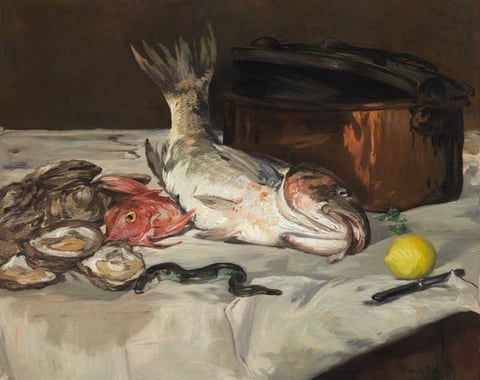
  3. Still-life painting, fish, open oysters, eel, lemon on tablecloth.
    Fish (Still Life)Édouard Manet, 1864Courtesy of the Art Institute of Chicago