Floor plan

Time and place19th-century France

19th-century France

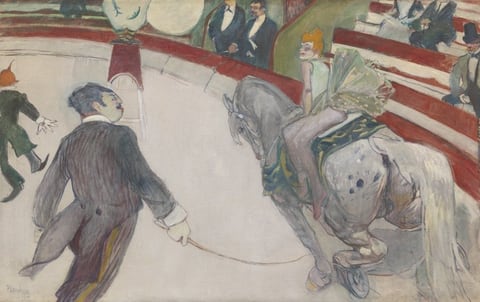
Painting of a performance inside a circus ring. A man wearing a suit holds a whip in his hand and looks towards a woman with red hair riding a gray horse and wearing a green dress. Audience members wearing suits and top hats watch from red and white benches on the side.
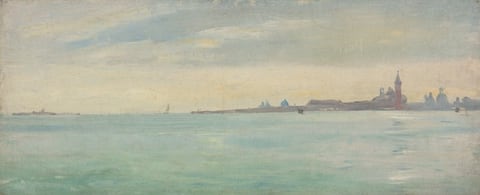
A work made of oil on paper, mounted on canvas.
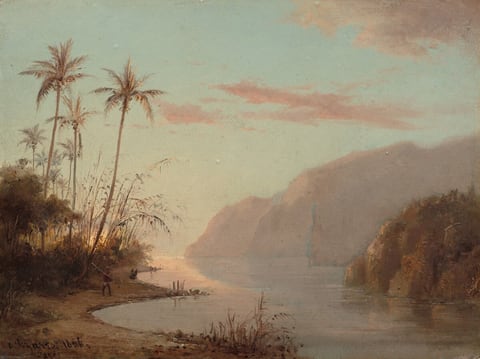
A wide creek winds between a tree-lined bank to our left and hazy mountains to our right in this horizontal landscape painting. The riverbank curves deeply like a backward capital letter B. Marshy grasses grow in tufts, and palm and other trees grow in a grove to our left. One brown-skinned person wearing only a white cloth around the hips carries a long stick near the shoreline. Dabs of brown and muted dark pink suggest other people farther along the riverside. Tree-covered boulders jut into the creek from our right. A band of rocky, mountains are smoky mauve-pink across the rightmost two-thirds of the horizon, which comes a third of the way up the composition. The butter-yellow sun is low on the horizon to our right, peeking through the grove of palm trees. The light pours across the placid surface of the creek, creating a soft yellow streak next to the reflection of the mountain ridge. A few heather-pink clouds drift across the pale turquoise sky. The artist signed and dated the painting in the lower left corner, “C. Pizarro. 1856. Paris.”
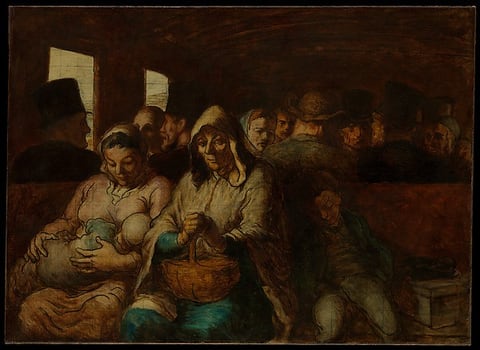
The Third-Class Carriage, by Honoré Daumier, 1864
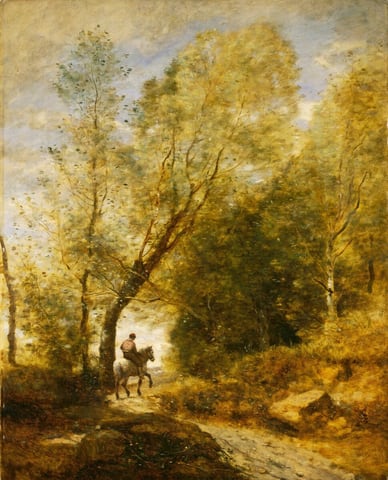
A person rides a horse away from us on a narrow dirt path curving through a forest dominated by golden yellow trees in this vertical landscape painting. A boulder about twice the width of the path is backlit where it sits just left of the lower center of the canvas. The path begins near the bottom right corner of the painting and curves back and to the right. The horse is white, and the rider wears dark brown pants and a hat, and a lighter brown shirt. Trees towering over the rider to either side of the curve nearly reach the top of the composition. The horizon comes less than a third of the way up the painting. Pearly white sky fills in the gap between the trees around the rider, and ivory-colored clouds frame an icy blue sky above. The scene is painted with textured and blended strokes, which gives the painting a soft look even though some of the brushstrokes are visible. The artist signed and dated the lower center of the canvas, though it is partially cut off: “COROT 1872.”
A work made of oil on canvas.

The works in this room are listed below.

Works in this room

Works made in France in the 19th century.

First room, north wall

  1. Painting of a performance inside a circus ring. A man wearing a suit holds a whip in his hand and looks towards a woman with red hair riding a gray horse and wearing a green dress. Audience members wearing suits and top hats watch from red and white benches on the side.
    Equestrienne (At the Cirque Fernando)Henri de Toulouse-Lautrec, 1887–88Courtesy of the Art Institute of Chicago
  2. A work made of oil on paper, mounted on canvas.
    Venice Seen from the Public GardenJean Jules Antoine Lecomte du Noüy, 1873Courtesy of the Art Institute of Chicago
  3. A wide creek winds between a tree-lined bank to our left and hazy mountains to our right in this horizontal landscape painting. The riverbank curves deeply like a backward capital letter B. Marshy grasses grow in tufts, and palm and other trees grow in a grove to our left. One brown-skinned person wearing only a white cloth around the hips carries a long stick near the shoreline. Dabs of brown and muted dark pink suggest other people farther along the riverside. Tree-covered boulders jut into the creek from our right. A band of rocky, mountains are smoky mauve-pink across the rightmost two-thirds of the horizon, which comes a third of the way up the composition. The butter-yellow sun is low on the horizon to our right, peeking through the grove of palm trees. The light pours across the placid surface of the creek, creating a soft yellow streak next to the reflection of the mountain ridge. A few heather-pink clouds drift across the pale turquoise sky. The artist signed and dated the painting in the lower left corner, “C. Pizarro. 1856. Paris.”
    A Creek in St. Thomas (Virgin Islands)Camille Pissarro, 1856Courtesy National Gallery of Art, Washington

First room, south wall

  1. The Third-Class Carriage, by Honoré Daumier, 1864
    The Third-Class CarriageHonoré Daumier, 1864Courtesy of The Metropolitan Museum of Art
  2. A person rides a horse away from us on a narrow dirt path curving through a forest dominated by golden yellow trees in this vertical landscape painting. A boulder about twice the width of the path is backlit where it sits just left of the lower center of the canvas. The path begins near the bottom right corner of the painting and curves back and to the right. The horse is white, and the rider wears dark brown pants and a hat, and a lighter brown shirt. Trees towering over the rider to either side of the curve nearly reach the top of the composition. The horizon comes less than a third of the way up the painting. Pearly white sky fills in the gap between the trees around the rider, and ivory-colored clouds frame an icy blue sky above. The scene is painted with textured and blended strokes, which gives the painting a soft look even though some of the brushstrokes are visible. The artist signed and dated the lower center of the canvas, though it is partially cut off: “COROT 1872.”
    The Forest of CoubronJean Baptiste Camille Corot, 1872Courtesy National Gallery of Art, Washington
  3. A work made of oil on canvas.
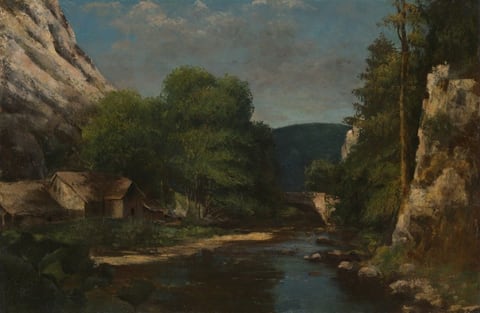
    LandscapeMarcel Ordinaire, 1867Courtesy of the Art Institute of Chicago

Second room, south wall
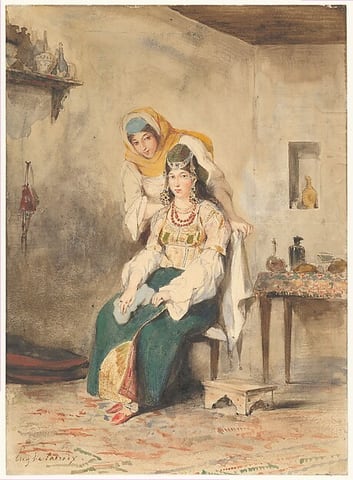
  1. Saada, the Wife of Abraham Ben-Chimol, and Préciada, One of Their Daughters, by Eugène Delacroix, 1832
    Saada, the Wife of Abraham Ben-Chimol, and Préciada, One of Their DaughtersEugène Delacroix, 1832Courtesy of The Metropolitan Museum of Art
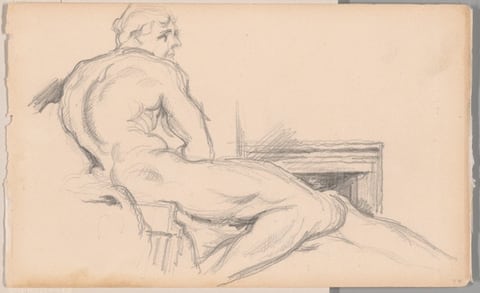
  2. A work made of graphite on ivory wove paper.
    Hercules RestingPaul Cézanne, 1897Courtesy of the Art Institute of Chicago
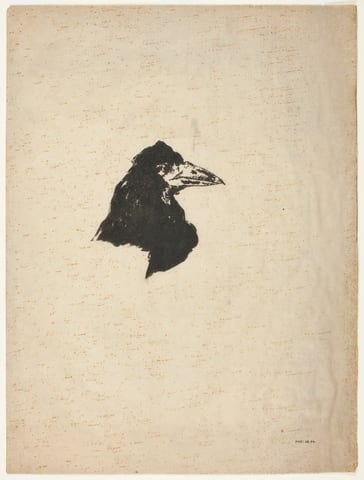
  3. A work made of transfer lithograph in black on tan simili-parchment paper.
    Head of a Raven in Profile, from The Raven (Le Corbeau)Édouard Manet, 1875Courtesy of the Art Institute of Chicago
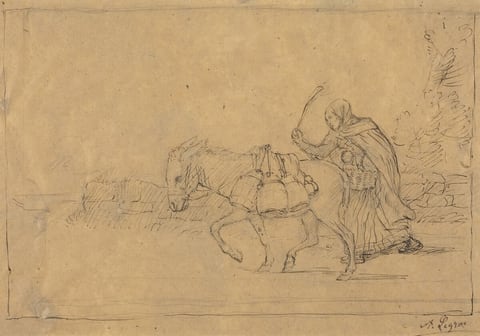
  4. This is a drawing of a person leading a donkey laden with goods. The image depicts a scene with a donkey walking to the left side while being guided by an individual dressed in layered clothing. The donkey is burdened with sacks or baskets that are strapped to its back. The lines and shading are subtle and detailed, capturing the texture of the clothing and fur. The figure and the donkey are positioned on a lightly sketched landscape with a few hints of foliage to the right, suggesting a rural setting. The drawing's simplicity and detail suggest a narrative moment, with a sense of movement and purpose conveyed through the lines.
    The Milkmaid of BoulogneAlphonse LegrosCourtesy National Gallery of Art, Washington

Second room, north wall
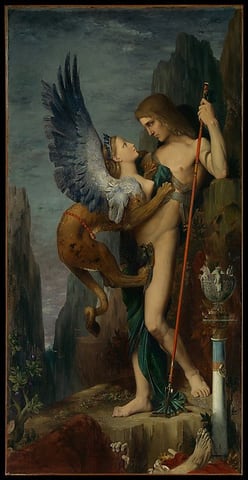
  1. Oedipus and the Sphinx, by Gustave Moreau, 1864
    Oedipus and the SphinxGustave Moreau, 1864Courtesy of The Metropolitan Museum of Art
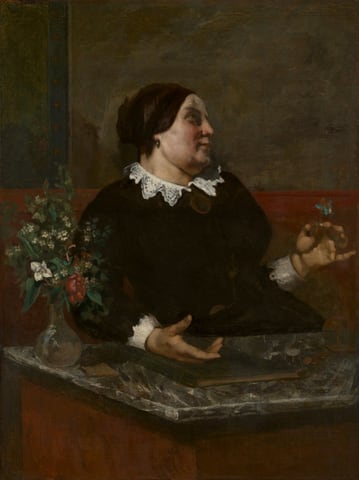
  2. Dark portrait of older woman in black dress with lace collar, flowers.
    Mère GrégoireGustave Courbet, 1855, reworked 1857–59Courtesy of the Art Institute of Chicago
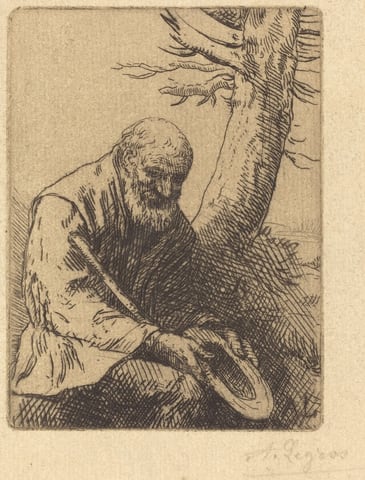
  3. The image depicts the upper half of a man's body, seated with his head tilted downwards. He has a pronounced brow and a long beard. His hair is sparse and closely cropped. He is wearing a textured cloak or robe, holding a hat in one hand and resting it on his knee. In the background, there is a large, bare tree trunk with bare branches.
    Beggar with Hat in Hand (Mendiant avec son chapeau a la main)Alphonse LegrosCourtesy National Gallery of Art, Washington

Third room, north wall
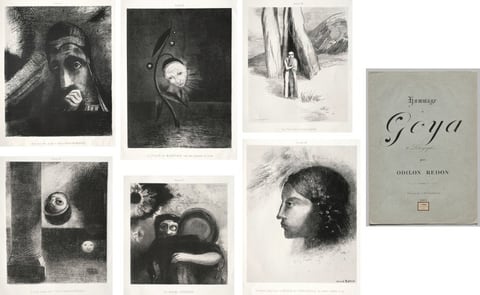
  1. Homage to Goya, by Odilon Redon, 1885
    Homage to GoyaOdilon Redon, 1885Courtesy of the Cleveland Museum of Art
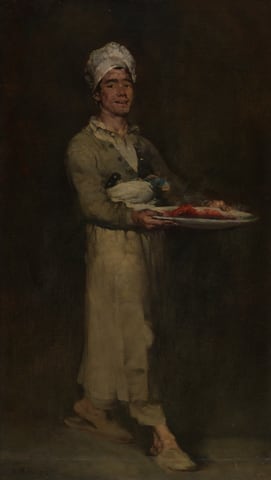
  2. A work made of oil on canvas.
    The ScullionAugustin Théodule Ribot, c. 1865Courtesy of the Art Institute of Chicago
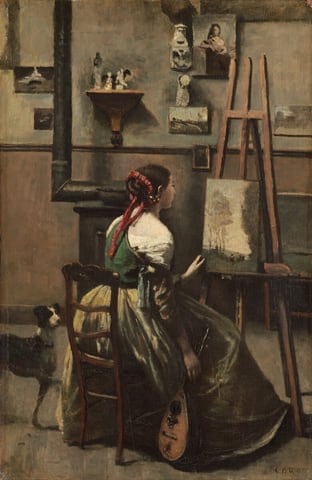
  3. A young, pale-skinned woman sits with her back to us as she looks at a painting on an easel in a studio in this vertical painting. She sits in a ladder-back wood chair so her knees angle away from us, toward the back right corner of the studio. We look onto the side of her right cheek as she leans forward. Her brown hair is combed back and twisted into a bun wrapped with a raspberry-red ribbon that trails down her back. Touches of pearl white, pale pink, and silvery gray suggest flowers by the ear we can see. A cream-white chemise falls off the shoulder closer to us, under a grass-green bodice. She holds a mandolin down by her right side, which is closer to us, to nestle in the folds of her voluminous, olive-green skirt. She reaches forward with her other hand to touch the lower left corner of the painting resting on the easel. That vertically-oriented scene is loosely painted and shows a few people gathered in a landscape. A white and black dog stands with one front leg lifted to the left of the woman's chair, looking at her. The wall opposite us is parchment white over a strip of molding, like a high chair rail, and muted mauve pink below. An L-shaped pipe leads to an iron stove to our left of center. A narrow shelf tucked into the L of the pipe holds three hand-sized sculptures or casts. Small paintings and plaster casts hang around it on the wall above the molding. The artist signed the painting in the lower right: “COROT.”
    Corot's Studio: Woman Seated Before an Easel, a Mandolin in her HandJean Baptiste Camille Corot, c. 1868Courtesy National Gallery of Art, Washington