Floor plan

Time and place19th-century France

19th-century France

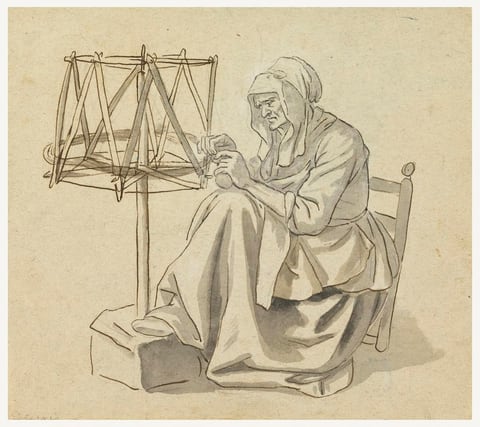
AN OLD WOMAN SPINNING
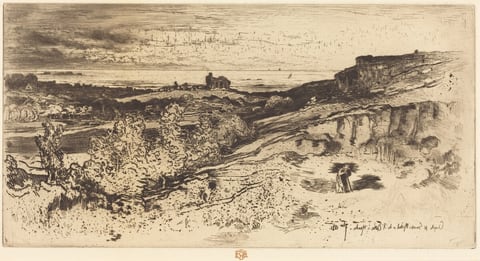
The image shows an elevated view of a landscape with detailed line work in warm sepia tones. The horizon is located near the top, with a cluster of structures visible in the distance. Close to us, there is textured shrubbery, and the ground is marked with dots and lines. Rolling hills and flat areas lead towards the horizon, where the sky is depicted with horizontal lines and hatchings.
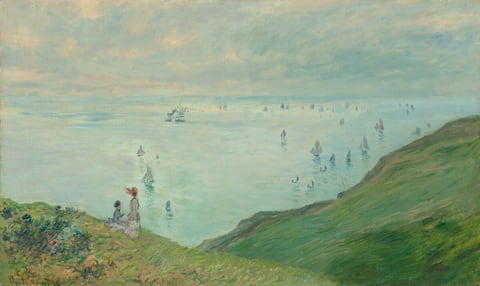
From a high perspective, we look beyond two overlapping, emerald-green hills to a body of powder-blue water dotted with sailboats in this loosely painted horizontal landscape. Closest to us, the hills create a shallow V that spans the lower third of the composition, with the right-hand hill rising to more than halfway up the right edge. The hills are painted with dashes and long strokes mostly in seafoam, shamrock, and celery green, with some swipes of peach, goldenrod yellow, and royal blue. On the hill to our left, one woman sits and the other stands next to her. They wear hats, long-sleeved, fitted jackets, and long skirts in tones of dusky pink and dove gray. A touch of peach on the seated woman, to our left, gives the impression of a pale face. A red veil or scarf at the back of the other woman’s hat is lifted, as if in the wind. The water is painted with blended strokes of pale blue, light turquoise, smoky mauve pink, and touches of soft peach. The horizon comes two-thirds of the way up the composition, and the sky is painted with the same tones of blue, green, and peach to suggest a screen of clouds. Triangles and dashes of slate blue suggest about three dozen sailboats, rowboats, and one steamship in the rippling water. Squiggles of teal and sage green create reflections for some of the boats. The brushstrokes are visible throughout. In some areas, the paint is so thinly applied that the texture of the canvas shows through, especially in the sky. The artist signed the work in the lower left corner: “Claude Monet 82.”
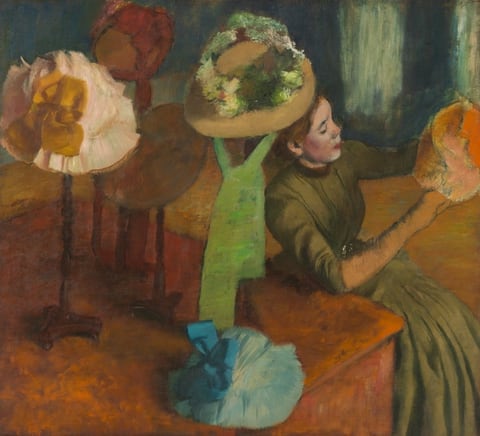
Impressionist painting of woman wearing green dress trying on hats.
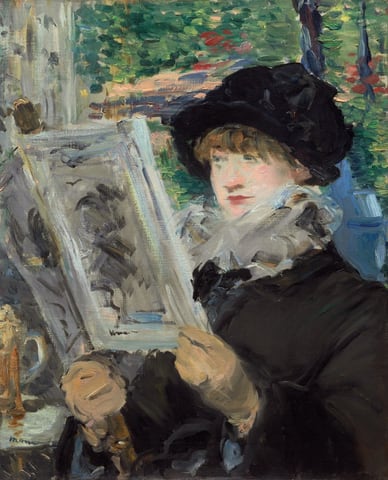
A young woman in a dark hat and coat with light ruffled collar sits reading a large periodical held up in her gloved hands. Flowers and foliage are suggested behind her.
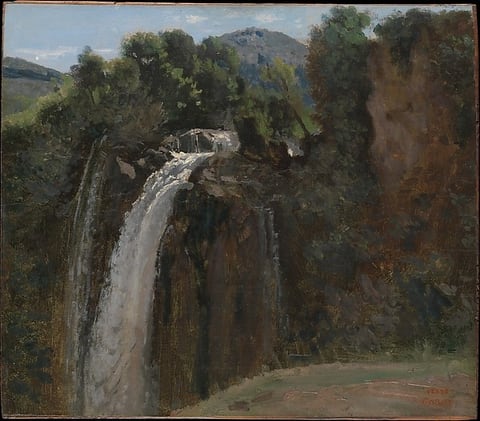
Waterfall at Terni, by Jean Baptiste Camille Corot, 1826
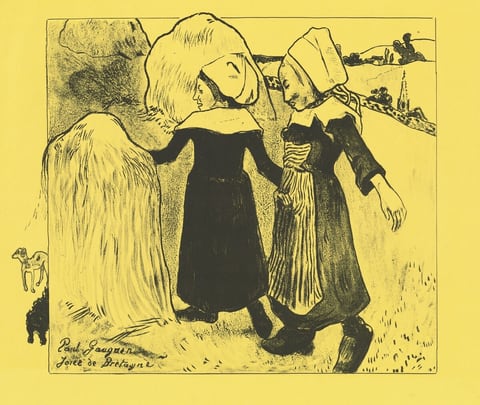
The image shows two women walking arm in arm, both in traditional attire. One woman is facing away with a slight profile, while the other is seen from the side. Their faces are stylized and simplistic with covered hair. They wear long dresses with aprons and collars, and one has a striped apron. Haystacks and greenery surround them. Faint figures are in the background, as well as a spire-like structure. A dog is seen near the haystack, with simple lines suggesting a landscape.

The works in this room are listed below.

Works in this room

Works made in France in the 19th century.

First room, north wall

  1. AN OLD WOMAN SPINNING
    An Old Woman SpinningClaude-Louis Desrais, 1810–30Courtesy of Cooper Hewitt, Smithsonian Design Museum
  2. The image shows an elevated view of a landscape with detailed line work in warm sepia tones. The horizon is located near the top, with a cluster of structures visible in the distance. Close to us, there is textured shrubbery, and the ground is marked with dots and lines. Rolling hills and flat areas lead towards the horizon, where the sky is depicted with horizontal lines and hatchings.
    La Chapelle Saint-Michel à l'EstreFélix-Hilaire BuhotCourtesy National Gallery of Art, Washington
  3. From a high perspective, we look beyond two overlapping, emerald-green hills to a body of powder-blue water dotted with sailboats in this loosely painted horizontal landscape. Closest to us, the hills create a shallow V that spans the lower third of the composition, with the right-hand hill rising to more than halfway up the right edge. The hills are painted with dashes and long strokes mostly in seafoam, shamrock, and celery green, with some swipes of peach, goldenrod yellow, and royal blue. On the hill to our left, one woman sits and the other stands next to her. They wear hats, long-sleeved, fitted jackets, and long skirts in tones of dusky pink and dove gray. A touch of peach on the seated woman, to our left, gives the impression of a pale face. A red veil or scarf at the back of the other woman’s hat is lifted, as if in the wind. The water is painted with blended strokes of pale blue, light turquoise, smoky mauve pink, and touches of soft peach. The horizon comes two-thirds of the way up the composition, and the sky is painted with the same tones of blue, green, and peach to suggest a screen of clouds. Triangles and dashes of slate blue suggest about three dozen sailboats, rowboats, and one steamship in the rippling water. Squiggles of teal and sage green create reflections for some of the boats. The brushstrokes are visible throughout. In some areas, the paint is so thinly applied that the texture of the canvas shows through, especially in the sky. The artist signed the work in the lower left corner: “Claude Monet 82.”
    Cliffs at PourvilleClaude Monet, 1882Courtesy National Gallery of Art, Washington

First room, south wall

  1. Impressionist painting of woman wearing green dress trying on hats.
    The Millinery ShopEdgar Degas, 1879-86Courtesy of the Art Institute of Chicago
  2. A young woman in a dark hat and coat with light ruffled collar sits reading a large periodical held up in her gloved hands. Flowers and foliage are suggested behind her.
    Woman ReadingÉdouard Manet, 1880–82Courtesy of the Art Institute of Chicago
  3. Waterfall at Terni, by Jean Baptiste Camille Corot, 1826
    Waterfall at TerniJean Baptiste Camille Corot, 1826Courtesy of The Metropolitan Museum of Art
  4. The image shows two women walking arm in arm, both in traditional attire. One woman is facing away with a slight profile, while the other is seen from the side. Their faces are stylized and simplistic with covered hair. They wear long dresses with aprons and collars, and one has a striped apron. Haystacks and greenery surround them. Faint figures are in the background, as well as a spire-like structure. A dog is seen near the haystack, with simple lines suggesting a landscape.
    Pleasures of Brittany (Joies de Bretagne)Paul Gauguin, 1889Courtesy National Gallery of Art, Washington

Second room, south wall
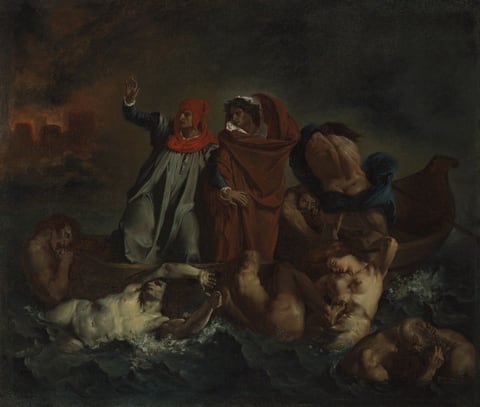
  1. A work made of oil on canvas.
    Dante's BarkAfter Eugène Delacroix, c. 1840–60Courtesy of the Art Institute of Chicago
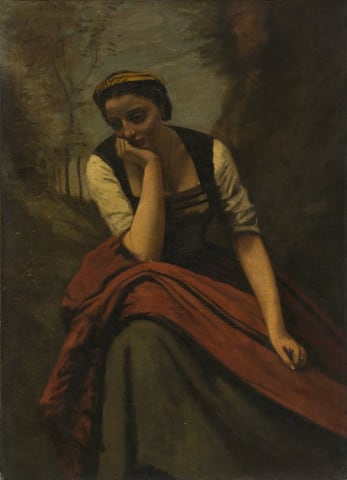
  2. Woman Meditating, by Jean Baptiste Camille Corot, after 1868
    Woman MeditatingJean Baptiste Camille Corot, after 1868Courtesy of the Cleveland Museum of Art
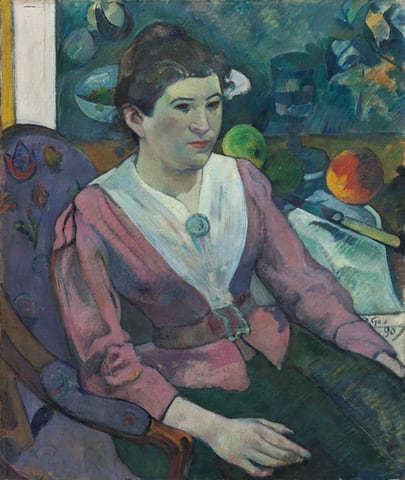
  3. A work made of oil on linen canvas.
    Woman in Front of a Still Life by CezannePaul Gauguin, 1890Courtesy of the Art Institute of Chicago
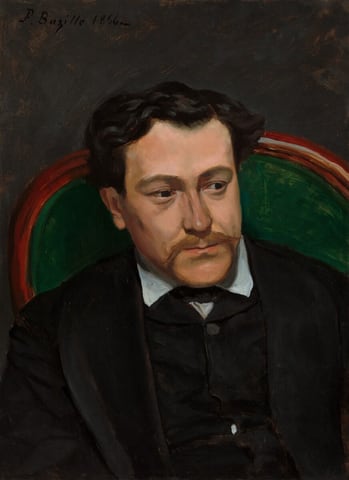
  4. Shown from the chest up, a pale-skinned man in a suit sits in a high-backed chair, looking slightly to our right in this vertical portrait painting. His eyes and head are both turned slightly to our right, with only one ear visible on our left. His shoulder on our right and the right side of the chair are slightly cut off by the edge of the painting. He has a straight nose, high cheekbones, and pale pink closed lips. His eyes are dark, with small shadows beneath them. His black, wavy hair is parted on our right and cropped short on the sides of his head, with thick, defined waves on top. He has a light brown mustache that extends past the edge of his lips and flips up at the ends and a small, thin goatee. Beneath his chin, the collar of his white shirt is visible. The man wears an open suit jacket with a black vest, which folds slightly just below his chest, revealing a glimpse of his white shirt beneath it in a gap between buttons. The chair is only visible from the man’s shoulders up and ends at his forehead. It has a curved, round top back with a red frame and dark green upholstery. The part of the red frame on the right side of the painting has white and yellow highlights. The background is dark gray with visible brushstrokes. The artist signed and dated the painting at the top left, “F. Bazille. 1866.”
    Edouard BlauFrédéric Bazille, probably 1869Courtesy National Gallery of Art, Washington

Second room, north wall
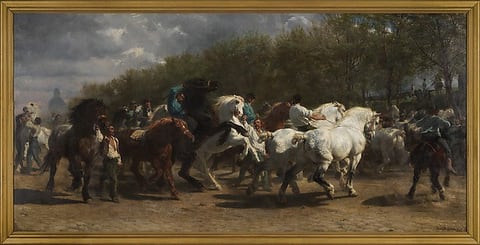
  1. The Horse Fair, by Rosa Bonheur, 1852–55
    The Horse FairRosa Bonheur, 1852–55Courtesy of The Metropolitan Museum of Art
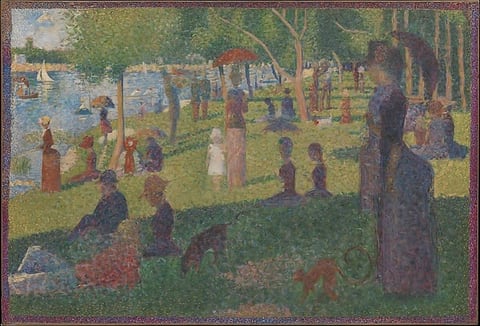
  2. Study for "A Sunday on La Grande Jatte", by Georges Seurat, 1884
    Study for "A Sunday on La Grande Jatte"Georges Seurat, 1884Courtesy of The Metropolitan Museum of Art

Third room, north wall
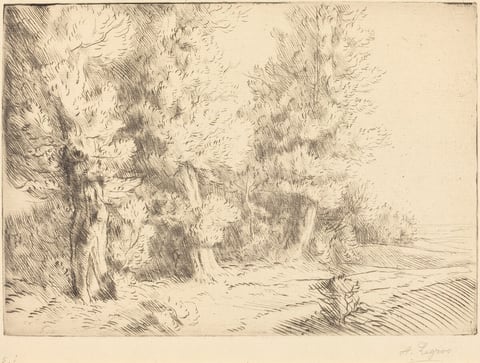
  1. The image shows a sketch-like scene viewed from a slightly elevated perspective, depicting a landscape dominated by a line of trees. The horizon is low in the image, just above a rising slope, with tall trees extending towards the sky. The trees and foliage are characterized by brushstrokes and crosshatching technique, conveying texture and shading. The color palette is monochromatic, with dark and light tones for a serene, natural quality. Line and shadow add movement and highlight the beauty of the trees as they recede into the distance, merging with the sky.
    In the Forest of Fontainebleau (Dans la foret de Fontainebleau)Alphonse LegrosCourtesy National Gallery of Art, Washington
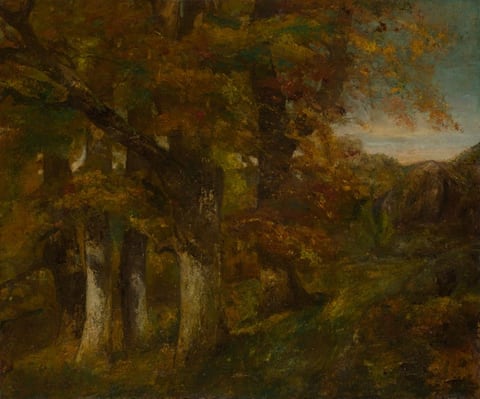
  2. A work made of oil on canvas.
    Wooded LandscapeGustave Courbet, 1860–65Courtesy of the Art Institute of Chicago
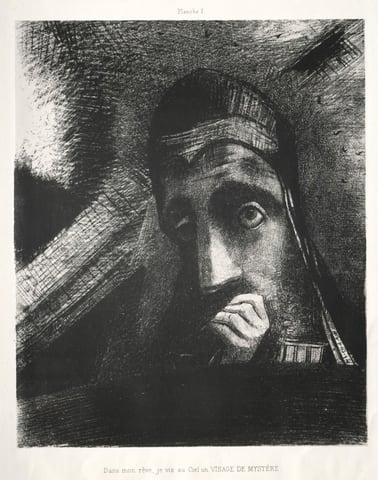
  3. In My Dream I Saw in the Sky a Face of Mystery, by Odilon Redon, 1885
    In My Dream I Saw in the Sky a Face of MysteryOdilon Redon, 1885Courtesy of the Cleveland Museum of Art