Floor plan

Time and placeThe 18th century

The 18th century

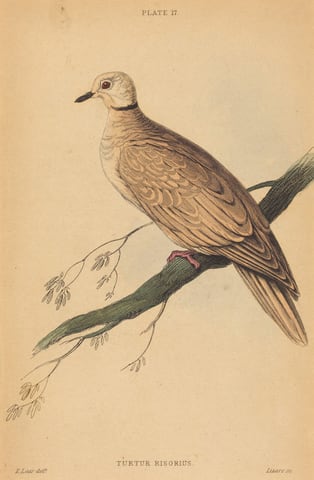
This is a drawing of a bird perched on a branch. The bird is detailed and identified as "Turtur Risorius." It rests on a green textured branch against a plain background. The bird has a black ring around its neck, soft brown plumage with intricate feather patterns, and light pink legs. Its eye is prominent and outlined within its head design. The branch is minimalist with small buds and thin twigs.
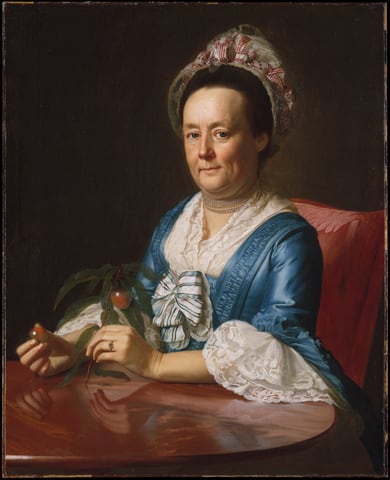
Mrs. John Winthrop, by John Singleton Copley, 1773
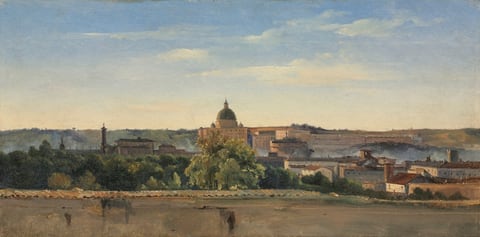
View of Rome, by Pierre Henri de Valenciennes, c. 1782–84
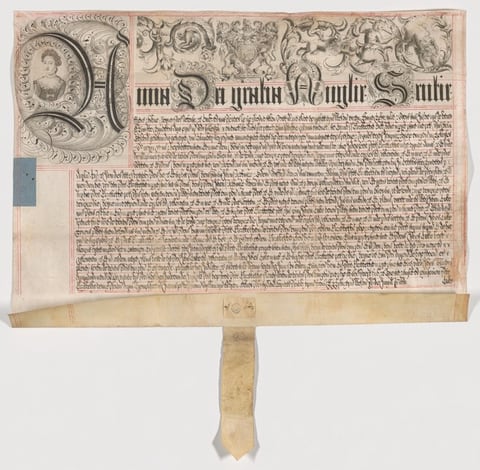
A work made of engraved letterhead, pen and ink calligraphy, and graphite ruling on parchment, folded with strap and (missing) seal.
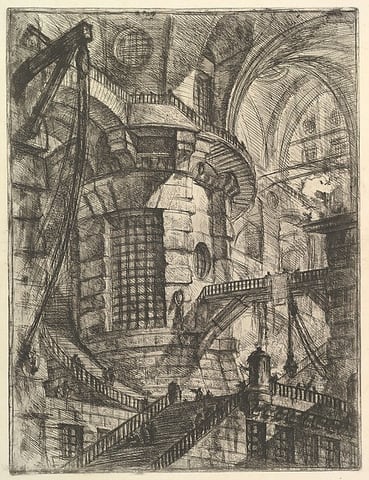
The Round Tower, from "Carceri d'invenzione" (Imaginary Prisons), by Giovanni Battista Piranesi, ca. 1749–50

The works in this room are listed below.

Works in this room

Works made in the 18th century, anywhere in the world.

Section 1, north wall

  1. This is a drawing of a bird perched on a branch. The bird is detailed and identified as "Turtur Risorius." It rests on a green textured branch against a plain background. The bird has a black ring around its neck, soft brown plumage with intricate feather patterns, and light pink legs. Its eye is prominent and outlined within its head design. The branch is minimalist with small buds and thin twigs.
    Turtur RisoriusWilliam Home LizarsCourtesy National Gallery of Art, Washington
  2. Mrs. John Winthrop, by John Singleton Copley, 1773
    Mrs. John WinthropJohn Singleton Copley, 1773Courtesy of The Metropolitan Museum of Art

Section 1, south wall

  1. View of Rome, by Pierre Henri de Valenciennes, c. 1782–84
    View of RomePierre Henri de Valenciennes, c. 1782–84Courtesy of the Cleveland Museum of Art
  2. A work made of engraved letterhead, pen and ink calligraphy, and graphite ruling on parchment, folded with strap and (missing) seal.
    Recovery Document (Land Title Grant)Unrecorded British maker, 1702/14 (Queen Anne period)Courtesy of the Art Institute of Chicago
  3. The Round Tower, from "Carceri d'invenzione" (Imaginary Prisons), by Giovanni Battista Piranesi, ca. 1749–50
    The Round Tower, from "Carceri d'invenzione" (Imaginary Prisons)Giovanni Battista Piranesi, ca. 1749–50Courtesy of The Metropolitan Museum of Art

Section 2, south wall
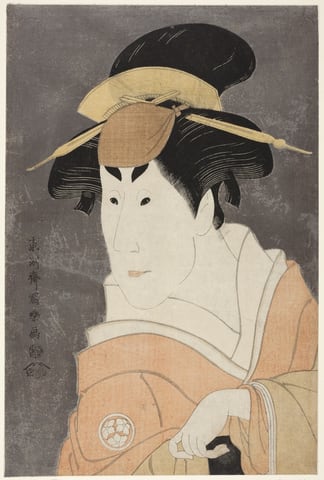
  1. A work made of color woodblock print; oban.
    The actor Osagawa Tsuneyo II as Osan, Ippei’s elder sisterTōshūsai Sharaku, 1794Courtesy of the Art Institute of Chicago
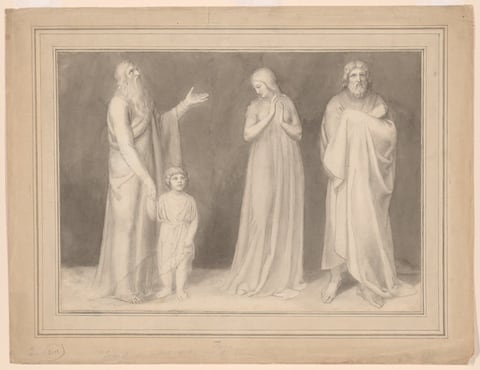
  2. A work made of pen and black ink and brush and black ink wash, with touches of pen and brown ink, on ivory laid paper.
    Hannah Presenting Samuel to EliJohn Flaxman, c. 1783Courtesy of the Art Institute of Chicago
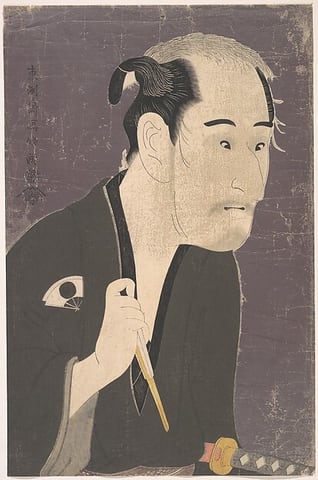
  3. The Actor Onoye Matsusuke as a Ronin, by Tōshūsai Sharaku
    The Actor Onoye Matsusuke as a RoninTōshūsai SharakuCourtesy of The Metropolitan Museum of Art

Section 2, north wall
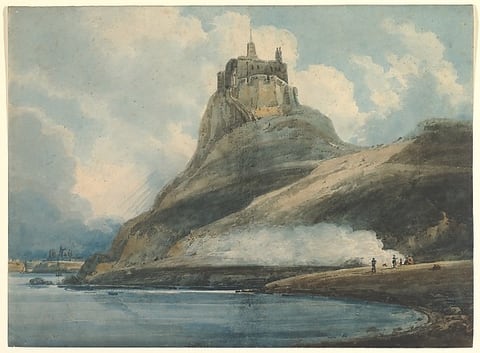
  1. Lindisfarne Castle, Holy Island, Northumberland, by Thomas Girtin, 1796–97
    Lindisfarne Castle, Holy Island, NorthumberlandThomas Girtin, 1796–97Courtesy of The Metropolitan Museum of Art
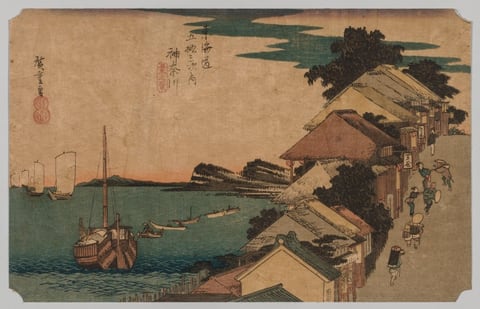
  2. Kanagawa, Inland Sea: Top of the Street, by Utagawa Hiroshige, 1797–1858
    Kanagawa, Inland Sea: Top of the StreetUtagawa Hiroshige, 1797–1858Courtesy of the Cleveland Museum of Art
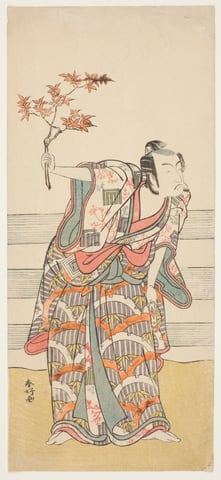
  3. A work made of color woodblock print; hosoban.
    Actor Ichikawa Monnosuke II in an Unidentified RoleKatsukawa Shunkо̄, About 1785Courtesy of the Art Institute of Chicago

Section 3, north wall
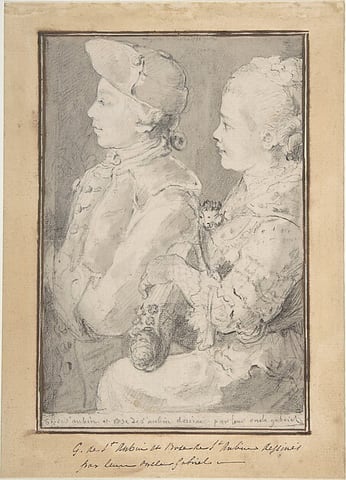
  1. Germain-Augustin and Rose de Saint-Aubin, Drawn by Their Uncle, by Gabriel de Saint-Aubin, 1766
    Germain-Augustin and Rose de Saint-Aubin, Drawn by Their UncleGabriel de Saint-Aubin, 1766Courtesy of The Metropolitan Museum of Art
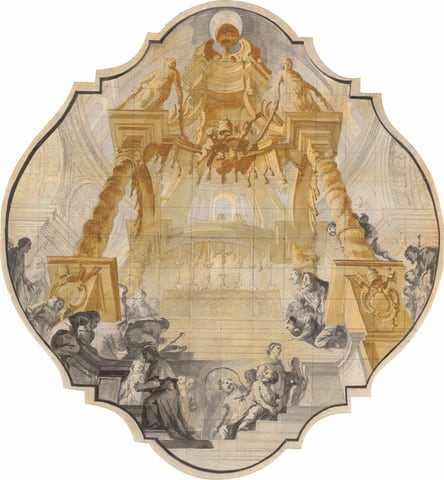
  2. This is a painting of an architectural scene with decorative and religious elements. The painting features a grand interior setting, possibly a church or cathedral, dominated by ornate columns and a ceiling structure. Figures appear on pedestals atop the columns. In the background, there is a depiction of a religious or ceremonial space with detailed balustrades and steps, where figures are shown in dynamic poses. The color palette consists of warm golden hues contrasted with cooler grey tones, highlighting the intricate details of the architecture and figures. This is in the style of Giovanni Battista Tiepolo.
    Worshippers at the Tomb of Saint PeterMatthäus Günther, 1740/1741Courtesy National Gallery of Art, Washington
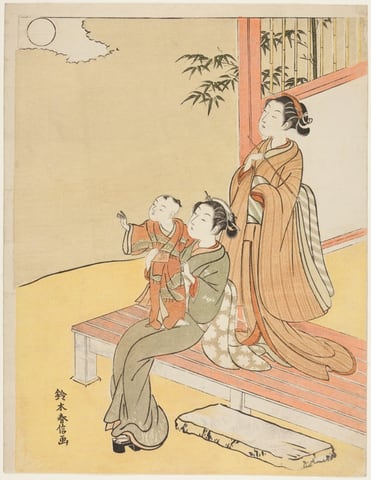
  3. A work made of color woodblock print; chuban.
    Viewing the MoonSuzuki Harunobu, c. 1767/68Courtesy of the Art Institute of Chicago

Section 3, south wall
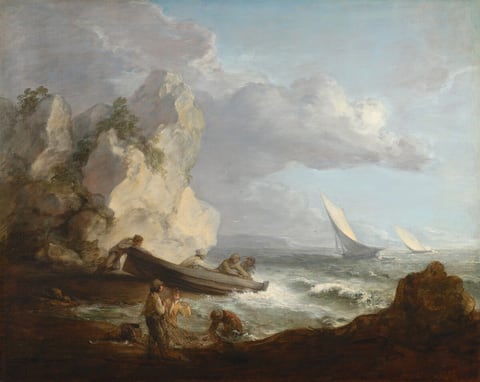
  1. From a rocky shoreline, we look on several light-skinned people working by the sea with a boat and a net in this freely painted, almost square seascape. The scene is framed by a silhouette of low boulders along the lower right corner, and a towering cream-white rock rising two-thirds of the way up the composition to our left. Scrubby, celery-green vegetation grows on the rocky outcropping. Near the center, close to the towering white rocks, three people sit, reaching for something near one end of a boat while a fourth person braces against the rock, presumably to push the boat out to the sea. Closer to us, three people on the shore work with a net. Two stand with the net hooked over their shoulders, and a third person crouches in the water with head down. The people all wear simple shirts and pants in shades of tan, mustard yellow, burnt orange, and pale blue. All but two wear hats. The sea meets the shore with frothy white foam and cresting, low waves. The sea beyond fades from pale sage green to arctic blue along the horizon, which comes about a third of the way up the composition. Two sail boats tilt against the wind in the distance. Pale, smoky lavender-purple clouds drift across the ice-blue sky.
    Seashore with FishermenThomas Gainsborough, c. 1781/1782Courtesy National Gallery of Art, Washington
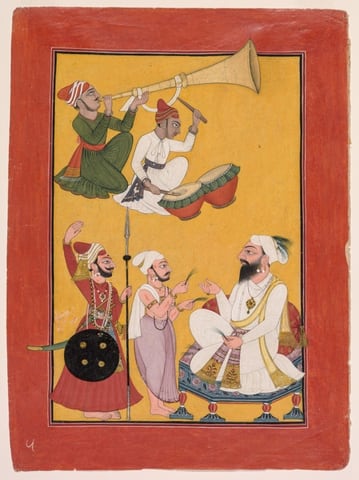
  2. Celebrations of Krishna's Birth, from a Bhagavata Purana, c. 1725–30
    Celebrations of Krishna's Birth, from a Bhagavata PuranaUnrecorded Indian maker, c. 1725–30Courtesy of the Cleveland Museum of Art