Floor plan

Time and place18th-century France

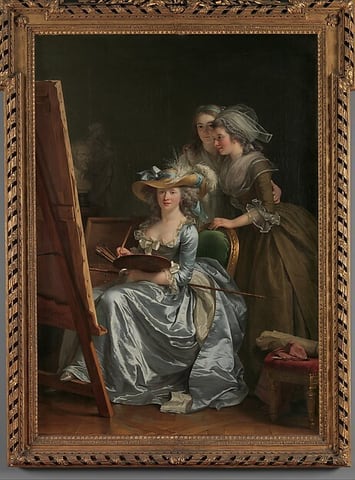
18th-century France

A work made of oil on canvas.
Self-Portrait with Two Pupils, Marie Gabrielle Capet (1761–1818) and Marie Marguerite Carraux de Rosemond (1765–1788), by Adélaïde Labille-Guiard, 1785
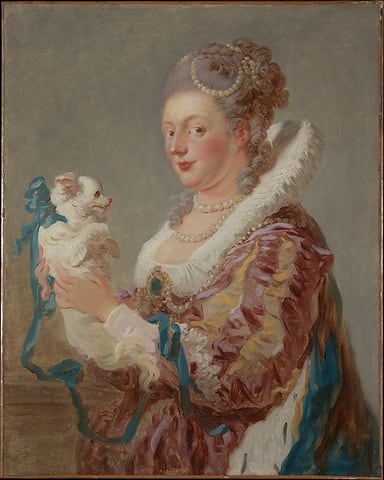
Marie Emilie Coignet de Courson (1716–1806) with a Dog, by Jean Honoré Fragonard, ca. 1769
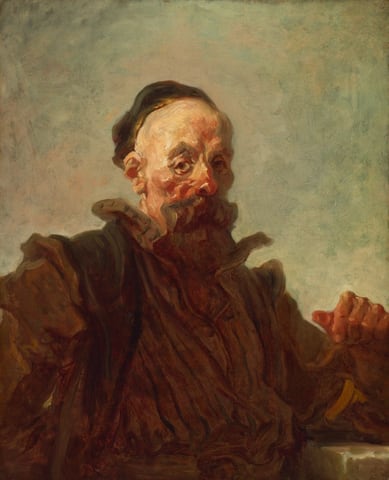
Painting of bearded, ruddy-faced man in eighteenth century style clothing.
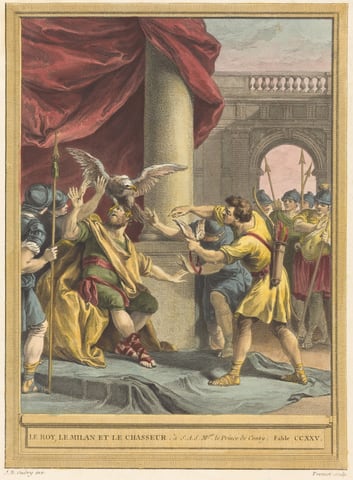
This is a painting of a king, a hawk, and a hunter in a classical architectural setting with columns and arches. In the image, a figure in royal clothing is seated beneath draped red fabric, facing a man in hunting attire holding a bird. A hawk perches on the royal figure's head, wings spread, while the hunter reaches toward the hawk. Surrounding them are other figures in armor, holding spears and shields. The style is reminiscent of classic European paintings with themes of mythology or allegory.
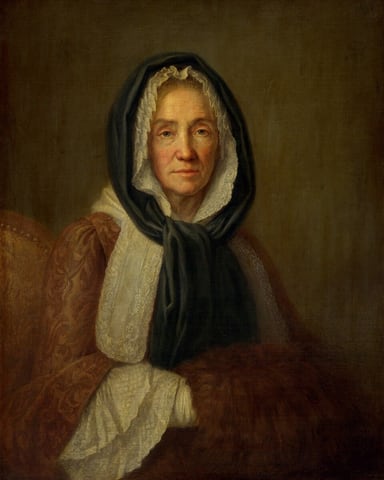
This painting shows a seated elderly woman from the waist up. She faces us with a neutral expression. She has a fair complexion with visible wrinkles, rosy cheeks, and pink lips. Her hair is mostly covered by a white lace cap and a black headscarf. She wears a patterned reddish-brown garment with lace around the collar and sleeves, and her hands rest on a brown fur muff. The background is a dark gray-brown color with visible brushstrokes.
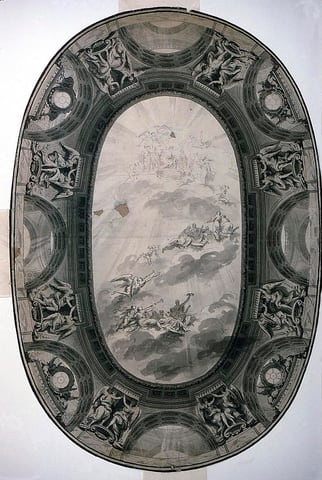
PROJECT FOR THE PAINTED DECORATION OF THE CEILING OF A HALL (PAINTED OVAL CEILING)

The works in this room are listed below.

Works in this room

Works made in France in the 18th century.

Section 1, north wall

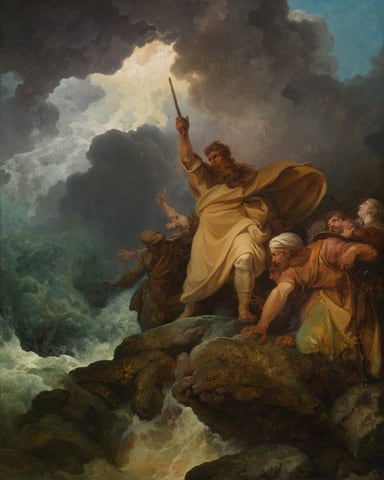
  1. A work made of oil on canvas.
    The Destruction of Pharaoh's ArmyPhilippe Jacques de Loutherbourg, II, 1792Courtesy of the Art Institute of Chicago
  2. Self-Portrait with Two Pupils, Marie Gabrielle Capet (1761–1818) and Marie Marguerite Carraux de Rosemond (1765–1788), by Adélaïde Labille-Guiard, 1785
    Self-Portrait with Two Pupils, Marie Gabrielle Capet (1761–1818) and Marie Marguerite Carraux de Rosemond (1765–1788)Adélaïde Labille-Guiard, 1785Courtesy of The Metropolitan Museum of Art
  3. Marie Emilie Coignet de Courson (1716–1806) with a Dog, by Jean Honoré Fragonard, ca. 1769
    Marie Emilie Coignet de Courson (1716–1806) with a DogJean Honoré Fragonard, ca. 1769Courtesy of The Metropolitan Museum of Art

Section 1, south wall

  1. Painting of bearded, ruddy-faced man in eighteenth century style clothing.
    Portrait of a Man in CostumeJean Honoré Fragonard, c. 1767–68Courtesy of the Art Institute of Chicago
  2. This is a painting of a king, a hawk, and a hunter in a classical architectural setting with columns and arches. In the image, a figure in royal clothing is seated beneath draped red fabric, facing a man in hunting attire holding a bird. A hawk perches on the royal figure's head, wings spread, while the hunter reaches toward the hawk. Surrounding them are other figures in armor, holding spears and shields. The style is reminiscent of classic European paintings with themes of mythology or allegory.
    Le roi, le milan, et le chasseur (The King, the Kite, and the Hunter)Benoît-Louis Prévost, published 1759Courtesy National Gallery of Art, Washington
  3. This painting shows a seated elderly woman from the waist up. She faces us with a neutral expression. She has a fair complexion with visible wrinkles, rosy cheeks, and pink lips. Her hair is mostly covered by a white lace cap and a black headscarf. She wears a patterned reddish-brown garment with lace around the collar and sleeves, and her hands rest on a brown fur muff. The background is a dark gray-brown color with visible brushstrokes.
    Old Woman with a MuffUnrecorded French maker, second half 18th centuryCourtesy National Gallery of Art, Washington
  4. PROJECT FOR THE PAINTED DECORATION OF THE CEILING OF A HALL (PAINTED OVAL CEILING)
    Project for the Painted Decoration of the Ceiling of a Hall (Painted Oval Ceiling)Jean Baptiste Marie Pierre, 1761Courtesy of Cooper Hewitt, Smithsonian Design Museum

Section 2, south wall
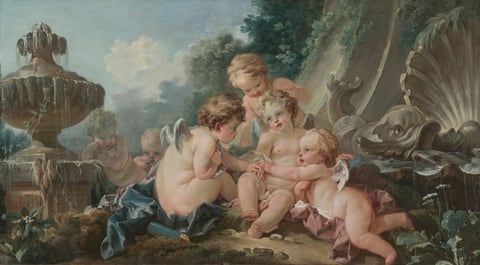
  1. Cupids in Conspiracy, by François Boucher, 1740s
    Cupids in ConspiracyFrançois Boucher, 1740sCourtesy of the Cleveland Museum of Art
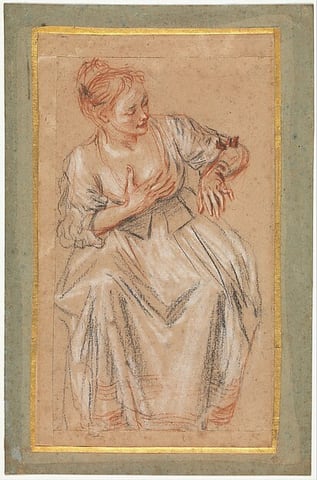
  2. Seated Woman, by Antoine Watteau, 1716–17
    Seated WomanAntoine Watteau, 1716–17Courtesy of The Metropolitan Museum of Art
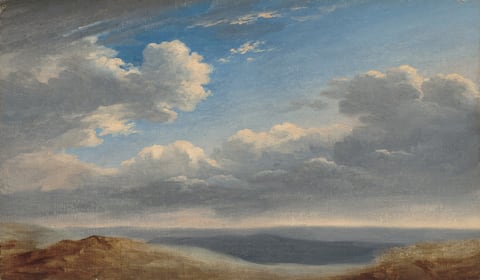
  3. A sliver of land across the bottom of this composition gives way to a procession of puffy gray and white clouds sweeping up across a vivid blue, panoramic sky in this horizontal landscape painting. An area of darker gray beyond the brown land could be a valley, mountain, or shadows from the billowing clouds. About one-fifth of the way up the composition, the horizon glows the faintest peach. The clouds trundle from our left up and to our right. The view is loosely painted, especially in the land.
    Study of Clouds over the Roman CampagnaPierre Henri de Valenciennes, c. 1782/1785Courtesy National Gallery of Art, Washington
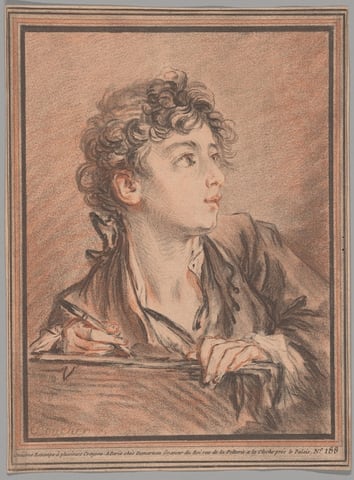
  4. A work made of crayon manner engraving in red and black on cream laid paper.
    The Young DraftsmanGilles Demarteau, 1750/70Courtesy of the Art Institute of Chicago

Section 2, north wall
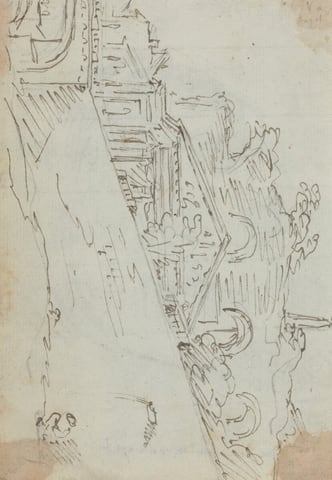
  1. The image shows a sketch of an architectural scene with structures lining a road or pathway. The horizon is not clearly defined, and the sketch focuses on architectural details. The drawing features loose, freehand lines outlining buildings and trees, with classical elements like columns and entablatures. The color palette is monochromatic, with light parchment and dark ink strokes creating contrast. Close-up details are lightly shaded for depth, while distant details are less defined. The composition is open and airy, emphasizing architectural features over precision.
    Ancient Ruins on the Bank of the TiberAugustin Pajou, 1752/1756Courtesy National Gallery of Art, Washington
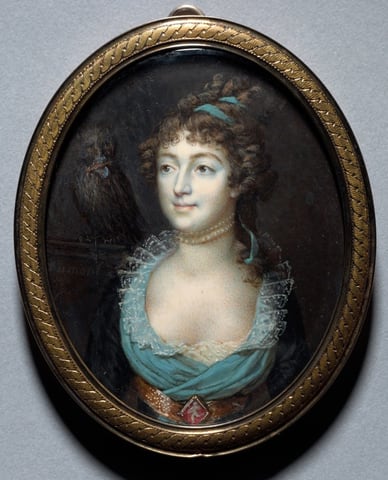
  2. Portrait of Mademoiselle Marie-Anne Adelaide Le Normand, by François Dumont, c. 1793
    Portrait of Mademoiselle Marie-Anne Adelaide Le NormandFrançois Dumont, c. 1793Courtesy of the Cleveland Museum of Art
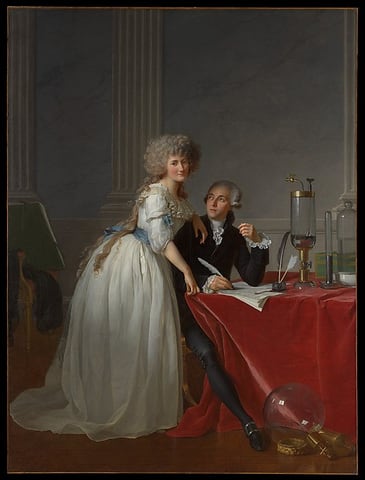
  3. Antoine Laurent Lavoisier (1743–1794) and Marie Anne Lavoisier (Marie Anne Pierrette Paulze, 1758–1836), by Jacques-Louis David, 1788
    Antoine Laurent Lavoisier (1743–1794) and Marie Anne Lavoisier (Marie Anne Pierrette Paulze, 1758–1836)Jacques-Louis David, 1788Courtesy of The Metropolitan Museum of Art

Section 3, north wall
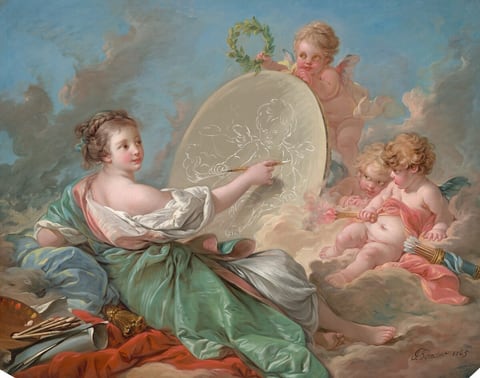
  1. A young woman draws on an oval surface with white chalk while three winged, baby-like putti gather nearby, all on a bank of pale pink clouds in this horizontal painting. The woman and putti have pale, rosy skin, flushed cheeks, and hazel-brown eyes. To our left, the woman reclines with her upper body propped up on her far elbow, which rests on a steel-blue cushion as her legs stretch out to our right. Her light brown hair is braided and wrapped across the top of her head. She wears a loose, seafoam-green robe over a billowing ivory-white garment that has slipped off the shoulder closer to us. A round paint palette with brushes sticking out of its thumb hole and a roll of blue and white paper sit in the lower left corner, behind the woman. The woman and the objects are on a red cloth. In front of the woman is a rounded surface, perhaps a canvas, on which she draws. She holds up a gold-colored stylus with her right hand, closer to us, with a pointed piece of white chalk in one end and black chalk in the other. The canvas is taller than her head, so the child-like putto she draws on it is life-sized. The three nude putti on the far side of the canvas have copper or golden-blond, curly hair, flushed, rounded cheeks, short wings in white or peacock blue, pudgy torsos, and dimpled limbs. One putto, presumably the one the woman draws, sits back on the bank of clouds with a carnation-pink sash across his chest. He pulls his chin back and looks at her from under his eyebrows. He holds a gold-colored torch with a pink flame in one hand, and the other hand rests near a cylindrical quiver of arrows. Another putto peeks around the side of the canvas, and the third stands and props the canvas up. That third putto holds up a wreath of laurel leaves up over the canvas, above the woman’s drawing hand. The bank of clouds is parchment-brown with muted pink and blue highlights against a vivid blue sky. The artist signed and dated the lower right, “F Boucher – 1765.”
    Allegory of PaintingFrançois Boucher, 1765Courtesy National Gallery of Art, Washington
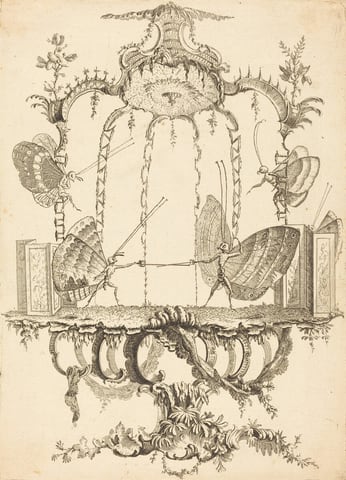
  2. This is a drawing of anthropomorphic butterflies engaged in a duel with fencing swords. The butterflies have human-like bodies with wings resembling cloaks or capes. They stand on an ornate structure featuring decorative architectural elements like columns with floral and leaf motifs. Above them are arches, canopies, and hanging vines, creating a theatrical setting. The drawing combines fantasy and nature elements, showcasing elegance and imagination.
    Le Duel (The Duel)Charles Germain de Saint-Aubin, in or after 1756Courtesy National Gallery of Art, Washington